Lessons from the Grid

The electrical power grid is a study in organizational behavior. Take how electricity is generated and distributed to the point of consumption. Huge power plants or arrays – fueled by “green energy” sources such as solar, wind, biomass, geothermal, and hydroelectric, or “brown energy” sources such as fossil fuels and nuclear – concentrate electrical power generation to take advantage of “economies of scale.” The resulting current is transmitted through an extensive redundancy of power lines, cables, substations, circuit breakers, switches and transformers – oftentimes referred to as the “power grid” – to individual consumers across wide areas.

Organizationally, this is a centralized model. Power is concentrated in a select number of locations and authority is distributed to other points as needed and according to priorities driven by limited supply during periods of peak demand. The overall system, no matter how inefficient or costly, strives to be convenient, available when needed, standardized in delivery, and transparent during use. The goal is to please the most and dissatisfy the least so that fundamental assumptions about the design of the system are unquestioned, significant investments in infrastructure modernization or extensive system redesign are delayed, and increases in operational costs, along with services, are passed fluidly to the consumer. In other words, the existing power structure prevails and remains unchallenged and the consumer is dependent on that structure to get what is needed and wanted.

For every movement, there is a counter-movement. There are those who regard being “on the grid” as a lifestyle that epitomizes wanton consumerism, promoting waste, excess, banality, and destruction of the environment. Their alternative is to live “off-the-grid” disconnected from public services including electrical power. Initiated during the 1960’s and ’70’s, the “back to the land” movement is often synonymous with off-the-grid solutions such as energy from solar, wind, and biomass sources.

The off-the-grid approach represents an alternative organization structure – a decentralized model. In this instance, power is held by a wide range of relatively small, independent individuals / families who are in total control of an electrical power system that meets their consumption requirements. As with many decentralized structures, one’s destiny is in one’s hands. However, the limits of these structures become apparent when consumption patterns change and more power is required or disaster strikes and there is no opportunity for a quick recovery.

As the title of this blog article, “Solar Power FAQs: Will The Electricity Meter Run Backwards?” posted on the Alba Energy website suggests, some homes with photovoltaic (PV) panels generate sufficient electricity during the day to meet and exceed the immediate consumption needs of the home. In a different twist to back to the land homes sporting off-the-grid solar-powered systems, the scenarios presented in this article illustrate how consumers can load surplus electrical power generated by solar panels onto the grid and receive financial credit for doing so through various net metering plans.

While a national mandate for electric power companies to offer fair net metering practices is not in place – albeit Jay Draiman of Northridge, CA, author of “Mandatory Renewable Energy – The Energy Evolution – R12,” touts this as a necessary step in overcoming our dependence on fossil fuels – momentum is gaining in several states as commitment to renewable energy is strengthened. One of these is New York where the New York Energy Research and Development Authority (NYSERDA) promotes net metering / remote net metering and interconnections 1 through a range of incentive programs directed toward offsetting the installation costs for small-scale solar systems and encouraging connection to the public power grid in order to facilitate net metering.

From an organizational standpoint, this represents a very different structure – the integrated model. Although neither centralized nor decentralized, integrated structures blend a centralized surplus distribution and backup system with a decentralized network of small-scale operations. Such interdependence distributes responsibility and authority to individual members in the social system so they can engage in self-sustaining behavior patterns while linked to a broader network of resources and markets. Individuals are in control of investments, operating expenses, and utilization of resources. They can take care of themselves first, sell the surplus, or if circumstances warrant, buy what they need or want when they are unable to provide enough by themselves.

The combination of electrical power grid, PV panels, and net metering represents one way developments in technology influence organization structure and design. As systems technologies become more powerful, pervasive, and transparent, sub-systems will become more embedded, integrated, and interdependent. The same concept applies to computers, the Internet, and payment for posting articles on a website or blog. As information and communication technologies continue to evolve, they will empower individuals to THINK independently, work openly and in parallel, and collaborate when opportunities arise for bargains and balances to be struck among the various comparative advantages, surpluses, and deficits in the larger system.

Thereby comes one of the unintended but inevitable consequences of pursuing “green energy” sources for power generation in lieu of “brown energy” sources: the fundamental organization structure and assumptions for organization design shift. Control is no longer held by a central body, be it a corporation, government, or special interest group; nor is it fractured and splintered to such a degree that collective effort is no longer possible. Instead, it is held in balance at the point where production, distribution, and consumption work in unison with one another for the advantage of the system rather than favoring the interests of a few at the expense of the many. Conventional wisdom may differ, but the world will be a better place for it!

Originally posted to New Media Explorer by Steve Bosserman on Wednesday, February 7, 2007

  1. The original New York Energy $martSM Program is no longer available

Leadership 101

Last week was spent on the road checking in with clients and helping them manage changes within their organizations. Oftentimes, the causes for such changes are presented to me as breakdowns in communication, unrealized opportunities, performance problems, inadequate adaptation, and gaps in the flow of resources. The clients’ default reactions are hierarchical: someone needs to be contracted or hired, someone else is opting to retire, others need to be reassigned, and others still, let go. However, the reality is bigger and more complex than having a few people go and bringing in fresh blood. Change, in a flurry of what’s working, what’s not, and what could work better, first requires that these disparate conditions be placed within a framework. This is followed by convening people whose interactions have the potential to make a positive difference for their organization within that framework. Their interactions lead to more appropriate and measured actions through goals, objectives, strategies, and tactics.

As explored more fully in an earlier posting, organizations consist of sustained conversations – the basis of all human social behavior. If one wants to change an organization, change the conversations its members are having. On one level this is simple and straightforward. Matching forums with meaningful agendas is at the heart of what strategic framing and organization design are all about. People draw upon their power to convene within a social system to setup a wide range of conversations and sustain those that are deemed the most important. Of course, the point of these conversations when establishing or sustaining an organization is to gain alignment – the energy source for growth, progress, and success of any organization.

There is a clear association between those who have the power to convene for alignment and leadership. In fact, while there are hundreds of definitions for leadership, the one I use is “the exercising of power by an individual within a social system to produce alignment.” Productive, collective effort within a social system requires people to be pulling on the rope in the same direction. And through that alignment, motivation is stimulated.

Alignment occurs in three ways:

  1. Integrity. Just as an organization has integrity, so do people. Purpose: why am I here; principles: what do I stand for; intentions: what am I up to, constitute the foundation of institutional and personal integrity. When I feel that my integrity is held in the integrity expressed by others and, ultimately, their organization, I am motivated to participate in what they are doing to see how our collective efforts can be leveraged.
  2. Vision. Imagining a world where one’s purpose, principles, and intentions play out so that others can see it, too, and want to be part of making it happen is a powerful act of vision. Any vision is based first in personal experience. When it is presented to others such that they can shape it with their own dreams and create a shared view of what is possible, the vision becomes an engaging, motivating force.
  3. Fear – Greed. Visions cannot become reality without drawing upon the talents and skills of those who do not necessarily align with the values of integrity or share the same vision. Their motivation comes from a combination of “what’s in it for me” and “what will happen to me if I don’t participate.” The fear – greed continuum appeals to the baser instincts of people in areas where their absence of detachment affects their decisions. For the vast majority, it is easier to do what one is told, to do one’s job, to follow the rules. Alignment means playing along to enjoy the benefits and avoid the pitfalls. But it is a route that is susceptible to the corruptive forces of the hierarchy as explored in a previous posting.

Depending on the circumstances, leaders draw upon the energies available within each of the three types of alignment to advance the organizations they lead. Some have integrity so unquestionably solid it compels others to follow despite not having a clear picture of what the world would look like if everyone behaved according to these values or a hierarchical structure upon which to calculate the cost, risk, and benefit of participation. The most notable of such leaders represent particular spiritual or philosophical belief systems that became the cornerstones for the most persistent social systems in human history. Certainly the evidence is strong that there is much to be gained from fronting one’s core values as a key element in leadership. But, not everyone is ready to cast their lot with someone solely on values alone. This may garner alignment at the outset, but they need more to stay aligned.

Some leaders are able to describe through words and graphics how the world could look if a particular set of core values were adopted such that many others are immediately engaged by it, resonate with it, take it as their own, and start down the path toward making it reality; the vision of one becomes the vision of many. However, the more likely scenario is that one person’s vision matches the visions of others to one degree or another, but not completely. In this case, the effective leader introduces a process by which multiple visions are brought together into one shared vision that holds critical elements for all who want to pursue it. While a shared vision produces alignment, it commands the strongest buy-in only by those who were there when it was created. The leader must stay vigilant in continually representing the vision to those who are new to the organization and in some instances prompt further adaptation of the vision to hold others who come in later.

With both integrity and vision, the virtual or physical presence of and interaction with the leader is essential to maintain alignment. Collective efforts that have dependency on one leader are at risk to go astray unless a formal system is setup to manage the behavior of people in the organization. Formal systems provide boundaries that determine who is in and who is out of an organization, enable the formation of hierarchies, enact rules, regulations, policies, and procedures, and establish processes that manage the work of organizations. Within a formal system, the vision of the organization is translated into sets of actionable goals, objectives, strategies, and tactics. Alignment is achieved when people work these plans. Some leaders are effective enforcing this type of alignment within the formal systems by encouraging them through the promise of reward should they accomplish what they are responsible to do and threatening them with undesirable consequences should they fail. It is the classic case of “carrot and stick” motivation. In other words, the fear – greed continuum is alive and well.

As mentioned earlier, my work with people in client organizations is about framing their circumstances so that an appropriate set of conversations are convened and the participants can make a positive difference in helping their organization adapt. The evolving design of the organization is based on the results of certain conversations that need to happen: does the organization need to recall its integrity – get back to its roots, so to speak; does it need to renew its vision – see itself in an entirely different way filled with more possibilities; does it need to redirect its formal system – become more consequent and disciplined. These questions require different conversations and depending on whether the organizational alignment is better derived from integrity, vision, or fear – greed determines the leadership skills required to make the conversations happen.

Therein lays the challenge of doing my work well – matching the skills of leaders with the circumstances where they will prompt alignment. And if there are no immediate leaders available with the requisite skills, I coach those who show talent and interest so they strengthen their “toolkits,” gain confidence in their capabilities, and embark upon leading in new ways under unfamiliar situations. And helping those people become more evolved, well-rounded, and flexible leaders is what makes doing this work worthwhile!

Originally posted to New Media Explorer by Steve Bosserman on Wednesday, February 1, 2006

Changing Organizations

An organization is a sustained, focused set of conversations between and among people intended to generate results that are deemed of sufficient value by participants such that the relationships are worth continuing. Since conversations are inherent in human communication, it can be concluded that an organization is defined and held together by the unique communication patterns it manifests. People in conversations establish organizations.

Oftentimes, we have little choice about the organization in which we are a member. In some instances, such as with parents and family, it is a lifelong association over which we have no say about who these people are to us. Other organizations are much more elective and temporary. Regardless of the type of organization or whether our membership is by choice, as long as we are associated with it we continually look for ways to make it function more effectively in meeting our interests. The dilemma becomes one of how to change the organization, but keep it intact.

At the heart of staying together is the concept of “integrity.”” In an earlier post, the notion of personal integrity was introduced as shown in the lower-left part of the graphic in the diagram below. Organizations, as human social constructs, also have integrity – —organizational integrity. Many of the elements, such as those in the authority, fiduciary, and legal arenas, are almost identical with personal integrity. Others are variations on personal integrity themes: “purpose”” is transposed to “mission statement,”” “principles”” to “vision statement”” and “intentions”” to “values statement.”” As indicated by the arrow in the background, people with their individual statements of “personal integrity,”” carry those forward into the organizational integrity of the group to which they are members. Hence, what I endeavor to do that is beyond my capacity as one person, I link with others in an organization so that I can accomplish more.

Organizations stay intact by keeping their organizational integrity unwavering. However, to adapt and respond to different conditions and circumstances organizations have to change. What is it, then, that changes? The answer is—: the formal system. In the diagram below, the triangle of organizational integrity is layered with the hierarchy (authority structure) of a formal system characterized by “rules and regulations” – ”—compliance to externally imposed laws; “policies and procedures” – ”—compliance to internally imposed guidelines; “programs and processes” – ”—what work is done in the organization and how; “funding and resources” – ”—how the work of the organization is supported according to the dictates of wise stewardship; and “roles and relationships” – ”—how authority and responsibility are distributed to assure accountability. This formal system carries with it certain conversations, e.g., staff meetings, program reviews, performance evaluations, etc., that keep its basic functioning intact. However, the formal system is immersed in a larger informal system of networks and webs which fosters a much less constrained set of conversations, usually dealing with possibilities outside the scope of formal system conversations. Members of the organization belong to both systems simultaneously. Since they wear both hats, they draw upon the dynamics of each system depending on the nature of the conversation at hand— – a delicate balancing act to be sure!

There is an infinite variety of manifestations of the formal system structure that can be adopted. It is incumbent on members to keep looking for different ways to change the formal system so the organization is more effective and efficient. However, when members are not clear what the organizational integrity is or they are not aligned with it, their dependency on the formal system deepens. This dependency leads, on the one hand, to fear of change to the formal system over concern that the organization will lose its integrity and destruct, or, on the other hand, unwillingness to change the formal system because its current state is overtly beneficial to certain members. Either way, the result, as depicted in the graphic below, is a “red arrow”” of resistance to change. This is opposed to the green “explosions”” on the edge of the informal system where receptivity to change is a way of life. As we well know, change begins at the periphery of a living system and pushes inward.

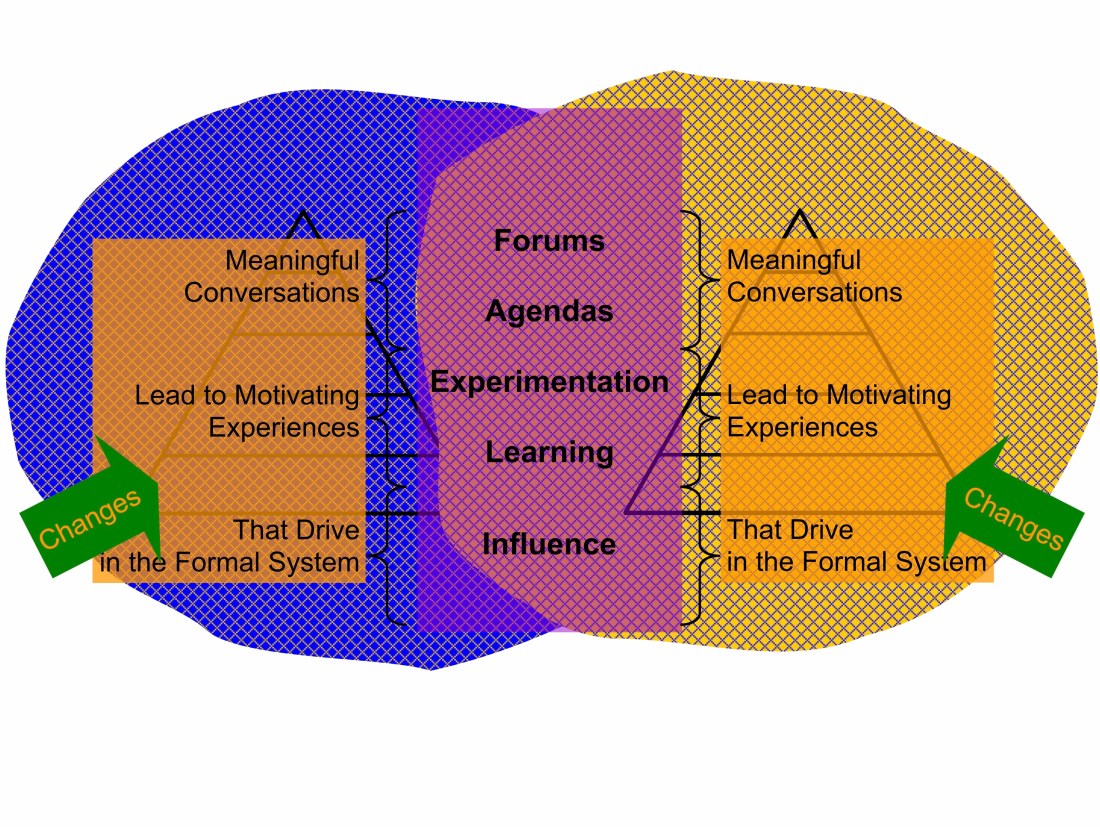
One role of a knowledge broker is to promote healthy organization change by convening those conversations that will make a positive difference in the formal system without damaging the integrity of the organization. In a previous posting, the visual of forums, agendas, experimentation, learning, and influence superimposed over the integrity and filters and screens representing two people in conversations gave a sense of the complexity involved. The graphic below builds on this concept as it extends from a couple of people to two organizations. Here again, the approach is to convene conversations, largely in the informal system, yet ask participants to wear their formal system hats long enough to give credence to the applicability of what they experience. Armed with that understanding and agreement, they commit to tell the stories in the formal system conversations that initiate changes in that system. Knowing what conversations to convene and setting up viable forums and agendas in response – —that is the heart of organization design.

Originally posted to New Media Explorer by Steve Bosserman on Sunday, September 11, 2005and updated on Saturday, September 24, 2005

Integrity Expanded

As a knowledge broker, one of our main goals is to stay “in integrity,” in other words, to remain true to our purpose, principles, and intentions. Because these characteristics have personal significance rather than public they are considered “informal.” The graphic below, a variation of the diagram posted in an earlier blog, associates these three integrity elements with sides of a triangle.

4eed44b2-a530-4f1a-b416-77a41cd48ca0

The use of a triangle sends a mixed message. Its structure is symbolic of a rigid, top-down hierarchy. However, it is the most stabile of all geometric forms requiring changes to the lengths of the sides and sizes of the angles in order to alter its overall dimensionality. In other words, the original must be destroyed to take another shape. Because of this duality between rigidity and stability, both the sides AND the angles have meaning in the metaphor.

In the diagram below, the angles are labeled “authority,” fiduciary,” and “legal.” These three characteristics are more public than personal in their significance and are considered “formal” integrity elements. In dealing with other people as part of a larger social system, we are expected to be wise stewards of resources be they investments / use of time, talent, money, creativity, etc. We are also expected to comply with the laws enacted by the government having local jurisdiction. Finally, we are accountable for our responsibilities commensurate with the authority we have to act. This is the foundation of justice.

abc1e4a8-25a0-4339-9c40-8ca3d0d14553

The combination of both informal and formal components represented by the sides and angles of the triangle provides us with integrated personal and public dimensions of integrity. This is represented graphically below.

501f42da-25d1-475d-9ad1-f4d2290775e3

This same sense of informal and formal can be applied to organizations as well as individuals. In addition, any organization has an integrity as does each person who is a member of it. Because of the correlation in integrity between formal and informal, and individual and organization, integrity is the foundation of organization design approaches.

Originally posted to New Media Explorer by Steve Bosserman on Thursday, September 1, 2005 and updated on Saturday, September 24, 2005