
An organization is a sustained, focused set of conversations between and among people intended to generate results that are deemed of sufficient value by participants such that the relationships are worth continuing. Since conversations are inherent in human communication, it can be concluded that an organization is defined and held together by the unique communication patterns it manifests. People in conversations establish organizations.
Oftentimes, we have little choice about the organization in which we are a member. In some instances, such as with parents and family, it is a lifelong association over which we have no say about who these people are to us. Other organizations are much more elective and temporary. Regardless of the type of organization or whether our membership is by choice, as long as we are associated with it we continually look for ways to make it function more effectively in meeting our interests. The dilemma becomes one of how to change the organization, but keep it intact.
At the heart of staying together is the concept of “integrity.” In an earlier post, the notion of personal integrity was introduced as shown in the lower-left part of the graphic in the diagram below. Organizations, as human social constructs, also have integrity – organizational integrity. Many of the elements, such as those in the authority, fiduciary, and legal arenas, are almost identical with personal integrity. Others are variations on personal integrity themes: “purpose” is transposed to “mission statement,” “principles” to “vision statement” and “intentions” to “values statement.” As indicated by the arrow in the background, people with their individual statements of “personal integrity,” carry those forward into the organizational integrity of the group to which they are members. Hence, what I endeavor to do that is beyond my capacity as one person, I link with others in an organization so that I can accomplish more.

Organizations stay intact by keeping their organizational integrity unwavering. However, to adapt and respond to different conditions and circumstances organizations have to change. What is it, then, that changes? The answer is: the formal system. In the diagram below, the triangle of organizational integrity is layered with the hierarchy (authority structure) of a formal system characterized by “rules and regulations” – compliance to externally imposed laws; “policies and procedures” – compliance to internally imposed guidelines; “programs and processes” – what work is done in the organization and how; “funding and resources” – how the work of the organization is supported according to the dictates of wise stewardship; and “roles and relationships” – how authority and responsibility are distributed to assure accountability. This formal system carries with it certain conversations, e.g., staff meetings, program reviews, performance evaluations, etc., that keep its basic functioning intact. However, the formal system is immersed in a larger informal system of networks and webs which fosters a much less constrained set of conversations, usually dealing with possibilities outside the scope of formal system conversations. Members of the organization belong to both systems simultaneously. Since they wear both hats, they draw upon the dynamics of each system depending on the nature of the conversation at hand – a delicate balancing act to be sure!

There is an infinite variety of manifestations of the formal system structure that can be adopted. It is incumbent on members to keep looking for different ways to change the formal system so the organization is more effective and efficient. However, when members are not clear what the organizational integrity is or they are not aligned with it, their dependency on the formal system deepens. This dependency leads, on the one hand, to fear of change to the formal system over concern that the organization will lose its integrity and destruct, or, on the other hand, unwillingness to change the formal system because its current state is overtly beneficial to certain members. Either way, the result, as depicted in the graphic below, is a “red arrow” of resistance to change. This is opposed to the green “explosions” on the edge of the informal system where receptivity to change is a way of life. As we well know, change begins at the periphery of a living system and pushes inward.

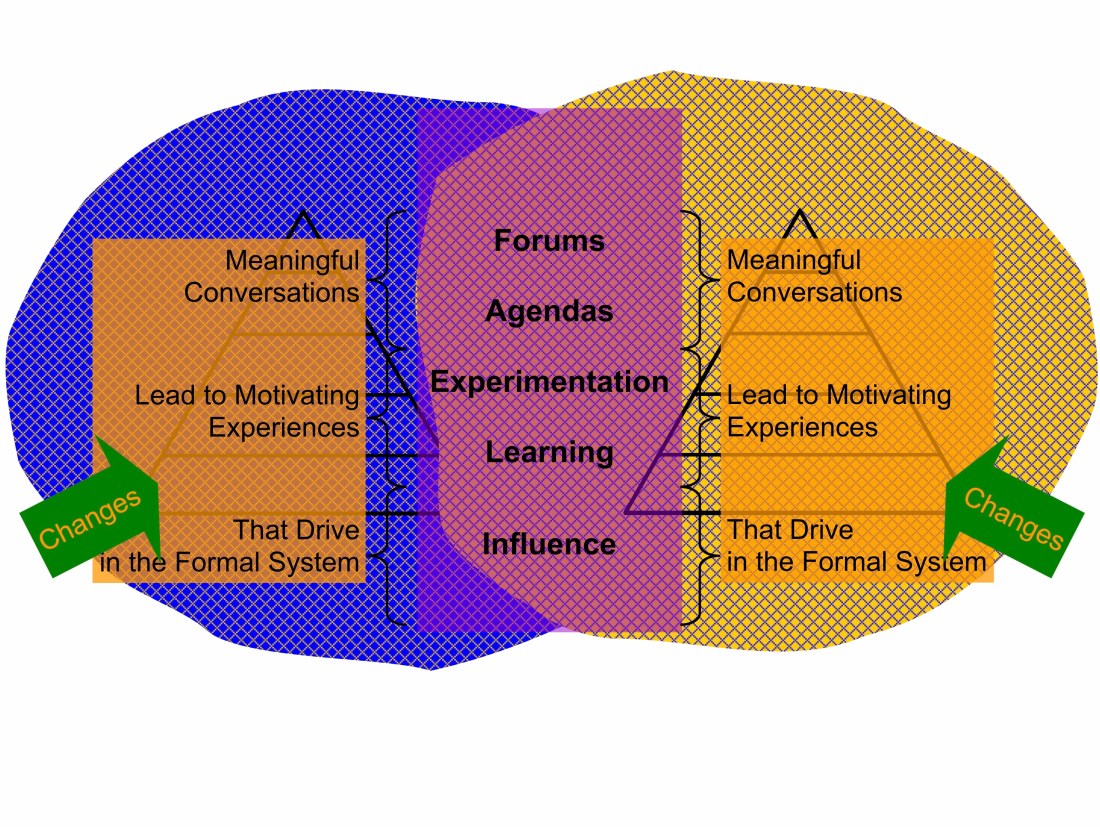
One role of a knowledge broker is to promote healthy organization change by convening those conversations that will make a positive difference in the formal system without damaging the integrity of the organization. In a previous posting, the visual of forums, agendas, experimentation, learning, and influence superimposed over the integrity and filters and screens representing two people in conversations gave a sense of the complexity involved. The graphic below builds on this concept as it extends from a couple of people to two organizations. Here again, the approach is to convene conversations, largely in the informal system, yet ask participants to wear their formal system hats long enough to give credence to the applicability of what they experience. Armed with that understanding and agreement, they commit to tell the stories in the formal system conversations that initiate changes in that system. Knowing what conversations to convene and setting up viable forums and agendas in response – that is the heart of organization design.
Originally posted to New Media Explorer by Steve Bosserman on Sunday, September 11, 2005and updated on Saturday, September 24, 2005


 Frameworks for Understanding the World