We all have a right to our opinions, we are bound to think differently; but a Bahá’í must accept the majority decision of his Assembly, realizing that acceptance and harmony—even if a mistake has been made—are the really important things, and when we serve the Cause properly, in the Bahá’í way, God will right any wrongs done in the end. Bahá’ís are not required to vote on an Assembly against their consciences. It is better if they submit to the majority view and make it unanimous. But they are not forced to. What they must do, however, is to abide by the majority decision, as this is what becomes effective. They must not go around undermining the Assembly by saying they disagreed with the majority. In other words, they must put the Cause first and not their own opinions. He (a Spiritual Assembly member) can ask the Assembly to reconsider a matter, but he has no right to force them or create in harmony because they won’t change. Unanimous votes are preferable, but certainly cannot be forced upon Assembly members by artificial methods such as are used by other societies. — Shoghi Effendi [1]
Question for Consideration
Summarize what a paper with the title, “Conversations That Matter: A Protagonist’s Guide to Consultation Based on Bahá’í Principles” might cover as a starting point for further development. [2] [3]
Gemini Notebook Response:
This guide outlines a structured approach to group decision-making based on the Bahá’í principles of consultation. It provides a comprehensive framework for facilitators to transition meetings from competitive debates toward a collective search for truth. The document details specific preparatory steps, meeting agendas, and communication techniques designed to foster an atmosphere of mutual respect and detachment from personal ego. By prioritizing unity of purpose and inclusive dialogue, the text ensures that every participant feels empowered to speak freely while remaining committed to the final group outcome. Ultimately, the source serves as a practical manual for achieving harmony and effective action within diverse community settings.
Be the Voice of…
In a video interview with @IranIntl, @vesaghsanaei, spokesperson for the Baha'i International Community, spoke out about the intensifying pressure on Baha'is in Iran following searches of several Baha'i homes in Shiraz and the summoning of five citizens to a Ministry of… pic.twitter.com/1rcwHC4K6a
— Bahá'í International Community – Human Rights (@BahaiBIC_Rights) September 24, 2026
Therefore, all souls should consider it incumbent upon them to investigate reality. Reality is one; and when found, it will unify all mankind. Reality is the love of God. Reality is the knowledge of God. Reality is justice. Reality is the oneness or solidarity of mankind. Reality is international peace. Reality is the knowledge of verities. Reality unifies humanity. — ‘Abdu’l-Bahá. [4]
Footnotes
[1] Research Department of the Universal House of Justice. CONSULTATION: A COMPILATION. February 1978, Revised November 1990. Bahá’í Reference Library. https://www.bahai.org/r/969654881
The Guardian advises that you should refer to other doctors, and follow the majority vote. 6— Shoghi Effendi [1]
Question for Consideration
As individual, community, and institutional protagonists attract increasing numbers of diverse participants within a culture of Bahá’í consultation to convene “conversations that matter,” seek “ways that work,” and adopt “changes that sustain” in response to complex issues inherent in social system transformation, what fundamental steps can be taken to “build safety into every forum”? [2] [3]
Perplexity Computer Response:
To build safety into every forum, treat it as a shared spiritual, relational, procedural, material, and digital responsibility—not as a pleasant atmosphere or a set of ground rules added at the beginning of a meeting. In a Bahá’í frame, people need confidence that they may express themselves freely, will not be belittled, that differing views will be investigated rather than weaponized, and that their participation can influence collective learning and action. [4] [5]
Establish the moral foundation
Safety begins before an agenda is set. Conveners, facilitators, institutional leaders, and participants need to cultivate the qualities Bahá’í guidance associates with consultation: purity of motive, humility, patience, detachment from personal views, courtesy, dignity, moderation, and service to a shared purpose. Consultation is described as “spiritual conference” conducted in an atmosphere of love and fellowship; those are operational conditions for collective inquiry, not merely private virtues. [4] [6] [7]
Every forum can therefore begin by naming a simple common purpose:
We are here to investigate reality together, seek the welfare of all, and learn what action can move us toward greater unity and justice.
Then make several commitments explicit:
Every participant may speak with freedom and without fear of ridicule, dismissal, retaliation, or loss of standing.
No one may belittle another person’s contribution.
Participants bring views as contributions to a common search, not possessions to defend.
The group examines assumptions, evidence, structures, and proposals without attacking the motives or worth of people.
Differences are expected; they are resources for discovering aspects of reality that a single viewpoint misses.
Unity means a willingness to act together around a decision and learn from its results—not forced conformity or silence about injustice.
This orientation changes the basic question from “Who is right?” or “Whose interests win?” to “What does the welfare of the whole require, and what can we learn by acting?” Bahá’í guidance warns that insistence on one’s own opinion leads to discord and can conceal truth; it calls instead for frank expression combined with moderation, care, and a search for truth. [4] [8]
Create reliable participation conditions
A person cannot participate safely if participation requires resources, language, physical access, digital confidence, or schedule flexibility they do not have. Inclusion is therefore not achieved by issuing a broad invitation; it requires changing the practical conditions of entry.
Build each forum around these minimum conditions:
Use familiar, physically accessible, transit-connected, non-stigmatizing venues; rotate among neighborhoods and institutional settings where appropriate.
Offer varied times: daytime, evenings, weekends, and asynchronous options. Do not treat a single meeting time as representative of the whole community.
Provide child care, food, transportation support, interpretation, captioning, large-print and plain-language materials, and disability accommodations.
Make telephone, text, voice-message, paper, one-to-one, and small-group pathways as legitimate as speaking in a public meeting or joining a video call.
Distribute agendas and accessible background materials in advance, explain jargon, and reserve time for questions and reflection.
Compensate or otherwise support sustained participation by people whose time, travel, caregiving, or lost wages would otherwise make involvement costly.
Do not require public disclosure of immigration status, income, disability, trauma, political affiliation, religion, or other sensitive information simply to contribute.
These arrangements recognize that historically excluded people may need more than the nominal right to enter a forum. Meaningful participation involves taking part in conceptualizing, designing, implementing, and evaluating the policies and programs that affect one’s life. [9] [10]
Protect voice and dignity
The practical discipline of consultation must prevent informal hierarchies from determining whose knowledge counts. Expertise matters, but lived experience, local knowledge, caregiving insight, front-line work, youth perspectives, and historically marginalized voices also disclose realities that institutions may otherwise miss.
Facilitate for equitable voice
Use trained facilitators or rotating hosts who can:
Invite quieter participants without putting them on display.
Interrupt domination, condescension, stereotyping, personal attacks, or repeated interruption.
Ask speakers to distinguish observation, experience, inference, value, and proposal.
Summarize competing views fairly before moving on.
Make space for reflection—silence, writing, paired conversation, or small groups—before opening plenary discussion.
Offer anonymous or private channels for people unable to speak publicly.
Ensure online participants are not treated as spectators while those physically present carry the discussion.
A useful practice is a structured first round in which each person has equal uninterrupted time to answer one clearly framed question: What reality must this group understand if it is to serve everyone justly? The group then gathers themes before arguing for solutions.
Separate people from ideas
An expressed view becomes material for the group’s inquiry. It can be clarified, strengthened, revised, combined with another proposal, or set aside—without diminishing the person who offered it. This detachment protects both candor and unity.
Bahá’í guidance is unequivocal that every member should have freedom to express an opinion, and that it is not permissible to belittle another’s thought. The same guidance calls on participants to set forth truth with moderation and to avoid a spirit of exclusiveness, secrecy, domination, prejudice, and passion. [5] [8]
Make power visible and accountable
A safe forum is not one that avoids difficult subjects. It is one in which people can identify unequal power, exclusion, and harm without punishment—and where institutions have a disciplined obligation to respond.
At the start of each process, clarify:
Purpose: What problem or possibility is being explored?
Scope: What is open to change, what is constrained, and why?
Authority: Who will decide, and what role do participants have in shaping that decision?
Resources: What money, staff time, information, legal authority, or community capacity is available?
Privacy: Which contributions are public, confidential, anonymous, or subject to safeguarding requirements?
Decision rule: Will the group seek unity, use consent, advise a responsible body, or make a majority decision after consultation?
Accountability: When, how, and by whom will participants hear what happened to their recommendations?
This prevents a damaging form of unsafety: inviting people to share painful experience, then offering no route by which that testimony can affect decisions. Participants must be able to see a traceable path from input to consideration, decision, implementation, review, and revision.
A transparent record after each forum should state:
What was heard, including areas of agreement and unresolved difference.
What evidence or experience shaped the group’s understanding.
What was decided, by whom, and according to what authority.
What will happen next, with named responsibilities and dates.
How participants can challenge, correct, or add to the record.
This makes consultation an operating expression of justice rather than a ritual of consultation without consequence. [9] [10]
Safeguard material and digital spaces
Safety must include the physical and technological environments in which consultation occurs.
Physical safety
Assess venues for accessibility, privacy, emergency procedures, lighting, safe transportation, and the risk of surveillance or intimidation.
Provide safeguarding procedures when children, young people, vulnerable adults, or people experiencing abuse may participate.
Establish clear routes for confidential reporting and independent support when harassment, discrimination, threats, or coercion occur.
Do not force people with trauma or precarious status to share personal experience publicly; offer private testimony, representative statements, or anonymous input.
Avoid making law enforcement presence a default feature of community consultation, particularly where it may deter participation; use trained, non-escalatory safety support appropriate to the setting.
Digital safety
Use accessible platforms with captions, screen-reader support, low-bandwidth and phone-in options, and clear technical assistance.
Collect the least personal data necessary; explain who has access, how it is protected, how long it is retained, and how people can request removal.
Give participants choices between named, pseudonymous, and confidential contribution where compatible with the forum’s purpose.
Publish moderation standards, identify moderators, and act consistently against harassment, impersonation, hate, threats, and doxxing.
Retain original contributions where appropriate so that summaries—especially AI-assisted summaries—can be checked for accuracy, bias, omission, or distortion.
Never make high-bandwidth access, a smartphone, a public social-media account, or a particular commercial platform the only route to civic participation.
The test is straightforward: Can someone with limited money, time, mobility, literacy, digital access, social status, or institutional trust still participate meaningfully and safely?
Build a learning-and-repair cycle
Safety grows when people observe that mistakes can be named, harms repaired, and processes improved. A culture of consultation cannot be sustained if participants must be flawless, if institutions defend every decision, or if critique is treated as disloyalty.
After every significant forum, ask participants privately and publicly:
Did you understand the purpose, agenda, evidence, and decision process?
Did you have a genuine opportunity to contribute in a form that worked for you?
Did anyone dominate, dismiss, intimidate, or exclude others?
Whose experience or knowledge was missing?
Did the process change what the group understood or decided?
What access, confidentiality, facilitation, or follow-up practices need improvement?
Are participants safer and more capable of contributing than when the process began?
Publish the aggregate findings and the changes made in response. If harm occurred, acknowledge it promptly, protect those affected, investigate fairly, and repair what can be repaired. Do not conceal failure in the name of unity; durable unity depends on truthfulness and justice.
A minimum safety charter
Before convening “conversations that matter,” every individual, community, or institution can adopt a one-page charter:
We recognize the inherent dignity and capacity of every person.
We seek truth and the common good, not personal, partisan, or institutional victory.
We protect free, courteous, and candid expression.
We will not belittle, retaliate against, or exclude participants.
We will remove practical barriers to participation and provide multiple ways to contribute.
We will be transparent about authority, evidence, resources, privacy, and decisions.
We will give special attention to those historically excluded or most affected by the issue.
We will act on what we learn, report back, evaluate results, and correct course.
We will address harm and improve the process through ongoing reflection.
Such a charter does not guarantee safety. Its value comes when it is matched by resources, capable facilitation, transparent institutional behavior, and the repeated practice of love, justice, truthfulness, and shared service. In that combination, safety becomes the enabling condition for people to speak honestly, think together across difference, experiment responsibly, and sustain social transformation.
Be the Voice of…
Court Hearing Scheduled for Flora Samadani and Ahmad Naimi in Yazd
On 15 September 2026, it was learned that Mrs. Flora Samadani and Mr. Ahmad Naimi, a Bahá’í couple residing in Yazd, have been summoned to appear before the Revolutionary Court of the city.
— Bahá'í International Community – Human Rights (@BahaiBIC_Rights) September 22, 2026
Therefore, all souls should consider it incumbent upon them to investigate reality. Reality is one; and when found, it will unify all mankind. Reality is the love of God. Reality is the knowledge of God. Reality is justice. Reality is the oneness or solidarity of mankind. Reality is international peace. Reality is the knowledge of verities. Reality unifies humanity. — ‘Abdu’l-Bahá. [11]
Footnotes
[1] Research Department of the Universal House of Justice. CONSULTATION: A COMPILATION. February 1978, Revised November 1990. Bahá’í Reference Library. https://www.bahai.org/r/109233249
[6] Research Department of the Universal House of Justice. CONSULTATION: A COMPILATION. February 1978, Revised November 1990. Bahá’í Reference Library. https://www.bahai.org/r/528587863
The remedy to Assembly inharmony cannot be in the resignation or abstinence of any of its members. It must learn, in spite of disturbing elements, to continue to function as a whole, otherwise the whole system would become discredited through the introduction of exceptions to the rule.
The believers, loving the Cause above all else and putting its interests first, must be ready to bear the hardships entailed, of whatever nature they may be. Only through such persistence and self-sacrifice can we ever hope to preserve on the one hand our divine institutions intact, and on the other force ourselves to become nobler, better instruments to serve this glorious Faith.— Shoghi Effendi [1]
Question for Consideration
A “culture of Bahá’í consultation” provides the capability and capacity for highly variable designs of forums and agendas that honor the spiritual principle of oneness and facilitate communications among people with limited or no experience participating in “conversations that matter,” seeking “ways that work”, and adopting “changes that sustain.” How does the “culture of Bahá’í consultation” address challenges of proximity, means, or history to include, connect, and count everyone? [2] [3]
Perplexity Computer Response:
A culture of Bahá’í consultation addresses unequal proximity, means, and history by treating participation as a matter of justice and capacity, not merely invitation or representation. Its practical task is to create many accessible, recurring spaces in which people can learn to investigate reality together, contribute according to their circumstances and abilities, act on shared understanding, and refine their efforts through reflection.
The three barriers
“Proximity, means, and history” identify three different reasons people may be absent from conversations that shape their lives.
Barrier
What it looks like
Consultative response
Proximity
Distance, mobility limits, unsafe travel, dispersed populations, lack of local relationships, unfamiliar meeting places
Bring consultation into ordinary life and close to where people live; create small, neighborhood-based and home-based spaces; link them through wider networks
Means
Unequal time, income, childcare, language access, technology, literacy, confidence, education, or institutional influence
Remove participation costs, share knowledge plainly, develop skills through practice, and value experiential knowledge alongside formal expertise
History
Exclusion, racism, class hierarchy, trauma, distrust, inherited conflict, prior tokenism, or memories of institutions that did not listen
Build trust slowly through consistency, truthful acknowledgment, respectful listening, shared service, and visible follow-through on what people say
The Bahá’í principle at stake is not that every person participates in exactly the same way, at the same time, or in the same forum. It is that every person has both the right to benefit from a prosperous civilization and the obligation—and genuine opportunity—to help create it according to their capacities. Bahá’í social-action guidance explicitly links justice with universal participation and identifies access to knowledge, and participation in generating, applying, and sharing it, as a right and responsibility of all. [4] [5]
Addressing proximity: build a web of local spaces
A consultative culture does not depend on a single central meeting, a professional facilitator, or access to formal civic venues. It develops a distributed ecology of conversation: small, familiar spaces near people’s daily lives that connect to one another and, when appropriate, to wider institutions.
Design principles
Hold conversations where relationships already exist: homes, apartment common rooms, schools, libraries, workplaces, online groups, neighborhood gatherings, and service projects.
Use small groups when people are new to consultation. A circle of six to twelve people usually lowers the social cost of speaking compared with a large public forum.
Offer multiple routes into the same process: in-person sessions, phone participation, paper or voice-note input, online meetings, one-to-one listening, youth gatherings, and intergenerational conversations.
Schedule at varied times rather than assuming that one evening meeting serves workers, caregivers, older adults, youth, or people with irregular employment.
Connect neighborhood learning to wider coordination without absorbing local initiative into bureaucracy. Local spaces should be able to identify their own realities and propose action; broader bodies can help share resources, patterns, and learning.
In Bahá’í community-building practice, activity is intentionally rooted in neighborhoods and villages while also connected to wider patterns of learning. The Universal House of Justice describes a rising spirit of universal participation emerging through intense activity in particular localities alongside concerted effort across a wider area. [6]
A practical example
If a city wants to address youth isolation, it need not begin with one citywide “stakeholder forum” at city hall. It might begin with:
Small youth-adult listening circles in several neighborhoods.
Conversations hosted by parents, teachers, youth mentors, faith communities, and local organizations.
Accessible channels for those unable to attend: texts, short recorded responses, school-based input, or one-to-one conversations.
Periodic gatherings of facilitators to compare what is being learned.
A citywide consultation only after neighborhood experience has clarified common patterns and practical priorities.
This sequence reverses the usual assumption that legitimacy flows downward from a central meeting. Instead, the wider agenda grows out of local observation, relationship, action, and reflection.
Addressing unequal means: make participation possible
Formal equality—“everyone is welcome”—is insufficient when some people face far greater costs in attending, speaking, understanding, or acting. A culture of consultation therefore seeks to equalize the conditions of participation while respecting different capacities and circumstances.
Remove practical costs
Before convening, ask directly:
Can people get to the space safely and affordably?
Is childcare available or are children welcomed appropriately?
Are language interpretation, plain-language materials, disability accommodations, and non-digital options available?
Does the meeting time exclude shift workers, caregivers, young people, or older adults?
Is reimbursement, a meal, transportation assistance, or technology access needed?
Who has the time to prepare, and whose unpaid labor is being silently assumed?
These choices are not peripheral logistics. They determine whose knowledge can enter the collective understanding of reality.
Democratize knowledge
Bahá’í consultation does not treat formal credentials as the sole warrant for speaking. It asks people to distinguish fact, experience, interpretation, and opinion; to seek valid evidence; and to investigate reality together. The relevant knowledge may include data and scientific analysis, but also the daily knowledge of a caregiver, renter, young person, immigrant, worker, elder, or resident who encounters a system’s effects firsthand.
The consultative ideal is a “free, respectful, dignified, and fair-minded” exchange that seeks truth and a common course of action, rather than a contest in which confidence, jargon, wealth, or professional authority determines whose view prevails. [7]
Build capacity through repeated practice
People with little experience in public deliberation should not be treated as deficient or relegated to “community input.” The capability to participate grows through repeated, supported experience:
Learn a shared language for naming needs, assets, evidence, principles, and possible action.
Practice listening and expression in smaller, lower-risk settings.
Take responsibility for a limited and achievable action.
Reflect on results without blame.
Facilitate or accompany others in the next cycle.
The Universal House of Justice has described educational processes and spaces for reflection as building the capacity for consultation among young and old alike, while helping participants learn from experience and determine immediate next steps together. [8] [9]
Addressing history: restore trust through practice
The historical barrier is often the deepest. People who have been ignored, exploited, stereotyped, or invited to meetings where decisions were already made have good reasons to distrust new calls for “engagement.” No facilitation technique can erase that history. What matters is a sustained practice that demonstrates a different social relationship.
Begin with humility and truthfulness
A consultative forum should not demand immediate trust or insist on premature consensus. It can begin by asking:
What experiences have made participation difficult or unsafe?
Which institutions, rules, or past decisions have caused harm?
Who has repeatedly been consulted but not heard?
What would make this space credible enough to try?
What commitments must organizers make before requesting further participation?
Acknowledgment must be joined to practical correction. If the group identifies an accessibility barrier, a discriminatory process, a missing constituency, or an unkept promise, the next meeting should report plainly on what changed and what did not.
Separate ideas from persons
A central capacity cultivated through Bahá’í consultation is detachment from personal ownership of views. Participants offer a perspective for the group’s examination rather than as a position to be defended as an extension of identity or status. This makes it more possible to disagree without humiliating one another, revise a view without losing face, and accept a collective decision without requiring every person to prevail.
That discipline does not mean ignoring power or silencing rightful dissent. Rather, it redirects the group from adversarial bargaining among interests toward a collective investigation of what is true, just, and workable. Bahá’í guidance describes this process as one that values diversity of perspective, gives due importance to valid empirical information, and resists treating opinion as fact or truth as merely a compromise between opposing interests. [10]
Prove reliability in small matters
Trust grows when participants can see a reliable connection between voice, decision, action, and feedback:
What people say → what the group decides → what is done → what is learned → what changes next
If a consultation cannot act on an issue, it should state why, identify who can act, and make the limits transparent. If it can act, it should begin with a sufficiently modest commitment that participants can see results. Repeated follow-through matters more than eloquent declarations of inclusion.
Forum designs that include, connect, and count
A mature consultative culture needs several formats, not one “best” design. The form should fit the people, purpose, and stage of learning.
Purpose
Suitable forum
How it includes
What it produces
Hear experience and rebuild trust
Listening circles, home visits, story-based conversations, one-to-one accompaniment
Low threshold; familiar settings; allows people who distrust formal meetings to speak in their own terms
Shared map of lived realities, harms, assets, and unanswered questions
Develop confidence and relationships
Study circles, youth groups, parent groups, neighborhood conversations
Repeated meetings; shared learning; roles distributed among participants
Skills in expression, listening, facilitation, and collective inquiry
Define a local issue
Neighborhood reflection meeting or community mapping session
Brings together multiple small circles; combines data with lived experience
A prioritized question, assets inventory, and initial plan
Test “ways that work”
Time-limited action team or service project
Participants become co-designers and implementers rather than advisers only
Practical results, lessons, and evidence about what to retain or change
Coordinate across distance or institutions
Facilitator network, periodic cluster-wide reflection, hybrid forum
Links local knowledge to broader resources while preserving local initiative
Shared learning, resource alignment, and wider advocacy or institutional response
Review justice and accountability
Public learning review or participatory evaluation
Makes decisions and outcomes visible; asks who benefited and who was missed
Adapted priorities, transparent commitments, and corrective action
The important shift is from seeing people as service recipients, audiences, or data sources to recognizing them as protagonists in the generation of knowledge and the construction of social well-being. Bahá’í social-action materials state that development’s primary concern is building the capacity of a population to participate in creating a better world—not simply providing goods and services. [4] [11]
A usable agenda
For a 90-minute neighborhood consultation involving people new to “conversations that matter,” the following structure can work:
Set purpose and ground rules — 10 minutes. State the shared concern, establish respect and confidentiality where needed, and make clear that no person must be an expert to contribute.
Share observation and experience — 20 minutes. Invite each person to answer one concrete question: “What do you see or experience that others need to understand about this issue?”
Identify patterns — 15 minutes. Group observations under a few themes. Ask what is fact, what is interpretation, what needs more evidence, and what strengths are already present.
Frame the common question — 10 minutes. Turn complaints into a constructive inquiry: “How might we ensure that older residents can remain connected and safe during winter?” rather than “Why does nobody help seniors?”
Generate and choose one feasible action — 20 minutes. Seek an action that is useful, within the group’s present capacity, and likely to teach something: a call tree, transportation exchange, shared check-in arrangement, accessibility walk, or meeting with a responsible agency.
Assign stewardship — 10 minutes. Decide who will do what, what help they need, and how people who were absent can still contribute.
Close with reflection — 5 minutes. Ask: “What made it easier or harder to participate today?” Use the answer to improve the next forum.
Signs the culture is maturing
Progress is visible when a community moves beyond occasional consultation toward habits that make collective learning normal.
More people host, facilitate, document, or act—not merely attend.
Participation broadens across age, class, race or ethnicity, language, ability, gender, neighborhood, and prior institutional experience.
Participants can name both local strengths and structural injustices without cynicism or denial.
Data, lived experience, moral principle, and practical knowledge are considered together.
Decisions produce clear responsibilities, timelines, and feedback loops.
Differences are voiced candidly but without personal attack, factionalism, or the need for anyone to “win.”
Failed experiments are examined honestly and used to improve subsequent action.
Institutions become more responsive because their authority is exercised as stewardship: listening, explaining, allocating fairly, and reporting back.
People who once saw themselves as marginal or powerless begin to initiate service, convene others, and contribute to shared knowledge.
A culture of Bahá’í consultation therefore works on access at two levels at once. It changes the architecture of participation—where, when, how, and with what support people can join—and the moral relationships within it—how people listen, speak, disagree, learn, decide, and act together. When those two levels reinforce one another, inclusion becomes more than presence, connection becomes more than networking, and counting everyone becomes a lived form of justice.
Be the Voice of…
(1/4) Thank you @ShokoofehAzar for this article on the escalating persecution against #Iran 's #Bahai religious minority. Violent home raids, property confiscations, harsh sentences & arrests are again intensifying — simply because of their faith. More details 👇🏽 #HumanRightspic.twitter.com/3W8rBIphuh
Therefore, all souls should consider it incumbent upon them to investigate reality. Reality is one; and when found, it will unify all mankind. Reality is the love of God. Reality is the knowledge of God. Reality is justice. Reality is the oneness or solidarity of mankind. Reality is international peace. Reality is the knowledge of verities. Reality unifies humanity. — ‘Abdu’l-Bahá. [12]
Footnotes
[1] Research Department of the Universal House of Justice. CONSULTATION: A COMPILATION. February 1978, Revised November 1990. Bahá’í Reference Library. https://www.bahai.org/r/342126683
[6] Universal House of Justice. “30 December 2021 – To the Conference of the Continental Boards of Counsellors.” Bahá’í Reference Library. https://www.bahai.org/r/758524486
[7] Research Department of the Universal House of Justice. SOCIAL ACTION. Bahá’í Reference Library. https://www.bahai.org/r/259331543
[8] Universal House of Justice. “Riḍván 2013 – To the Bahá’ís of the World.” Bahá’í Reference Library. https://www.bahai.org/r/170427781
[9] Universal House of Justice. “Riḍván 2010 – To the Bahá’ís of the World.” Bahá’í Reference Library. https://www.bahai.org/r/813406593
Through the clash of personal opinions, as ‘Abdu’l-Bahá has stated, the spark of truth is often ignited, and Divine guidance revealed. The friends should therefore not feel discouraged at the differences of opinion that may prevail among the members of an Assembly, for these, as experience has shown, and as the Master’s words attest, fulfil a valuable function in all Assembly deliberations. But once the opinion of the majority has been ascertained, all the members should automatically and unreservedly obey it, and faithfully carry it out. Patience and restraint, however, should at all times characterize the discussions and deliberations of the elected representatives of the local community, and no fruitless and hair-splitting discussions indulged in, under any circumstances. — Shoghi Effendi [1]
Question for Consideration
What practical combinations of forums—afforded by place, timing, and technology—offer safety, robustness, and flexibility for all individuals from formal and informal communities and institutions to apply Bahá’í consultation on agendas pertaining to reinventing their governance structures and processes to align with spiritual guidance? [2] [3]
Perplexity Computer Response:
The most practical answer is an adaptive ecology of forums, not a single meeting format or platform: small trusted circles for depth and safety; accessible local assemblies for shared inquiry; cross-institutional design tables for coordinated action; and interoperable digital channels that sustain participation between gatherings. The system should let people enter through the places, times, languages, and technologies that fit their circumstances—then connect their insights to decisions, action, and learning. [4] [5] [6]
A layered forum ecology
Each forum should have a distinct job, appropriate scale, and explicit connection to the others. Informal settings generate trust and firsthand understanding; formal bodies carry authority, resources, accountability, and continuity. Neither is sufficient alone.
Web portal, SMS/WhatsApp-style messaging, phone hotline, email, paper-to-digital intake
The core design principle is many doors, one learning process. A person should be able to speak privately to a trusted listener, contribute by phone or paper, join an accessible hybrid gathering, participate in a small group, and see how their contribution affects a formal decision.
That approach accords with Bahá’í-informed ideas of meaningful participation: people should be involved not merely as beneficiaries or occasional commenters, but in identifying problems, designing responses, choosing approaches, implementing action, and evaluating results. [4] [5] [7]
Build safety into every forum
Safety is not created simply by choosing a secure app or a pleasant venue. It depends on a culture and process in which people can speak with “absolute freedom,” while members act with love, harmony, candor, courage, and regard for unity. [8]
Relational safety
Before discussing institutional reform, establish shared consultation agreements:
Seek truth and the common good, rather than victory for a person, party, profession, neighborhood, or institution.
Treat each contribution as a shared object of inquiry—not as the permanent property of the speaker.
Welcome differences of experience and interpretation; unity does not require sameness.
Critique proposals, systems, assumptions, and evidence—not the worth or motives of participants.
Protect people from humiliation, retaliation, doxxing, harassment, and coercion.
Make clear when confidentiality applies and when reporting obligations exist, particularly for safeguarding or legal concerns.
Ensure facilitators actively balance participation, especially when status, fluency, gender, race, age, income, professional authority, or digital confidence may shape who speaks.
The aim is not a quiet room without disagreement. It is a setting in which hard truths can be expressed without converting difference into antagonism. The Bahá’í conception of consultation explicitly joins freedom of expression with unity, justice, fellowship, candor, discretion, prudence, and courage. [8]
Material and accessibility safety
A forum that excludes someone because they cannot travel, hear, see, speak English fluently, find child care, risk unpaid time away from work, or navigate an application is not genuinely all-inclusive. Build participation supports into the operating budget:
Hold sessions in physically accessible, transit-connected, familiar, and non-stigmatizing locations.
Rotate time slots: early evening, daytime, weekend, and asynchronous options; do not assume every participant works a standard schedule.
Offer child care, food, transportation support, and where feasible compensation for sustained community labor.
Provide interpretation, plain-language materials, large print, accessible digital files, captions, sign-language interpretation, and audio descriptions.
Permit participation by phone, text, email, paper form, recorded voice message, or trusted intermediary—not only through video platforms.
Send agendas, maps, connection instructions, and materials in advance; publish plain-language summaries and action items afterward.
For hybrid sessions, practical accessibility guidance includes caption-compatible platforms, sign-language interpretation, accessible venues and transit, clear advance instructions, reading chat contributions aloud, live transcripts, and feedback channels for accessibility barriers. [9] [10]
Digital and civic safety
The digital layer needs proportional safeguards, especially where people face political, employment, housing, immigration, or interpersonal risks:
Offer low-barrier participation without requiring public profiles or disclosure of unnecessary personal data.
Publish a plain-language data policy: what is collected, who can see it, how long it is stored, and how it can be removed.
Use separate channels for public ideas, private testimony, and confidential safeguarding reports.
Moderate actively and visibly; do not leave harassment control solely to automated filters.
Maintain a non-digital alternative for every essential step.
Use technology to widen access and preserve learning, not to replace relationships or transfer public deliberation to opaque commercial platforms.
Match forum to agenda
Not every governance question should go to the same kind of consultation. The forum must match the maturity, urgency, complexity, and consequences of the question.
Agenda type
Best forum combination
Illustrative question
Early discovery
Listening circles + neighborhood gatherings + digital/paper idea collection
“What keeps people from participating in local decisions?”
Shared understanding
Learning circles + accessible public evidence sessions
“What do housing, transportation, wages, and care data reveal about exclusion?”
Co-design
Mixed working groups + institutional consultation table
“How should a city redesign its public-engagement process and budget?”
Urgent response
Small operational group + rapid community feedback channels
“How can residents and agencies coordinate during an extreme-weather emergency?”
Long-term system redesign
Recurring community forums + deliberative panels + cross-sector institutional table
“What structure enables residents to help govern education, health, housing, and ecological priorities over the next decade?”
Evaluation and renewal
Public reflection forum + published results + small corrective working group
“Who benefited, who was left out, what did we learn, and what changes next?”
Consultation should start before institutions have settled on solutions. The Bahá’í International Community has noted that participation becomes hollow when consultation begins only after solutions have already been proposed; meaningful involvement spans conceptualization, design, implementation, and evaluation. [4] [11]
A governance-reinvention agenda might therefore move through a recurring cycle:
The cycle makes decisions revisable in light of experience, while preventing endless discussion with no responsibility for action.
Connect informal and formal life
Informal communities—families, friendship networks, cultural groups, mutual-aid networks, study groups, congregations, workplace teams, neighborhood associations—often perceive conditions and develop practical trust long before institutions do. Formal institutions hold legal responsibilities, funding, professional skills, and the ability to sustain action at scale. Reinvented governance should make them mutually reinforcing.
The role of informal forums
Informal forums are particularly valuable for:
Discovering concerns people may not voice in official settings.
Helping participants formulate questions, acquire information, and gain confidence.
Testing whether institutional language matches lived reality.
Reaching people distrustful of government, formal organizations, or public meetings.
Generating small acts of service that demonstrate capacity before a larger policy change is attempted.
They should not, however, become a way for institutions to offload responsibility onto volunteers or expect marginalized communities to solve problems caused by structural inequity.
The role of formal institutions
Formal bodies should commit publicly to:
Receiving community findings in a traceable form.
Explaining what authority and resources are available.
Naming constraints honestly rather than offering empty promises.
Publishing a response to recommendations: adopted, adapted, deferred, or declined—with reasons.
Returning results to the same communities that contributed knowledge.
Creating routes for participants to join implementation and evaluation.
This closes the common gap between “being heard” and having influence. It also reflects the Bahá’í International Community’s view that consultation supports transparency, accountability, equitable distribution of adjustment costs, and more sustainable reform. [4]
Use technology as connective tissue
Technology is most valuable when it connects people across distance, time, language, mobility, and institutional boundaries while preserving human judgment and accountability.
A robust local-to-global consultation infrastructure can include:
A public civic knowledge base: agendas, evidence, accessible summaries, definitions, budgets, meeting records, proposals, decisions, and progress measures.
An asynchronous contribution channel: voice, text, image, phone, paper, or facilitated in-person input, so participation does not depend on attending one meeting at one time.
A moderated multilingual discussion space: organized by agenda rather than by ideological identity, with clear norms and transparent moderation.
A decision and action register: each commitment identifies the responsible body, resources, timeline, equity implications, measures, and next review date.
A community feedback loop: SMS check-ins, telephone hotlines, community liaisons, short surveys, and feedback tables at local events.
A learning archive: records of pilots, outcomes, mistakes, adaptations, and transferable practices, so communities do not repeatedly start from zero.
Artificial intelligence can assist with transcription, translation, plain-language summaries, clustering repeated concerns, and making large bodies of material searchable. It should not silently determine whose views count, rank people’s worthiness, make unreviewable public decisions, or replace accountable human facilitation. Every AI-generated summary should be auditable against the original contributions, reviewed by people, and available in formats that do not require digital literacy.
A good rule is: no essential public process should require high bandwidth, a smartphone, a paid account, or a willingness to expose personal data.
Start with a practical pilot
A community, institution, or coalition can begin without waiting for comprehensive political reform. Choose one governance issue that is important, concrete, and within some group’s ability to influence—for example, how a school district, municipality, health provider, library, nonprofit coalition, or workplace sets priorities and receives public input.
Over a six-month pilot:
Convene 8–12 small listening circles in different social settings, at varied times, with phone and paper alternatives.
Produce a short, accessible “what we heard” document that distinguishes evidence, lived experience, unresolved differences, and proposed questions.
Hold several public learning sessions where residents and institutions examine the issue together before advancing solutions.
Form a mixed working group—especially including those most affected—to develop two or three feasible changes.
Obtain a formal institutional response that names commitments, responsible persons, resources, timelines, and limits.
Test one change in a limited area or period.
Convene a reflection forum and publish a transparent account of results, unequal impacts, lessons, and next adjustments.
Assess the pilot not only by attendance or online clicks, but by whether people from previously excluded groups shaped the agenda; whether participants understood the evidence and decision process; whether institutions acted visibly; whether relationships across differences improved; and whether the resulting action advanced human well-being and the capacity of everyone to serve.
This is how Bahá’í consultation can move from an admirable ideal to a practical civic architecture: a durable network of places, rhythms, relationships, procedures, and technologies through which every person can contribute knowledge, participate in collective learning, and help translate the principle of human oneness into the ordinary functioning of social life.
Be the Voice of…
@AnthropicAI 's Threat Intelligence report reveals that Iranian state-aligned actors used Claude to build influence operations campaigns tied to Iran's "soft war" or "cognitive warfare" program.
The operations were run by actors working within or on behalf of named Iranian state… pic.twitter.com/YQ7xCKz9DR
— Bahá'í International Community – Human Rights (@BahaiBIC_Rights) September 18, 2026
Therefore, all souls should consider it incumbent upon them to investigate reality. Reality is one; and when found, it will unify all mankind. Reality is the love of God. Reality is the knowledge of God. Reality is justice. Reality is the oneness or solidarity of mankind. Reality is international peace. Reality is the knowledge of verities. Reality unifies humanity. — ‘Abdu’l-Bahá. [12]
Footnotes
[1] Research Department of the Universal House of Justice. CONSULTATION: A COMPILATION. February 1978, Revised November 1990. Bahá’í Reference Library. https://www.bahai.org/r/668053600
The prime requisites for them that take counsel together are purity of motive, radiance of spirit, detachment from all else save God, attraction to His Divine Fragrances, humility and lowliness amongst His loved ones, patience and long-suffering in difficulties and servitude to His exalted Threshold. Should they be graciously aided to acquire these attributes, victory from the unseen Kingdom of Bahá shall be vouchsafed to them…. The members thereof must take counsel together in such wise that no occasion for ill-feeling or discord may arise. This can be attained when every member expresseth with absolute freedom his own opinion and setteth forth his argument. Should any one oppose, he must on no account feel hurt for not until matters are fully discussed can the right way be revealed. The shining spark of truth cometh forth only after the clash of differing opinions. If after discussion a decision be carried unanimously, well and good; but if, the Lord forbid, differences of opinion should arise, a majority of voices must prevail. — ‘Abdu’l-Bahá [1]
Question for Consideration
Given the unique value each person possesses through their personality, experiences, and capabilities, what combinations of forums, agendas, and technologies establish safe spaces for Baháʼí consultation where participants can express their value for individual and collective benefit while adapting to constantly changing personal and contextual situations? [2] [3]
Perplexity Computer Response:
The most resilient safe space for Bahá’í consultation is not one forum or platform, but an adaptive ecology: small relational circles for depth, larger community forums for shared learning, decision-focused bodies for action, and inclusive digital channels for continuity. Across all of them, safety arises less from technology than from a disciplined spiritual culture of prayer, courtesy, freedom of expression, detachment from personal views, and a collective search for truth. [4] [5]
A layered consultation ecology
Forum
Appropriate agenda
Helpful technologies
How it protects and releases value
Devotional-reflective circles
Meaning-making, personal experience, moral or spiritual orientation
In-person circle; accessible video call; shared prayer/reading document
Gives people room to speak from lived experience without being pressed prematurely toward a decision
Study circles and learning groups
Shared inquiry, capacity building, reflection on action
Provides clarity, accountability, and unity of action after full consideration
One-to-one or family consultation
Sensitive personal concerns, discernment, conflict repair
Private conversation; optionally secure messaging for follow-up
Allows vulnerability and contextual nuance where public discussion would be unsafe or unhelpful
This design honors the Bahá’í premise that truth is more likely to emerge when diverse perspectives are genuinely heard, while neither allowing every issue to become a mass discussion nor treating private matters as public business. Consultation calls for gathering information widely, including perspectives from people with varied backgrounds and relevant expertise. [6]
A reusable agenda
A safe consultative agenda should have both a stable moral structure and flexible pacing. Rather than leading with positions or proposed solutions, begin by constructing a shared understanding of the question.
Arrive spiritually and relationally. Open with prayer, silence, and brief human connection. This establishes that people are not adversaries defending interests but co-workers seeking a truth none may see alone. Bahá’í guidance describes consultation as a prayerful process marked by love, sincerity, and unity. [4]
Name the purpose and decision horizon. Clarify whether the gathering is for listening, learning, planning, deciding, or reviewing. State what is within the group’s authority and what is not.
Make the question precise. Frame it in an inquiry form: “What conditions would enable…?” rather than “Which proposal should win?” A clear question, relevant facts, and applicable principles are a foundation for unity of purpose. [5]
Gather reality before advocating. Present evidence, lived experiences, relevant guidance, constraints, risks, and capacities. Make deliberate space for those affected by the outcome, not only those already confident in speaking.
Offer views freely, then release them. Invite each person to contribute without interruption, ridicule, or pressure. An idea, once expressed, is treated as belonging to the group rather than to its originator; participants may refine, combine, or set it aside in pursuit of truth. [6]
Seek convergence and identify experiments. Ask what is emerging, what uncertainties remain, and what small, reversible action can generate learning. This is particularly useful when personal circumstances and social conditions are changing.
Decide, assign, and record. State the decision, rationale, responsibilities, resources, timing, and how results will be reviewed. The goal is unanimity; where a decision is duly reached, unity in implementation matters even when initial views differed. [6] [7]
Close with reflection and care. Invite a brief check-out: What felt heard? What needs follow-up? Who may need support? If discussion has become contentious or unproductive, defer it rather than forcing resolution. [4]
Technology as servant, not substitute
Technology should widen participation and preserve learning—not accelerate argument or turn consultation into a sequence of competing comments.
Use hybrid meetings with equal participation rules: remote participants can speak first periodically; chat comments enter the record; cameras are optional when bandwidth, privacy, disability, or caregiving makes them burdensome.
Use asynchronous preparation: distribute the question, factual background, relevant quotations or principles, and agenda beforehand. Permit voice notes or written reflections for those who think better outside live conversation.
Use shared living records: distinguish clearly among observations, questions, proposals, decisions, responsibilities, and lessons learned. A decision log makes institutional memory available while preventing recollection from becoming a source of contention.
Enable accessibility by design: captions, interpretation, plain-language summaries, translated materials, screen-reader-compatible documents, low-bandwidth options, and varied modes of contribution.
Offer protected channels for sensitive input: confidential one-to-one follow-up, carefully governed anonymous feedback, and clear limits on who can access notes or recordings. Do not record sensitive consultation by default.
Avoid platform incentives that reward speed, visibility, or polarization. Disable public reaction counts where possible, avoid debate-style polling before consultation, and establish norms against forwarding or screenshotting private exchanges.
Safeguards for changing conditions
Because people’s capacities and circumstances change—through illness, caregiving, trauma, mobility, language, social position, or changing knowledge—the process should be regularly recalibrated.
Rotate facilitation, note-taking, timekeeping, and presentation roles so authority and competence do not become concentrated in a few voices.
Build in a “context check”: What has changed since we last consulted? Whose experience is missing? What assumptions should be tested?
Separate brainstorming from decision-making when power differences are significant; invite input first, then disclose constraints and deliberate.
Use short cycles: act, observe, reflect, adjust. Bahá’í community practice frames consultation as integral to a mode of learning, not merely a procedure for one-time decisions. [4]
Establish repair practices: acknowledge harm, clarify misunderstanding, revisit process agreements, and if necessary pause consultation until participants can re-enter with composure and mutual regard.
Measure quality as well as outcomes: whether people felt able to speak, whether marginalized knowledge shaped the discussion, whether decisions were understood, and whether learning altered subsequent action.
In this model, each person’s distinctive personality, experience, and capacity is neither romanticized as an untouchable private possession nor absorbed into a collective uniformity. It becomes a contribution to a shared investigation of reality—expressed freely, considered fairly, and integrated into united action. [4] [5]
Footnotes
[1] Research Department of the Universal House of Justice. CONSULTATION: A COMPILATION. February 1978, Revised November 1990. Bahá’í Reference Library. https://www.bahai.org/r/644110934
@ReligionMag examines the growing issue of violence based on religion or belief globally, including the systematic persecution of Baha'is in Iran.
Dr. Ewelina U. Ochab outlines key steps needed to address such violations, including monitoring, criminal accountability, targeted… pic.twitter.com/5Vj1Z8nuUa
— Bahá'í International Community – Human Rights (@BahaiBIC_Rights) August 25, 2026
Therefore, all souls should consider it incumbent upon them to investigate reality. Reality is one; and when found, it will unify all mankind. Reality is the love of God. Reality is the knowledge of God. Reality is justice. Reality is the oneness or solidarity of mankind. Reality is international peace. Reality is the knowledge of verities. Reality unifies humanity. — ‘Abdu’l-Bahá The Promulgation of Universal Peace | Bahá’í Reference Library.
Last week was spent on the road checking in with clients and helping them manage changes within their organizations. Oftentimes, the causes for such changes are presented to me as breakdowns in communication, unrealized opportunities, performance problems, inadequate adaptation, and gaps in the flow of resources. The clients’ default reactions are hierarchical: someone needs to be contracted or hired, someone else is opting to retire, others need to be reassigned, and others still, let go. However, the reality is bigger and more complex than having a few people go and bringing in fresh blood. Change, in a flurry of what’s working, what’s not, and what could work better, first requires that these disparate conditions be placed within a framework. This is followed by convening people whose interactions have the potential to make a positive difference for their organization within that framework. Their interactions lead to more appropriate and measured actions through goals, objectives, strategies, and tactics.
As explored more fully in an earlier posting, organizations consist of sustained conversations – the basis of all human social behavior. If one wants to change an organization, change the conversations its members are having. On one level this is simple and straightforward. Matching forums with meaningful agendas is at the heart of what strategic framing and organization design are all about. People draw upon their power to convene within a social system to setup a wide range of conversations and sustain those that are deemed the most important. Of course, the point of these conversations when establishing or sustaining an organization is to gain alignment – the energy source for growth, progress, and success of any organization.
There is a clear association between those who have the power to convene for alignment and leadership. In fact, while there are hundreds of definitions for leadership, the one I use is “the exercising of power by an individual within a social system to produce alignment.” Productive, collective effort within a social system requires people to be pulling on the rope in the same direction. And through that alignment, motivation is stimulated.
Alignment occurs in three ways:
Integrity. Just as an organization has integrity, so do people. Purpose: why am I here; principles: what do I stand for; intentions: what am I up to, constitute the foundation of institutional and personal integrity. When I feel that my integrity is held in the integrity expressed by others and, ultimately, their organization, I am motivated to participate in what they are doing to see how our collective efforts can be leveraged.
Vision. Imagining a world where one’s purpose, principles, and intentions play out so that others can see it, too, and want to be part of making it happen is a powerful act of vision. Any vision is based first in personal experience. When it is presented to others such that they can shape it with their own dreams and create a shared view of what is possible, the vision becomes an engaging, motivating force.
Fear – Greed. Visions cannot become reality without drawing upon the talents and skills of those who do not necessarily align with the values of integrity or share the same vision. Their motivation comes from a combination of “what’s in it for me” and “what will happen to me if I don’t participate.” The fear – greed continuum appeals to the baser instincts of people in areas where their absence of detachment affects their decisions. For the vast majority, it is easier to do what one is told, to do one’s job, to follow the rules. Alignment means playing along to enjoy the benefits and avoid the pitfalls. But it is a route that is susceptible to the corruptive forces of the hierarchy as explored in a previous posting.
Depending on the circumstances, leaders draw upon the energies available within each of the three types of alignment to advance the organizations they lead. Some have integrity so unquestionably solid it compels others to follow despite not having a clear picture of what the world would look like if everyone behaved according to these values or a hierarchical structure upon which to calculate the cost, risk, and benefit of participation. The most notable of such leaders represent particular spiritual or philosophical belief systems that became the cornerstones for the most persistent social systems in human history. Certainly the evidence is strong that there is much to be gained from fronting one’s core values as a key element in leadership. But, not everyone is ready to cast their lot with someone solely on values alone. This may garner alignment at the outset, but they need more to stay aligned.
Some leaders are able to describe through words and graphics how the world could look if a particular set of core values were adopted such that many others are immediately engaged by it, resonate with it, take it as their own, and start down the path toward making it reality; the vision of one becomes the vision of many. However, the more likely scenario is that one person’s vision matches the visions of others to one degree or another, but not completely. In this case, the effective leader introduces a process by which multiple visions are brought together into one shared vision that holds critical elements for all who want to pursue it. While a shared vision produces alignment, it commands the strongest buy-in only by those who were there when it was created. The leader must stay vigilant in continually representing the vision to those who are new to the organization and in some instances prompt further adaptation of the vision to hold others who come in later.
With both integrity and vision, the virtual or physical presence of and interaction with the leader is essential to maintain alignment. Collective efforts that have dependency on one leader are at risk to go astray unless a formal system is setup to manage the behavior of people in the organization. Formal systems provide boundaries that determine who is in and who is out of an organization, enable the formation of hierarchies, enact rules, regulations, policies, and procedures, and establish processes that manage the work of organizations. Within a formal system, the vision of the organization is translated into sets of actionable goals, objectives, strategies, and tactics. Alignment is achieved when people work these plans. Some leaders are effective enforcing this type of alignment within the formal systems by encouraging them through the promise of reward should they accomplish what they are responsible to do and threatening them with undesirable consequences should they fail. It is the classic case of “carrot and stick” motivation. In other words, the fear – greed continuum is alive and well.
As mentioned earlier, my work with people in client organizations is about framing their circumstances so that an appropriate set of conversations are convened and the participants can make a positive difference in helping their organization adapt. The evolving design of the organization is based on the results of certain conversations that need to happen: does the organization need to recall its integrity – get back to its roots, so to speak; does it need to renew its vision – see itself in an entirely different way filled with more possibilities; does it need to redirect its formal system – become more consequent and disciplined. These questions require different conversations and depending on whether the organizational alignment is better derived from integrity, vision, or fear – greed determines the leadership skills required to make the conversations happen.
Therein lays the challenge of doing my work well – matching the skills of leaders with the circumstances where they will prompt alignment. And if there are no immediate leaders available with the requisite skills, I coach those who show talent and interest so they strengthen their “toolkits,” gain confidence in their capabilities, and embark upon leading in new ways under unfamiliar situations. And helping those people become more evolved, well-rounded, and flexible leaders is what makes doing this work worthwhile!
Originally posted to New Media Explorer by Steve Bosserman on Wednesday, February 1, 2006
There are myriad ways in which we humans understand ourselves and our needs and wants within our experiences of the world around us. Self-awareness coupled with the dissatisfaction resulting from unmet needs and wants motivate us to influence circumstances in an effort to have a more favorable experience—to find a solution. Contentment, if ever achieved, is fleeting. The viability of a solution just found crumbles in the face of curiosity, “antsiness,” or ennui as further needs and wants rush in to renew the cycle. While this predicament may appear to be a routine fueled by frustration, the continual search for solutions is the creative impetus that advances every aspect of human civilization.
Solutions exist at multiple levels. The one most familiar to us, personally, is at the mind level. Despite our immediate circumstances we can always dream about a reality quite different from our current condition. In the realm of the imagination all realities are possible. Even though I may not have the details, the mental world in which my solution is envisioned is different than what I experience in the physical world; and it is preferable. This reality envisioned is a powerful construct, that when acted upon externally has the potential to bring a solution into existence at other levels.
Solutions stated are externalized. Whether verbalized, graphically represented, or physically demonstrated, the act of moving a solution from the mind to the surrounding world externalizes the solution. It becomes an agenda item in a forum outside myself and initiates conversation with others. Those in my family or community or workplace react to it by doing nothing or something, but react they must.
Solutions experienced externally are virtual or material. For instance, I can play soccer on a real field in a real stadium with real teammates and a real opposing team or I can play soccer on a virtual field in a virtual stadium with virtual teammates and a virtual opposing team. In the first case I am required to be somewhere at a specific time with the proper equipment and be prepared to expend a great deal of physical and mental energy for the duration of the game and run considerable risk of getting exhausted or injured. In the second case, I have an avatar who responds as I dictate within a virtual space wherein my teammates and the opposing team are similar representations. The game can start whenever and be played by whoever shows up online or I can make up my own players and have my own game independent of others. Fatigue and injury are still possible. However, eye fatigue from staring at the screen too long and injury to fingers and wrists due to excessive rapid maneuvering of the joystick are of a different nature!
The cost of designing and developing the material solution dictates the use of a virtual solution. When the cost of the material solution is quite high and testing is essential to manage risks, modeling that solution virtually at the outset carries significant value. Buildings, equipment, vehicles, appliances, even construction and manufacturing systems are likely candidates for designing and developing the virtual solution first to prove the concept before converting it into the much more expensive material solution.
Virtual and material solutions are transactional. Once solutions are expressed in the external world by whatever means other people experience those solutions and have conversations about them. Our desire to see our solutions be successful defines needs and wants for information, resources, and authority beyond what we can muster by ourselves to fulfill our solutions in the virtual or material realm. These needs and wants lead us to conduct conversations with others in transactional patterns to gain their understanding of, agreement with, and commitment to or permission for our solution to advance. Many times the world easily accommodates our efforts to advance our solutions and the transactions required to carry them out are minimal. Other times, though, the social and natural systems are perturbed by our solutions such that we are compelled to engage in numerous transactions to move forward with our solutions.
Transactions are economic. I need or want information, resources, or authority that others have and I must negotiate with others to get it. Either they give it to me through some altruistic motivation or we come to an agreement where I get it in exchange for something I give them. The nature and type of transactions I conduct to get what I need and want are directly related to the importance and urgency I have for my solution to be successful. As a result, transactions are governed by social convention, ethical and moral frameworks, conversational skill and savvy, and immediate personal circumstances. Transactions constitute the medium of exchange within an economic system by which solutions are externalized within the political and business arenas.
Originally posted to New Media Explorer by Steve Bosserman on Sunday, September 18, 2005 and updated on Saturday, September 24, 2005
An organization is a sustained, focused set of conversations between and among people intended to generate results that are deemed of sufficient value by participants such that the relationships are worth continuing. Since conversations are inherent in human communication, it can be concluded that an organization is defined and held together by the unique communication patterns it manifests. People in conversations establish organizations.
Oftentimes, we have little choice about the organization in which we are a member. In some instances, such as with parents and family, it is a lifelong association over which we have no say about who these people are to us. Other organizations are much more elective and temporary. Regardless of the type of organization or whether our membership is by choice, as long as we are associated with it we continually look for ways to make it function more effectively in meeting our interests. The dilemma becomes one of how to change the organization, but keep it intact.
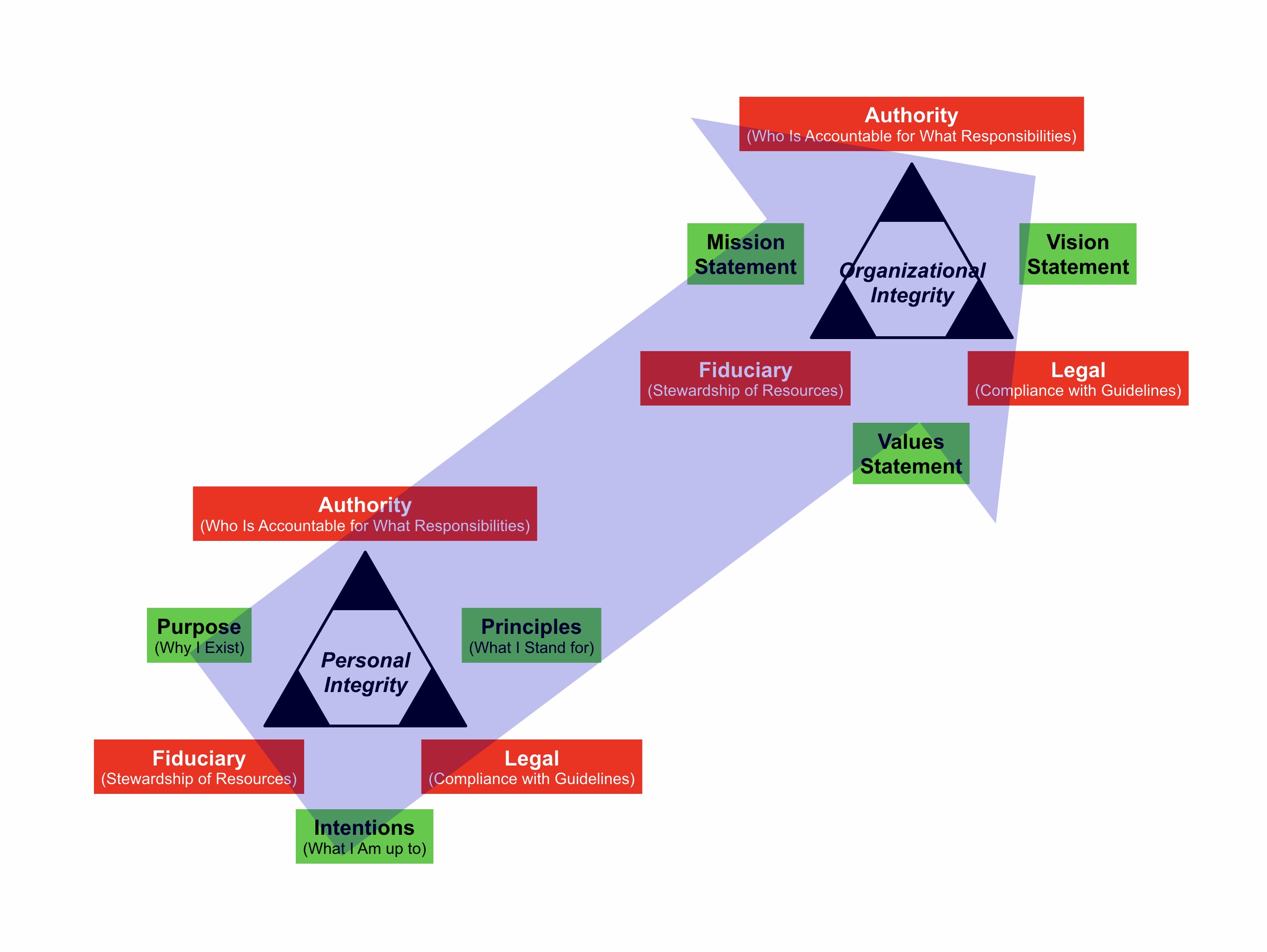
At the heart of staying together is the concept of “integrity.” In an earlier post, the notion of personal integrity was introduced as shown in the lower-left part of the graphic in the diagram below. Organizations, as human social constructs, also have integrity – organizational integrity. Many of the elements, such as those in the authority, fiduciary, and legal arenas, are almost identical with personal integrity. Others are variations on personal integrity themes: “purpose” is transposed to “mission statement,” “principles” to “vision statement” and “intentions” to “values statement.” As indicated by the arrow in the background, people with their individual statements of “personal integrity,” carry those forward into the organizational integrity of the group to which they are members. Hence, what I endeavor to do that is beyond my capacity as one person, I link with others in an organization so that I can accomplish more.
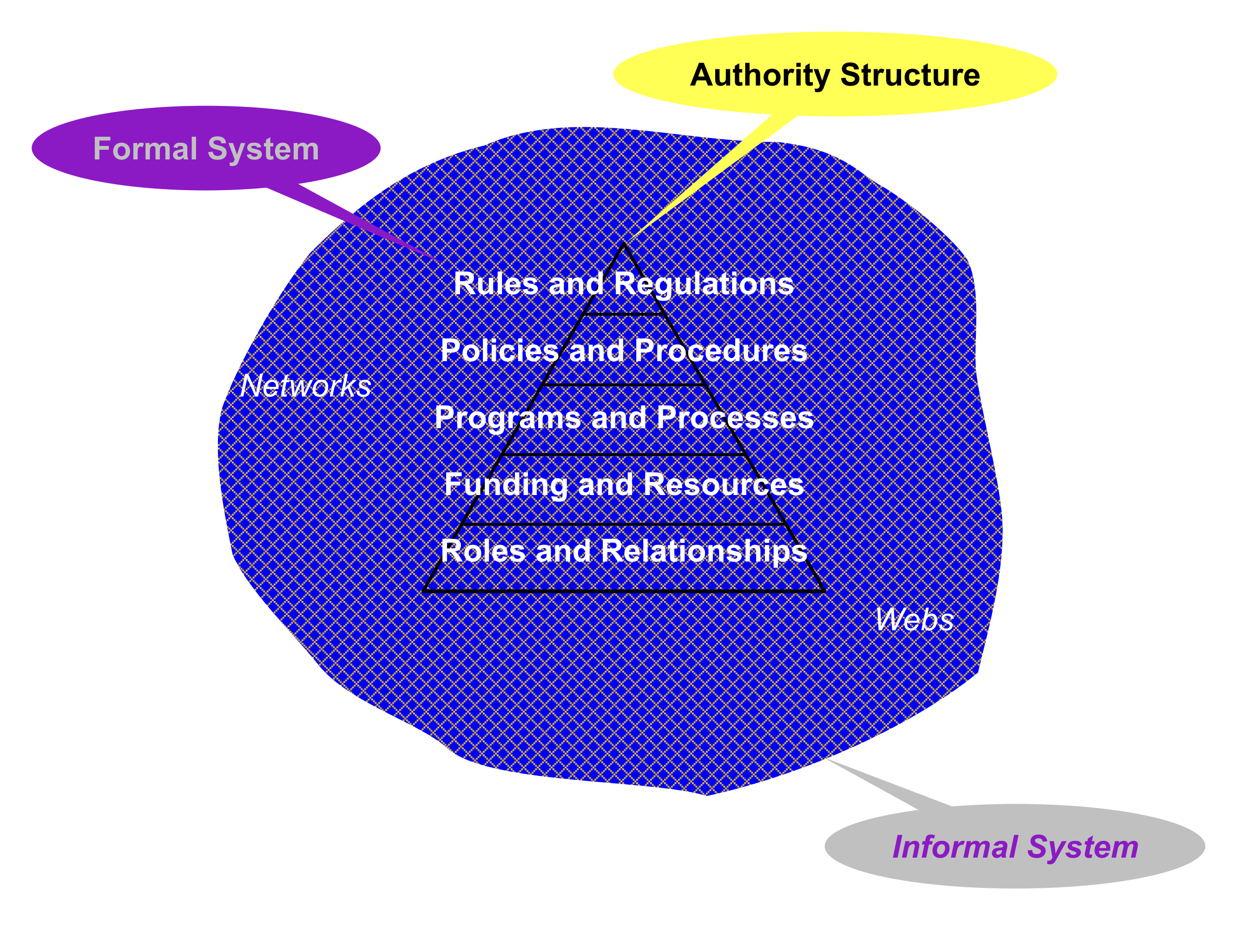
Organizations stay intact by keeping their organizational integrity unwavering. However, to adapt and respond to different conditions and circumstances organizations have to change. What is it, then, that changes? The answer is: the formal system. In the diagram below, the triangle of organizational integrity is layered with the hierarchy (authority structure) of a formal system characterized by “rules and regulations” – compliance to externally imposed laws; “policies and procedures” – compliance to internally imposed guidelines; “programs and processes” – what work is done in the organization and how; “funding and resources” – how the work of the organization is supported according to the dictates of wise stewardship; and “roles and relationships” – how authority and responsibility are distributed to assure accountability. This formal system carries with it certain conversations, e.g., staff meetings, program reviews, performance evaluations, etc., that keep its basic functioning intact. However, the formal system is immersed in a larger informal system of networks and webs which fosters a much less constrained set of conversations, usually dealing with possibilities outside the scope of formal system conversations. Members of the organization belong to both systems simultaneously. Since they wear both hats, they draw upon the dynamics of each system depending on the nature of the conversation at hand – a delicate balancing act to be sure!
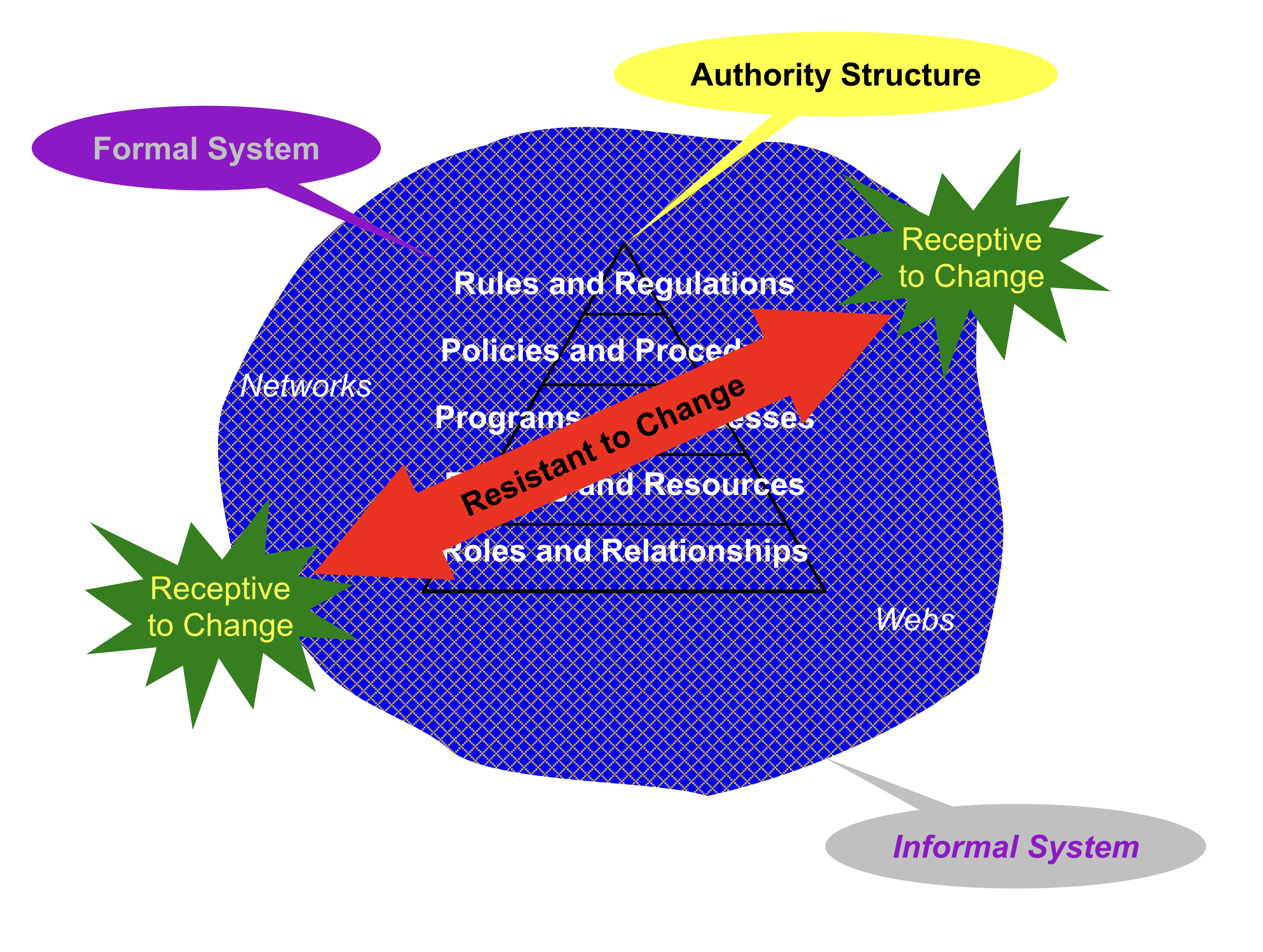
There is an infinite variety of manifestations of the formal system structure that can be adopted. It is incumbent on members to keep looking for different ways to change the formal system so the organization is more effective and efficient. However, when members are not clear what the organizational integrity is or they are not aligned with it, their dependency on the formal system deepens. This dependency leads, on the one hand, to fear of change to the formal system over concern that the organization will lose its integrity and destruct, or, on the other hand, unwillingness to change the formal system because its current state is overtly beneficial to certain members. Either way, the result, as depicted in the graphic below, is a “red arrow” of resistance to change. This is opposed to the green “explosions” on the edge of the informal system where receptivity to change is a way of life. As we well know, change begins at the periphery of a living system and pushes inward.
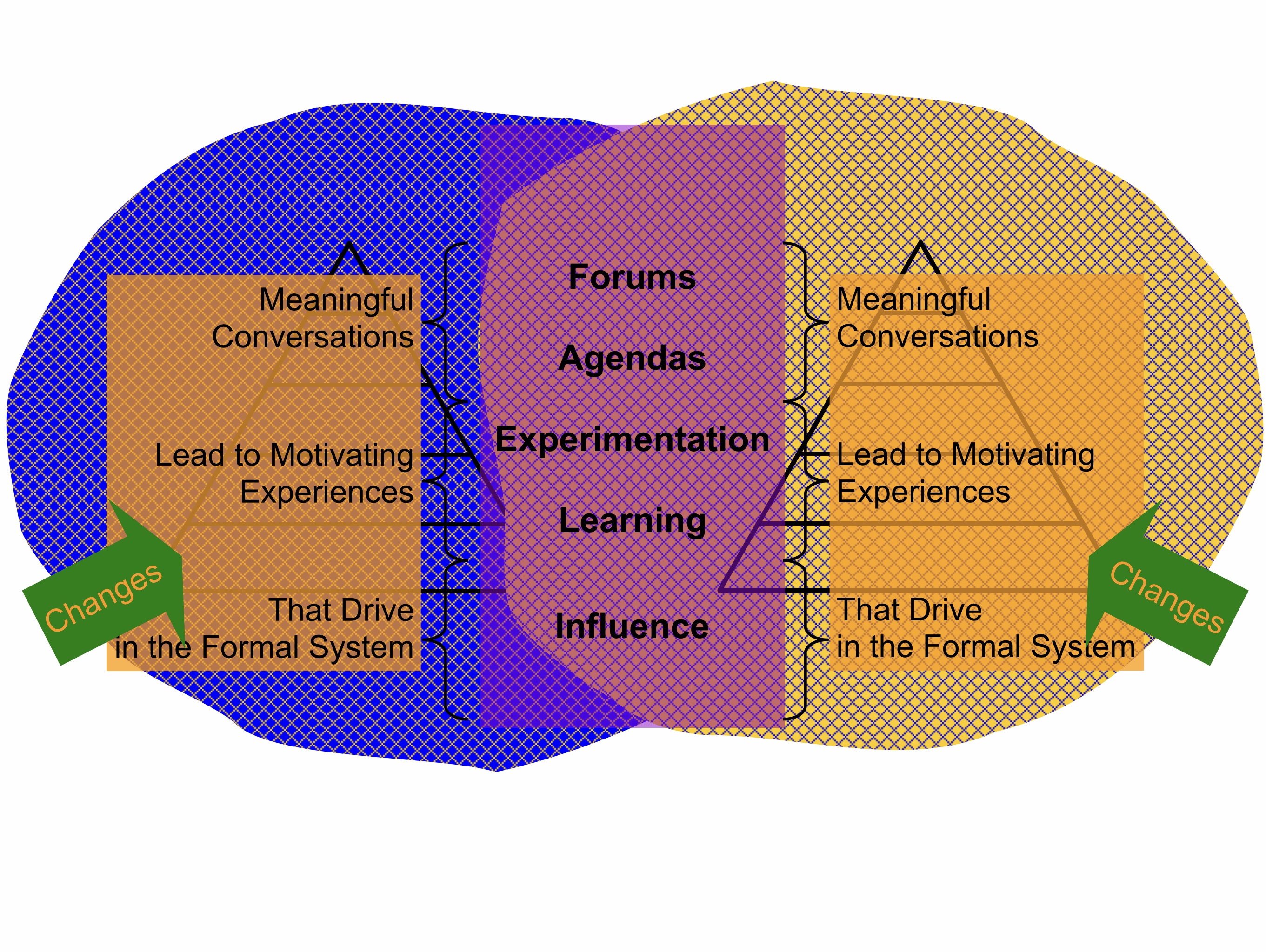
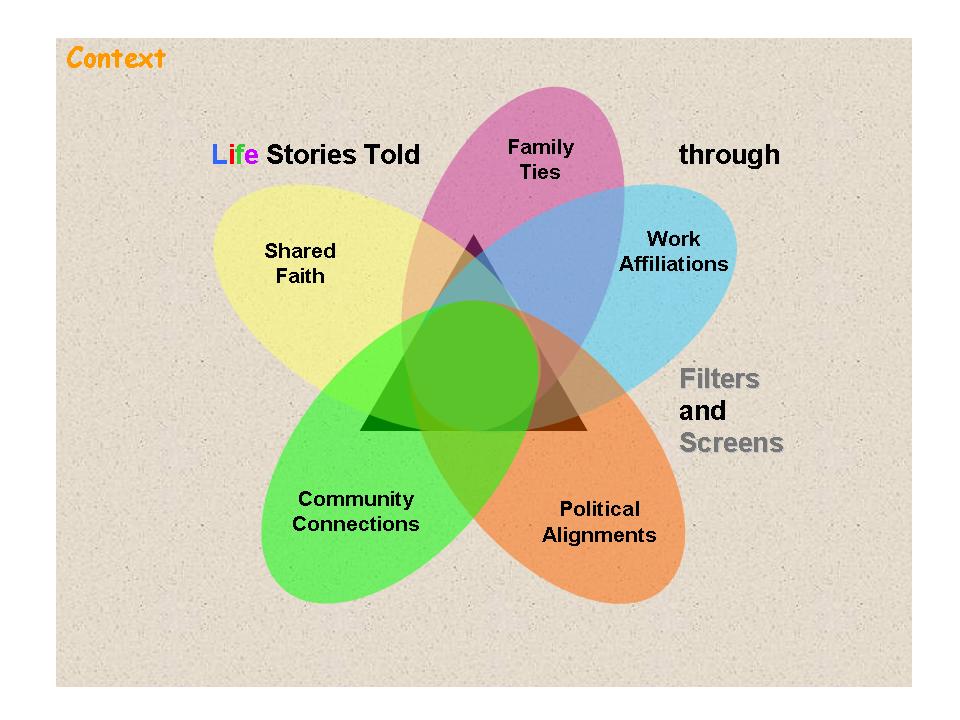
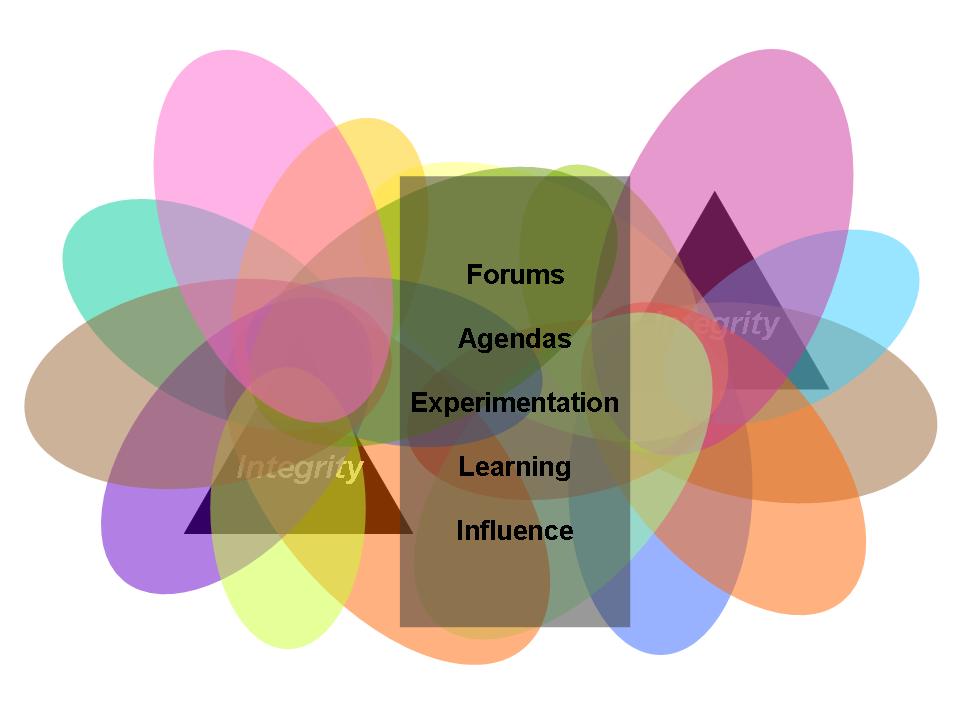
One role of a knowledge broker is to promote healthy organization change by convening those conversations that will make a positive difference in the formal system without damaging the integrity of the organization. In a previous posting, the visual of forums, agendas, experimentation, learning, and influence superimposed over the integrity and filters and screens representing two people in conversations gave a sense of the complexity involved. The graphic below builds on this concept as it extends from a couple of people to two organizations. Here again, the approach is to convene conversations, largely in the informal system, yet ask participants to wear their formal system hats long enough to give credence to the applicability of what they experience. Armed with that understanding and agreement, they commit to tell the stories in the formal system conversations that initiate changes in that system. Knowing what conversations to convene and setting up viable forums and agendas in response – that is the heart of organization design.
Originally posted to New Media Explorer by Steve Bosserman on Sunday, September 11, 2005and updated on Saturday, September 24, 2005
Conversation, simply defined as a combination of verbal and non-verbal “statements between two individuals,” is the fundamental building block of human communication. Conversations can be real-time or asynchronous. Participants can be present, virtually or physically.
Regardless of how a conversation is enacted, at a minimum it strives to produce understanding. In many cases being understood is insufficient, especially when changes to one’s current condition are expected. A press ensues for agreement about what is, what that means, and what are possibilities for the future. With agreement in hand about a preferable condition it is possible to pursue commitment the impetus for deliberate and purposeful action which drives experimentation, learning, and, ultimately, influence.
Any conversation, formal or informal,, consists of a forum and agenda. A forum is the context in which a conversation occurs. This includes who is in the conversation (invited and attending), where the conversation is held, what technologies are used to support the conversation, what date and time the conversation takes place, even in what language the conversation is conducted. The agenda is the subject of the conversation. Depending on psychological, social, and political factors, the agenda can be explicit and openly stated or implicit and hidden. In addition, there can be more than one agenda in a conversation each shaped by a different motivation and entertaining a unique position along the explicit-to-implicit continuum.
This blending of forum and agenda makes conversation an extension of complex human social behavior. Knowing the agenda(s) requires relating it to the forum in order to get a fuller sense of what is behind the conversation and a better interpretation of what are the expected outcomes of the conversation. Obviously, the more one knows others in the conversation and their contextual circumstances the higher the likelihood of accurately “reading” the agenda layers and offering culturally appropriate responses.
Conversations are convened. Someone sets the forum and determines an agenda and others participate. Convening is an exercise of social power. Everyone is experienced at convening if nothing more than saying “Good morning!” to another and soliciting a response. This requires minimal social power to extend the invitation for the other to join. However, depending on who are the desired participants in a particular conversation, differing levels of power are often required to garner the commitments of each to join.
Social power is directly related to the capacity one has to affect consequences for others. The more a person can influence the context in which the interests of others are advanced or met and costs are minimized, the more convening power that person has. Social power not only grants an individual the license to convene, it also permits a person to NOT invite. A conversation says much about the convening authority carried by the person who initiated it based on who is there AND who isn’t!
Knowledge brokers are conveners. They are granted the authority to initiate conversations based on the trust placed in them by participants that their “ground truths” will be respected and their stories heard and understood. Knowledge brokers gain this trust because of the consistency and thoroughness with which they conduct personal investigations of truth then relate those discoveries in conversations where to speak one’s truth carries a potentially negative consequence. This capacity to know one’s truth, grant others the conversational space and opportunity to hold and state theirs, and pursue the lines of experimentation, learning, and influence that follow understanding, agreement, and commitment is a hallmark of a knowledge broker.
Originally posted to New Media Explorer by Steve Bosserman on Saturday, September 10, 2005 and updated on Saturday, September 24, 2005
As mentioned in an earlier post, integrity is manifested through the filters and screens that make up the various affiliations in a person’s life. Some of these affiliations are stronger, newer, and exercise greater influence than others. Because of these differences, integrity is not necessarily central in a person’s affiliation landscape as evidenced in the graphic below. Furthermore, this positioning is not static. As time passes, the filters and screens vary in intensity and significance, and the balance point for integrity shifts.
We humans are social creatures. We have highly evolved language skills and capabilities which we use to communicate with each other through conversation. These conversations convey meaning about us, our situations, our needs, and our aspirations. Essentially, they are our stories.
Stories are structured conversations we have with others about our experiences and the meanings they hold for us. Because of the influence exacted by filters and screens upon us, the stories we tell at one time may be quite different than the stories we tell at another time, place, and circumstance. Stories are contextual. The “truth” they express is relative.
As stated in an earlier post, establishing ground truth is a critical first step for knowledge brokers to ascertain behavior and communication patterns and make relevant responses be they positive or negative. Proclaiming one’s ground truth is an exercise of story-telling. Context is crucial if the reality that shapes a person’s story and truth can be well-understood and acted upon appropriately.
Stories are dependent on the conditions that exist at the time of their telling. The forum — who is in the conversation, where it occurs, when it takes place, and what processes are followed — and the agenda — topics for conversation, expected outcomes from the conversation, and next steps to be taken — are major determinants in how the story is told. Even the same experience shared by many will be related differently depending on the forum and agenda.
Knowledge brokers are concerned about ground truth because of the implications on communication patterns. Repeated over time, stories are reflections of sustained conversation themes and understanding. Changing forums and agendas changes these conversations. Changing conversations leads to experimentation and different experiences. New experiences prompt learning which leads to different stories in an attempt to make meaning out of the new experiences. These new stories influence recurring conversation themes. Told with sufficient frequency over time, stories change the underlying communication patterns and adaptation and evolution occur.
Originally posted to New Media Explorer by Steve Bosserman on Tuesday, September 6, 2005 and updated on Saturday, September 24, 2005