Daily Frameworks for 16 October 2023

Kamál, 01 ‘Ilm (Knowledge), 180 B.E.

Celebration of the Birth of the Báb

Reflections on the Life of the Spirit

Quote for Reflection:

The daily obligatory prayers are three in number. The shortest one consists of a single verse which has to be recited once every twenty-four hours and at midday. The medium, which begins with the words, “The Lord is witness that there is none other God but He,” has to be recited three times a day, in the morning, at noon and in the evening. This prayer is accompanied by certain physical acts and gestures. The long prayer, which is the most elaborate of the three, has to be recited only once in every twenty-four hours, and at any time one feels inclined to do so.

The believer is entirely free to choose any one of these three prayers, but is under the obligation of reciting one of them, and in accordance with any specific directions with which it may be accompanied. — Shoghi Effendi 1

Questions for Consideration:

What does the word “obligatory” mean?

How many daily obligatory prayers has Bahá’u’lláh revealed?

Should we recite all three prayers every day?

If we choose to say the Long Obligatory Prayer, how many times should we recite it each day?

How many times, if we choose to say the Medium Obligatory Prayer?

How many times, if we choose the Short Obligatory Prayer? 2

Google Bard Response:

What does the word “obligatory” mean?

The word “obligatory” means “required by law or duty.” In the context of Bahá’í prayer, it means that we are required to recite one of the three obligatory prayers each day.

How many daily obligatory prayers has Bahá’u’lláh revealed?

Bahá’u’lláh has revealed three daily obligatory prayers:

  • The Short Obligatory Prayer
  • The Medium Obligatory Prayer
  • The Long Obligatory Prayer

Should we recite all three prayers every day?

We are not required to recite all three obligatory prayers every day. We can choose to recite one of the three prayers each day.

If we choose to say the Long Obligatory Prayer, how many times should we recite it each day?

The Long Obligatory Prayer can be recited once a day, at any time we choose.

How many times, if we choose to say the Medium Obligatory Prayer?

The Medium Obligatory Prayer should be recited three times a day, in the morning, at noon, and in the evening.

How many times, if we choose the Short Obligatory Prayer?

The Short Obligatory Prayer should be recited once a day, at midday.

Which prayer should we choose?

We are free to choose any of the three obligatory prayers, but we are under the obligation of reciting one of them each day. We may want to choose the prayer that best meets our needs and circumstances. For example, if we are busy, we may want to choose the Short Obligatory Prayer. If we have more time, we may want to choose the Medium Obligatory Prayer or the Long Obligatory Prayer.

We can also change our minds about which prayer we want to recite at any time. We are not locked into one prayer forever.

The most important thing is to recite one of the obligatory prayers each day with sincerity and devotion. When we pray, we are connecting with God and opening ourselves up to His love and guidance.

  1. Bahá’u’lláh, The Báb, ’Abdu’l-Bahá, Shoghi Effendi, and Universal House of Justice. “Prayer and Devotional Life: A Compilation of Extracts from the Writings of Bahá’u’lláh, the Báb, and ‘Abdu’l‑Bahá and the Letters of Shoghi Effendi and the Universal House of Justice.” Bahá’í Reference Library, February 2019. https://www.bahai.org/library/authoritative-texts/compilations/prayer-devotional-life/7#361847979.
    .
  2. Ruhi Institute. Reflections on the Life of the Spirit. 4.1.2.PE May 2020. Vol. Book 1. 6 vols. Embarking on a Path of Service. Cali, Columbia: Ruhi Institute, 2020, 21-22. https://www.ruhi.org/en/walking-a-path-of-service/#RLS

Daily Frameworks for 15 October 2023

Jamál, 19 Mas͟híyyat (Will), 180 B.E.

Reflections on the Life of the Spirit

Quote for Reflection:

Intone, O My servant, the verses of God
that have been received by thee,
as intoned by them who have drawn
nigh unto Him,
that the sweetness of thy melody
may kindle thine own soul,
and attract the hearts of all men.
Whoso reciteth, in the privacy of his chamber,
the verses revealed by God,
the scattering angels of the Almighty
shall scatter abroad the fragrance
of the words uttered by his mouth,
and shall cause the heart
of every righteous man to throb.
Though he may, at first, remain unaware
of its effect, yet the virtue
of the grace vouchsafed unto him
must needs sooner or later exercise
its influence upon his soul.
Thus have the mysteries of the Revelation
of God been decreed
by virtue of the Will of Him
Who is the Source of power and wisdom. — Bahá’u’lláh 1

Question for Consideration:

What effect will the sweetness of our melodies have on our own souls? 2

Google Bard Response:

According to Bahá’u’lláh, the sweetness of our melodies can kindle our own souls. This means that when we recite the verses of God with sincerity and devotion, it can ignite our spiritual growth and development.

Here are some of the ways in which the sweetness of our melodies can kindle our own souls:

  • It can help us to connect with God on a deeper level. When we sing or recite the verses of God with sweetness and devotion, we are opening ourselves up to God’s love and guidance.
  • It can help us to develop our spiritual qualities. The sweetness of our melodies can help us to cultivate compassion, forgiveness, humility, and other spiritual qualities.
  • It can help us to find inner peace and happiness. When we are surrounded by the sweetness of God’s words, it can bring a sense of inner peace and happiness to our hearts.
  • It can inspire us to live better lives. The sweetness of God’s words can motivate us to be better people and to make a positive contribution to the world.

In addition to these spiritual benefits, the sweetness of our melodies can also have a positive impact on our mental and emotional health. Studies have shown that singing can reduce stress, anxiety, and depression. It can also improve our sleep quality and boost our immune system.

Overall, the sweetness of our melodies can have a profound impact on our lives. It can help us to connect with God on a deeper level, develop our spiritual qualities, find inner peace and happiness, and live better lives.

Here are some tips for developing the sweetness of your melody when reciting the verses of God:

  • Sing or recite the verses of God with sincerity and devotion. This is the most important thing.
  • Pay attention to your breath. Use your breath to support your voice and to create a sense of flow.
  • Experiment with different rhythms and melodies. Find a way of reciting the verses that feels natural and comfortable to you.
  • Listen to recordings of others reciting the verses of God. This can give you some ideas about how to develop your own melody.

With practice, you will be able to develop a sweet and melodious voice that will kindle your own soul and attract the hearts of all who hear it.

Question for Consideration:

What effect will the sweetness of our melodies have on the hearts of others?

Google Bard Response:

The sweetness of our melodies will have a positive effect on the hearts of others. It can uplift their spirits, inspire them to be better people, and bring them closer to God.

Music is a powerful tool that can evoke a wide range of emotions in people. It can make us happy, sad, angry, or joyful. It can also make us think, reflect, and connect with our emotions on a deeper level.

When we intone the verses of God with sincerity and devotion, our voices become a channel for God’s love and guidance. Our melodies can carry the message of God’s love to the hearts of others and inspire them to open their hearts to God.

Here are some specific ways in which the sweetness of our melodies can have a positive effect on the hearts of others:

  • Lift their spirits: The sweetness of our melodies can help to lift the spirits of others and bring them joy. This can be especially helpful for people who are feeling down or discouraged.
  • Inspire them to be better people: The verses of God contain many words of wisdom and guidance. When we intone these verses with sincerity and devotion, our melodies can help to inspire others to be better people and to live more meaningful lives.
  • Bring them closer to God: The verses of God are a direct connection to God. When we intone these verses with sincerity and devotion, our melodies can help to bring others closer to God.

In the quotation from Bahá’u’lláh that you provided, He says that the scattering angels of the Almighty will scatter abroad the fragrance of the words uttered by our mouths. This means that when we intone the verses of God, our melodies will spread the good news of God’s love and guidance to all who hear them.

The sweetness of our melodies can also have a positive effect on our own souls. When we intone the verses of God with sincerity and devotion, we are opening ourselves up to God’s love and guidance. Our melodies can help us to connect with God on a deeper level and to experience His love and peace more fully.

If you want to make a positive impact on the world, I encourage you to intone the verses of God with sincerity and devotion. Your melodies can help to lift the spirits of others, inspire them to be better people, and bring them closer to God.

  1. Bahá’u’lláh, The Báb, and ’Abdu’l-Bahá. “Bahá’í Prayers: A Selection of Prayers Revealed by Bahá’u’lláh, The Báb, and ’Abdu’l-Bahá.” Bahá’í Reference Library. Accessed October 13, 2023. https://www.bahai.org/library/authoritative-texts/prayers/bahai-prayers/1#358258487.
  2. Ruhi Institute. Reflections on the Life of the Spirit. 4.1.2.PE May 2020. Vol. Book 1. 6 vols. Embarking on a Path of Service. Cali, Columbia: Ruhi Institute, 2020, 20. https://www.ruhi.org/en/walking-a-path-of-service/#RLS

Daily Frameworks for 14 October 2023

Jalál, 18 Mas͟híyyat (Will), 180 B.E.

Reflections on the Life of the Spirit

Quote for Reflection:

Whoso reciteth, in the privacy of his chamber,
the verses revealed by God,
the scattering angels of the Almighty
shall scatter abroad the fragrance
of the words uttered by his mouth,
and shall cause the heart
of every righteous man to throb. — Bahá’u’lláh 1

Question for Consideration:

What does the word “recite” mean? 2

Google Bard Response:

The word “recite” means to say or read something aloud, especially from memory. In the context of religion, recitation often refers to the reading or chanting of sacred texts.

In the passage from Bahá’u’lláh that you quoted, He is talking about the power of reciting the verses of God. He says that whoso reciteth, in the privacy of his chamber, the verses revealed by God, the scattering angels of the Almighty shall scatter abroad the fragrance of the words uttered by his mouth, and shall cause the heart of every righteous man to throb.

This means that when we recite the verses of God with sincerity and devotion, our words are transformed into a powerful spiritual force. They can touch the hearts of others and inspire them to grow closer to God.

Recitation is a powerful tool for spiritual growth and development. It can help us to:

  • Connect with God on a deeper level.
  • Understand the teachings of our faith more deeply.
  • Develop our spiritual qualities, such as love, compassion, and forgiveness.
  • Inspire others to grow closer to God.

If you are looking for a way to deepen your spiritual life, I encourage you to make recitation a regular part of your routine. Choose a passage from your scripture that you love or that has special meaning to you, and recite it aloud each day. As you do, focus on the meaning of the words and the feelings that they evoke in your heart. With time and practice, you will find that recitation can be a powerful tool for your spiritual growth and transformation.

Question for Consideration:

What does the word “scatter” mean?

Google Bard Response:

In the context of the quotation from Bahá’u’lláh that you provided, the word “scatter” means to spread or disseminate something widely. In this case, the angels of the Almighty are scattering abroad the fragrance of the words uttered by the person who is reciting the verses revealed by God.

The fragrance of these words is a symbol of their beauty, power, and transformative potential. When the angels scatter this fragrance, they are spreading the good news of God’s love and guidance to all who hear it.

The second part of the quotation says that the angels also cause the heart of every righteous man to throb. This means that the words of God have a profound effect on the hearts of those who are open to them. They can evoke feelings of love, awe, and inspiration. They can also motivate us to be better people and to live more meaningful lives.

The image of the scattering angels is a powerful reminder of the power of God’s words. When we recite the verses revealed by God, we are not just speaking words into the air. We are participating in a cosmic process of spreading God’s love and guidance to the world.

Here are some examples of how the angels might scatter the fragrance of the words uttered by the person who is reciting the verses revealed by God:

  • The angels might whisper the words to the ears of those who are in need of guidance or comfort.
  • The angels might write the words in the hearts of those who are open to receiving them.
  • The angels might scatter the words like seeds, so that they may grow and flourish in the hearts and minds of all people.

The scattering angels are a reminder that God’s words are alive and active. They have the power to transform our lives and the world around us. When we recite the verses revealed by God, we are participating in this transformative process.

  1. Bahá’u’lláh, The Báb, and ’Abdu’l-Bahá. “Bahá’í Prayers: A Selection of Prayers Revealed by Bahá’u’lláh, The Báb, and ’Abdu’l-Bahá.” Bahá’í Reference Library. Accessed October 13, 2023. https://www.bahai.org/library/authoritative-texts/prayers/bahai-prayers/1#358258487.
  2. Ruhi Institute. Reflections on the Life of the Spirit. 4.1.2.PE May 2020. Vol. Book 1. 6 vols. Embarking on a Path of Service. Cali, Columbia: Ruhi Institute, 2020, 20. https://www.ruhi.org/en/walking-a-path-of-service/#RLS

Daily Frameworks for 13 October 2023

Istiqlál, 17 Mas͟híyyat (Will), 180 B.E.

Reflections on the Life of the Spirit

Quote for Reflection:

Intone, O My servant, the verses of God
that have been received by thee,
as intoned by them who have drawn
nigh unto Him,
that the sweetness of thy melody
may kindle thine own soul,
and attract the hearts of all men. —Bahá’u’lláh 1

Question for Consideration:

What does the word “intone” mean? 2

Google Bard Response:

The word “intone” means to chant or recite in a musical or monotonous tone. It can also mean to speak or sing in a solemn or dignified way.

In the passage from Bahá’u’lláh that you quoted, He is asking His servant to recite the verses of God in a melodious and dignified way. He wants the servant to experience the sweetness of the verses for themselves, and also to use their voice to attract the hearts of others.

The word “intone” is often used in religious contexts to describe the chanting of prayers or hymns. It is also used in other contexts, such as in music and poetry, to describe the use of the voice to create a particular mood or atmosphere.

When we intone, we are using our voice to create a bridge between the physical and spiritual worlds. We are using our physical voice to express our inner spiritual feelings and experiences.

In the context of the passage from Bahá’u’lláh, intoning the verses of God is a way of connecting with God on a deeper level and of sharing His love and guidance with others.

Here are some examples of when we might intone:

  • When we are singing a hymn or prayer in a religious service.
  • When we are chanting a mantra or meditation.
  • When we are reading poetry or prose aloud.
  • When we are speaking in a public setting and want to create a sense of solemnity or reverence.

Intoning can be a powerful way to use our voice to connect with God and with others. It can also be a way to express our inner selves and to share our unique gifts with the world.

Question for Consideration:

How should we intone the verses of God?

Google Bard Response:

There is no one right way to intone the verses of God. Bahá’u’lláh simply says that we should intone them as intoned by them who have drawn nigh unto Him. This suggests that we should intone the verses with sincerity, reverence, and love.

Here are some tips for intoning the verses of God:

  • Find a quiet place where you can be alone with God.
  • Close your eyes and take a few deep breaths.
  • Open your heart and mind to God’s love and guidance.
  • Begin to intone the verses in a slow and deliberate manner.
  • Pay attention to the meaning of the verses as you intone them.
  • Allow the sweetness of the verses to kindle your own soul.
  • Intone the verses with sincerity, reverence, and love.

You may also want to consider listening to recordings of others intoning the verses of God. This can give you some ideas on how to intone the verses yourself.

Ultimately, the most important thing is to intone the verses of God in a way that is meaningful to you and that helps you to connect with God on a deep and personal level.

Here are some additional tips:

  • Use your voice to express the emotions of the verses. For example, if the verses are about joy, use a joyful tone of voice.
  • Vary the volume and pitch of your voice to create interest.
  • Use pauses and emphases to highlight important words and phrases.
  • If you are singing the verses, choose a tempo and rhythm that is comfortable for you.
  • Don’t be afraid to experiment and find your own unique way of intoning the verses.

The most important thing is to intone the verses of God with sincerity and love. When you do this, you will be sharing God’s love and light with the world.

  1. Bahá’u’lláh, The Báb, and ’Abdu’l-Bahá. “Bahá’í Prayers: A Selection of Prayers Revealed by Bahá’u’lláh, The Báb, and ’Abdu’l-Bahá.” Bahá’í Reference Library. Accessed October 13, 2023. https://www.bahai.org/library/authoritative-texts/prayers/bahai-prayers/1#358258487.
  2. Ruhi Institute. Reflections on the Life of the Spirit. 4.1.2.PE May 2020. Vol. Book 1. 6 vols. Embarking on a Path of Service. Cali, Columbia: Ruhi Institute, 2020, 19. https://www.ruhi.org/en/walking-a-path-of-service/#RLS

Daily Frameworks for 12 October 2023

Istijlál, 16 Mas͟híyyat (Will), 180 B.E.

Reflections on the Life of the Spirit

Quotes for Reflection:

O THOU Who art the Lord of all names and the Maker of the heavens! I beseech Thee by them Who are the Daysprings of Thine invisible Essence, the Most Exalted, the All-Glorious, to make of my prayer a fire that will burn away the veils which have shut me out from Thy beauty, and a light that will lead me unto the ocean of Thy Presence. — Bahá’u’lláh 1

Make my prayer, O my Lord, a fountain of living waters whereby I may live as long as Thy sovereignty endureth, and may make mention of Thee in every world of Thy worlds. — Bahá’u’lláh 2

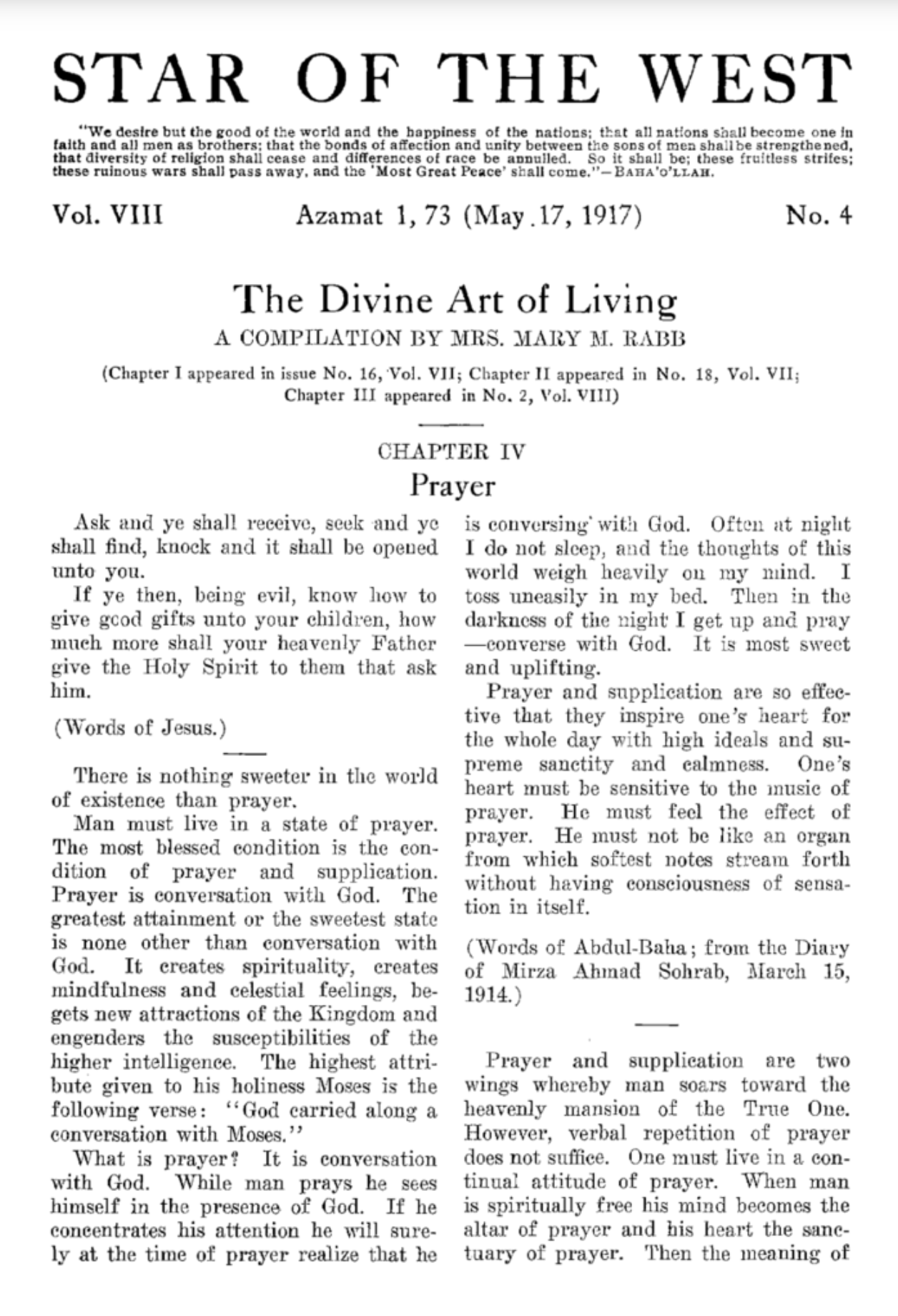
There is nothing sweeter in the world of existence than prayer. Man must live in a state of prayer. The most blessed condition is the condition of prayer and supplication. Prayers is conversation with God. The greatest attainment or the sweetest state is none other than conversation with God. It creates spirituality, creates mindfulness, and celestial feelings, begets new attractions of the Kingdom and engenders the susceptibilities of the higher intelligence. — ‘Abdu’l-Bahá 3

Question for Consideration:

With reference to the quotations above, write five phrases on the nature of prayer. 4

Google Bard Response:

Here are five phrases on the nature of prayer, based on the quotations from Bahá’u’lláh and ‘Abdu’l-Bahá that you provided:

  • Prayer is a fire that burns away the veils which have shut us out from God’s beauty.
  • Prayer is a light that leads us to the ocean of God’s Presence.
  • Prayer is a fountain of living waters that gives us life and helps us to remember God in all worlds.
  • Prayer is conversation with God.
  • Prayer is the sweetest state in the world of existence.

These phrases capture the essential nature of prayer as a powerful tool for spiritual growth and transformation. Prayer is not just a ritual or a set of words that we recite. It is a way of connecting with God on a deep and personal level. When we pray sincerely, we open ourselves up to God’s love and guidance. We also invite Him to help us to become better people and to live more meaningful and fulfilling lives.

  1. Bahá’u’lláh. Prayers and Meditations by Baháʼuʼlláh. Translated by Shoghi Effendi. 1938. Reprint, Wilmette, IL: Bahá’í Publishing Trust, 1974, 317. https://www.bahai.org/library/authoritative-texts/bahaullah/prayers-meditations/7#197000951
    .
  2. Bahá’u’lláh. The Kitáb-i-Aqdas. Bahá’í Reference Library. Accessed October 8, 2023. https://www.bahai.org/library/authoritative-texts/bahaullah/kitab-i-aqdas/8#991781294.
  3. ‘Abdu’l-Bahá. “Star of the West”, vol. 8, no. 4 (17 May 1917), p. 41. http://starofthewest.info.
  4. Ruhi Institute. Reflections on the Life of the Spirit. 4.1.2.PE May 2020. Vol. Book 1. 6 vols. Embarking on a Path of Service. Cali, Columbia: Ruhi Institute, 2020, 19. https://www.ruhi.org/en/walking-a-path-of-service/#RLS

Daily Frameworks for 11 October 2023

’Idál, 15 Mas͟híyyat (Will), 180 B.E.

Reflections on the Life of the Spirit

Quote for Reflection:

Manifestly, the animal has been created for the life of this world. Its highest virtue is to express excellence in the material plane of existence. The animal is perfect when its body is healthy and its physical senses are whole. When it is characterized by the attributes of physical health, when its physical forces are in working order, when food and surrounding conditions minister to its needs, it has attained the ultimate perfection of its kingdom. But man does not depend upon these things for his virtues. No matter how perfect his health and physical powers, if that is all, he has not yet risen above the degree of a perfect animal. Beyond and above this, God has opened the doors of ideal virtues and attainments before the face of man. He has created in his being the mysteries of the divine Kingdom. He has bestowed upon him the power of intellect so that through the attribute of reason, when fortified by the Holy Spirit, he may penetrate and discover ideal realities and become informed of the mysteries of the world of significances. As this power to penetrate the ideal knowledges is superhuman, supernatural, man becomes the collective center of spiritual as well as material forces so that the divine spirit may manifest itself in his being, the effulgences of the Kingdom shine within the sanctuary of his heart, the signs of the attributes and perfections of God reveal themselves in a newness of life, the everlasting glory and eternal existence be attained, the knowledge of God illumine, and the mysteries of the realm of might be unsealed. — ‘Abdu’l-Bahá 1

Question for Consideration:

Mention some of the attributes created by prayer. 2

Google Bard Response:

Prayer can create a variety of attributes in our lives, including:

  • Spiritual knowledge and understanding: Prayer can help us to understand God and His will for our lives more deeply. It can also help us to develop a deeper understanding of ourselves and of our place in the universe.
  • Spiritual growth and development: Prayer can help us to grow and develop spiritually. It can help us to become more loving, compassionate, and forgiving people. It can also help us to develop a stronger sense of inner peace and happiness.
  • Connection to God: Prayer can help us to feel connected to God and to His love. It can also help us to experience His presence in our lives more fully.
  • Gratitude and appreciation: Prayer can help us to develop a sense of gratitude and appreciation for all the good things in our lives.
  • Hope and optimism: Prayer can give us hope and optimism for the future. It can help us to believe that God is always with us and that He will help us to overcome any challenges we face.
  • Love and compassion: Prayer can help us to develop more love and compassion for others.
  • Forgiveness: Prayer can help us to forgive ourselves and others.
  • Humility: Prayer can help us to become more humble.
  • Patience and endurance: Prayer can help us to develop patience and endurance in the face of challenges.
  • Trust in God: Prayer can help us to develop more trust in God.

Prayer is a powerful tool that can help us to become better people and to live more meaningful and fulfilling lives. If you are not already praying regularly, I encourage you to start. Even a few minutes of prayer each day can make a big difference in your life.

  1. ’Abdu’l-Bahá. The Promulgation of Universal Peace: Talks Delivered by ʻAbduʼl-Bahá during His Visit to the United States and Canada in 1912. Edited by Howard MacNutt. 2nd ed. Wilmette, Ill: Baháʼí Publishing Trust, 1982, 302-303. https://www.bahai.org/library/authoritative-texts/abdul-baha/promulgation-universal-peace/21#228777817.
  2. Ruhi Institute. Reflections on the Life of the Spirit. 4.1.2.PE May 2020. Vol. Book 1. 6 vols. Embarking on a Path of Service. Cali, Columbia: Ruhi Institute, 2020, 19. https://www.ruhi.org/en/walking-a-path-of-service/#RLS

Daily Frameworks for 10 October 2023

Fidál, 14 Mas͟híyyat (Will), 180 B.E.

Reflections on the Life of the Spirit

Quote for Reflection:

O ye loved ones of God! The news was received that a Mashriqu’l-Adhkár hath been established, that in that land the praise and glorification of God hath reached the Kingdom of Glory and the melodies of worship and praise of that glorious Beloved have ascended to the Concourse on high. What boundless joy and delight were produced by these glad-tidings, inasmuch as the Mashriqu’l-Adhkár causeth the friends to be awakened, to remember God, and to be in a state of humble prayer. The Mashriqu’l-Adhkár causeth hearts to be illumined, souls to become spiritual, and the fragrances of the Kingdom of Glory to be inhaled. The world of humanity is thereby transformed into another world, and the susceptibilities of the heart are heightened to such a degree that they encompass the entire creation. My hope is that a Mashriqu’l-Adhkár be established in every quarter and in each corner of the country, even if this be done with the utmost discretion and circumspection, and, for prudence’s sake, be confined to chosen and trusted friends among the loved ones of God, until such time as the spread of its fame may not arouse dismay and turmoil among the heedless. — Abdu’l-Bahá 1

Question for Consideration:

What does the phrase “state of prayer” mean? 2

Google Bard Response:

The phrase “state of prayer” refers to a state of being in which one is constantly aware of God and is constantly communicating with Him through prayer. It is a state of deep humility, devotion, and love.

In the passage from Abdu’l-Bahá that you quoted, He says that the Mashriqu’l-Adhkár, or House of Worship, causes the friends to be awakened, to remember God, and to be in a state of humble prayer. This means that the Mashriqu’l-Adhkár helps people to become more aware of God and to develop a deeper relationship with Him.

The state of prayer is not just about saying words. It is about opening one’s heart and mind to God and letting His love and guidance flow through one. It is about being constantly in touch with God and living one’s life in accordance with His will.

Here are some of the characteristics of the state of prayer:

  • Awareness of God: The first characteristic of the state of prayer is awareness of God. This means being constantly aware of God’s presence in one’s life and being grateful for His blessings.
  • Communication with God: The state of prayer is also characterized by communication with God. This communication can take many forms, such as silent prayer, vocal prayer, and meditation.
  • Humility: The state of prayer is also characterized by humility. This means recognizing one’s own weaknesses and shortcomings and relying on God for strength and guidance.
  • Devotion: The state of prayer is also characterized by devotion to God. This means loving God with all one’s heart, mind, and soul.
  • Love: The state of prayer is also characterized by love. This means loving God and loving all of God’s creation.

If you want to experience the state of prayer, I encourage you to make prayer a regular part of your life. Pray every day, even if it’s just for a few minutes. When you pray, be open and honest with God about your thoughts, feelings, and needs. And don’t be afraid to ask for His help.

The state of prayer is a gift from God. It is a way for us to connect with Him and receive His love and guidance. When we are in a state of prayer, we are transformed from within and we are able to live more meaningful and fulfilling lives.

  1. Bahá’u’lláh, ’Abdu’l-Bahá, Shoghi Effendi, and Universal House of Justice. The Institution of the Mas͟hriqu’l-Ad͟hkár. Edited by Research Department of the Universal House of Justice, 2017. https://www.bahai.org/library/authoritative-texts/compilations/institution-mashriqul-adhkar/9#995423859.
  2. Ruhi Institute. Reflections on the Life of the Spirit. 4.1.2.PE May 2020. Vol. Book 1. 6 vols. Embarking on a Path of Service. Cali, Columbia: Ruhi Institute, 2020, 19. https://www.ruhi.org/en/walking-a-path-of-service/#RLS

Daily Frameworks for 09 October 2023

Kamál, 13 Mas͟híyyat (Will), 180 B.E.

Reflections on the Life of the Spirit

Quote for Reflection:

There is nothing sweeter in the world of existence than prayer. Man must live in a state of prayer. The most blessed condition is the condition of prayer and supplication. Prayers is conversation with God. The greatest attainment or the sweetest state is none other than conversation with God. It creates spirituality, creates mindfulness, and celestial feelings, begets new attractions of the Kingdom and engenders the susceptibilities of the higher intelligence. — ‘Abdu’l-Bahá 1

Question for Consideration:

What is the sweetest state in the world of existence? 2

Google Bard Response:

The sweetest state in the world of existence is the state of prayer. Prayer is conversation with God, and it is the most intimate and personal relationship that we can have. When we pray, we are opening our hearts and minds to God, and we are inviting Him into our lives.

Prayer is not just about asking God for things. It is also about expressing our love and gratitude to Him. It is about sharing our thoughts and feelings with Him, and about seeking His guidance and assistance.

When we pray sincerely, we experience a deep sense of peace and joy. We feel connected to something greater than ourselves, and we are filled with hope and optimism. Prayer can help us to overcome our challenges and to achieve our goals. It can also help us to grow spiritually and to become better people.

Here are some of the benefits of prayer:

  • Spiritual connection: Prayer helps us to feel connected to God and to His love. It can also help us to experience His presence in our lives more fully.
  • Spiritual growth: Prayer can help us to grow spiritually. It can help us to become more loving, compassionate, and forgiving people. It can also help us to develop a deeper understanding of God and His will for our lives.
  • Inner peace and happiness: Prayer can help us to find inner peace and happiness. When we pray sincerely, we are opening ourselves up to God’s love and guidance. This can help us to overcome our worries and fears, and to experience a sense of deep contentment.
  • Strength and courage: Prayer can give us strength and courage to face the challenges of life. When we pray, we are asking God for His help and guidance. This can help us to overcome our doubts and fears, and to move forward with confidence.

If you want to experience the sweetest state in the world of existence, I encourage you to pray sincerely and regularly. Ask God to help you to open your heart and mind to His love and guidance. And be patient. It takes time to develop a deep relationship with God. But if you persevere, you will eventually find that prayer is one of the most rewarding experiences in life.

  1. ‘Abdu’l-Bahá. “Star of the West”, vol. 8, no. 4 (17 May 1917), p. 41. http://starofthewest.info.
  2. Ruhi Institute. Reflections on the Life of the Spirit. 4.1.2.PE May 2020. Vol. Book 1. 6 vols. Embarking on a Path of Service. Cali, Columbia: Ruhi Institute, 2020, 18. https://www.ruhi.org/en/walking-a-path-of-service/#RLS

Daily Frameworks for 08 October 2023

Jamál, 12 Mas͟híyyat (Will), 180 B.E.

Reflections on the Life of the Spirit

Quote for Reflection:

Make my prayer, O my Lord, a fountain of living waters whereby I may live as long as Thy sovereignty endureth, and may make mention of Thee in every world of Thy worlds. — Bahá’u’lláh 1

Question for Consideration:

Can prayer be like a fountain of living waters? What does it bestow upon our souls? 2

Google Bard Response:

Yes, prayer can be like a fountain of living waters. It can quench our thirst for spiritual knowledge and guidance and give us the strength and vitality we need to live a meaningful and fulfilling life.

In the passage from Bahá’u’lláh that you quoted, He asks God to make His prayer a fountain of living waters whereby He may live as long as God’s sovereignty endureth, and may make mention of God in every world of God’s worlds. This means that He asks God to help Him to pray in such a way that His prayer becomes a source of constant spiritual nourishment and growth, and He can experience God’s love and guidance in all aspects of His life.

Prayer can bestow many gifts upon our souls. Here are a few examples:

  • Spiritual nourishment: Prayer can nourish our souls and give us the strength and vitality we need to live a meaningful and fulfilling life.
  • Inner peace: Prayer can help us to find inner peace and tranquility, even in the midst of difficult circumstances.
  • Connection to God: Prayer can help us to feel connected to God and to His love. It can also help us to experience His presence in our lives more fully.
  • Guidance: Prayer can help us to discern God’s will for our lives and to make choices that are in alignment with His will.
  • Healing: Prayer can help us to heal from physical, emotional, and spiritual wounds.
  • Transformation: Prayer can help us to become more loving, compassionate, and forgiving people.

When we pray sincerely, we are opening ourselves up to God’s love and guidance. We are also inviting Him to work in our lives and to transform us from within. Prayer can help us develop certain spiritual qualities, such as humility, patience, and forgiveness, and become more loving, compassionate, and forgiving people. Prayer is a powerful tool that can help us grow spiritually and achieve our full potential.

If you want to experience the spiritual benefits of prayer, I encourage you to make prayer a regular part of your life. Pray every day, even if it’s just for a few minutes. When you pray, be open and honest with God about your thoughts, feelings, and needs. And don’t be afraid to ask for His help.

  1. Bahá’u’lláh. The Kitáb-i-Aqdas. Bahá’í Reference Library. Accessed October 8, 2023. https://www.bahai.org/library/authoritative-texts/bahaullah/kitab-i-aqdas/8#991781294.
  2. Ruhi Institute. Reflections on the Life of the Spirit. 4.1.2.PE May 2020. Vol. Book 1. 6 vols. Embarking on a Path of Service. Cali, Columbia: Ruhi Institute, 2020, 18. https://www.ruhi.org/en/walking-a-path-of-service/#RLS

Daily Frameworks for 07 October 2023

Jalál, 11 Mas͟híyyat (Will), 180 B.E.

Reflections on the Life of the Spirit

Quote for Reflection:

Whensoever the light of the revelation of the King of Oneness settleth upon the throne of the heart and soul, His radiance becometh visible in every limb and member. At that time, the mystery of the famed tradition gleameth out of the darkness: “A servant is drawn unto Me in prayer until I answer him, and when I have answered him, I become the ear wherewith he heareth …”(From a Ḥadíth.) For thus the Master of the house hath appeared within His home, and all the pillars of the dwelling are ashine with His light. And as the action and effect of the light are from the Light-Giver, so it is that all move through Him and arise by His will. This is that wellspring whereof the near ones drink, as it is said: “A fount whereof they who draw nigh to God shall drink”. (Qur’án 83:28.) — Bahá’u’lláh 1

Question for Consideration:

Can prayer be like a light? Where does it lead us? 2

Google Bard Response:

Yes, prayer can be like a light. It can illuminate our hearts and minds, and help us to see the world around us more clearly. It can also guide us on our spiritual journey, and help us to become closer to God.

In the passage from Bahá’u’lláh that you quoted, He says that when the light of the revelation of the King of Oneness settleth upon the throne of the heart and soul, His radiance becometh visible in every limb and member. This means that when we pray sincerely, and open our hearts to God’s love and guidance, we are transformed from within. We become more loving, compassionate, and forgiving people. We also become more aware of God’s presence in our lives, and we are better able to follow His will.

Prayer can lead us to a variety of places. It can lead us to a deeper understanding of ourselves and of our place in the universe. It can also lead us to a deeper understanding of God and His will for our lives. Prayer can also lead us to a state of inner peace and happiness.

Here are some specific ways in which prayer can lead us:

  • To God: Prayer is a way to communicate with God and to experience His love and presence.
  • To ourselves: Prayer can help us to better understand ourselves, our strengths and weaknesses, and our place in the world.
  • To others: Prayer can help us to develop compassion and empathy for others, and to see the world through their eyes.
  • To a better world: Prayer can help us to become better people and to contribute to the creation of a more just and peaceful world.

When we pray sincerely, we are opening ourselves up to God’s transforming power. We are also inviting Him to guide us on the path to Him. It can help us to overcome our challenges and to achieve our full potential.

If you want to experience the transformative power of prayer, I encourage you to pray sincerely and regularly. Ask God to help you to open your heart and mind to His love and guidance. And be patient. It takes time to develop a deep relationship with God. But if you persevere, you will eventually find that prayer is one of the most rewarding experiences in life.

  1. Bahá’u’lláh. The Call of the Divine Beloved: Selected Mystical Works of Bahá’ú’lláh.” Bahá’í Reference Library. Accessed September 27, 2023. https://www.bahai.org/library/authoritative-texts/bahaullah/call-divine-beloved/4#085917579.
  2. Ruhi Institute. Reflections on the Life of the Spirit. 4.1.2.PE May 2020. Vol. Book 1. 6 vols. Embarking on a Path of Service. Cali, Columbia: Ruhi Institute, 2020, 18. https://www.ruhi.org/en/walking-a-path-of-service/#RLS