The most important characteristic of business models in a local economy is universal participation by community members. In other words, all community members contribute to their local economy however they can. This may be counterintuitive if one thinks of business models from a typical global economy perspective. Let’s consider some of the main differences between the two economic views.
In a local economy, members are both the market for and the means by which their needs are met. This is quite the opposite of what happens in the global economy where those who produce, process, prepare, and distribute are often separated from one another by considerable distance and even further removed from the end-user or customer. Because of this, the consequence of buying decisions on a particular community does not impact consumer choices within the global economy.
As a result, the purpose of a local economy is to assure sustainability of the community that defines it. The community is the central focus. Community members contribute in whatever ways they can to establish, manage, and maintain the requisite level of business activity within the community that meets their needs. The intent is to advance interdependence among many businesses in the interest of resilience, adaptability, and self-reliance.
In contrast, each business in the global economy strives to be first to market, remain alone in that market for as long as possible, and be deemed best in the market among any other competitors should they appear. The business is the center of attention. A wide array of stakeholders comprised of management, employers, suppliers, and investors promote the business in an effort to gain acceptable returns. The objective is to survive in an intensely competitive environment that challenges the right of each business to exist on a routine basis.
Given participation in a local economy is so important, what does it look like?
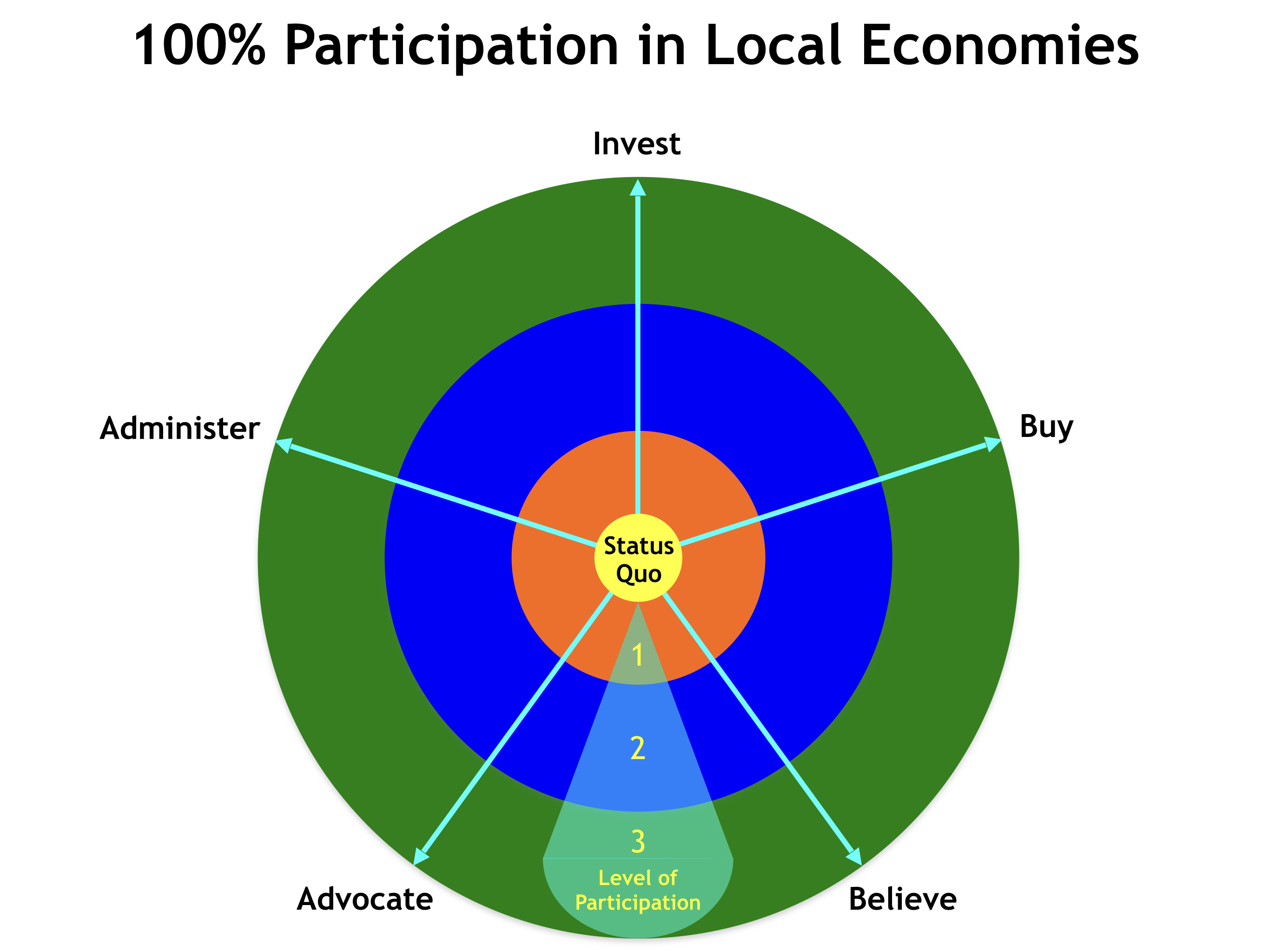
Essentially, community members participate in their local economy along five pathways of action:
They buy from local businesses
They believe that interdependent local businesses must be successful to assure community sustainability
They advocate on behalf of local businesses and the local economy
They administer to the rules of the local economy so that businesses within it have opportunities to function more effectively and efficiently
They invest in businesses
The following graphic recasts the five paths mentioned above as vectors positioned on a backdrop of concentric circles that represent level of participation as indicated by the teardrop scale at the bottom which begins with limited involvement at the status quo center and progresses through three levels to much wider participation in the outer ring.
The view below offers additional descriptors for each vector, level by level. Although this particular example relates to a local food system, the diagram applies to any product or service related to meeting the basic needs of a community.
But these details are not answers. They are merely placeholders to spur your thinking.
How do you participate in YOUR local economy?
What are the appropriate labels to indicate involvement by you and your community members?
Whether you want to go into business within the global economy to satisfy customer wants in markets around the world or a local economy to meet the needs of community members close to home, an effective business model is essential. However, a business model that applies in the global economy is different than one in a local economy. Why?
Two Economies:
The global economy is driven by people’s insatiable desire to have more than what is required to sustain their lives. In contrast, a local economy is focused on meeting the basic physiological (food, water, energy, housing, and clothing) and safety (security, education, and health) needs of its immediate members. In the former, I can live without it, whereas in the latter, I can’t.
In a global economy, customers have two choices: first, do they want something, in general—a car, for instance; and second, do they want a particular item within that general category—a specific car by make, model, year, and other specifications. Any number of factors influence customers in their decisions to buy at all and, if so, which ones. As a result, in the global economy, customers rule.
In a local economy, the market is automatically defined as all who live in the immediate area. The common factor is that everyone must have food to eat, water to drink, air to breathe, shelter as protection from the elements, energy to heat and cool the home, and clothing to wear outside. In addition, everyone must have a reasonable measure of security, means to manage their health, and access to education opportunities so they can better care for themselves and contribute to the sustainability of their local community. The capacity of a local economy to sustain community members predicts how well and for how long those members can participate in the global economy. As a result, in a local economy, the community rules.
Two Business Models:
Given the emphasis on customer choice, a successful business model in the global economy is one that:
Anticipates customer readiness for proposed products and services
Strengthens company readiness to deliver to customers
Adapts quickly to customer reaction and responses to what’s delivered
The net result is to establish and maintain a competitive edge among countless others who want the same outcome for their companies.
For further insights on the development and use of adaptive business models in the global economy, consider Steve Blank (@sgblank) an excellent resource. Steve brings his extensive firsthand experience in building early stage businesses to bear through informative posts about entrepreneurship, start-ups, and applied business principles on his website. Business models is one topic he treats particularly well. In his posting, “What’s a Startup? First Principles,” he describes what is a business model and how to apply it. He also contrasts it to business plans, an analysis he carries forward in a later posting, “No Plan Survives First Contact with Customers – Business Plans versus Business Models.”
In a local economy, community members can choose to source their needs from suppliers far afield from their community. However, to do so puts at risk long-term sustainability due to interrupted supply lines. As a consequence, business models for a local economy offer attractive choices to members so they can meet their needs from local sources.
Key characteristics of business models for a local economy include the following:
Universal participation by community members
Initial focus on meeting the needs of community members without fail
Integration across all value-added steps from the point of consumption back to the points of production
Utilization of community assets and resources without reliance on outside funding
Application of performance metrics that deepen the resolve to establish a fully functioning local economy, spur creativity and innovation to find business solutions, increase the rate and degree of adaptiveness, and significantly improve the odds of long-term sustainability
As indicated by these qualities, business models that deliver the basic needs of community members within a sustainable local economy are quite different than those that satisfy wants of customers throughout the global economy. Given the importance of these local economy business models, they warrant further attention. Look for more details in future postings.
Meals on Wheels America (MOWA) delivers affordable, healthy noon meals to seniors in their homes or at MOWA-sponsored group dining locations. In that single instance each day MOWA fills the food gap between the point of preparation and the point of consumption for seniors. And with that meal come the only calories some seniors will have for the entire day.
What if a local food system delivered ALL the calorie needs for each person in that community every day? Kind of a MOWA on steroids! Yet as far-fetched as this proposition might seem, it is the challenge every community faces if its members choose a sustainable path. After all, everyone NEEDS food and to not have it puts survival at risk.
How might a single meal everyday for everyone system work? The Meals on Wheels of Boulder, Colorado offers a glimpse. The MOW of Boulder mission is
…to provide tasty, nutritious meals to residents of our community who need and want our service, regardless of age or income.
That’s quite a statement. Add “affordable” and “familiar” to the description of the meals and the stage is set for meeting the food needs of the community.
The current MOW of Boulder tagline reads, “Building a Future, Nourishing Our Community.” Formerly, it read, “We Deliver Energy”! And that’s exactly what nourishment is—energy in the form of calories for the human body!
Here’s the rub, though. On average, each of us needs 2,000 calories per day. Those calories are delivered via three meals plus a snack. Like all MOWA chapters, MOW of Boulder delivers one meal per day for a sliding-scale fee based on ability to pay. If we take the cost of a meal yielding 600-700 calories times three in order to meet the 2,000 calorie daily requirement, the total cost may well exceed the threshold of $10 per day. That brings us back to the challenge of affordability each community faces if it is to have a self-sustaining local food system.
The key to the solution rests in how well value-added operations throughout a local food system fit and function together. As a result, sustainability depends on the successful integration of local food preparation and distribution, such as what MOW of Boulder provides, with upstream local food processing and food production. When done effectively, the result is a flexible, interdependent food value chain that stretches from the points of consumption to the points of production. Interestingly, MOW of Boulder shows significant progress enrolling value chain partners with the inclusion of several Community-Supported Agriculture (CSA) shares and other fresh produce from local farms and community gardens.
The community of Boulder has a long way to go before its local food system has the capacity to serve all members and be sustainable. But the efforts of MOW – Boulder and its partner organizations has given it a tremendous leg-up in the process. Keep it up, Boulder!
What can YOU do to help YOUR community establish a Meals on Wheels chapter? And if there is a MOW chapter already up and running, what can YOU do to help it extend its scope to fill the food gap wherever it exists in YOUR community?
Social justice prevails when all members of a society have their basic physiological (food, water, energy, housing, and clothing) and safety (security, education, and health) needs met.
The purpose of a sustainable local economy is to provide the means by which all community members can meet their needs through legitimate transactions and with their dignity intact.
The metrics for a local economy indicate how well it meets basic needs. In other words, does everyone have sufficient food, water, energy, shelter, and clothing? Are they secure, healthy, and capable? If “no” is the answer to one or both, the economic system needs attention. People must step up and “make it right.”
Five years ago, Hurricane Katrina wiped out hundreds of homes in New Orleans and displaced thousands of people. This disaster left a huge deficiency of basic needs.
Due to the vagaries of the storm’s path and the uneven quality of levee design and construction, several parishes and wards suffered decidedly higher losses than others. To make matters worse, not all were treated fairly during the long slog of recovery. Many who escaped with far less damage garnered a disproportionate degree of favor while assistance for those who needed it most was agonizingly slow to arrive.
The Lower Ninth Ward was particularly hard hit by the storm and subsequent flooding due to failed levees. And it was home to some of the most disadvantaged people in the city. Obviously, they were among those who had the least funding, materials, know-how, and support to clean-up, rebuild, and resettle in their homes. The starkness of the situation epitomized social injustice.
To address this, in part, Brad Pitt launched an initiative, Make It Right. The purpose was to tap the creative spirit and commitment of leading architects and builders in the design and construction of affordable, environmentally sustainable, easy-to-maintain homes for people who had little or no hope of rebuilding on their own.
This is the kind of program that applies a key metric, housing, to “make it right” and mark progress of the local economy on the path to social justice. And while this initiative is not the full answer, it’s a good place to start. The opportunities to “make it right” even more in New Orleans and many other places are endless.
Perhaps the time is nigh to advance sustainable local food systems as suggested in the posting, “Which Food System Do You Use to Get Your Calories?”. Hence the question, who’s up for sustainable living?
Is there an alternative to the global food system where a person in the U.S. can get 2,000 affordable (no more than $10 / day), accessible, available, nutritious, tasty, familiar, quick, convenient, and safe calories? Obviously, the global food system is quite capable of hitting most of those guidelines as evidenced in Tom Barlow’s posting on Aol, “Eat for a Dollar a Day; Thanks, Costco”. Such foodstuffs comply with government regulations and they are acceptable to consumers who cannot afford or find otherwise.
Unfortunately, these same foods contain high levels of saturated fat, sugar, and sodium. When eaten to excess, which is too often the case when the target markets are those demographic groups that rely on them most to meet their basic food needs (see Natasha Singer’s posting in The New York Times, ”Fixing a World That Fosters Fat”), they contribute to serious obesity-related conditions such as hypertension, heart disease, stroke, and diabetes. But is health reason enough to go for another food system?
The diagram below illustrates the flow of food from points of production that can be almost anywhere in the world, through processing, preparation, and retail, to points of consumption that can be almost anywhere else in the world. Various non-profit, for-profit, governmental, and non-governmental organizations have assigned or assumed responsibilities to inspect food for compliance with safety regulations as it travels throughout the global distribution system on its way to consumers in communities and neighborhoods wherever they are located. The system is highly evolved and marvelously effective given its design specifications. However, it is also highly subsidized through trade agreements, tariffs, duties, taxes, incentives, price controls, and limited accountability for externality costs, which offset costs and keep prices low.
The major issue with total reliance on the global food system is that residents of a community / neighborhood are dependent on others outside their jurisdiction for food. Their lives are literally in the hands of those who do not suffer the abject consequences of failure to deliver. Climate change, natural disasters, unavailability of or exorbitant prices for fuel, political upheaval, and widespread pandemic outbreaks can singularly or in combination set a series of events in motion that threaten food security and safety. It is this risk to survival that makes the establishment of a local food system in every community, neighborhood, and rural area an imperative.
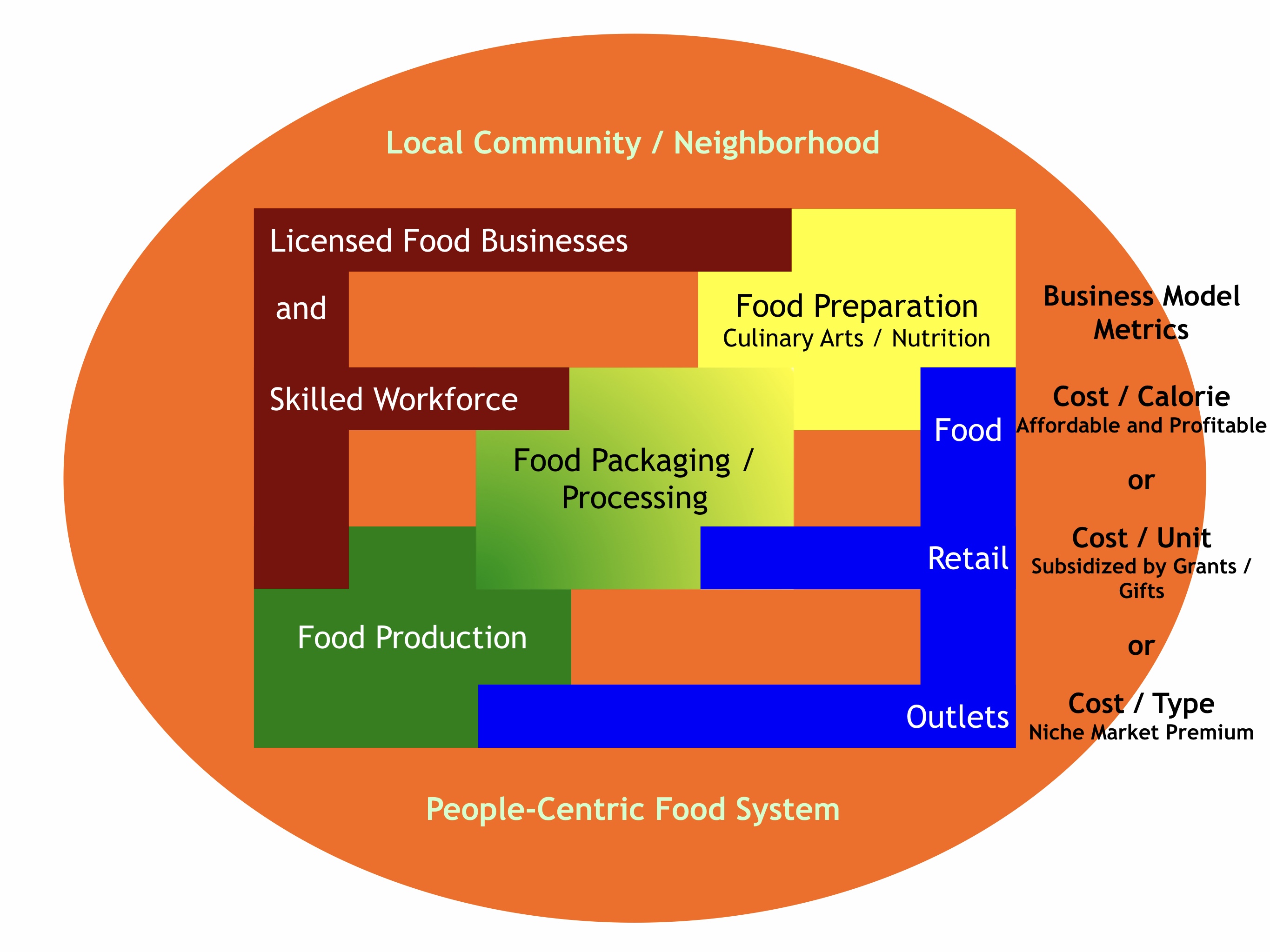
How does a local food system compare to the global food system? The diagram below offers a quick look. First of all, residents of a given local community / neighborhood take significant responsibility for their food supply, hence, the title “People-Centric Food System”. People are the social fabric or operating system by which skilled / licensed practitioners conduct food production, packaging, processing, and preparation so that “accessible, available, nutritious, tasty, familiar, quick, convenient, and safe calories” are delivered to community members through myriad retail outlets.
But does such a system provide sufficient calories to sustain residents? That depends on its business model and key metric. The diagram below offers three alternatives:
Food products of special types that target high-end niche markets and command top prices. The consumer subsidizes the local food system by paying a premium for unique, locally sourced products that cannot be easily purchased from global food system retail outlets. The key metric is cost / type.
Food products packaged in units (pounds, quarts, containers, bunches, etc.) generally available from the global food system for a lesser price. However, the locally sourced products are subsidized through grants and gifts (property, equipment, inputs, labor, etc.) awarded to those who produce, process, package, and prepare them so that prices are comparable to global system offerings. The key metric in this instance is cost / unit.
Food products are packaged into meals that, when consumed in a given day, yield 2,000 accessible, available, nutritious, tasty, familiar, quick, convenient, and safe calories for no more than $10. Additionally, the businesses involved in producing, processing, packaging, and preparing those calories for eventual consumption are profitable. As a result, the local food system is sustainable, not subsidized. The key metric is cost / calorie.
The first two are prevalent business models for local food enterprises in the U.S. today. They require subsidization through prices, grants, or gifts to remain solvent. However, they do not provide sufficient affordable calories in a given day for each community / neighborhood resident. The third alternative claims to meet all the criteria, but how does it work?
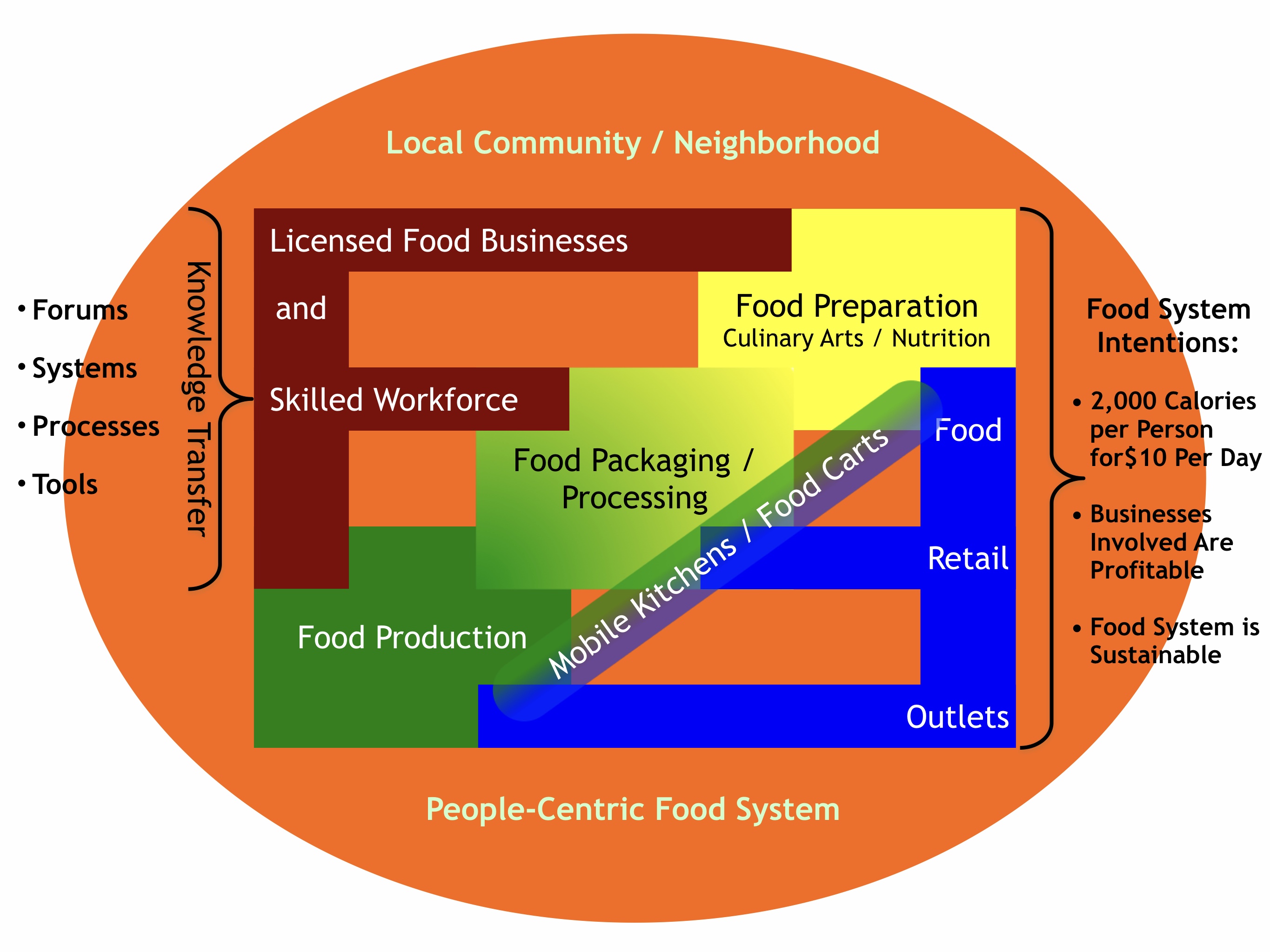
The graphic below begins to answer the question.
First, the clear intentions of the people-centric food system are as follows:
No more than $10 is spent by each person in the system for 2,000 calories per day
The businesses involved are profitable
The system is sustainable.
That intent drives the design of the system.
Second, community members transfer the knowledge they need to be successful through multiple forums, systems, processes, and tools made available by the community / neighborhood. They use this know-how to set the rules for local food security and safety, license food businesses, and build the community’s skill base in food system operations, In other words, they establish a strong foundation of competency upon which to take ownership of their food supply and focus on attaining self-sufficiency.
Third, the entry point is delivery of affordable calories where people live their lives. Mobile kitchens and food carts strategically distributed throughout communities and neighborhoods is the most effective way to accomplish this. The startup investment and operating expenses are low, the market penetration is high and offers a wide range of excellent meals from which to gain the needed calories, and the opportunity to catalyze significant interdependence among all manner of businesses throughout the local food system is substantial.
Today, less than 5% of the food (and calories) consumed in the U.S. is locally sourced. The answer to the question posed in the title is decidedly obvious–the global food system is the major source of calories. But the point of the question is to prompt thoughtful consideration as to the consequences, understand that there is a way out of the predicament, step up, step out, and make a difference in your community / neighborhood by participating in its local food system.
Future postings on this blog will go into more detail about how to implement a people-centric food system. Meanwhile, you are welcome to ask questions.
Everyone needs food. The average calorie intake level for adults is 2000 / day. But that may vary given one’s unique health profile. The How Many Calories Should I Eat blog lists several tools one can use to target a specific number of calories that address particular health conditions and personal circumstances. In addition, the Department of Health and Human Services’s Healthy People 2010 Final Review, the National Institutes of Health’s National Heart, Lung, and Blood Institute, and the U.S. Department of Agriculture’s Center for Nutrition Policy and Promotion offer in-depth information about the impact of diet and nutrition on health and wellness. Please check them out.
Food needs to be affordable. The USDA’s Center for Nutrition Policy and Promotion Cost of Food at Home report for June 2010 and a University of Washington study estimate the average American spends $7 / day on food. Depending on one’s economic circumstances, that average may drop as low as $5 / day. All too often the nutritional value of the 2,000 calories drops along with the cost as stated in this March 1, 2010 Institute for Agriculture & Trade Policy article, “Cheap food policy contribution to childhood obesity.” Unfortunately, cheaper calories contribute to greater instances of obesity and related health issues.
An informal comparison between a 2,000 calorie typically “Western” menu and its healthier “Mediterranean” counterpart conducted by U.S. News & World Report writer, Katherine Hobson, pegs the average cost at $10 / day for the Western fare. Ms. Hobson alleges it could be done for less with more judicious planning and shopping.
To that point, the My Money Blog author does an interesting riff on the prices of several food items each in 200 calorie increments. He concludes we could eat reasonably well on substantially less than $10 / day.
Lastly, the USDA reimburses schools $2.72 / lunch (2010-11 school year) for those students who meet the National School Lunch Program guidelines. Each fully prepared lunch provides at least one-third of the Recommended Dietary Allowance (RDA) for calories and essential nutrients. That suggests that $10 / day for 2,000 calories delivered in three meals plus a snack is a reasonable estimate.
Given the above argument, 2,000 calories for $10 / day is the upper limit of affordability for the average person. However, at this level these same 2,000 calories must be accessible, available, nutritious, tasty, familiar, quick, convenient, and safe. If otherwise, the risk is run that the consumer will default to a less healthy option that is easier to come by, less expensive, and tastes better.
Can local food systems routinely deliver 2,000 accessible, available, nutritious, tasty, familiar, quick, convenient, and safe calories for $10 / day to each person within them? A topic for a later posting!
A local economy delivers needs such as food, water, energy, housing, etc., to those who reside within a specific neighborhood, community, or rural area. Like any social system, its function is predicated on what or who is in the center.
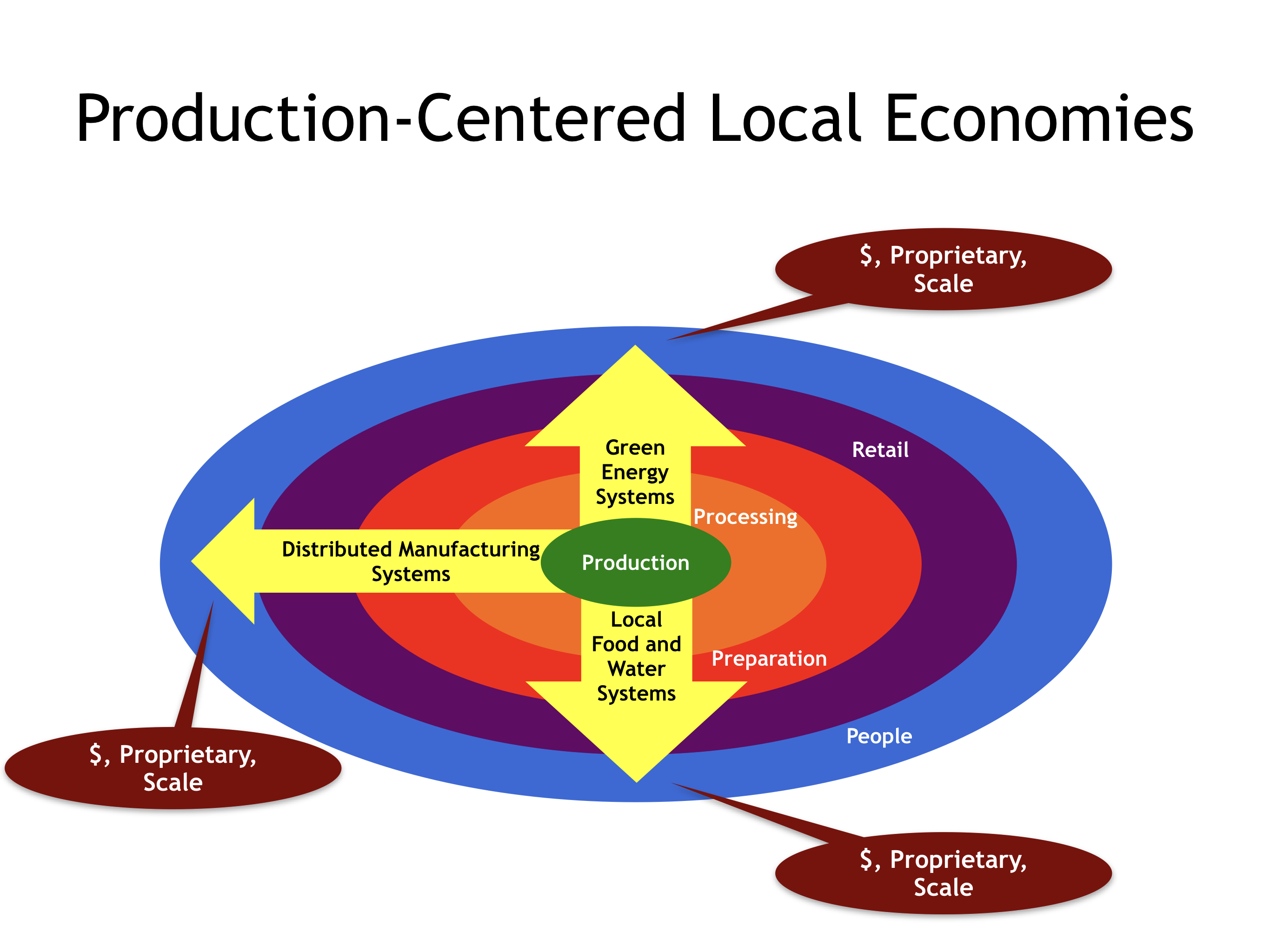
In the diagram below, those who produce goods and services are in the center. From there, the system distributes output across stages of processing, preparation, and retail into a market where people choose to purchase what is delivered from multiple competitive options. Such a design opens up the possibility to purchase needs delivered by providers in the global economy and far removed from the transactional boundaries of the local economy. With such choices comes a reduction in local business revenue, outsourcing of paid work, and leakage of expenditures to provisioners outside the area. Basically, this is the way the current global economy works. It is the antithesis to the intent of a sustainable local economy.
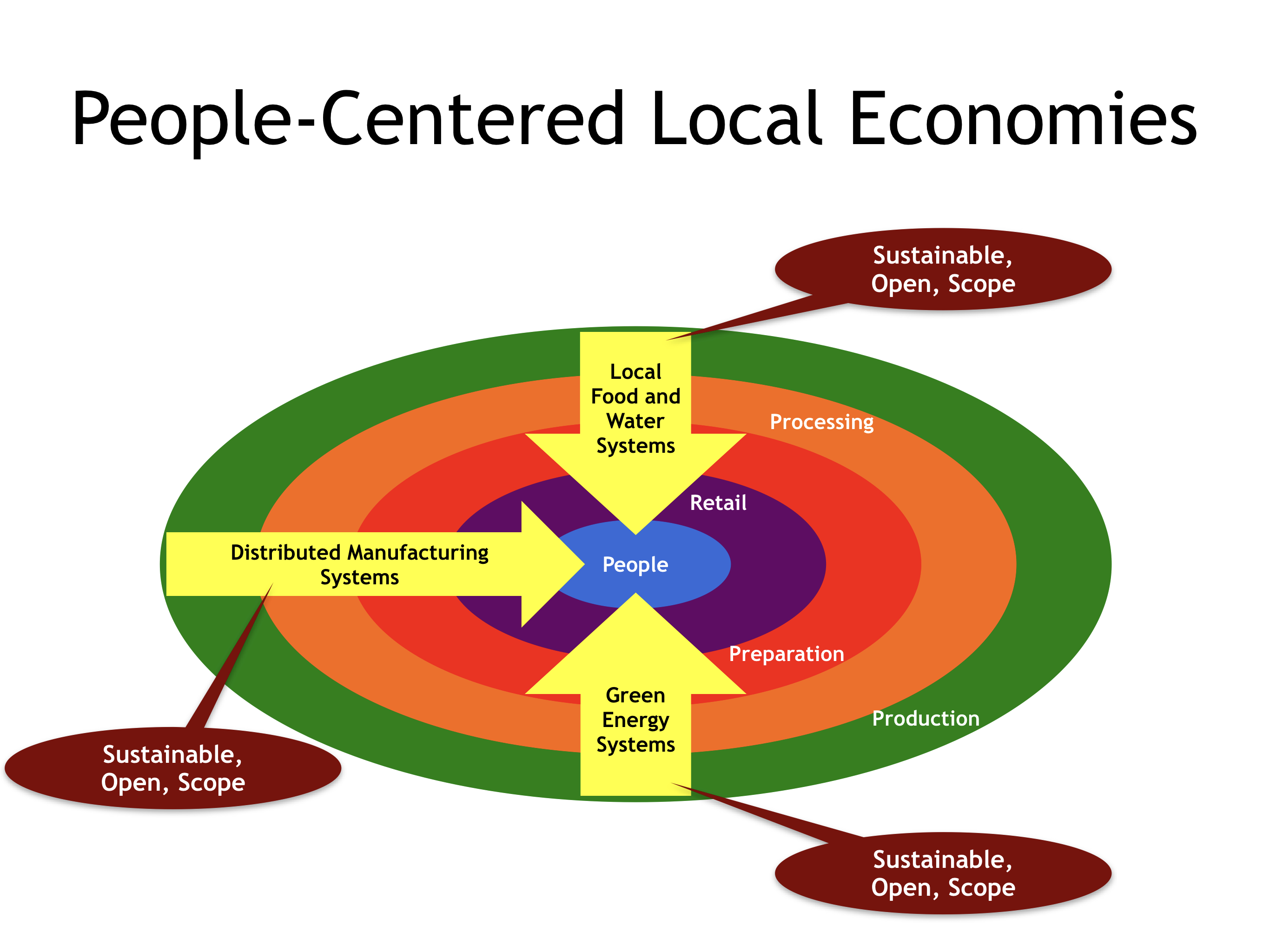
In contrast, people placed in the center of a local economy invite a very different dynamic as suggested in the graphic below. Members of the social system meet their needs as close to the point of consumption as possible. The retail “ring” represents the transactional space wherein people take delivery of a needed product or service after completing its value-added cycle.
Since people within a given locality share the same basic needs, they, collectively, define a steady market. This stabile and consistent demand invites an interdependence among businesses in the locally-oriented preparation, processing, and production “rings”.
A local economy is, by definition, a needs economy (see At the Bottom of the Pyramid, It’s Looking Up!). The survival and sustainability of people as a social unit depend on whether they can meet their basic needs without interruption. This imperative places people at the center of their local economy. This gives them access to the assets and resources within their purview and grants them license to deploy those means in ways that assure their continuity and reasonable quality of life.
To have production in the center invites those who are not invested in the sustainability of the local system to have control over its destiny. That is not an enviable situation in which to be. What’s in the center of your local economy?
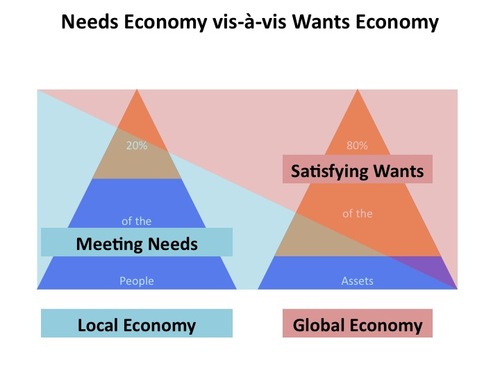
The 80% that have access to only 20% of the resources make choices about their survival and sustainability within a different economic system than those in the top 20% of the socio-economic pyramid. The diagram below offers further definition of these two economic systems. The 80% participate in a “needs economy” that focuses on delivering the essentials of a life: food, water, air, energy, fuel, housing, clothing, safety, security, health, and education.
Because a needs economy strives to meet the basic requirements for quality of life among people in a given area, it is deemed a local economy in that the participants have extensive social relationships among family, friends, and community members. It is the strength and scope of this social fabric that provides the platform for self-sufficiency and sustainability of the body politic and keeps the door open for a wide range of choices.
In contrast, 80% of the world’s assets are marshaled into the design, production, and delivery of products and services that attempt to satisfy an insatiable demand for everything and anything. A “wants economy” is a most apropos label. And because no place on earth is exempt from the compelling effects of its all-consuming nature, it is truly a global economy.
Choices in a wants economy are limited by the means available to act on those alternatives. The lack of self-sufficiency and sustainability garnered from a global or wants economy requires a heavy political investment—a constant feeding of the bureaucracy—to exercise a level of diplomacy sufficient to assure an uninterrupted supply of essentials. At times, the burden imposed upon society to maintain such a complex and bloated political system becomes too much and a sorely-needed adjustment ensues. But such decline and renewal is inevitable in the cycle of life.
Despite these changes, the basic social units that give our humanity expression—family, friends, and community members—persist. They are the foundation upon which civilization is rebuilt and rejuvenated. In effect, these relationships constitute a vibrant local economy, which becomes the bedrock of survival, sustainability, and quality of life. So at the bottom of the pyramid, it’s looking up!
On a recent trip to New England, I had the opportunity to make my first visit to Concord, Massachusetts and Walden Pond where Henry David Thoreau got the inspiration and first hand experience to write his book, Walden. In his introduction to the 1992 edition of The Annotated Walden, Philip Van Doren Stern writes:
Thoreau understood clearly the essential nature of work. Observing, thinking and writing were what he wanted most to do. Hoeing his bean-field, carpentry, and surveying gave him enough money for his needs. To simplify things, he reduced his wants to the fewest possible. “I learned … that it would cost incredibly little to obtain one’s food,” he says in Walden.
As Stern’s analysis suggests, Thoreau invites the reader to learn a fundamental economics lesson in choice making: do what one needs to do efficiently to conserve as many resources as possible to do what one wants to do.
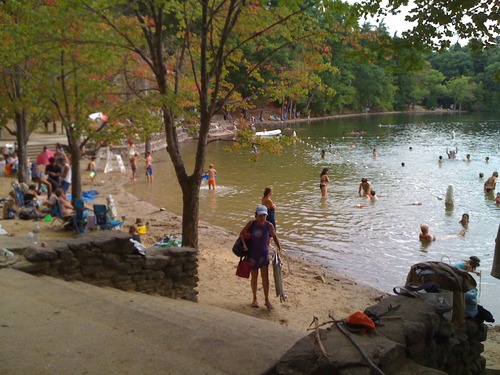
This lesson is borne out on an almost daily basis at the Walden Pond State Reservation. In Thoreau’s day, visitors frequented Walden Pond as a matter of personal choice and little cost other than the time and energy spent to walk there. Today, the number of visitors is limited by the number of spaces in the only parking area across the street. Once full, no more cars are allowed to enter.
Of course, the assumption is that visitors who want to go to Walden Pond need to take a car to get there. Through a twist of logic, the decision to visit Walden Pond is controlled by the availability of a parking place. This despite the fact that choosing to walk, instead, affords a more efficient means to get there and assures entrance upon arrival.
Thoreau knew all too well that people in his time and much later would struggle with these lessons in economic trade-offs. Do I walk and have more opportunities? Or, do I ride a horse; take a carriage; drive a car and compromise my range of choices as a consequence? Thoreau captures this dilemma quite eloquently in the opening commentary of his lecture, Walking, delivered in 1861 and posthumously published as an essay in 1862:
We have felt that we almost alone hereabouts practised this noble art; though, to tell the truth, at least, if their own assertions are to be received, most of my townsmen would fain walk sometimes, as I do, but they cannot. No wealth can buy the requisite leisure, freedom, and independence, which are the capital in this profession. It comes only by the grace of God. It requires a direct dispensation from heaven to become a walker. You must be born into the family of the Walkers. Ambulator nascitur, non fit. Some of my townsmen, it is true, can remember, and have described to me some walks which they took ten years ago, in which they were so blessed as to lose themselves for half an hour in the woods, but I know very well that they have confined themselves to the highway ever since, whatever pretensions they may make to belong to this select class. No doubt, they were elevated for a moment as by the reminiscence of a previous state of existence, when even they were foresters and outlaws.
Do I take to the path or stay on the highway? A good question to ask every day!




 Frameworks for Understanding the World