239 Days in America, Day 26: May 06, 1912 | Cleveland

The Ultimate Taboo 1

‘Abdu’l-Bahá arrived at Cleveland’s Union Station on the New York Central train from Chicago at 4:20 p.m. on May 7 [May 6 – ed.], 1912. During the past two weeks, Americans had learned of his battle against the ideologies of racial prejudice from major Washington newspapers and the Chicago Defender. But hardly anyone, whether black or white, had any inkling of just how far ‘Abdu’l-Bahá was willing to go.

Reporters and visitors followed him up to his rooms after his evening talk to 200 people at the Hotel Euclid. To an African-American clergyman and a group of about twenty white women sitting in a circle, he broached the most dangerous of all subjects. The Cleveland Plain Dealer, one of Ohio’s biggest newspapers, reported it unvarnished the next morning [May 7]:

“Abdul Baha . . . declared last night for an amalgamation of the white and negro races by intermarriage.” What ‘Abdu’l-Bahá advocated was illegal in twenty-nine of the forty-eight states — but not in Ohio.

Cleveland, Pittsburgh, Washington, D.C.

The friends and reporters met ‘Abdu’l-Bahá at the train station when He arrived at 4:00 P.M. on May 6. He checked into rooms at the Hotel Euclid and talked to the reporters, and an hour later went to Dr. C. M. Swingle’s home to talk to the Bahá’ís.

He returned to the Hotel for a public meeting attended by some five hundred people, many of whom had to stand. Afterward, a number of them, including reporters, followed Him to His rooms and asked Him questions on various subjects, including intermarriage. This latter discussion caused front-page headlines the next day.

The Cleveland News article stated:

WED RACES? SURE …

“Perfect results follow the marriage of black and white races. All men are the progeny of one… They are of different colors, but the follow is nothing.” — Abdu’l-Bahá

“I believe Abdul Baha is absolutely right. It is inevitable that all races will unite. Black and white and yellow will intermarry and make one perfect race. It is the only logical conclusion.” — Mrs. C. M. Swingle. 2

Talk at Euclid Hall, Cleveland, Ohio

This revered American nation presents evidences of greatness and worth. It is my hope that this just government will stand for peace so that warfare may be abolished throughout the world and the standards of national unity and reconciliation be upraised. This is the greatest attainment of the world of humanity. This American nation is equipped and empowered to accomplish that which will adorn the pages of history, to become the envy of the world and be blest in the East and the West for the triumph of its democracy. I pray that this may come to pass, and I ask the blessing of God in behalf of you all. 3

Monday, May 6, 1912 4

‘Abdu’l-Bahá left Chicago for Cleveland in the morning. As He was leaving, Bahá’ís and non-Bahá’ís surrounded Him like moths around a light, their hearts burning with thoughts of separation and tears flowing from their eyes.

The train reached Cleveland in the afternoon. Many friends and newspaper reporters were at the station to welcome Him. The reporters photographed Him with His companions and asked for an interview.

After making arrangements at the Euclid Hotel for His stay, ‘Abdu’l-Bahá gave the reporters permission to visit. He gave them an account of the history and teachings of the Cause. One of them questioned Him about His mission. He replied:

My message is the oneness of humanity and universal peace; the harmony of true science and religion; the equality of rights; the elimination of religious, racial and political prejudices; the truth of all the divine religions; the removal of religious imitations and superstitions; the education of women to such a degree that they may have equal rights with men; the adjustment of the economic condition of all people so that if a rich man enjoys honor and affluence, the poor man may also have a mat to lie on and a house to dwell in; the establishment of spiritual civilization; the reformation of human morals; the unity of all religions, so that when the people of the world recognize the truth of all religions, they may become united since truth is one — if they follow imitation, war and dissension shall remain, because imitations are the cause of differences.

After an hour, He left the hotel for Dr Swingle’s home for a meeting with the Bahá’ís. After He had some tea, He entered a room that was filled to capacity. He spoke to the friends about the prosperity of America and the perfecting of material civilization with spiritual refinement, the rising of the Sun of Truth, the raising of the divine call and spreading the teachings of God. The friends were deeply moved and full of admiration. Through their meeting with Him, they had found new life. At the beginning of the meeting, a photograph was taken of Him with His companions and some of the friends.

In the evening, the auditorium of the Euclid Hotel was full and there was standing room only. About five hundred Bahá’ís and non-Bahá’ís were enchanted by His charm and speech. The meeting began and ended with music. The audience was most appreciative of ‘Abdu’l-Bahá’s talk on the necessity of religion, the dangers of war and the benefits of love, unity and harmony.

  1. Menon, Jonathan. “The Ultimate Taboo.” 239 Days in America, May 6, 2012. https://239days.com/2012/05/06/the-ultimate-taboo/.
  2. Ward, Allan L. 239 Days: ʻAbdu’l-Bahá’s Journey in America. Wilmette, Ill: Bahá’í Publishing Trust, 1979, 60.
  3. ʻAbduʼl-Bahá. The Promulgation of Universal Peace: Talks Delivered by ʻAbduʼl-Bahá during His Visit to the United States and Canada in 1912. Edited by Howard MacNutt. 2nd ed. Wilmette, Ill: Baháʼí Publishing Trust, 1982, 103. https://www.bahai.org/library/authoritative-texts/abdul-baha/promulgation-universal-peace/6#532038348
  4. ’Abdu’l-Bahá, and Mirza Mahmud-i-Zarqani. Mahmúd’s Diary: The Diary of Mírzá Mahmúd-i-Zarqání Chronicling ’Abdu’l-Bahá’s Journey to America. Edited by Shirley Macias. Translated by Mohi Sobhani. Oxford: George Ronald, 1998. https://bahai-library.com/zarqani_mahmuds_diary&chapter=3#section43.

239 Days in America, Day 25: May 05, 1912 | Chicago

The Master and the President 1

On ‘Abdu’l-Bahá’s last day in Chicago — May 5, 1912 — he spent some time in the morning with children who had gathered at the Plaza Hotel, and walked with them into the park to be photographed. Then he said that he wanted to be alone. ‘Abdu’l-Bahá left the group and paced down toward the entrance of Lincoln Park. There he stood gazing up at the sixteenth President cast in bronze…

Today, a few hours after his quiet moment alone with the President, ‘Abdu’l-Bahá spoke to the congregation of All Souls Church. In 1905, the church, which didn’t have a building of its own, constructed the Abraham Lincoln Center, a settlement house serving “the advancement of the physical, intellectual, social, civic, moral and religious interests of humanity, irrespective of age, sex, creed, race, [or] condition of political opinion.”

‘Abdu’l-Bahá concluded his speech at All Souls with a prayer. It was about unity:

“O Thou kind Lord! Thou hast created all humanity from the same stock. Thou hast decreed that all shall belong to the same household . . . . O Thou kind Lord! Unite all. Let the religions agree and make the nations one, so that they may see each other as one family and the whole earth as one home.”

Chicago

At 11:00 A.M. [Sunday, May 5] He spoke at the Plymouth Congregational church on East 50th Street. The Reverend Joseph A. Milburn introduced Him: “‘Having heard of the teachings of this peerless qualities of ‘Abdu’l-Bahá, I had made arrangements to leave for ‘Akká. Then I was informed that ‘Abdu’l-Bahá, Himself, was coming to America. God has today endowed us with His presence here.’” As ‘Abdu’l-Bahá came forward, the audience stood, and, even though in a church sanctuary, they burst into prolonged cheers that stopped only when He motioned them to silence. Some of the audience at this and other meetings became so attracted to Him, even though they had just met Him, that they followed Him from meeting to meeting. 2

Talk at Plymouth Congregational Church, 935 East Fiftieth Street, Chicago, Illinois

O God! O Thou Who givest! This congregation is turning to Thee, casting their glances toward Thy Kingdom and favor, longing to behold the lights of Thy face. O God! Bless this nation. Confirm this government. Reveal Thy glory unto this people and confer upon them life eternal. O God! Illumine the faces, render the hearts radiant, exhilarate the breasts, crown the heads with the diadem of Thy providence, cause them to soar in Thy pure atmosphere so they may reach the highest pinnacles of Thy splendor. Assist them in order that this world may ever find the light and effulgence of Thy presence. O God! Shelter this congregation and admonish this nation. Render them progressive in all degrees. May they become leaders in the world of humanity. May they be Thine examples among humankind. May they be manifestations of Thy grace. May they be filled with the inspiration of Thy Word. Thou art the Powerful. Thou art the Mighty. Thou art the Giver, and Thou art the Omniscient. 3

Sunday, May 5, 1912 4

As it was the last day of the Master’s stay, there was much commotion among the friends visiting the Master’s apartment. A large number of Bahá’ís and their children had gathered in the [Plaza] hotel’s salon. ‘Abdu’l-Bahá embraced and kissed each child with love and kindness. Giving them flowers and sweets, He said to them:

According to Christ you are the children of the Kingdom and according to Bahá’u’lláh, the candles of the world of man, for your hearts are in the utmost purity and your spirits are sanctified. You are not soiled with the things of this world. Your hearts are pure and clean like the mirror. Your parents must bring you up with great kindness and must educate you in morals and praiseworthy attributes so that the virtues of the world of man may be exemplified perfectly in your characters and conduct, that you may progress in all fields of endeavor, may acquire knowledge of the arts and sciences, and may become the cause of the manifestation of eternal bounties and universal advancement.

Then addressing the entire assembly, He said:

“I am going, but you must rise up to serve the Cause of God. Endeavor to keep your hearts sanctified and your intentions pure so that you may attract divine bounties. Remember, although the sun shines equally on all things, yet in the mirror its effulgence is intense, and not in the dark stone. The cause of this intensity and heat in the glass is its purity; without purity and cleanliness, these effects would never appear in it. Similarly, if rain fall on barren land, it produces nothing, but if it fall on pure fertile land, it makes it verdant and causes it to yield a harvest. This is the day in which only pure and chaste hearts can derive benefit from the eternal bounties and only pious souls can receive light from the ever-existent splendors. Praise be to God that ye believe in God, have faith in His words and are turned to His Kingdom. You have heard the voice of God and your hearts are delighted with the breezes of the Abhá paradise. Your intentions are good; your object is the will of God; and your desire is to render service to the Kingdom of God.

Therefore, you must gird up your loins with unswerving determination, you must be united among yourselves and you must not be irritated by one another. Your eyes must be turned always to the kingdom of God and not to the world of man. You must love His creation for His sake and not for your own. When you love one another for the sake of God you shall never be perturbed. No human being is perfect, every person has some flaw. If you look to your fellowman you will always be upset; but if you look to God it shall not be so, because the world of God is a world of perfection and endless mercy; therefore, you will love and show kindness to all for His sake. You must not look to the faults of others; you must look with the eye of forgiveness and pardon. The eye that regards faults sees nothing but faults and the eye that overlooks faults is fixed on the Creator of the souls. It is He Who has created all, has nurtured all, has endowed all with life and spirit and has given to all eyes and ears. Thus all are the signs of His power and for His sake we must love all, and show kindness to all, assist the poor, render help to the weak, heal the sick and educate the ignorant.

It is my desire that the union and harmony of the friends of Chicago may be an example for all the friends in America and that all creation may derive benefit from their behavior; that they may lead all. Then and only then shall the confirmations of the Abhá Kingdom and the bounties of the Sun of Reality encircle you.”

  1. Sockett, Robert. “The Master and the President.” 239 Days in America, May 5, 2012. https://239days.com/2012/05/05/the-master-and-the-president/.
  2. Ward, Allan L. 239 Days: ʻAbdu’l-Bahá’s Journey in America. Wilmette, Ill: Bahá’í Publishing Trust, 1979, 56.
  3. ʻAbduʼl-Bahá. The Promulgation of Universal Peace: Talks Delivered by ʻAbduʼl-Bahá during His Visit to the United States and Canada in 1912. Edited by Howard MacNutt. 2nd ed. Wilmette, Ill: Baháʼí Publishing Trust, 1982, 96. https://www.bahai.org/library/authoritative-texts/abdul-baha/promulgation-universal-peace/5#374930584
  4. ’Abdu’l-Bahá, and Mirza Mahmud-i-Zarqani. Mahmúd’s Diary: The Diary of Mírzá Mahmúd-i-Zarqání Chronicling ’Abdu’l-Bahá’s Journey to America. Edited by Shirley Macias. Translated by Mohi Sobhani. Oxford: George Ronald, 1998. https://bahai-library.com/zarqani_mahmuds_diary&chapter=3#section42.

239 Days in America, Day 24: May 04, 1912 | Chicago

Blame It On Religion 1

IT’S NOT BEEN A month since ‘Abdu’l-Bahá arrived in America, yet he has succeeded in placing himself at the center of virtually all of the nation’s raging debates. He has championed women’s rights. He has challenged whites and blacks to work together. He has argued that, of all nations, America is uniquely capable of leading the world to peace.

He is the unlikeliest of spokesmen: a sixty-eight-year-old Middle-Easterner, recently released from forty years captivity at the hands of the Ottoman Empire, accompanied by an entourage of men wearing fezzes.

But ‘Abdu’l-Bahá has shown that he is entirely at home in America. He converses with ease in the company of scientists, philosophers, businessmen, politicians, and men of religion, whether Christian or Jew.

Racial equality. Social progress. International peace. For ‘Abdu’l-Bahá these matters are fundamentally spiritual in nature. Yet the faith he offers isn’t one of mystical contemplation, though there seems time for that too. As he noted at the temple’s cornerstone ceremony three days ago: spiritual devotion must be manifested in material action.

Chicago

On Saturday, May 4, ‘Abdu’l-Bahá spoke to the Theosophists at Northwestern University in Evanston… 2

Talk to Theosophical Society, Northwestern University Hall, Evanston, Illinois

The spiritual blessings of God are greatest. When we were in the mineral kingdom, although we were endowed with certain gifts and powers, they were not to be compared with the blessings of the human kingdom. In the matrix of the mother we were the recipients of endowments and blessings of God, yet these were as nothing compared to the powers and graces bestowed upon us after birth into this human world. Likewise, if we are born from the matrix of this physical and phenomenal environment into the freedom and loftiness of the spiritual life and vision, we shall consider this mortal existence and its blessings as worthless by comparison.

In the spiritual world the divine bestowals are infinite, for in that realm there is neither separation nor disintegration, which characterize the world of material existence. Spiritual existence is absolute immortality, completeness and unchangeable being. Therefore, we must thank God that He has created for us both material blessings and spiritual bestowals. He has given us material gifts and spiritual graces, outer sight to view the lights of the sun and inner vision by which we may perceive the glory of God. 3

Saturday, May 4, 1912 4

As ‘Abdu’l-Bahá’s stay in Chicago was drawing to a close, there were numerous meetings and receptions. In the morning some clergymen visited Him in His hotel room. At the usual daily reception, He spoke about the three kingdoms of nature and the need for comprehensive education. He then went to the Plymouth Congregational Church, which was magnificent and most beautifully decorated. Its rector, Dr [Joseph A.] Milburn, had seen the Master several times and was greatly attracted to Him. After the customary service, the rector introduced ‘Abdu’l-Bahá:

“Having heard of the teachings and the peerless qualities of ‘Abdu’l-Bahá, I arranged to leave for ‘Akká. Then I was informed that ‘Abdu’l-Bahá, Himself, was coming to America. Now God has endowed us with a great blessing that ‘Abdu’l-Bahá has graced us with His presence here.

He then went on to give a detailed history and teachings of the Cause and introduced the Master as the Herald of Peace and the Son of God, ‘Abbás Effendi.

As the Master approached the pulpit, the congregation rose to their feet, and although they were in church, they greeted Him with prolonged applause and cheers of joy. ‘Abdu’l-Bahá called them to order then spoke about the manifestation of the center of illumination and the Sun of Truth which appears at different times at different points of the zodiac, thus illustrating the renewal of religions and the unity of the Messengers and the Holy Books. At the end of His talk He chanted a prayer in Persian in a melodious voice.

The hearts of the listeners were so attracted that the church seemed to be filled with the Holy Spirit. The people crowded around ‘Abdu’l-Bahá to the extent such that it became difficult for the Master and His companions to leave. Groups of people surrounded Him to shake His hand and to ask for His blessing. The most surprising thing about these meetings was that although most of the people had never before heard of the Bahá’í teachings, they were so attracted and fascinated that they would follow the Master in their cars from one meeting to another.

’ Abdu’l-Bahá had lunch at the home of Dr Forde and after meeting with a few people, He left for the hotel, saying, ‘Let us walk for a while, and then take the tram.’ Our host and some of us suggested that the distance was great and pointed out that Mr Forde’s car was available. At our insistence, ‘Abdu’l-Bahá rode in the car but as it twice punctured its tires, He took the tram.

When ‘Abdu’l-Bahá arrived at the hotel, many people were already waiting for Him. He answered their questions, for which they were filled with gratitude. One person asked him about the future affairs of Asia and the countries in the East. ‘Abdu’l-Bahá gave a detailed answer:

“No progress is possible except through the power of the Holy Spirit and the Cause of God. Each of the Manifestations of God appeared amongst a nation and in a country which outwardly had no means of salvation or progress. But no sooner had those nations come under the shelter of the Cause of God than they excelled all the civilized countries of the world. Today, whichever nation raises the standard of the oneness of humanity and comes under the shelter of this divine power will ultimately lead the whole world.

Question: ‘What is the difference between the Bahá’í religion and the other religions of the world?’

“The foundation of all the religions is one and this foundation is truth. In this respect there is no difference between either the divine religions or their Founders. The subsidiary laws that pertain to the affairs of society differ. These social laws are subject to the demands of time and place, so they are modified in each age.

Question: ‘What are evil and bad qualities?’

There is no evil in the world of existence; rather, evil is the absence of goodness just as darkness is the absence of light.

Speaking of the exigencies of the material world and its creation, ‘Abdu’l-Bahá said:

“It [the world of creation] calls for change and transformation. Without change there can be no composition or development. Change and transformation, decomposition and composition produce opposites. In the realm of reality, however, there are no opposites. Consider the world of the sun, which has neither darkness nor east and west. But owing to the exigencies of this world, there is night and day, light and darkness.

After answering these questions, ‘Abdu’l-Bahá went with Mrs [Corinne] True and other friends to a Chicago cemetery to offer prayers for the departed.

In the early evening ‘Abdu’l-Bahá went to the All-Souls Church. A great excitement was also created among the people of this church. His eloquent address, given in sweet and melodious tones, concerned the missions of the Divine Manifestations of God and the peace and unity of humanity. He concluded His talk with a detailed account of the Most Great Manifestation, Bahá’u’lláh, and the influence of His exalted Word.

After members of the audience came to Him to shake His hand and express their thanks and devotion, He went to the home of Dr Melborne [sic], the rector of the Congregational Church. There He gave a most impressive and eloquent talk on the benefits of peace and harmony and the harm caused by war and strife. He discussed the requisites for prosperity and the unity of humankind. It was the last night of His stay and the effect of His words was so deep and far-reaching that it is beyond description.

  1. Sockett, Robert. “Blame It On Religion.” 239 Days in America, May 4, 2012. https://239days.com/2012/05/04/a-man-of-both-faith-and-reason/.
  2. Ward, Allan L. 239 Days: ʻAbdu’l-Bahá’s Journey in America. Wilmette, Ill: Bahá’í Publishing Trust, 1979, 55.
  3. ʻAbduʼl-Bahá. The Promulgation of Universal Peace: Talks Delivered by ʻAbduʼl-Bahá during His Visit to the United States and Canada in 1912. Edited by Howard MacNutt. 2nd ed. Wilmette, Ill: Baháʼí Publishing Trust, 1982, 90. https://www.bahai.org/library/authoritative-texts/abdul-baha/promulgation-universal-peace/4#018271400
  4. ’Abdu’l-Bahá, and Mirza Mahmud-i-Zarqani. Mahmúd’s Diary: The Diary of Mírzá Mahmúd-i-Zarqání Chronicling ’Abdu’l-Bahá’s Journey to America. Edited by Shirley Macias. Translated by Mohi Sobhani. Oxford: George Ronald, 1998. https://bahai-library.com/zarqani_mahmuds_diary&chapter=3#section41.

239 Days in America, Day 23: May 03, 1912 | Chicago

America Will Lead the World to Peace 1

On May 3, 1912, ‘Abdul-Bahá met with visitors in the hotel’s ballroom throughout the day. If he was impressed, he failed to comment. There were more urgent things at hand.

‘Abdul-Bahá turned his attention once again to the war taking place in Libya. He painted an apocalyptic scene: “Observe what is taking place in Tripoli: men cutting each other into pieces, bombardment from the sea, attacks from the land and the hail of dynamite from the very heaven itself.”

The subject of war and peace has occupied much of ‘Abdu’l-Bahá’s time. He has become a well-known voice in the international peace movement. In fact one of the reasons for his trip to America is to speak at the Lake Mohonk Conference on International Arbitration on May 14.

‘Abdu’l-Bahá believes that the American nation is singly positioned to lead the world to peace:

Because I find the American nation so capable of achievement, and the American government the fairest of Western governments, its systems superior to others, my wish and hope is that the banner of peace may be raised first on this continent, that the standard of the Most Great Peace may here be unfurled. 2

Chicago

‘Abdu’l-Bahá often walked in the morning and evening through Lincoln Park and through the zoo, taking the friends with Him and talking on the way, sometimes calling the friends to take photographs of Him. At times He picked up a stick as He walked, using it like a cane. The friends recalled how, as He stood seemingly absorbed in watching the polar bear, they tiptoed back out of camera rage as the photographer positioned himself for a profile view, without asking ‘Abdu’l-Bahá. But just as he was about to click the shutter, ‘Abdu’l-Bahá laughed and playfully hit him across the back of the neck with a light touch of the cane.

From the zoo He led the friends toward the lake, sat on a bench, motioned to the friends to do likewise, and discussed unity with them. He said,

Some of you may have observed that I have not called attention to any of your individual shortcomings, I would suggest to you , that if you shall be similarly considerate in your treatment of each other, it will be greatly conducive to the harmony of your association with each other… 3 4

Talk at Plaza Hotel, Chicago, Illinois

The Prophets of God are the first Educators. They bestow universal education upon man and cause him to rise from the lowest levels of savagery to the highest pinnacles of spiritual development. The philosophers, too, are educators along lines of intellectual training. At most, they have only been able to educate themselves and a limited number about them, to improve their own morals and, so to speak, civilize themselves; but they have been incapable of universal education. They have failed to cause an advancement for any given nation from savagery to civilization. 5

Friday, May 3, 1912

From early morning friends and inquirers visited ‘Abdu’l-Bahá in twos and threes, all profusely offering their thanks and praise for the favors they had received from Him.

Today the members of an association of Indians residing in Chicago, who had previously attended ‘Abdu’l-Bahá’s receptions, arrived as one body and after obtaining His permission, read Him an address of welcome:

“From the Society of Indians Residing in Chicago to His Holiness ‘Abdu’l-Bahá ‘Abbás. In the Name of God!

We, the members of the Society of Indians Residing in Chicago welcome you to this country. The Cause that has brought your Excellency to this country is most surely a source of honor and grace to us. Asia has always been the dawning-place of religions: Muhammad, Christ, Buddha and Confucius were born in that enlightened continent; and we confidently believe that at this time, too, Asia will again usher in the universal principles of accord. The Bahá’í Cause, like the Cause of the Buddha, will be a source of uniting nations and will be a fulfillment of the teachings of our forefathers. Although Asia presently is in a state of backwardness, we console ourselves with the thought that although we are lacking in material progress, yet, concerning spirituality, we are the pride of the world.

We feel happy when we realize that through your Excellency, the means for the acquisition of Western arts and sciences will become available for those in the East and that the youth of Persia will come to these parts to acquire material knowledge and broaden their thinking and will return to their homes to benefit their brothers and sisters in the East on the road to progress.

Further, we believe that our country, India, will greatly benefit from a visit from your Excellency. The lack of unity between the Hindus and Muslims has kept them in the utmost contention and strife. As your Excellency’s teachings are very much like the teachings of our religious leaders, they will undoubtedly unite them and make these contending nations one. We are certain that you will receive the same warmth and honor in India as here in America.

We pray to God to give your Excellency long life so that you may be enabled to convey your message to all mankind.

We are, most beloved Master, your sincere friends, the members of the Society of Indians Residing in Chicago.”

More people gathered, forming a large group. The Master gave a public talk at the hotel on the gradual weakening of man’s physical and material powers and the effect on man of divine civilization and spiritual education. All were struck with the charm of ‘Abdu’l-Bahá’s expression and the power of His argument. They openly expressed their conviction that the true salvation of the world of humanity lay in following the teachings of Bahá’u’lláh. The address by the Society of Indians and the testimony of others are examples for the fair-minded of the degree of attachment and attraction of the people, just as ‘a drop expresses oceans’.

In the evening the Bahá’ís consulted. ‘Abdu’l-Bahá sent us there and later joined us. He spoke briefly to the meeting but on the subject of the Mashriqu’l-Adhkár, the Master said, ‘I will not discuss this matter. It is the business of the consultative assembly.’ Later He added: ‘If I were to speak about the Mashriqu’l-Adhkár, it would have to be built at once.’

In the early evening ‘Abdu’l-Bahá gave a very eloquent and impressive address for the Theosophical Society, which fascinated the audience, especially the members of the society.

Some of the friends had asked whether they could take photographs of ‘Abdu’l-Bahá. Several photographs were therefore taken in the park across from the hotel by Mr and Mrs Killius, two of the devoted believers. In one of the photographs ‘Abdu’l-Bahá is standing with a flower in His hand. In another He is with His entourage and in the third He is standing among the believers. Although photographs of the Master had been taken in other cities, these are better and more lifelike. 6

  1. Sockett, Robert. “America Will Lead the World to Peace.” 239 Days in America, May 3, 2012. https://239days.com/2012/05/03/will-america-lead-world-to-peace/.
  2. ʻAbduʼl-Bahá. The Promulgation of Universal Peace: Talks Delivered by ʻAbduʼl-Bahá during His Visit to the United States and Canada in 1912. Edited by Howard MacNutt. 2nd ed. Wilmette, Ill: Baháʼí Publishing Trust, 1982, 83. https://www.bahai.org/library/authoritative-texts/abdul-baha/promulgation-universal-peace/4#683021952.
  3. Jaxon, Honore J. “A Stroll with Abdul-Baha.” Star of the West, May 17, 1912, 29.
  4. Ward, Allan L. 239 Days: ʻAbdu’l-Bahá’s Journey in America. Wilmette, Ill: Bahá’í Publishing Trust, 1979, 54-55.
  5. ʻAbduʼl-Bahá. The Promulgation of Universal Peace: Talks Delivered by ʻAbduʼl-Bahá during His Visit to the United States and Canada in 1912. Edited by Howard MacNutt. 2nd ed. Wilmette, Ill: Baháʼí Publishing Trust, 1982, 84-85. https://www.bahai.org/library/authoritative-texts/abdul-baha/promulgation-universal-peace/4#219087740
  6. ’Abdu’l-Bahá, and Mirza Mahmud-i-Zarqani. Mahmúd’s Diary: The Diary of Mírzá Mahmúd-i-Zarqání Chronicling ’Abdu’l-Bahá’s Journey to America. Edited by Shirley Macias. Translated by Mohi Sobhani. Oxford: George Ronald, 1998. https://bahai-library.com/zarqani_mahmuds_diary&chapter=3#section40.

239 Days in America, Day 21: May 01, 1912 | Chicago

Breaking Ground at Grosse Point 1

Early this morning, May 1, 1912, they had begun to assemble on this piece of land in the village of Wilmette. The Master had arrived at 1 p.m. First he took a private moment to console Mrs. Corinne True, whose son, Davis, had passed away the night before. Mrs. True had invested more than five years of her life in finding a site for the temple, and in raising the funds necessary to buy the land. Today, in spite of her recent loss, she was here to see things through. Then ‘Abdu’l-Bahá walked under the large tent where three hundred people sat on chairs in concentric circles, between nine equally spaced aisles. He strode to the center and began to talk about this unique religious institution.

“Thousands,” he said, “will be built in the East and in the West.” 2 But they were more than just places to pray. They would become the central edifices in a complex of institutions devoted to social, humanitarian, educational, and scientific pursuits. Together, they would offer a new model of faith dedicated to the service of humankind. They would become “one of the most vital institutions in the world.” 3

Chicago

On Wednesday, May 1, the day ‘Abdu’l-Bahá was to lay the foundation stone for the first Bahá’í House of Worship in the Western Hemisphere, weather forecasters in the Chicago Daily News predicted unsettled conditions “and probably occasional showers to-night.” A marquee tent had been set up on the Temple site, with three hundred chairs arranged in nine sections separated by aisles leading to a central open area. A special entryway had been prepared for ‘Abdu’l-Bahá’s carriage in the middle of the eastern side of the tract. He arrived, instead, by taxi and entered on the northern side. Pacing back and forth before the filled chairs and two hundred additional person who were standing, He spoke of the importance of the Mashriqu’l-Adhkár. 4

Talk at Public Meeting Concluding Convention of Bahá’í Temple Unity, Drill Hall, Masonic Temple, Chicago, Illinois, 30 April 1912

[T]he original purpose of temples and houses of worship is simply that of unity—places of meeting where various peoples, different races and souls of every capacity may come together in order that love and agreement should be manifest between them. That is why Bahá’u’lláh has commanded that a place of worship be built for all the religionists of the world; that all religions, races and sects may come together within its universal shelter; that the proclamation of the oneness of mankind shall go forth from its open courts of holiness—the announcement that humanity is the servant of God and that all are submerged in the ocean of His mercy. It is the Mashriqu’l-Adhkár. The world of existence may be likened to this temple and place of worship. For just as the external world is a place where the people of all races and colors, varying faiths, denominations and conditions come together—just as they are submerged in the same sea of divine favors—so, likewise, all may meet under the dome of the Mashriqu’l-Adhkár and adore the one God in the same spirit of truth; for the ages of darkness have passed away, and the century of light has come. Ignorant prejudices are being dispelled, and the light of unity is shining. The differences existing between nations and peoples will soon be annulled, and the fundamentals of the divine religions, which are no other than the oneness and solidarity of the human race, are being established. For thousands of years the human race has been at war. It is enough. Now let mankind, for a time at least, consort in amity and peace. Enmity and hatred have ruled. Let the world, for a period, exercise love. For thousands of years the nations have denied each other, considering each other as infidel and inferior. It is sufficient. We must now realize that we are the servants of one God, that we turn to one beneficent Father, live under one divine law, seek one reality and have one desire. Thus may we live in the utmost friendship and love, and in return the favors and bounties of God shall surround us; the world of humanity will be reformed; mankind, enjoy a new life; eternal light will illumine, and heavenly moralities become manifest. 5

Talk at Dedication of the Mashriqu’l-Adhkár Grounds, Wilmette, Illinois

The power which has gathered you here today notwithstanding the cold and windy weather is, indeed, mighty and wonderful. It is the power of God, the divine favor of Bahá’u’lláh which has drawn you together. We praise God that through His constraining love human souls are assembled and associated in this way.

Thousands of Mashriqu’l-Adhkárs, dawning points of praise and mention of God for all religionists will be built in the East and in the West, but this, being the first one erected in the Occident, has great importance. In the future there will be many here and elsewhere—in Asia, Europe, even in Africa, New Zealand and Australia—but this edifice in Chicago is of especial significance. It has the same importance as the Mashriqu’l-Adhkár in ‘Ishqábád, Caucasus, Russia, the first one built there. In Persia there are many; some are houses which have been utilized for the purpose, others are homes entirely devoted to the divine Cause, and in some places temporary structures have been erected. In all the cities of Persia there are Mashriqu’l-Adhkárs, but the great dawning point was founded in ‘Ishqábád. It possesses superlative importance because it was the first Mashriqu’l-Adhkár built. All the Bahá’í friends agreed and contributed their utmost assistance and effort. The Afnán devoted his wealth, gave all he had to it. From such a mighty and combined effort a beautiful edifice arose. Notwithstanding their contributions to that building, they have assisted the fund here in Chicago as well. The Mashriqu’l-Adhkár in ‘Ishqábád is almost completed. It is centrally located, nine avenues leading into it, nine gardens, nine fountains; all the arrangement and construction is according to the principle and proportion of the number nine. It is like a beautiful bouquet. Imagine a very lofty, imposing edifice surrounded completely by gardens of variegated flowers, with nine avenues leading through them, nine fountains and pools of water. Such is its matchless, beautiful design. Now they are building a hospital, a school for orphans, a home for cripples, a hospice and a large dispensary. God willing, when it is fully completed, it will be a paradise.

I hope the Mashriqu’l-Adhkár in Chicago will be like this. Endeavor to have the grounds circular in shape. If possible, adjust and exchange the plots in order to make the dimensions and boundaries circular. The Mashriqu’l-Adhkár cannot be triangular in shape. It must be in the form of a circle. 6

Wednesday, May 1, 1912

In the morning ‘Abdu’l-Bahá looked at some buildings from His balcony and enjoyed the lovely view of the park. He spoke to us, until visitors arrived, about the early days of the Most Great Prison and the sufferings of the Blessed Beauty. He sent several telegrams today to the assemblies of the East, sharing with them the glad tidings of the assistance of Bahá’u’lláh.

He spoke with the friends for a time and bestowed upon them His love. About an hour later He went to the proposed site of the Mashriqu’l-Adhkár located outside the city, where property had been purchased for the construction of this great building. By the time He arrived the friends had already assembled and had pitched a large tent for the meeting.

’ Abdu’l-Bahá first drove around the site, inspecting its boundaries, and then entered the tent. The friends stood all about Him, their eyes intently fixed on His luminous face. It was in these circumstances that ‘Abdu’l-Bahá gave His talk on the power of the Cause of Bahá’u’lláh to unite the people of the East and the West beneath the shadow of the Word of God. He also spoke about the Mashriqu’l-Adhkárs of ‘Ishqábád and America. He then went to the spot where He was to lay the cornerstone with His own hands. Miss Holmes presented Him with a golden trowel especially prepared for the occasion. He took it in His hand and dug the earth for the foundation stone. Then the delegates from the American assemblies, followed by representatives of the Eastern friends, each took the trowel and continued digging the foundation. Among them were Mihtar Ardishír Bahrám Surúsh representing the Bahá’ís of Pársí background, Siyyid Asadu’lláh representing the Bahá’ís of Muslim origin, Zia Bagdadi representing the Arabian friends and Ghodsieh (Qudsíyyih) Khánum Ashraf representing the Bahá’í women of the East. When the digging was completed, the Master set the stone in place with His own hand.78 He then showered His love and affection on the friends and left the site. Most of the friends remained and had lunch inside the tent.

There was a reception at the Plaza Hotel later that afternoon at which the Master spoke on divine civilization and spiritual qualities.79 Both before and after the meeting friends and inquirers requested interviews and asked Him questions on several subjects. 7

  1. Sockett, Robert. “Breaking Ground at Grosse Point.” 239 Days in America, May 1, 2012. https://239days.com/2012/05/01/dont-call-it-a-church/.
  2. Effendi, Shoghi. God Passes By. 1944. Reprint, Wilmette, IL: Bahá’í Publishing Trust, 1970, 351.https://www.bahai.org/library/authoritative-texts/shoghi-effendi/god-passes-by/1#337700484.
  3. Baháʾuʾlláh. The Kitáb-i-Aqdas: The Most Holy Book. Haifa: Baháʾi World Centre, 1992, 190-191. https://www.bahai.org/library/authoritative-texts/bahaullah/kitab-i-aqdas/13#371279610.
  4. Ward, Allan L. 239 Days: ʻAbdu’l-Bahá’s Journey in America. Wilmette, Ill: Bahá’í Publishing Trust, 1979, 51.
  5. ʻAbduʼl-Bahá. The Promulgation of Universal Peace: Talks Delivered by ʻAbduʼl-Bahá during His Visit to the United States and Canada in 1912. Edited by Howard MacNutt. 2nd ed. Wilmette, Ill: Baháʼí Publishing Trust, 1982, 65-66. https://www.bahai.org/library/authoritative-texts/abdul-baha/promulgation-universal-peace/4#281413700.
  6. ʻAbduʼl-Bahá. The Promulgation of Universal Peace: Talks Delivered by ʻAbduʼl-Bahá during His Visit to the United States and Canada in 1912. Edited by Howard MacNutt. 2nd ed. Wilmette, Ill: Baháʼí Publishing Trust, 1982, 71-72. https://www.bahai.org/library/authoritative-texts/abdul-baha/promulgation-universal-peace/4#181680280.
  7. ’Abdu’l-Bahá, and Mirza Mahmud-i-Zarqani. Mahmúd’s Diary: The Diary of Mírzá Mahmúd-i-Zarqání Chronicling ’Abdu’l-Bahá’s Journey to America. Edited by Shirley Macias. Translated by Mohi Sobhani. Oxford: George Ronald, 1998. https://bahai-library.com/zarqani_mahmuds_diary&chapter=3#section38.

239 Days in America, Day 20: April 30, 1912 | Chicago

The Fallout from a City in Flames 1

Next door to Handel Hall, at the Masonic Temple on the corner of State and Randolph Streets, another convention was underway that evening. Fifty-eight delegates from forty-three cities were about to elect nine members to the governing board of the Bahá’í Temple Unity, a national body formed to coordinate the largest project ever undertaken by the Bahá’ís in North America: the construction of an enormous house of worship north of Chicago. White fluted columns with capitals wrapped in acanthus leaves surrounded the delegates in Corinthian Hall as they cast their secret ballots.

After the first round of voting there was a tie for ninth place between Frederick Nutt, a white doctor from Chicago, and Louis Gregory 2, the black lawyer from Washington, DC. In a dramatic departure from the vicious 1912 Presidential election, which raged all around them, each man resigned in favor of the other.

Then Mr. Roy Wilhelm 3, a delegate from Ithaca, NY, stood and put forward a proposal. His motion, seconded by Dr. Homer S. Harper of Minneapolis, recommended that the convention accept Dr. Nutt’s resignation.

The delegates assented unanimously.

To have elected an African American to the governing board of a national organization of largely middle- and upper-class white Americans — and to have done so at the nadir of the Jim Crow era in 1912 — was rare in the extreme. Even the NAACP had only elected one black member to its executive committee when it had been formed in 1909.

‘Abdu’l-Bahá’s assault on the color line was beginning to bear fruit.

Chicago

It was a warm, springlike day on Tuesday, April 30, when Jane Addams welcomed ‘Abdu’l-Bahá to an audience that far exceeded the auditorium’s seating capacity of 750. ‘Abdu’l-Bahá spoke on the unity of races, saying, “God is not pleased with , neither should any reasonable or intelligent man be willing to recognize inequality in the races because of this distinction [color].” 4

Talk at Hull House, Chicago, Illinois

But there is need of a superior power to overcome human prejudices, a power which nothing in the world of mankind can withstand and which will overshadow the effect of all other forces at work in human conditions. That irresistible power is the love of God. It is my hope and prayer that it may destroy the prejudice of this one point of distinction between you and unite you all permanently under its hallowed protection. Bahá’u’lláh has proclaimed the oneness of the world of humanity. He has caused various nations and divergent creeds to unite. He has declared that difference of race and color is like the variegated beauty of flowers in a garden. If you enter a garden, you will see yellow, white, blue, red flowers in profusion and beauty—each radiant within itself and although different from the others, lending its own charm to them. Racial difference in the human kingdom is similar. If all the flowers in a garden were of the same color, the effect would be monotonous and wearying to the eye.

Therefore, Bahá’u’lláh hath said that the various races of humankind lend a composite harmony and beauty of color to the whole. Let all associate, therefore, in this great human garden even as flowers grow and blend together side by side without discord or disagreement between them. 5

Tuesday, April 30, 1912

Several friends and inquirers gathered in one of the rooms of ‘Abdu’l-Bahá’s suite and went in two or three at a time to speak with Him through an interpreter. Each returned transformed, soaring high in the atmosphere of happiness and joy. A few newspaper reporters were announced and He addressed them:

“We believe Bahá’u’lláh to be the supreme educator of the humanity. When the gloom of contention was spread over the Orient; when the nations of the East were steeped in enmity and hatred; when its religious sects shunned one another, denouncing one another as impure, and the people were ever engaged in war and the shedding of blood, Bahá’u’lláh appeared as the sun from the horizon of the East and summoned all to fellowship and harmony. He devoted Himself to their education and upliftment. He guided people from all nations and religions, cemented different denominations and united diverse nationalities to such an extent that if you attend their meetings you cannot say who is a Jew, who is a Muslim, who is a Parsi or who is a Christian. The despotic king of Persia with the legions of his ‘ulamá [Muslim clergymen] arose against Him and inflicted the severest persecution upon Him. They imprisoned Bahá’u’lláh and killed His followers. The oppression intensified to such a degree that all those who dared obey Bahá’u’lláh would lose life and property. But with all this, they could not resist Him; His teachings spread more and more. Then His persecutors exiled Him to Baghdád, whence He was sent to Rumelia and finally to the penal city of ‘Akká. He passed away in that city. I myself was in the same prison until the declaration of liberty by the Committee of Union and Progress when all prisoners were set free.

As to the teachings of Bahá’u’lláh, they are, first, the investigation of truth. The fundamental principle of all the Prophets is Truth. Truth is one. Abraham was the promulgator of truth; Moses was the servant of truth; Christ laid down the cornerstone of truth; Muhammad was the propagator of truth; the Báb was the herald of truth; and Bahá’u’lláh was the light of truth. Truth is the foundation of all the divine religions and is one. In truth there is no dissension. Imitations are different and are a cause of dissension and division. If people investigate truth and set aside imitations, all the nations will unite, for there exists no difference in religious truth; the differences lie in imitations only.

The second principle of Bahá’u’lláh is the unity of mankind. Bahá’u’lláh proclaims that all are the servants of one God; He has created all and provides for and sustains all. All are immersed in the ocean of His mercy and God is kind to all. Why should we be unkind to one another? We must follow the polity of God. Can we conceive a better polity than that of God?

The third principle He gave us is the harmony of science and religion. Both science and religion are truth. If religion is against reality and truth it is mere superstition. Every religious tenet that conflicts with true knowledge and sound reasoning is not worthy of belief. Thus the dogmas and imitations that stand in the way of science and progress must be removed.

The fourth principle is that religion must be the cause of unity, it must connect hearts to one another. Christ and all the other divine messengers came to create unity and love. Therefore, if religion becomes the cause of differences, its nonexistence is preferable.

The fifth principle is that all religious, racial, patriotic and political prejudices are the causes of war and the destroyers of the edifice of humanity. All these must be discarded and abolished.

The sixth principle is Universal Peace. Humanity must achieve this peace. Until its light illumines the decisions of the leaders and governments of the world, humanity will find no rest.

The seventh principle is the equality of rights for men and women. The education of women must be equal to that of men so that they may advance and achieve the same status as men. Teachings of this kind are numerous. In addition to the visits of large numbers of people at the hotel both day and night, three large meetings were held, attended by almost three thousand people, all of whom were honored to see Abdu’l-Bahá. The first meeting was held at Hull House and was attended by both blacks and whites. The Master spoke on the subject of the unity and oneness of humanity; that God has given faculties and powers equally to all and that the different colors of humankind are like the various colors of the flowers of a garden, which increases the beauty and charm of the garden. His eloquent and impressive talk thrilled His listeners.”

In addition to the visits of large numbers of people at the hotel both day and night, three large meetings were held, attended by almost three thousand people, all of whom were honored to see ‘Abdu’l-Bahá. The first meeting was held at Hull House and was attended by both blacks and whites.71 The Master spoke on the subject of the unity and oneness of humanity; that God has given faculties and powers equally to all and that the different colors of humankind are like the various colors of the flowers of a garden, which increases the beauty and charm of the garden. His eloquent and impressive talk thrilled His listeners.

There exists among the whites in America a marked animosity for the blacks, who are held in such low esteem that the whites do not allow them to attend their public functions and think it beneath their dignity to mix with them in some of the public buildings and hotels. One day, Dr Zia Bagdadi 6invited Mr [Louis] Gregory, a black Bahá’í, to his home. When his landlord heard about this, he gave notice to Dr Bagdadi to vacate his residence because he had had a black man in his home. Although such prejudice was intense, the influence of the Cause of God and the power of God’s Covenant is so great that in many cities in America hundreds of black and white Bahá’ís mingle together and associate with each other as brothers and sisters.

Another meeting held at Handel Hall especially to bring together the blacks and the whites. The Master offered a commentary on a verse from the Old Testament, ‘Let us make man in our image, after our likeness’: ‘By “image and likeness”‘, He said, ‘is meant human virtues and perfections and not the black or white color of the skin.’ The Master’s impressive talk transformed and deeply affected the gathering.

The Master then went to a third meeting, addressing some two thousand people at the Convention of the Bahá’í Temple Unity held at the spacious Drill Hall. The entire audience stood when the Master entered, even though not all were Bahá’ís. The friends were full of excitement and cried ‘Alláh-u-Abhá’ so loudly that the hall resounded with their voices.’After a song of praise and glorification, the Master gave a detailed and eloquent talk on the purpose of the Temple and the unification of all under one standard. He concluded His talk by chanting a prayer in Persian in a most melodious voice. Some of those attending the convention met Him outside and asked whether they could visit Him at His residence. The crowd gathered around Him until He got into His carriage. 7

  1. Menon, Jonathan. “The Fallout from a City in Flames.” 239 Days in America, April 30, 2012. https://239days.com/2012/04/30/the-fallout-from-a-city-in-flames/.
  2. Reneau, Annie. “Shining Lamp: Louis Gregory (1874-1951).” Brilliant Star, April 6, 2020. https://brilliantstarmagazine.org/articles/louis-gregory-1874-1951.
  3. Radley, Gail. “Shining Lamp: Roy Wilhelm (1875-1951).” Brilliant Star, August 1, 2019. https://brilliantstarmagazine.org/articles/shining-lamp-roy-wilhelm-1875-1951.
  4. Ward, Allan L. 239 Days: ʻAbdu’l-Bahá’s Journey in America. Wilmette, Ill: Bahá’í Publishing Trust, 1979, 48.
  5. ʻAbduʼl-Bahá. The Promulgation of Universal Peace: Talks Delivered by ʻAbduʼl-Bahá during His Visit to the United States and Canada in 1912. Edited by Howard MacNutt. 2nd ed. Wilmette, Ill: Baháʼí Publishing Trust, 1982, 68-69. https://www.bahai.org/library/authoritative-texts/abdul-baha/promulgation-universal-peace/4#677388614.
  6. Reneau, Annie. “Shining Lamp: Dr. Zia Mabsoot Bagdadi.” Brilliant Star, May 15, 2018. https://brilliantstarmagazine.org/articles/shining-lamp-dr.-zia-mabsoot-bagdadi.
  7. ’Abdu’l-Bahá, and Mirza Mahmud-i-Zarqani. Mahmúd’s Diary: The Diary of Mírzá Mahmúd-i-Zarqání Chronicling ’Abdu’l-Bahá’s Journey to America. Edited by Shirley Macias. Translated by Mohi Sobhani. Oxford: George Ronald, 1998. https://bahai-library.com/zarqani_mahmuds_diary&chapter=2#section37.

239 Days in America, Day 16: April 26, 1912 | Washington, DC

A Trip Through New York City, 1911 1

The following eight-minute film [1911 – A Trip Through New York City from the collection of the Museum of Modern Art (MoMA)]… The speed of the film has been corrected to smooth over the jerky motion commonplace in old silent movies, and a tapestry of sound has been added to produce a faithful representation of life in New York in the early century.

Washington D. C. 2

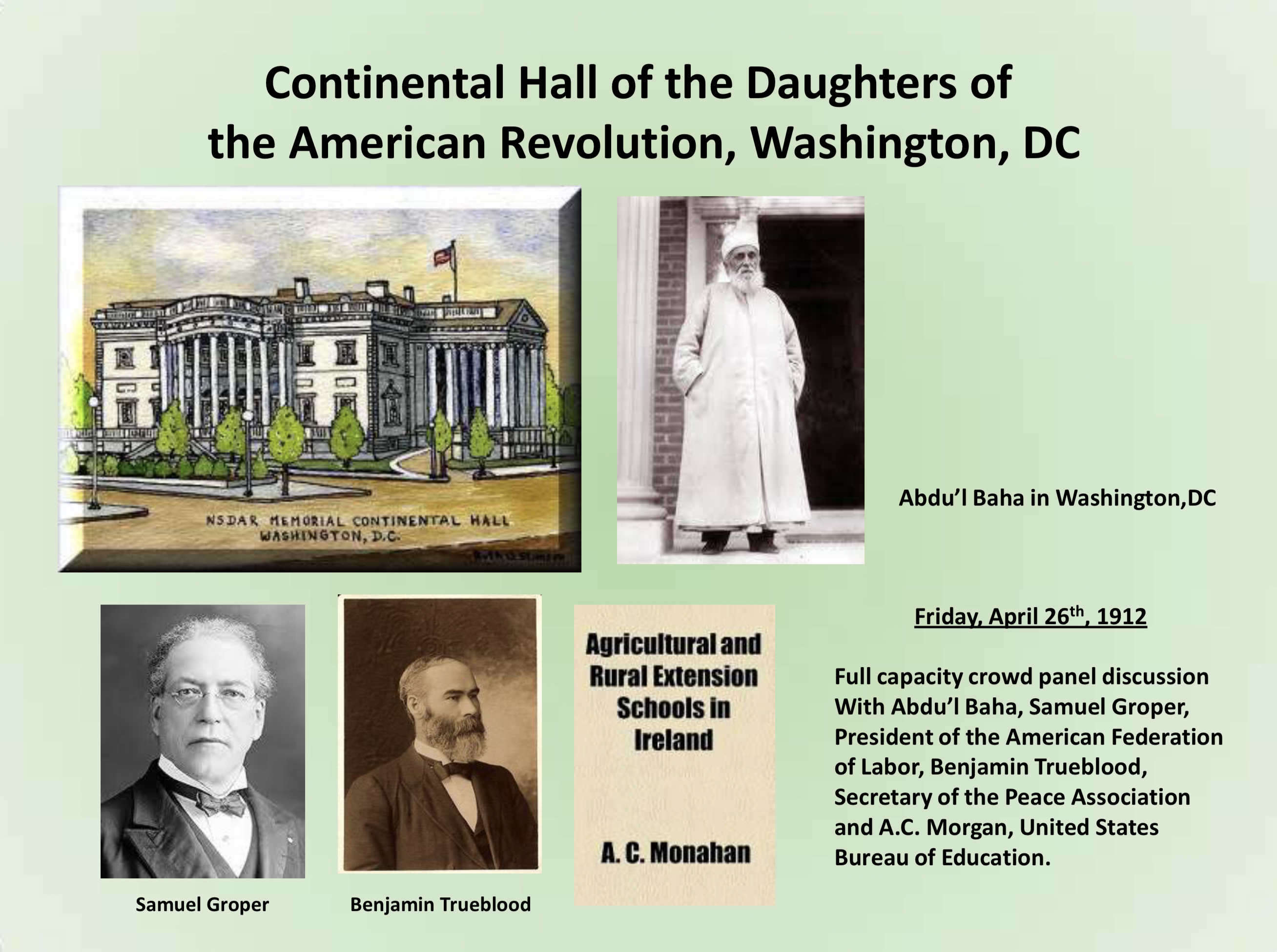
Among the visitors on Friday morning, April 26, was Lee McClung, the Secretary of the Treasury if the United States. Later ‘Abdul-Bahá addressed the ladies of President Taft’s All Saints [Souls] Unitarian Church, the room was completely filled. After the daily Parsons’ reception, He took a walk in the park. That evening He spoke to another capacity crowd, in one of the largest halls in Washington—the Continental Hall of the Daughters of the American Revolution—sharing the platform with Samuel Gompers, the president of the American Federation of Labor, Benjamin Trueblood, secretary of the American Peace Society, and A. C. Monohan [Arthur Coleman Monahan] of the United States Bureau of Education.

Abdul-Bahá, Who kept the friends in the Holy Land and Persia apprised of the activities through frequent cablegrams, cabled, “‘This day three thousand persons were interviewed in the utmost harmony.’”

“Remembering those who looked into His eyes” 3

Message to the Esperantists, Home of Mr. and Mrs. Arthur J. Parsons , 1700 Eighteenth Street, NW, Washington, D.C., 25 April 1912

Today the greatest need of the world of humanity is discontinuance of the existing misunderstandings among nations. This can be accomplished through the unity of language. Unless the unity of languages is realized, the Most Great Peace and the oneness of the human world cannot be effectively organized and established because the function of language is to portray the mysteries and secrets of human hearts. The heart is like a box, and language is the key. Only by using the key can we open the box and observe the gems it contains. Therefore, the question of an auxiliary international tongue has the utmost importance. Through this means international education and training become possible; the evidence and history of the past can be acquired. The spread of the known facts of the human world depends upon language. The explanation of divine teachings can only be through this medium. As long as diversity of tongues and lack of comprehension of other languages continue, these glorious aims cannot be realized. Therefore, the very first service to the world of man is to establish this auxiliary international means of communication. It will become the cause of the tranquillity of the human commonwealth. Through it sciences and arts will be spread among the nations, and it will prove to be the means of the progress and development of all races. We must endeavor with all our powers to establish this international auxiliary language throughout the world. It is my hope that it may be perfected through the bounties of God and that intelligent men may be selected from the various countries of the world to organize an international congress whose chief aim will be the promotion of this universal medium of speech. 4

Friday, April 26, 1912

In addition to the usual receptions at the home of Mrs Parsons, there were three public meetings: one in the morning, another in the afternoon and one in the evening. At the first gathering, at the All Saints Unitarian Church, the Master spoke on the subject of the varieties of light, the effulgence of the Sun of Reality in its original essence, and of the waiting souls with pure hearts who are like unto clear spotless mirrors, whose eyes and ears become enlightened by the appearance of the Sun of Reality. So great was the respect and devotion of the audience that ‘Abdu’l-Bahá wrote in a cable He sent to the Orient: ‘Today three thousand persons visited with the utmost harmony.’

At every gathering, whether for Bahá’ís or non-Bahá’ís, several stenographers, as well as the Persian secretaries, were in attendance. The English translations were published soon after the address itself but the Persian originals taken down by us verbatim had to be submitted to ‘Abdu’l-Bahá for correction. Because of His heavy schedule, He had little time for this, so the originals were often delayed in their publication.

The afternoon meeting was held at the home of Mrs Parsons. The subject of the talk was the interpretation of the Old Testament statement concerning the creation of man in the image of God. At the conclusion ‘Abdu’l-Bahá took His leave of the friends, promising to return to Washington DC from Chicago. On hearing this, the friends hastened to shake hands with Him and showed great reverence and humility to Him, joyful that soon He would return to their midst. After the meeting, ‘Abdu’l-Bahá went for a stroll in a park to recuperate.

In the evening ‘Abdu’l-Bahá went to a third gathering, held in a very large building, to speak to a group of young women of the suffrage movement. This was the largest meeting held thus far and the most spacious and majestic hall. ‘Abdu’l-Bahá delivered a most impressive address which He began by saying:

“One of the teachings of Bahá’u’lláh is equality of rights for men and women. When He promulgated this principle in the Orient, the people were astonished.

One of the proofs of the advancement of women is this magnificent and imposing building and this large gathering.”

‘Abdu’l-Bahá’s talk centered on the subject of equality of men and women and the necessity of giving women the same training as men. Many praised Him, both before and after His talk. The meeting closed with a song of praise.

The chairman of the meeting, Mr Hoover from New York, introduced the Master most eloquently. When ‘Abdu’l-Bahá came to the pulpit, He was received with a standing ovation and a burst of enthusiasm. Then, with a motion of His hand, all seated themselves.

As the Master arose to give His talk, everyone began to clap so loudly that the sound echoed around the great hall. Everyone was thrilled as the beloved Master stood and the hearts of the believers were relieved of all grief and anxiety. Indeed, the appearance of the Center of God’s Covenant in these meetings is worthy of the highest praise and will undoubtedly be of the greatest benefit to all. Instead of the harsh treatment meted out to the Manifestations of God, here was the advancement and elevation of the Cause of God. To listen to the melodious, resonant voice of the Center of the Covenant in such auditoriums fills one with excitement and raises the banner of everlasting honor. The presence of the Eastern friends was sorely missed.

At the end of the meeting, people again filled the room to capacity so they could glimpse ‘Abdu’l-Bahá’s beautiful face and shake His hand. 5

  1. Menon, Jonathan. “A Trip Through New York City, 1911.” 239 Days in America, April 26, 2012. https://239days.com/2012/04/26/a-great-harvest-of-results/.
  2. Ward, Allan L. 239 Days: ʻAbdu’l-Bahá’s Journey in America. Wilmette, Ill: Bahá’í Publishing Trust, 1979, 45.
  3. Van Ness, Zabine. “Remembering Those Who Looked into His Eyes: Abdul Baha’s Visits with Some Influential Dignitaries, April 11th to December 5th, 1912.” PDF, Seattle, WA, 2012, 26.https://hearttoheart.co/PDFs/Abdul-Bahaandhisvariousvisitations.pdf.
  4. ʻAbduʼl-Bahá. The Promulgation of Universal Peace: Talks Delivered by ʻAbduʼl-Bahá during His Visit to the United States and Canada in 1912. Edited by Howard MacNutt. 2nd ed. Wilmette, Ill: Baháʼí Publishing Trust, 1982, 60-61. https://www.bahai.org/library/authoritative-texts/abdul-baha/promulgation-universal-peace/3#293573670.
  5. Mahmud-i-Zarqani, Mirza. Mahmúd’s Diary: The Diary of Mírzá Mahmúd-i-Zarqání Chronicling ’Abdu’l-Bahá’s Journey to America. Edited by Shirley Macias. Translated by Mohi Sobhani. Oxford: George Ronald, 1998. https://bahai-library.com/zarqani_mahmuds_diary&chapter=2#section33

239 Days in America, Day 14: April 24, 1912 | Washington, DC

Breaking the Color Line 1

When dinner was announced ‘Abdu’l-Bahá stood, and everyone followed him into the dining room. Everyone, that is, except Louis Gregory. It was only 1912: Social Washington did not invite colored people to dinner.

Formality had laid out nineteen place settings along the sides of the long, rectangular banquet table according to strict Washington protocol. Good taste had strewn the table with rose petals. Regard had seated ‘Abdu’l-Bahá at its head. The guests took their seats.

Suddenly, ‘Abdu’l-Bahá stood up and looked around the table.

“Where is Mr. Gregory?” he asked. “Bring Mr. Gregory!” he told Ali-Kuli Khan.

Khan had no choice but to locate Mr. Gregory, whom he found trying to slip quietly out of the house without being noticed. By the time he re-entered the dining room with Louis Gregory, Social Washington had succumbed.

‘Abdu’l-Bahá had pushed aside the utensils, plates, and glasses that held sway over the place of honor to his right. Everyone moved over, sending a ripple of activity down one side of the table. In its place, he had laid out a twentieth place setting and ordered a twentieth chair brought to the table. Here he seated Louis Gregory. ‘Abdu’l-Bahá then sat down, explained that he was very happy to have Mr. Gregory here, and, as if nothing out of the ordinary had just occurred, began to speak on racial prejudice.

Washington D. C. 2

He then attended another of the daily receptions at the Parsons’ home, after which He proceeded to 13th Street N.W. to the home of Andrew J. Dyer. 3 In his diary, Dr. Zia Bagdadi, who served as one of ‘Abdu’l-Bahá’s translators, wrote, “In the evening, ‘Abdu’l-Bahá addressed the white and colored believers and their friends at the home of Mrs. Dyer, a member of the colored race… 4

‘Abdu’l-Bahá concluded His address by saying, … (see entry below)

Talk at Home of Mrs. Andrew J. Dyer, 1937 Thirteenth Street, NW, Washington, D.C.

When the racial elements of the American nation unite in actual fellowship and accord, the lights of the oneness of humanity will shine, the day of eternal glory and bliss will dawn, the spirit of God encompass, and the divine favors descend. Under the leadership and training of God, the real Shepherd, all will be protected and preserved. He will lead them in green pastures of happiness and sustenance, and they will attain to the real goal of existence. This is the blessing and benefit of unity; this is the outcome of love. This is the sign of the Most Great Peace; this is the star of the oneness of the human world. Consider how blessed this condition will be. I pray for you and ask the confirmation and assistance of God in your behalf. 5

Wednesday, April 24, 1912

In the morning ‘Abdu’l-Bahá went to a Bahá’í children’s conference. As He entered the hall, the children sang songs in praise of ‘Abdu’l-Bahá in unison, accompanied by the piano. When the Master saw the children, He said, ‘Praise be to God. These children, like flowers, are in a state of utmost purity, freshness and delicacy!’ After He spoke and recited prayers for the children, the Master kissed and embraced each child and gave them some sweets. The immensity of His love and affection for the children was clearly obvious.

A second meeting was held that evening at the home of Mr and Mrs Andrew J. Dyer, a mixed race couple. Those present were in such unity and love that the Master remarked:

“Before I arrived, I felt too tired to speak at this meeting but at the sight of such genuine love and attraction between the white and the black friends, I was so moved that I spoke with great love and likened this union of different colored races to a string of gleaming pearls and rubies.”

After He spoke and showered His love on each one, He left in His carriage for a third meeting.

’ Abdu’l-Bahá was so filled with joy and happiness and His voice resonated so loudly that even the people walking along the street could hear Him:

“O Bahá’u’lláh! What hast Thou done? O Bahá’u’lláh! May my life be sacrificed for Thee! O Bahá’u’lláh! May my soul be offered up for Thy sake! How full were Thy days with trials and tribulations! How severe the ordeals Thou didst endure! How solid the foundation Thou hast finally laid, and how glorious the banner Thou didst hoist!” 6

’ Abdu’l-Bahá continued in this manner until the carriage reached the home of Mr [Alexander Graham] Bell. This great individual is the inventor of the telephone and the head of a scientific society. The day before, this venerable and inventive old gentleman had visited the Master and invited Him to attend the meeting of the scientific society. When the Master entered, all rose and each in turn shook His hand. Those who had met the Master previously introduced Him to the others with the greatest respect and honor. After the Master was seated, discussion of scientific issues continued. Each spoke of his experiences and discussed his discoveries. After several people had spoken, Mr Bell asked Ali Kuli Khan, the Persian ambassador, to relate the history of the Faith. Then Mr Bell thanked the Master for coming to his home and asked Him to address the guests.

The Master began His talk by praising their good manners and praiseworthy qualities. He then spoke of the importance and the results of science, the greatness of this age and the interdependence of society, and paid a glorious tribute to the new Dispensation. Mr Bell was extremely delighted and rose to thank the Master for His talk. The hearts of those present were so moved that when the next member arose to give his talk, he could only say, ‘The talk of the Master from the East was so wonderful that I find myself inadequate to say anything’ and sat down. A few others spoke briefly and the meeting ended.

Mr Bell invited the Master and his guests to go into the dining hall. It was midnight, and as it is customary for people in the West to eat late at night before going to bed, the table was spread with bread, meat, candies, cookies, fruit and beverages. Although the Master had not yet had dinner, He spoke through Mr Bell to his wife and daughter. Mrs Bell is deaf and mute and communicates through sign language. Sign language is similar to writing, with lines, points and stops, just as in telegraph technology, and is now so well developed that people can speak easily with the deaf.

As is well known, Mr Bell’s main purpose was to invent an instrument that would enable the deaf to communicate. Out of his deep love for his wife, he devoted himself to this day and night and in the end invented the telephone. But this did not fulfill his intended purpose. The Master said:

“Yes, most of the great inventions were made in a similar way. For instance, the search for alchemy has brought into being thousands of useful medicines and the desire of finding a direct route to India from Europe became the cause of the discovery of America.” 7

  1. Menon, Jonathan. “Breaking the Color Line.” 239 Days in America, April 24, 2012. https://239days.com/2012/04/24/breaking-the-color-line/.
  2. Ward, Allan L. 239 Days: ʻAbdu’l-Bahá’s Journey in America. Wilmette, Ill: Bahá’í Publishing Trust, 1979, 43.
  3. “In those days, race constituted a social identity marker and the basis for pervasive social discrimination. One of the early American Baha’is, Andrew Jackson Dyer, said to be African American, or of a “mixed” race, was born in 1847 in Virginia, and died in 1918 in Washington, DC. Dyer was employed as a messenger in a government department. His wife, Maggie Jordan Dyer, became a Baha’i in 1909. Born in March 1858 (also in Virginia) and married around 1876, Maggie J. Dyer was listed as “mulatto” in the 1880 and 1910 United States Census and, yet was listed as “white” in the 1900 United States Census.”
    Buck, Christopher, and Steven Kolins. “African American Baha’is During Abdu’l-Baha’s Lifetime.” BahaiTeachings.org, June 1, 2020. https://bahaiteachings.org/african-american-bahais-during-abdul-bahas-lifetime/.
  4. Bagdadi, Zia. “”Abdu’l-Bahá in America.” Star of the West, June 1928, 89.
  5. ʻAbduʼl-Bahá. The Promulgation of Universal Peace: Talks Delivered by ʻAbduʼl-Bahá during His Visit to the United States and Canada in 1912. Edited by Howard MacNutt. 2nd ed. Wilmette, Ill: Baháʼí Publishing Trust, 1982, 50. https://www.bahai.org/library/authoritative-texts/abdul-baha/promulgation-universal-peace/3#769459639.
  6. Effendi, Shoghi. God Passes By. 1944. Reprint, Wilmette, IL: Bahá’í Publishing Trust, 1970, 293. https://www.bahai.org/library/authoritative-texts/shoghi-effendi/god-passes-by/21#543609895
  7. Mahmud-i-Zarqani, Mirza. Mahmúd’s Diary: The Diary of Mírzá Mahmúd-i-Zarqání Chronicling ’Abdu’l-Bahá’s Journey to America. Edited by Shirley Macias. Translated by Mohi Sobhani. Oxford: George Ronald, 1998. https://bahai-library.com/zarqani_mahmuds_diary&chapter=2#section31

239 Days in America, Day 13: April 23, 1912 | Washington, DC

This Shining Colored Man 1

Reverend Wilbur Patterson Thirkield, Howard’s eighth President, introduced ‘Abdu’l-Bahá. “This was a most notable occasion,” wrote Joseph Hannen, who was also in the audience, “and here, as everywhere when both white and colored people were present, Abdul-Baha seemed happiest. The address was received with breathless attention by the vast audience, and was followed by a positive ovation and a recall.” 2 3

‘Abdu’l-Bahá began by drawing attention to the diversity in the room. “Today I am happy,” he said, “for I see . . . white and black sitting together.” He then proceeded to reject prevailing black and white views about the essentialism of race — the popular belief that a person’s race was central to his or her humanity:

There are no whites and blacks before God. All colors are one, and that is the color of servitude to God. Scent and color are not important. The heart is important. If the heart is pure, white or black or any color makes no difference. 4

Washington D. C. 5

From Howard University He rode to the Persian Embassy, where Ali-Kuli Khan was preparing a reception. ‘Abdu’l‑Bahá went upstairs to rest and to grant a few private interviews, including conversations with Admiral Peary and Alexander Graham Bell. Mrs. Hebe Struven, who helped arrange the affair, recalling it years later, said that after the place cards had been arranged at the plates to seat people by strict Washington protocol, ‘Abdu’l‑Bahá at the last minute gathered them all up, shuffled and redistributed them, and then brought Louis G. Gregory to the place of honor at the head of the table in the otherwise all-white gathering. He thus—literally in this gather and symbolically for all occasions—abolished racial prejudice and social segregation.

Talk at Home of Mr. and Mrs. Arthur J. Parsons, 1700 Eighteenth Street, NW, Washington, D.C., 23 April 1912

…Although such an event is indeed regrettable, we must realize that everything which happens is due to some wisdom and that nothing happens without a reason. Therein is a mystery; but whatever the reason and mystery, it was a very sad occurrence, one which brought tears to many eyes and distress to many souls. I was greatly affected by this disaster. Some of those who were lost voyaged on the Cedric with us as far as Naples and afterward sailed upon the other ship. When I think of them, I am very sad indeed. But when I consider this calamity in another aspect, I am consoled by the realization that the worlds of God are infinite; that though they were deprived of this existence, they have other opportunities in the life beyond, even as Christ has said, “In my Father’s house are many mansions.” They were called away from the temporary and transferred to the eternal; they abandoned this material existence and entered the portals of the spiritual world. Foregoing the pleasures and comforts of the earthly, they now partake of a joy and happiness far more abiding and real, for they have hastened to the Kingdom of God. The mercy of God is infinite, and it is our duty to remember these departed souls in our prayers and supplications that they may draw nearer and nearer to the Source itself. 6

Talk to Bethel Literary Society, Metropolitan African Methodist Episcopal Church, M Street, NW, Washington, D.C.

All blessings are divine in origin, but none can be compared with this power of intellectual investigation and research, which is an eternal gift producing fruits of unending delight. Man is ever partaking of these fruits. All other blessings are temporary; this is an everlasting possession. Even sovereignty has its limitations and overthrow; this is a kingship and dominion which none may usurp or destroy. Briefly, it is an eternal blessing and divine bestowal, the supreme gift of God to man. Therefore, you should put forward your most earnest efforts toward the acquisition of science and arts. The greater your attainment, the higher your standard in the divine purpose. The man of science is perceiving and endowed with vision, whereas he who is ignorant and neglectful of this development is blind. The investigating mind is attentive, alive; the callous and indifferent mind is deaf and dead. A scientific man is a true index and representative of humanity, for through processes of inductive reasoning and research he is informed of all that appertains to humanity, its status, conditions and happenings. He studies the human body politic, understands social problems and weaves the web and texture of civilization. In fact, science may be likened to a mirror wherein the infinite forms and images of existing things are revealed and reflected. It is the very foundation of all individual and national development. Without this basis of investigation, development is impossible. Therefore, seek with diligent endeavor the knowledge and attainment of all that lies within the power of this wonderful bestowal. 7

How shall we utilize these gifts and expend these bounties? By directing our efforts toward the unification of the human race. We must use these powers in establishing the oneness of the world of humanity, appreciate these virtues by accomplishing the unity of whites and blacks, devote this divine intelligence to the perfecting of amity and accord among all branches of the human family so that under the protection and providence of God the East and West may hold each other’s hands and become as lovers. Then will mankind be as one nation, one race and kind—as waves of one ocean. Although these waves may differ in form and shape, they are waves of the same sea. Flowers may be variegated in colors, but they are all flowers of one garden. Trees differ though they grow in the same orchard. All are nourished and quickened into life by the bounty of the same rain, all grow and develop by the heat and light of the one sun, all are refreshed and exhilarated by the same breeze that they may bring forth varied fruits. This is according to the creative wisdom. If all trees bore the same kind of fruit, it would cease to be delicious. In their never-ending variety man finds enjoyment instead of monotony. 8

Tuesday, April 23, 1912

Today the Master went to Howard University, an educational institution for blacks. The hosts (mostly black with a few whites) had made special arrangements so that when the Master arrived He was welcomed by music from a band while the audience applauded with excitement and exuberance. It is difficult to describe the scene adequately. The president of the university was very cordial and introduced ‘Abdu’l-Bahá as the Prophet of Peace and the harbinger of unity and salvation. Then the Master rose from His seat and spoke on the subject of the harmony between blacks and whites and the unity of humankind. The audience repeatedly applauded Him during the talk, delighted at His words. At the conclusion, the president of the university thanked ‘Abdu’l-Bahá on behalf of all those gathered. As He left the auditorium, group after group formed two lines, one on each side, all showing their highest respect by bowing and waving their hats and handkerchiefs in farewell to the beloved Master.

’ Abdu’l-Bahá had lunch at the home of Ali Kuli Khan. Several believers were present, including ourselves. 9 10 11

There was a public meeting in the afternoon at the same house. The majority attending the meeting were ladies from high society. At this meeting the Master spoke about the education and improvement of women and the promotion of unity and peace in the world of humanity. After the meeting several new people arrived and sat for a brief time in the Master’s presence. They so enjoyed His company they did not want to leave.

In the evening, close to bedtime, when the Master was alone and extremely tired from the day’s activities, He prayed, praising and thanking the Blessed Beauty. On one occasion He said:

“We must offer thanks to the Blessed Beauty because it is His help that has stirred the people; it is His grace that has changed the hearts. The assistance of the Abhá Kingdom has transformed a drop into a mighty ocean. The aid of the Most High has turned a gnat into an eagle, has invested an ant with the power of a Solomon and has caused the debased one to become a source of eternal honor.’”

A third meeting was held this evening in a black church. All those present paid Him the highest respect and were delighted to hear about the new teachings. The Master’s talk, they felt, gave them honor and would cause them to progress. As is customary at churches, there was a collection and the Master made a contribution. 12

  1. Menon, Jonathan. “This Shining Colored Man.” 239 Days in America, April 23, 2012. https://239days.com/2012/04/23/this-shining-colored-man/.
  2. Hannen, Joseph H. “Abdul-Baha in Washington, D.C.” Star of the West, April 28, 1912, 6-8.
  3. Buck, Christopher. “Public Discourse on Race: ‘Abdu’l-Bahá’s Howard University Speech.” PDF presented at the Centenary of ‘Abdu’l-Bahá’s Visit to North America, Louhelen Bahá’í School, Davison, Michigan, February 11, 2012. https://bahai-library.com/pdf/b/buckabdulbahahowardlouhelen.pdf.
  4. ʻAbduʼl-Bahá. The Promulgation of Universal Peace: Talks Delivered by ʻAbduʼl-Bahá during His Visit to the United States and Canada in 1912. Edited by Howard MacNutt. 2nd ed. Wilmette, Ill: Baháʼí Publishing Trust, 1982, 44. https://www.bahai.org/library/authoritative-texts/abdul-baha/promulgation-universal-peace/3#098175321.
  5. Ward, Allan L. 239 Days: ʻAbdu’l-Bahá’s Journey in America. Wilmette, Ill: Bahá’í Publishing Trust, 1979, 40-41.
  6. ʻAbduʼl-Bahá. The Promulgation of Universal Peace: Talks Delivered by ʻAbduʼl-Bahá during His Visit to the United States and Canada in 1912. Edited by Howard MacNutt. 2nd ed. Wilmette, Ill: Baháʼí Publishing Trust, 1982, 46-47. https://www.bahai.org/library/authoritative-texts/abdul-baha/promulgation-universal-peace/3#242218565
  7. ʻAbduʼl-Bahá. The Promulgation of Universal Peace: Talks Delivered by ʻAbduʼl-Bahá during His Visit to the United States and Canada in 1912. Edited by Howard MacNutt. 2nd ed. Wilmette, Ill: Baháʼí Publishing Trust, 1982, 50. https://www.bahai.org/library/authoritative-texts/abdul-baha/promulgation-universal-peace/3#325690063.
  8. ʻAbduʼl-Bahá. The Promulgation of Universal Peace: Talks Delivered by ʻAbduʼl-Bahá during His Visit to the United States and Canada in 1912. Edited by Howard MacNutt. 2nd ed. Wilmette, Ill: Baháʼí Publishing Trust, 1982, 51. https://www.bahai.org/library/authoritative-texts/abdul-baha/promulgation-universal-peace/3#838638236.
  9. Hutchison, Sandra Lynn. ’Abdu’l-Baha in America: The Diary of Agnes Parsons. Edited by Richard Hollinger. Los Angeles: Kalimát Press, 1996, 31. https://archive.org/details/abdulbahainameri0000pars/page/30/mode/2up.
  10. Ober, Harlan F. “Louis G. Gregory.” Bahá’í World, 1956, 666-670.
  11. Thompson, Juliet. The Diary of Juliet Thompson. Edited by Marzieh Gail. 1st ed. 1947. Reprint, Los Angeles: Kalimát Press, 1983, 269. https://archive.org/details/diaryofjuliettho0000thom/page/268/mode/2up
  12. Mahmud-i-Zarqani, Mirza. Mahmúd’s Diary: The Diary of Mírzá Mahmúd-i-Zarqání Chronicling ’Abdu’l-Bahá’s Journey to America. Edited by Shirley Macias. Translated by Mohi Sobhani. Oxford: George Ronald, 1998. https://bahai-library.com/zarqani_mahmuds_diary&chapter=2#section30

239 Days in America, Day 11: April 21, 1912 | Washington, DC

Washington High Society Receives ‘Abdu’l-Bahá 1

Every afternoon at 5 p.m., members of Washington’s elite sought out ‘Abdu’l-Bahá at the Parsons’s home: members of the House of Representatives, of the Senate, and of the Cabinet; Justices of the Supreme Court; officials of foreign embassies; and men of science such as Alexander Graham Bell and Admiral Robert Peary.

Agnes [Parsons] 2 had built a large, bright ballroom to the left of the front door especially for this purpose. It was twenty-five feet wide by fifty feet long, decorated in white with yellow silk curtains, and it seated 150 people. Carved garlands blanketed the ceiling, the paneled walls, and the high mantel at one end of the room. ‘Abdu’l-Bahá spoke from a platform in front of the mantel, behind a bank of American Beauty roses that were delivered fresh every day. As the days passed, the crowds grew bigger.

Yet ‘Abdu’l-Bahá didn’t come to Washington simply to meet the nation’s wealthy and powerful. He also intended to assail America’s biggest taboo – the issue of race.

Washington D. C. 3

At 4:00 P.M. He [‘Abdu’l-Bahá ] spoke at the Universalist Church at 13th and L Streets to more than one thousand persons, who had started filling the auditorium an hour before time for the service to begin, In introducing Him the Reverend John Van Schairk, Jr., pastor of the church, said, “After arrangements for this meeting had been made, I received a letter warning me that I should be false to my belief if I held it… Against such narrowness this Church has always stood. We stand today humbly seeking the Spirit of Truth…” 4 ‘Abdu’l-Bahá then addressed the gathering…

Talk at Universalist Church, Thirteenth and L Streets, Washington, D.C.

All the existing nations had a divine foundation of truth or reality originally, which was intended to be conducive to the unity and accord of mankind, but the light of that reality gradually became obscured. The darkness of superstitions and imitations came and took its place, binding the world of humanity in the chains and fetters of ignorance. Enmity arose among men, increasing to such an extent that nation strove against nation in hatred and violence. War has been a religious and political human heritage.

Now it is enough! We must investigate reality. We must put away these superstitions. It is a self-evident truth that all humanity is the creation of God. All are His servants and under His protection. All are recipients of His bestowals. God is kind to all His servants. At most it is this: that some are ignorant; they must be educated in order that they may become intelligent. Some are immature as children; they must be aided and assisted in order that they may become mature. Some are sick and ailing; they must be healed. But the suffering patient must not be tested by false treatment. The child must not be warped and hindered in its development. The ignorant must not be restricted by censure and criticism. We must look for the real, true remedy. 5

Sunday, April 21, 1912

The highlight of the day was a very important and well-attended meeting at the Universalist Church. The minister of the church introduced ‘Abdu’l-Bahá with a most glowing tribute to His life and teachings. Then the Master rose from His seat and delivered an address on the need for cooperation, love, friendship and universal peace. He stressed Christ’s statement that ‘I have yet many things to say unto you, but ye cannot bear them now. Howbeit when he, the Spirit of truth, is come, he will guide you into all truth’ [John 16:12-13], and added, ‘And now that time has come and the Divine Spirit has spoken, revealing all truth.’ …

I will now pray on your behalf:

“O Lord! These Thy servants have assembled here out of pure love. They have gathered together in perfect accord and harmony. O God! Illumine their faces, make joyous their souls with Thy most great glad tidings. Brighten their eyes with the verses of Thy guidance and delight their ears with the melody of Thy sweet voice.

O Lord, we are wrongdoers; forgive us. We are sinners; grant us Thy pardon. Shelter us in Thy refuge. Satisfy the needy through Thy forgiveness. Free us from the world of vain imaginings and guide us to the Truth, that we may seek the divine reality, shun the mortal world, approach the divine kingdom and, withdrawn from the world of darkness, enter the realm of light.

Deliver us from the darkness of material existence and illumine us with the rays of the infinite realm. Make us the manifestations of Thy light and the dawning places of Thy signs. Turn us from all else save Thee and cause us to become the recipients of Thy mysteries. Thou, O God, art the Compassionate, the Wise, the Forgiving, the Mighty.” 6

  1. Menon, Jonathan. “‘Abdu’l-Bahá Goes to Washington.” 239 Days in America, April 20, 2012. https://239days.com/2012/04/20/abdul-baha-comes-to-washington/.
  2. Reneau, Annie. “Shining Lamp: Agnes Parsons (1861-1934),” Brilliant Star, September 28, 2017. https://brilliantstarmagazine.org/articles/agnes-parsons-1861-1934.
  3. Ward, Allan L. 239 Days: ʻAbdu’l-Bahá’s Journey in America. Wilmette, Ill: Bahá’í Publishing Trust, 1979, 39.
  4. Hannen, Joseph H. “Abdul-Baha in Washington, D.C.” Star of the West, April 28, 1912.
  5. ʻAbduʼl-Bahá. The Promulgation of Universal Peace: Talks Delivered by ʻAbduʼl-Bahá during His Visit to the United States and Canada in 1912. Edited by Howard MacNutt. 2nd ed. Wilmette, Ill: Baháʼí Publishing Trust, 1982, 39-40. https://www.bahai.org/library/authoritative-texts/abdul-baha/promulgation-universal-peace/3#593384709.
  6. Mahmud-i-Zarqani, Mirza. Mahmúd’s Diary: The Diary of Mírzá Mahmúd-i-Zarqání Chronicling ’Abdu’l-Bahá’s Journey to America. Edited by Shirley Macias. Translated by Mohi Sobhani. Oxford: George Ronald, 1998. https://bahai-library.com/zarqani_mahmuds_diary&chapter=2#section28