Where Am I — How Do I Find Out?

My previous post, Where Am I?, presents a number of cosmic possibilities for where one could be. How to narrow the options, though, is a personal decision. One must choose carefully among many reasoned and compelling theories about cosmology even as they are being challenged, revised, or supplanted through new discoveries, developments, and detours. The goal is to settle on whatever instills sufficient confidence to go forward as a “knowledge broker.” 1

Being lost is not a permanent condition. Being found is to confront the primary challenge mentioned above of knowing what integrity is and addressing the confounding questions honestly and openly. Peeling back the onion-like layers of representation that shroud our integrity is an exercise in independent investigation of truth – —a fundamental endeavor for a knowledge broker. 2

Independent Search after Truth, then, becomes the first of three core activities in the pursuit of knowledge:

Furthermore, know ye that God has created in man the power of reason, whereby man is enabled to investigate reality. God has not intended man to imitate blindly his fathers and ancestors. He has endowed him with mind, or the faculty of reasoning, by the exercise of which he is to investigate and discover the truth, and that which he finds real and true he must accept. He must not be an imitator or blind follower of any soul. He must not rely implicitly upon the opinion of any man without investigation; nay, each soul must seek intelligently and independently, arriving at a real conclusion and bound only by that reality. The greatest cause of bereavement and disheartening in the world of humanity is ignorance based upon blind imitation. It is due to this that wars and battles prevail; from this cause hatred and animosity arise continually among mankind. 3

The second core activity is the apprehension of reality through various worlds of perception:

  • material — one that can be perceived through the senses;
  • rational — one that can be perceived through the intellect;
  • historical — one that can be perceived through traditions and narratives; and
  • spiritual (non-material / suprarational) — one that can be perceived through a conduit or postulated as a theoretical possibility, but cannot be tested (observed) or proven with available knowledge. 4

While each realm is valuable in myriad ways, to regard any one of them as a sufficient pathway to applicable knowledge is susceptible to distortion of information and error in judgement. More useful answers emerge from mutually supportive evidence gleaned from several “worlds of perception” (or “multiple intelligences”) 5 and diverse starting conditions.

The third core activity is the adoption of a disciplined, “scientific method” 6 to follow when processing what one perceives in order to achieve a better understanding. This methodology applies in both material and spiritual realities especially when bridging between them as noted in this statement by ‘Abdu’l-Bahá:

It (science) is of two kinds: material and spiritual. Material science is the investigation of natural phenomena; divine science is the discovery and realization of spiritual verities. The world of humanity must acquire both. A bird has two wings; it cannot fly with one. Material and spiritual science are the two wings of human uplift and attainment. Both are necessary—one the natural, the other supernatural; one material, the other divine. By the divine we mean the discovery of the mysteries of God, the comprehension of spiritual realities, the wisdom of God, inner significances of the heavenly religions and foundation of the law. 7

The diagram below by Keng-Laing Huang 8 illustrates how the scientific method provides a disciplined approach by which an independent seeker can sort through spiritual and material perceptions about any topic and secure a firmer grasp on reality:

Armed with independence, perception and process, one forges ahead as a steeled knowledge broker confident to meet any circumstance during life’s journey. Along the way one learns through the merit of one’s logic, the strength and consistency of one’s narratives, and the perseverance of one’s curiosity and imagination to keep after truth. In effect, one maps one’s place in the cosmos and finds what may have seemed lost.

  1. “I describe myself as a “knowledge broker.” With the pervasiveness of ICT capabilities, the roles we play in our work and relationships to one another are a complex mix of saying our truths, aggregating these diverse points of truth into recognizable frameworks of patterns, and putting theories into action we believe will influence the patterns we see and experience. Knowledge brokers move easily and freely among these three roles depending upon the current circumstances in which they find themselves.”
    Bosserman, Steven L., “Welcome,” Steven L. Bosserman Archives (Blog), August 31, 2005. <https://stevenlbossermanarchives.com/2005/08/25/welcome/>
  2. Bosserman, Steven L., “Integrity and Groundtruth,” Steven L. Bosserman Archives (Blog), August 31, 2005. <https://stevenlbossermanarchives.com/2005/08/31/integrity-and-ground-truth/>
  3. ‘Abdu’l-Bahá, “Talk at Home of Madame Morey, 34 Hillside Avenue, Malden, Massachusetts, 29 August 1912,” The Promulgation of Universal Peace: Talks Delivered by ‘Abdu’l-Bahá during His Visit to the United States and Canada in 1912, 2nd ed. (Wilmette, IL: Bahá’í Publishing Trust, 1982), 291. http://www.bahai.org/r/693658082
  4. “Abdu’l-Bahá 1904-1906. “The Four Methods of Acquiring Knowledge”. Some Answered Questions. (Wilmette, IL: Bahá’í Publishing Trust, 1981, 297-299).
  5. “The purpose of their performance was three-fold. First, make rhythm and dance integral in the design of the leadership workshop as an appeal to the auditory-musical and bodily-kinesthetic intelligences of attendees, à la Howard Gardner and his theory of multiple intelligences.”
    Bosserman, Steven L., “Keeping the Beat with Jump Rhythm Jazz Project,” Steven L. Bosserman Archives (Blog), December 5, 2005. https://stevenlbossermanarchives.com/2005/12/05/keeping-the-beat-with-jump-rhythm-jazz-project/
  6. “The scientific method is an empirical method of acquiring knowledge that has characterized the development of science since at least the 17th century. It involves careful observation, applying rigorous skepticism about what is observed, given that cognitive assumptions can distort how one interprets the observation. It involves formulating hypotheses, via induction, based on such observations; experimental and measurement-based testing of deductions drawn from the hypotheses; and refinement (or elimination) of the hypotheses based on the experimental findings. These are principles of the scientific method, as distinguished from a definitive series of steps applicable to all scientific enterprises.” <https://en.wikipedia.org/wiki/Scientific_method>
  7. ‘Abdu’l-Bahá. “Talk at the Home of Mr. and Mrs. Francis W. Breed, 367 Harvard Street, Cambridge, Massachusetts, 23 May 1912,” The Promulgation of World Peace: Talks Delivered by ‘Abdu’l-Bahá during His Visit to the United States and Canada in 1912. 2nd ed. (Wilmette, IL: Bahá’í Publishing Trust, 1982). 138. http://www.bahai.org/r/988275660
  8. Huang, Keng-Laing, “The Science of Living,” BahaiTeachings.org
    February 28, 2020. <https://bahaiteachings.org/science-of-living/&gt;

Ménière’s Disease: Requiem for My Left Ear

This past Friday, my doctor told me I have Ménière’s disease. These two words explained a week of incessant, high-pitched ringing and pulse-throbbing pressure in my left ear, an unsteady gait when walking, and a counter-clockwise swirling of the room following any rapid movement of my head. The only action that seemed to curb it was sleeping, which is what I did. While there was much to be done, I felt like doing NOTHING!

Of course, I indulged in self-diagnosis in between waves of vertigo. Was it the result of too much coffee? Too little down-time? A simple case of the flu? I settled on three possibilities: an inoperable brain tumor (in deference to my mother – may God rest her soul – who believed in establishing an extremely severe alternative no matter how unlikely so that almost any diagnosis made by the doctor would be good news in comparison); an ear infection (where my bets were placed); and wax build-up in the ear canal (I knew this one was a long-shot, but it at least served as a balance to the first choice). Ménière’s disease?! Never heard of it!

“What is it?” I asked. The doctor offered an explanation: no one knows what causes it…could be genetic…could be a virus…there is no cure…it comes and goes unpredictably…you have atypical vestibular Ménière’s disease because you are not experiencing hearing loss in the left ear…long term prognosis is that you probably will have total, permanent hearing loss…severe vertigo can be incapacitating due to nausea and vomiting…can only treat the symptoms…surgery works in some cases to lessen vertigo. In the meantime, here is a prescription for 25mg of Meclizine to reduce dizziness…the side-effects include feeling lightheaded, sleepy, having blurred vision, change in thinking clearly…avoid driving, doing other tasks or activities that require alertness or clear vision. Anything else I can do for you?

I entered into the privacy of the doctor’s office aware of my very real, but unspecified condition. It was real because I physically and mentally experienced its consequences. And in that moment it was mine alone. No one else knew what I had or how I was affected by it, not even my wife who accompanied me. However, the doctor gave it a name. He now knew, my wife knew, and I knew and I was no longer alone with the unknowable.

The mere fact that it was symbolized with letters gave it a virtual existence extending far beyond me and touching the millions of others who have the same condition. This virtualization gives me access to the experiences, knowledge, empathy, and understanding of others; and they to mine. Because of a name, Ménière’s disease, such widespread connectedness becomes a powerful way for me to learn about myself and the result may carry far beyond the bounds of the condition. So, to start…

A Google search on the term, “Ménière’s disease” yields 667,000 results. A search of Amazon generates two pages of books, journals, magazines, even herbal medicines. There are 28 Yahoo! Groups and 3 Google Groups and almost 2700 groups across the Internet dedicated to the Ménière’s-related topics such as tinnitus, vertigo / dizziness, vestibular virus, etc. There are countless variations on how Ménière’s manifests itself and what people who have it do in response. The choices are many, ranging from pharmacological prescriptions to alternative medicines, and from low-salt diets to surgery.

It is almost impossible NOT to get connected. Clearly, I don’t know what’s next for me with Ménière’s — I could have another episode tomorrow or I could never have another one. At the moment I have no vertigo, no hearing loss, no spinning computer screen, no pressure in the ear, only a slight ringing. The prescription for Meclizine is filled, but unused. So in the moment, I go on reading more, asking more, learning more. And even if I don’t have call to use this knowledge for myself, I have it at hand in case others I meet or know are afflicted with similar symptoms and diagnoses. This potential for learning together in the future marks a distinct value of virtualization. If and when Ménière’s strikes again and the realization of the condition hits me hard, I thank all of you in the vast global network in advance for imparting your knowledge and wisdom and making me a better person for it!

Originally posted to New Media Explorer by Steve Bosserman on Saturday, October 22, 2005 and updated on Monday, October 24, 2005

Forums and Agendas

Conversation, —simply defined as a combination of verbal and non-verbal “statements” between two individuals,” —is the fundamental building block of human communication. Conversations can be real-time or asynchronous. Participants can be present, virtually or physically.

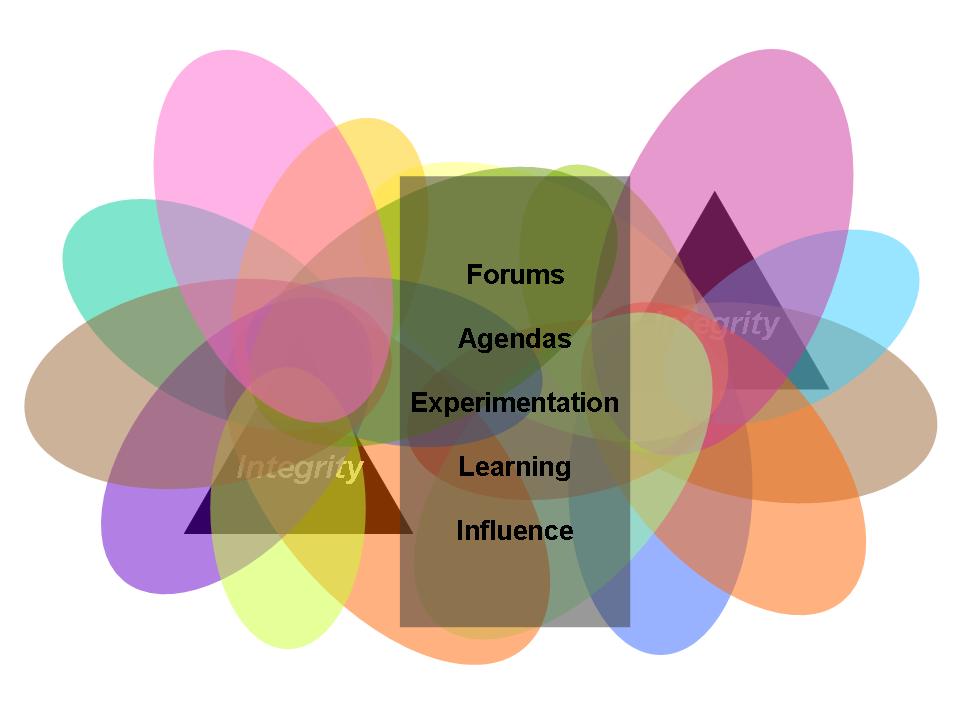
Regardless of how a conversation is enacted, at a minimum it strives to produce understanding. In many cases being understood is insufficient, especially when changes to one’s current condition are expected. A press ensues for agreement about what is, what that means, and what are possibilities for the future. With agreement in hand about a preferable condition it is possible to pursue commitment —the impetus for deliberate and purposeful action which drives experimentation, learning, and, ultimately, influence.

Any conversation, formal or informal,, consists of a forum and agenda. A forum is the context in which a conversation occurs. This includes who is in the conversation (invited and attending), where the conversation is held, what technologies are used to support the conversation, what date and time the conversation takes place, even in what language the conversation is conducted. The agenda is the subject of the conversation. Depending on psychological, social, and political factors, the agenda can be explicit and openly stated or implicit and hidden. In addition, there can be more than one agenda in a conversation each shaped by a different motivation and entertaining a unique position along the explicit-to-implicit continuum.

This blending of forum and agenda makes conversation an extension of complex human social behavior. Knowing the agenda(s) requires relating it to the forum in order to get a fuller sense of what is behind the conversation and a better interpretation of what are the expected outcomes of the conversation. Obviously, the more one knows others in the conversation and their contextual circumstances the higher the likelihood of accurately “reading”” the agenda layers and offering culturally appropriate responses.

Conversations are convened. Someone sets the forum and determines an agenda and others participate. Convening is an exercise of social power. Everyone is experienced at convening if nothing more than saying “Good morning!”” to another and soliciting a response. This requires minimal social power to extend the invitation for the other to join. However, depending on who are the desired participants in a particular conversation, differing levels of power are often required to garner the commitments of each to join.

Social power is directly related to the capacity one has to affect consequences for others. The more a person can influence the context in which the interests of others are advanced or met and costs are minimized, the more convening power that person has. Social power not only grants an individual the license to convene, it also permits a person to NOT invite. A conversation says much about the convening authority carried by the person who initiated it based on who is there AND who isn’t!

Knowledge brokers are conveners. They are granted the authority to initiate conversations based on the trust placed in them by participants that their “ground truths”” will be respected and their stories heard and understood. Knowledge brokers gain this trust because of the consistency and thoroughness with which they conduct personal investigations of truth then relate those discoveries in conversations where to speak one’s truth carries a potentially negative consequence. This capacity to know one’s truth, grant others the conversational space and opportunity to hold and state theirs, and pursue the lines of experimentation, learning, and influence that follow understanding, agreement, and commitment is a hallmark of a knowledge broker.

Originally posted to New Media Explorer by Steve Bosserman on Saturday, September 10, 2005 and updated on Saturday, September 24, 2005

Conversations and Stories

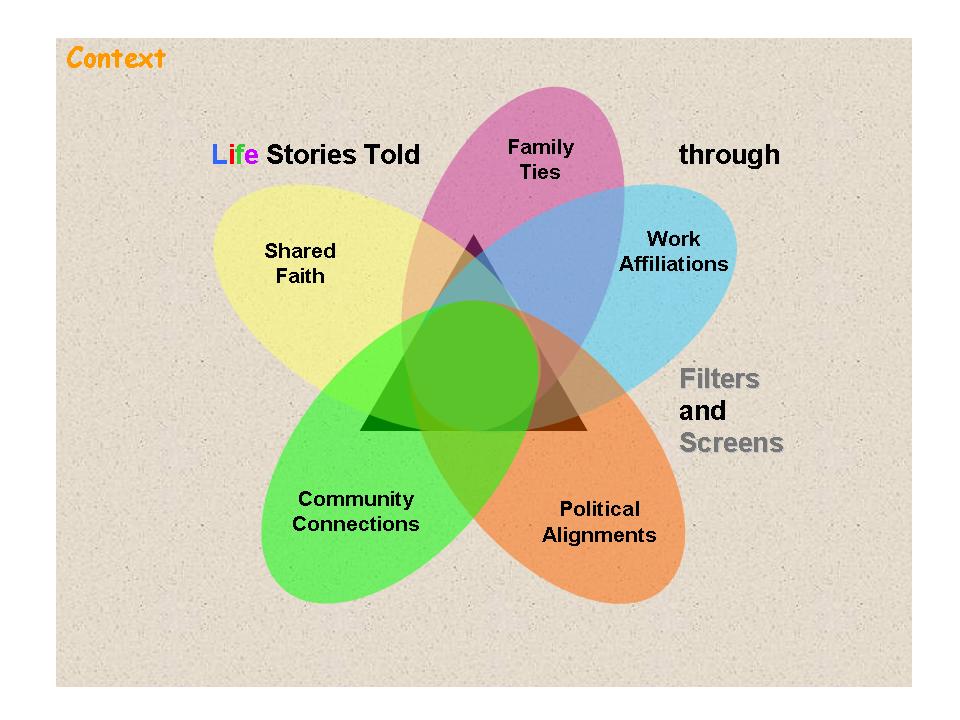
As mentioned in an earlier post, integrity is manifested through the filters and screens that make up the various affiliations in a person’s life. Some of these affiliations are stronger, newer, and exercise greater influence than others. Because of these differences, integrity is not necessarily central in a person’s affiliation landscape as evidenced in the graphic below. Furthermore, this positioning is not static. As time passes, the filters and screens vary in intensity and significance, and the balance point for integrity shifts.

Filters and Screens

We humans are social creatures. We have highly evolved language skills and capabilities which we use to communicate with each other through conversation. These conversations convey meaning about us, our situations, our needs, and our aspirations. Essentially, they are our stories.

Stories are structured conversations we have with others about our experiences and the meanings they hold for us. Because of the influence exacted by filters and screens upon us, the stories we tell at one time may be quite different than the stories we tell at another time, place, and circumstance. Stories are contextual. The “truth” they express is relative.

As stated in an earlier post, establishing ground truth is a critical first step for knowledge brokers to ascertain behavior and communication patterns and make relevant responses be they positive or negative. Proclaiming one’s ground truth is an exercise of story-telling. Context is crucial if the reality that shapes a person’s story and truth can be well-understood and acted upon appropriately.

Stories are dependent on the conditions that exist at the time of their telling. The forum — who is in the conversation, where it occurs, when it takes place, and what processes are followed — and the agenda — topics for conversation, expected outcomes from the conversation, and next steps to be taken — are major determinants in how the story is told. Even the same experience shared by many will be related differently depending on the forum and agenda.

Knowledge brokers are concerned about ground truth because of the implications on communication patterns. Repeated over time, stories are reflections of sustained conversation themes and understanding. Changing forums and agendas changes these conversations. Changing conversations leads to experimentation and different experiences. New experiences prompt learning which leads to different stories in an attempt to make meaning out of the new experiences. These new stories influence recurring conversation themes. Told with sufficient frequency over time, stories change the underlying communication patterns and adaptation and evolution occur.

Originally posted to New Media Explorer by Steve Bosserman on Tuesday, September 6, 2005 and updated on Saturday, September 24, 2005

Integrity and Ground Truth

Each of us as individuals is endowed with a unique personality, temperament, and intelligence footprint. In addition, each of us holds a unique set of experiences and associations that span our lives from “womb to tomb”,” so to speak. The combination of these two provides us with the way we understand ourselves, interpret who we are in the context of the world in which we live, and make meaning out of what happens to us along life’s path.

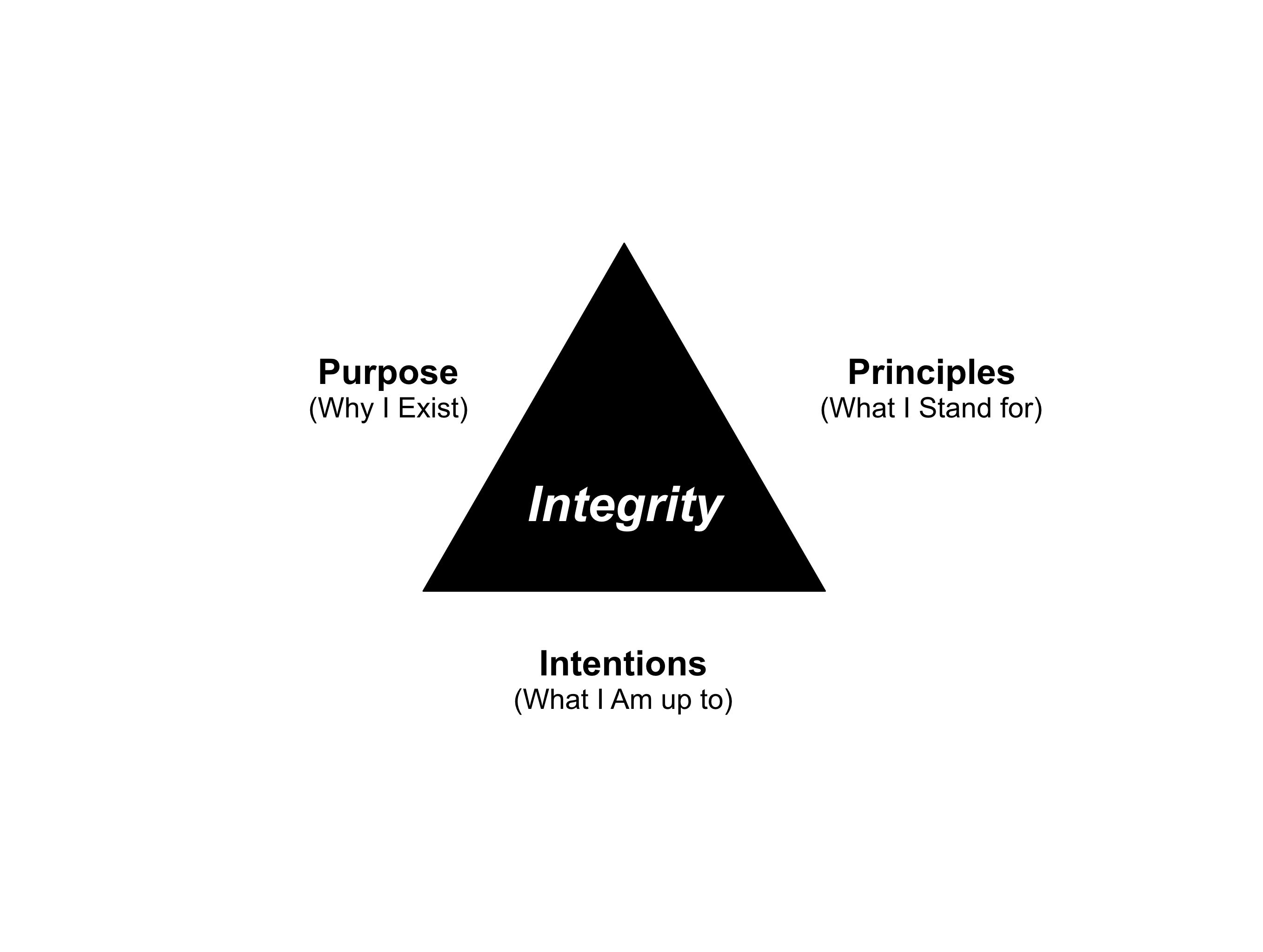
Because we are individuals, each of us sees ourselves as having distinctive characteristics in physical appearance, psychological profile, and “presence”” among others. The concept of presence is related to what is called “integrity.”” The diagram below shows the basic building blocks of integrity: purpose —- why I exist; principles— – what I stand for; and intentions – —what I am up to.

916f4183-484d-4019-ac71-6b61d57c7a9b

A person’s integrity is an inherent product of the life process. It is inevitable. The nature of our integrity is obvious regardless of our conscious and deliberate awareness of it.

This leads to one of our primary challenges: to KNOW what our integrity is. Only we can determine what are our purposes, principles, and intentions. Just like we can’t opt out and not have integrity, no one else can determine ours for us. And when we have even touched or deeply felt what comprises our integrity it remains ours alone; hence, the drawing is black and white just as our self-knowledge, though changing over time, appears at any given moment to be cut and dried.

Ah, if it was only that simple! Alas, we are social beings. Our lives are enmeshed with the lives of others. The diagram below positions the integrity of a person in the context of five general social categories wherein each of us is placed in relationship to others.

Family members, the locations where we live, our employers, the political platforms we advocate, and the religious beliefs we hold, etc. contribute to a “web” of experiences” we share with others and influence our sense of ourselves. These social structures have direct impact on the context in which our lives are conducted.

We tell stories about our experiences that project our integrity through the filters and screens of the groups to which we “belong.”” Our true selves – —our integrity – —is often concealed in the shadows overlaid by layers of interpretation about us that are not really ours. Those stories may or may not speak about how we really feel and what we really think and how we really believe, but how someone else wants us to.

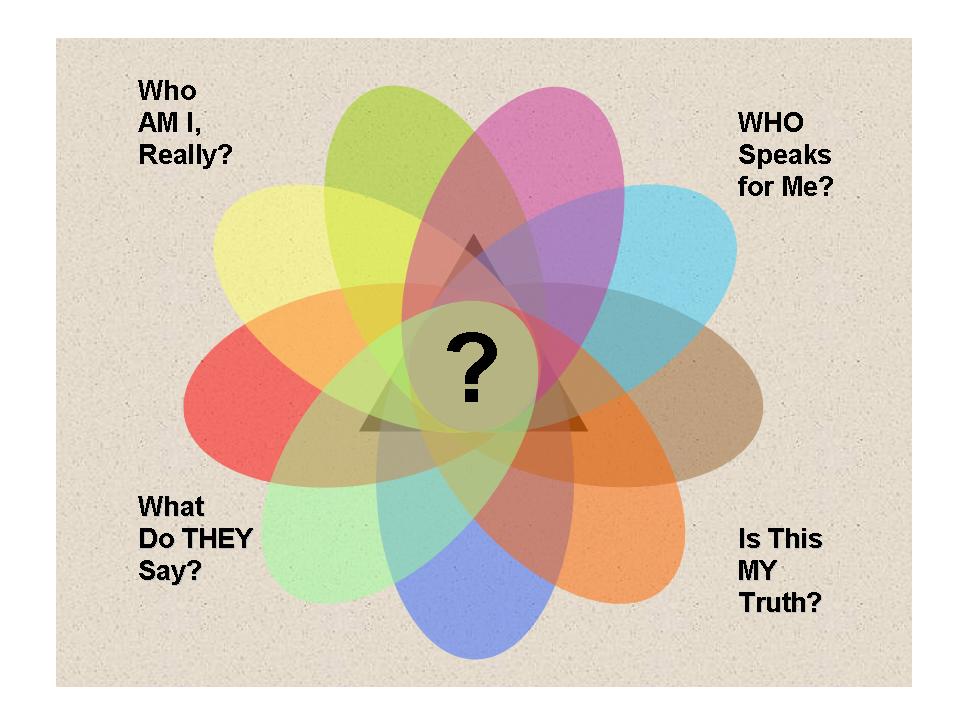
This theme is expressed in the illustration below. Because our relationships with others are lifelong, complex, and filled with nuances of meaning that extend from unrecalled memories, our integrity becomes lost in a maze of questions about who I am, who is speaking for me, what are they saying about me, and is this REALLY my truth being spoken.

Being lost is not a permanent condition. Being found is to confront the primary challenge mentioned above of knowing what integrity is and addressing the confounding questions honestly and openly. Peeling back the onion-like layers of representation that shroud our integrity is an exercise in independent investigation of truth – —a fundamental endeavor for a knowledge broker.

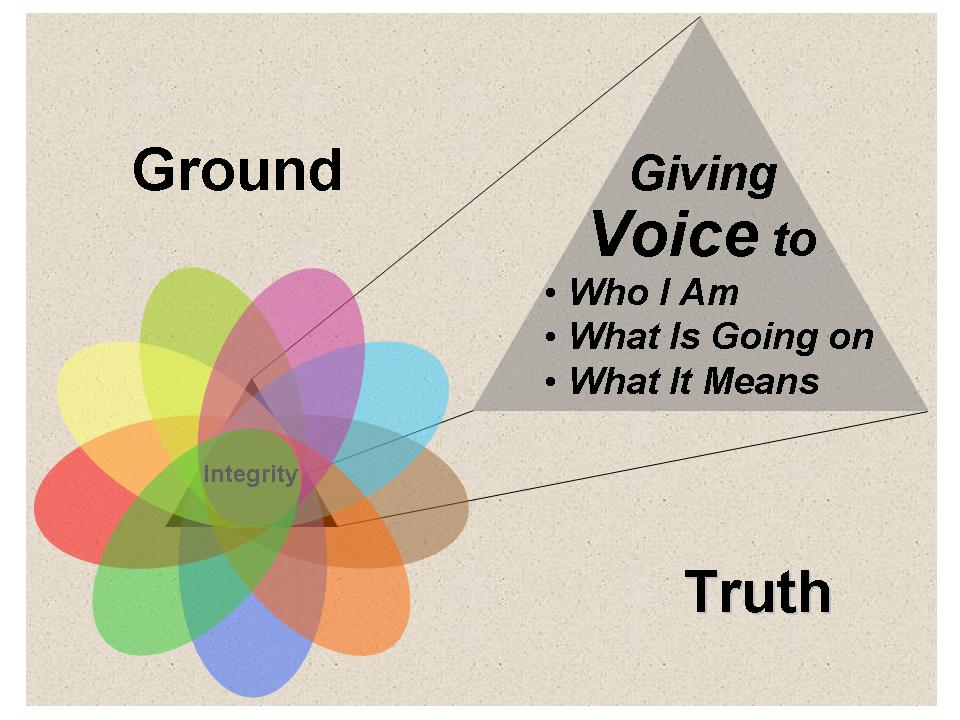
As the picture below suggests, aligning with our integrity “projects”” our voices. And with our voices, we can say who we are, what is happening to us, and what it means to us and others. In other words, we speak the ground truth and with that truth spoken and heard, the groundwork is laid for our participation rather than to have others represent us on our behalf.

Originally posted to New Media Explorer by Steve Bosserman on Wednesday, August 31, 2005 and updated on Saturday, September 24, 2005