239 Days in America, Day 29: May 09, 1912 | Washington, D.C.

It’s Not All Sunshine and Roses 1

Other churches in Washington also objected to ‘Abdu’l-Bahá. The Washington Post reported on April 29 that Methodists were praying for him — that he would see the light and go home. The Rev. Dr. James Montgomery told his congregation at the Metropolitan Memorial M. E. Church that he wished that “some of those who have listened to Abdul’s lectures would take the role of teacher themselves, and convert to Christ this remarkable priest of the ‘universal cult.’ ” While ‘Abdu’l-Bahá was “doubtless sincere,” he said, he hoped that becoming a Christian would enable him to “return to his Eastern home a greater man.”

Just four days ago, Dr. Ernest C. Smith reminded his congregation at St. Thomas’s Church, near Dupont Circle, that “By their fruits ye shall know them.” Nothing good could possibly come out of Persia, he believed, but the bigger problem was that ‘Abdu’l-Bahá raised other religions to the same status as the one taught by Jesus Christ, “whom we dare not compare.” “Because of these things,” Smith said, “the only Godspeed we can bid him is a Godspeed back to his own country.”

In spite of these reports, ‘Abdu’l-Bahá doesn’t seem at all perturbed by the negative press. He told one friend that he doesn’t worry about criticism. “The denunciation by the leaders of religion,” he said, “is a proof of the greatness and influence of the Cause because no one pays any attention to something insignificant.”

Cleveland, Pittsburgh, Washington, D.C.

On Thursday, May 9, people came to Him all day long. Many ministers invited Him to speak in their churches. When a few spoke against Him, He observed, “‘I deal with people very gently that they may not turn away and raise the least objection. Yet these ministers have accused us of atheism…’”. 2 3

Talk at Hotel Schenley, Pittsburgh, Pennsylvania, 7 May 1912

The fourth principle or teaching of Bahá’u’lláh is the readjustment and equalization of the economic standards of mankind. This deals with the question of human livelihood. It is evident that under present systems and conditions of government the poor are subject to the greatest need and distress while others more fortunate live in luxury and plenty far beyond their actual necessities. This inequality of portion and privilege is one of the deep and vital problems of human society. That there is need of an equalization and apportionment by which all may possess the comforts and privileges of life is evident. The remedy must be legislative readjustment of conditions. The rich too must be merciful to the poor, contributing from willing hearts to their needs without being forced or compelled to do so. The composure of the world will be assured by the establishment of this principle in the religious life of mankind.

The fifth principle or teaching of Bahá’u’lláh is the abandoning of religious, racial, patriotic and political prejudices, which destroy the foundations of human society. All mankind are creatures and servants of the one God. The surface of the earth is one home; humanity is one family and household. Distinctions and boundaries are artificial, human. Why should there be discord and strife among men? All must become united and coordinated in service to the world of humanity. 4

Thursday, May 9, 1912 5

There was a continuous going and coming of visitors at the Master’s house from morning until noon. ‘Abdu’l-Bahá had lunch at Mrs Parsons’s, where in the afternoon He received many people. In the evening He addressed a well-attended meeting, speaking on the principles and tenets of the Faith and counseling the friends to pay no attention to those who objected to the Cause. As the fame of ‘Abdu’l-Bahá and the Cause spread, certain narrow-minded ministers had, out of jealously, raised their voices in opposition. At the end of the meeting the Master said:

“Although I pay great respect to the feelings of people in order that they may not run away or make the least objection, yet the religious ministers of Washington have denounced us.”

Then He said:

“The denunciation by the leaders of religion is a proof of the greatness and influence of the Cause because no one pays any attention to something insignificant.”

Today various clergymen invited the Master to honor their churches by addressing their congregations. He told them that He was unable to accept because He had limited time but that He would be returning to Washington DC.

  1. Menon, Jonathan. “It’s Not All Sunshine and Roses.” 239 Days in America, May 9, 2012. https://239days.com/2012/05/09/its-not-all-sunshine-and-roses/.
  2. Bagdadi, Zia. “‘Abdu’l-Bahá in America,” Star of the West, 19, no. 5. (Aug. 1928) 141.
  3. Ward, Allan L. 239 Days: ʻAbdu’l-Bahá’s Journey in America. Wilmette, Ill: Bahá’í Publishing Trust, 1979, 64.
  4. ʻAbduʼl-Bahá. The Promulgation of Universal Peace: Talks Delivered by ʻAbduʼl-Bahá during His Visit to the United States and Canada in 1912. Edited by Howard MacNutt. 2nd ed. Wilmette, Ill: Baháʼí Publishing Trust, 1982, 107-108. https://www.bahai.org/library/authoritative-texts/abdul-baha/promulgation-universal-peace/7#904155405
  5. ’Abdu’l-Bahá, and Mirza Mahmud-i-Zarqani. Mahmúd’s Diary: The Diary of Mírzá Mahmúd-i-Zarqání Chronicling ’Abdu’l-Bahá’s Journey to America. Edited by Shirley Macias. Translated by Mohi Sobhani. Oxford: George Ronald, 1998. https://bahai-library.com/zarqani_mahmuds_diary&chapter=3#section46.

At the Bottom of the Pyramid, It’s Looking Up

A simple application of the Pareto Principle suggests that 20% of the world population controls 80% of global assets, wealth, or resources. Certainly the report entitled “Wealth, Income, and Power” by sociologist G. William Domhoff supports this notion as does the United Nations 2005 Report on the World Social Situation: The Inequality Predicament. The following graphic conveys this notion:

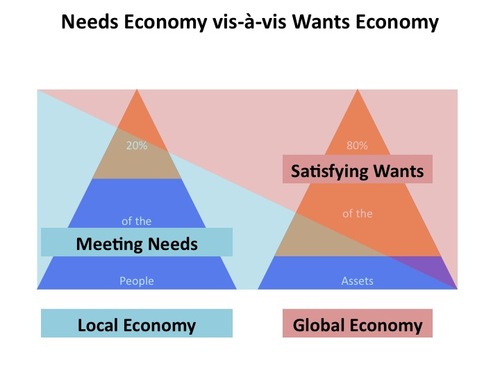
The 80% that have access to only 20% of the resources make choices about their survival and sustainability within a different economic system than those in the top 20% of the socio-economic pyramid. The diagram below offers further definition of these two economic systems. The 80% participate in a “needs economy” that focuses on delivering the essentials of a life: food, water, air, energy, fuel, housing, clothing, safety, security, health, and education.

Because a needs economy strives to meet the basic requirements for quality of life among people in a given area, it is deemed a local economy in that the participants have extensive social relationships among family, friends, and community members. It is the strength and scope of this social fabric that provides the platform for self-sufficiency and sustainability of the body politic and keeps the door open for a wide range of choices.

In contrast, 80% of the world’s assets are marshaled into the design, production, and delivery of products and services that attempt to satisfy an insatiable demand for everything and anything. A “wants economy” is a most apropos label. And because no place on earth is exempt from the compelling effects of its all-consuming nature, it is truly a global economy.

Choices in a wants economy are limited by the means available to act on those alternatives. The lack of self-sufficiency and sustainability garnered from a global or wants economy requires a heavy political investment—a constant feeding of the bureaucracy—to exercise a level of diplomacy sufficient to assure an uninterrupted supply of essentials. At times, the burden imposed upon society to maintain such a complex and bloated political system becomes too much and a sorely-needed adjustment ensues. But such decline and renewal is inevitable in the cycle of life.

Despite these changes, the basic social units that give our humanity expression—family, friends, and community members—persist. They are the foundation upon which civilization is rebuilt and rejuvenated. In effect, these relationships constitute a vibrant local economy, which becomes the bedrock of survival, sustainability, and quality of life. So at the bottom of the pyramid, it’s looking up!

Originally posted to Open for Consideration on Tumblr by Steve Bosserman on August 19, 2010

Adding Value and Receiving Fair Compensation

There are three ways to add value: make something others need / want; provide a service others value, but not enough to do it themselves; and, deliver a totally satisfying experience around a package of something(s) made and services provided.

When I entered the business world in the U.S. some forty-plus years ago, it was all about exploiting natural resources elsewhere and making things in highly, vertically-integrated production enterprises. Over the last 25 years, there has been a distinct split between making things and providing services others would rather not spend their time doing, vertically-integrated firms were decentralized and distributed, and U.S. businesses have “gone global” in an effort to exploit human resources elsewhere. During the last 10 years, there has been a significant uptick in melding a particular desired experience with things and services to provide an integrated, experiential package. The work I currently do with businesses and non-profit organizations focuses on helping them take advantage of this shift and get more efficient and effective at doing the integration and promoting the anticipated experience with customers.

The process Andrius Kulikauskas followed in the Chocolate Project to collect and compile information about the chocolate industry yielded a potential goldmine of business opportunities. These include:

  1. Making things – beans, nibs, cocoa liquor, cocoa butter, cocoa powder, finished chocolate products ready for retail – up and down the value chain
  2. Providing services such as logistics, inventory management, quality assurance, traceability, trading, etc.
  3. Developing integrated, experiential packages using chocolate as the centerpiece -a posting from Idziak Waclaw outlined ways to think about such possibilities

For that matter, the process, tools, and techniques Andrius used for the project can be replicated in other projects where there is a similar opportunity to merge openness with the proprietary in ways that “do no harm.” Some of the approaches Andrius used in the Chocolate Project include the following:

  1. Working openly / working in parallel wiki where all the information gathered was categorized and posted for the world to look over the participants’ shoulders and see
  2. Focused moderation to keep collaborative energies and efforts in the spaces where the value would be greatest for the sponsor
  3. Direct correspondence with the sponsor to assure that proprietary boundaries are honored

No doubt there are more. The point isn’t to be exhaustively philosophical in what they are, but to apply the ones we can do elsewhere for broader benefit. As an example, currently, I am floating the concept of a wiki to a private sector client wherein key questions related to the business are posed by the moderator. The wiki is organized to “catch” the responses in ways that prompt more questions and accelerate the exploration of those strategic spaces where the client’s business will be heavily influenced over the next 5-10 years.

As another example, several colleagues and I are completing a grant proposal which will be submitted later this month that explores characteristics of leadership in institutional contexts where the key objective is to prompt a higher rate of adaptation and responsiveness within non-profit organizations. One of the major elements of the strategy we are proposing is the use of a moderated wiki a la the Chocolate Project. Our intent is to create an extensive library of information on the wiki about leadership that is open to all, yet we are able to extract and compile specific content into publications that target particular audiences within the non-profit arena.

The bottom line is that this approach can be leveraged / applied over and over again to generate an enormous amount of information on a particular subject, identify potential candidates to participate in a supportive broad-based network, and develop opportunities to add value. However, adding value is only half of the equation:

On New Year’s Day, there was a posting on the Yahoo! Group, Cyfranogi from Stephen DeMeulenaere, about the organization he represents – Complementary Currency Resource Center. It makes a strong connection between adding value and receiving fair compensation. When people are compensated, in part, with a complementary currency that remains in the local community where it was earned, its expenditure continuhttps://www.linkedin.com/in/stephendemeulenaere/es to benefit the community. The bulk of mainstream financial systems used to compensate people for value-add are extensions of hierarchical and global political / economic systems. They are organized to concentrate power and wealth in the hands of a few. As a result, when people are compensated solely by these global, federally-backed currencies their expenditures remove the purchasing power from the community to a place far afield from the point of value-add.

Unfortunately, there is no system we can devise that escapes this reality – inequalities among people drive inequalities in access to power and wealth. What we can do, though, is experiment with more locally-based, complementary currency systems that mitigate the forces of concentrating wealth on the global level from draining creativity, energy, and resources from local communities. Andrius’ approach to blending federally-backed compensation with home-grown complementary currency compensation on the Chocolate Project is a start. As this blending is pursued on other projects, the experience base will be broadened and the mettle of the emerging complementary currency systems tested so the combination between the two becomes more robust, scalable, and, ultimately, effective.

Projects born in a social network are only as good as there are participants representing a wide and comprehensive set of perspectives about the topics under consideration. People are attracted to these efforts within a social network by a variety of reasons: alignment on the values the project leader and other participants hold dear and readily espouse; affinity for and commitment to the cause being advanced by the project; recognition for performance which can be carried into other opportunities where more compensation is available; and, fair compensation for value-add. Obviously, the more of these a project offers the higher the likelihood of widespread participation. For this reason, if an alternative to federally-backed currencies can be offered which fairly compensates people for the value their contributions add then, the chances are substantially increased that the creative talent, skill, and expertise in the social network can be tapped. The challenge is to know that we are nowhere close to where we need to be and to keep trying!

Originally posted to New Media Explorer by Steve Bosserman on Tuesday, January 3, 2006