Understanding Diversity as a Dynamic

Diversity is closely linked to organization effectiveness and feeds the dynamics associated with garnering social power, distributing authority, and exercising leadership. Ross MacDonald, introduced in previous blog postings here and here, and Monica Bernardo co-authored a recent paper published in the Journal of Developmental Education, Fall 2005, Vol 29, No 1 highlighting their research on “diversity” and “ground truth.” Ross is warmly welcomed back to this blog to draw from his and Monica’s paper about this key topic. Ross, the floor is yours…

In previous articles about ground truth, I highlighted the importance of attending to multiple perspectives. In this entry I consider the issue of how well we listen to and to what degree we value multiple perspectives by focusing on the catch phrase, diversity. Nearly every organization must consider issues of diversity. Weighing in on diversity are federal mandate, state law, judicial threat, moral authority, public pressure, and pressure from employees. Clearly, leadership in any organization must consider “diversity issues.” Whatever that means. And that’s the problem as I see it.

Too many discussions about diversity fail to consider what it is we are talking about. In so doing we make diversity issues an onus and not an opportunity. We have typically answered the call for diversity by attending to the most superficial features of skin tone and gender and by trying to up the numbers of the under-represented. In so doing, we delude ourselves and others that a “head counting” approach is both powerful and meaningful. After all, it is easier to vary the color of faces than to listen closely to their experiences and alter our thinking about the complex dynamics of difference that play out among us. An exclusive focus on placing people into a set of categories based on gender, religion, ethnicity, sexual orientation, and so forth blinds us to the less visible and more complex dynamics of diversity of which we all are a part.

The problem is that this is a convenient kind of blinding; it allows us to assume that because we have satisfied a numbers requirement, we have achieved diversity. While adding people to the mix certainly has intrinsic value and moral force, we must consider what happens in that mixing. How are people interacting? How are those satisfying diversity numbers being positioned and perceived? Pursuing these questions in good faith and with open minds increases organizational capacity. Wouldn’t that kind of understanding be immensely useful to any organization looking to enhance employee relations, heighten team productivity, and serve a broadening customer base?

Therefore I propose that we pursue diversity as a continually expanding knowledge about the dynamics of difference. Considering diversity as a dynamic of difference requires questioning how we perceive, value, and act on differences among us in our organizations and communities.

Recent advances in astrophysics provide an apt analogy for understanding the dynamic of diversity. In studying the universe to search for the origins of energy and life, astrophysicists traditionally have relied almost exclusively on what they could see — visible light and its properties — to explain the universe and its workings. Similarly, in our work and social environments, traditional thinking about diversity also has attended to what we could most conveniently see, variations in skin tone and gender, to understand the complex workings of our social and organizational universes.

Now, however, astrophysicists have inferred the presence of invisible matter and invisible energy. Invisible matter is believed to be a key underlying dynamic of the phenomena of gravity. Invisible energy exercises forces so powerful as to compel the continuing expansion of the universe. Once scientists attended to their own false assumption that there was nothing there, they saw that there was in fact a great deal operating outside their view of the world. Once they attended to those things and their operations, their understanding of the dynamics of the universe changed dramatically. For an example, click here.

Similarly, the seeming invisibility of complex energies surrounding the dynamics of difference should not lead us to falsely assume that there is simply nothing there. Like invisible light and invisible matter, these dynamics of difference are very much a part of our world, representing little-understood forms of energy which, if understood more thoroughly, could propel organizations to greater understanding, acceptance, and profit.

What are the implications of the dynamics of difference for communities and organizations? We must first recognize that those who stand out when we count heads are very likely minorities and thus subject to daily uncertainty as to when ill-founded judgments are being made about them. In my thirty years as an educator who focused on programs for nontraditional students, I heard story after story about the uncertainty of daily life. Did the store owner ignore me because of an automatic belief that I have no money to spend? Conversely, am I being followed in the music store because the employee thinks I am going to steal something? Are my children being tracked into lower expectation classes because of their skin color? In my work with organizations I have repeatedly heard questions such as the following: Am I being positioned on this work group because of my skills and knowledge like everyone else or is my skin tone being positioned to create the look of diversity? Does hiring an affirmative action officer deeply invest all employees with acting affirmatively or does it allow them to shift responsibility solely to the office of affirmative action?

Yes, these actions happen daily. Yes, there are situations which may look like these where there is no malice but still the harm. And yes, some situations lack both malice and harm. But it grinds on people to deal daily with the uncertainty and to have those who don’t deal with these uncertainties discredit reports of that experience. This daily uncertainty is a fundamental part of being different but is less detectable and thus believed less credible by those in the mainstream. Therefore an important part of the dynamic of diversity is that those who are perceived as different must daily try to navigate these situations and deal with the uncertainty presented to them. Click here for a wide range of resources.

Many of those not perceived as different just don’t understand this. Their detectors are not calibrated for this subtle dynamic. They can justifiably condemn the dramatically evil and violent acts stemming from prejudice in cases such as Matthew Shepherd and James Byrd Jr.. In contrast, however, the day-to-day grind of being different is not as easily detected by those who haven’t lived it. Like previous astrophysicists, they have falsely assumed that because something wasn’t visible to them, there was simply nothing there. Yet the presence of those moment-to-moment reminders of difference and the on-going uncertainty about whether those judgments are at play in any given circumstance are key components of the dynamics of diversity. We must therefore attend to them.

Moreover, attending to this dynamic creates opportunities to position people’s heretofore invisible energies in ways advantageous to the central purposes of an organization. Why is it that, when a major bank hires Spanish-speaking tellers in its branches in Spanish-speaking communities, its customer base expands? The obvious, easily seen reason is that the teller and the customer are of the same culture, speak the same language, and can therefore relate. Following that logic, a bank should identify languages spoken in various communities and hire tellers accordingly. Is this really possible? Consider that in Southern California’s 181 school districts and 2,000 public elementary schools, more than 90 languages are spoken.

But is there more to it than language? Is it a kind of resonance which is communicated from the teller and believed by the customer – an understanding of what it is for an outsider to access the bank and of how to make a smoother connection between the bank’s resources and its customers’ needs? Is it a kind of “seeing” of that customer that others don’t? Suppose these and other factors other than language are at play and can be trained in tellers, loan agents and branch managers? If so, then it would certainly benefit the bank to invest all employees in connecting with the customer base just coming into view. We will only know if we ask the question and peer into the less visible light.

In both the universe and the workplace, there is much to be learned from what we haven’t seen. A critical step is to recognize the limitations of one’s vision – in the case of astrophysics, the limitations of telescopes and mathematical models — and in the case of organizational leadership, the limitations of identifying diversity based only on that to which we have historically attended and is most easily seen. In the same way that scientists gained tremendous insight by gazing into those formerly invisible areas of space, so might we see the ‘invisible’ dynamics by gazing into the less seen areas of marginalized people’s experiences — if we simply direct our attention there. Understanding these ground truths and shaping them into positive assets increases social cohesion and business productivity.

Originally posted to New Media Explorer by Steve Bosserman on Sunday, February 19, 2006
Ground Truth and Multiple Truths

In Ross MacDonald’s last entry, “A Richer Concept of Ground Truth,” he discussed issues surrounding claims of truth and grounding as a way of opening up discussion about the concept of ground truth. In this entry Ross further explores the concept by discussing the related topics of multiple truths and their benefits, subjectivity and objectivity, and differences between open thinking and permissive processing of multiple truths. To help illustrate the ideas presented he will refer to the example of a developing ecotourism project in the spectacular mountains of Uttarakhand, Northern India. Take it away, Ross!

Uttaranchal Project

Uttaranchal, which translates as “Northern Mountains,” is a small state in the far north of India, bordering Tibet and Nepal. Site of the Ganges headwaters, the region has attracted many Hindus on annual pilgrimages, but, despite its alluring mountains and interesting culture, it is far less known on the international ecotourism scene. I am working with Manor Bhatt, currently a Ford Fellow at Columbia University’s Graduate School of International and Public Affairs while on leave from his senior position with the nongovernmental, environmentalist organization Shri Bhuvneshwari Mahila Ashram. Mr. Bhatt is a life-long resident of Uttaranchal.

The goal of the project is to support a sustainable, locally-owned and operated ecotourism industry based on a complicated formula of (a) building needed infrastructure of roads, water, sewer, reliable power; while at the same time (b) developing local capacity to provide eco-tourists with an enjoyable and stimulating experience; so as to (c) catalyze and support strong environmental and cultural protections; while (d) generating local income. Creating this synergy is expected to result in a sustainable tourist industry, reduction in resident’s out-migration for income, a curtailing of deforestation, maintenance of existing cultural practices and identities, and increased social and economic opportunities for residents of the region especially including women. My task is to design an on-going evaluation of the project and enhance local capacity to gather data related to project goals, to make sense of that data, and continuously improve the fledgling industry.

Multiple truths

A key part of the evaluation effort will be to recognize that multiple and conflicting truths will be abundant in the data — especially regarding some facets of the project, such as tourist satisfaction and awareness, changes in opportunities for women, and local’s assessments of tourism’s impact on local culture. Paradoxically, accepting the presence of multiple realities, even as they conflict, will actually contribute to the objectivity of the analysis. How can this be true? Aren’t individual truths each highly subjective?

That is exactly the point. Our impressions and experiences are obviously subjective, but in their collective and when considered intelligently, they yield insights and perspectives not available otherwise. In effect, because we are working in the realm of the social sciences, not in the physical sciences or religion, one more appropriately seeks truths with small “t’s.” Indeed, seeking these small “t” truths is not imprecise thinking, but actually a necessary precondition for the pursuit of objectivity. We strengthen objectivity by intelligently seeking and thinking about the many subjective realities present in the situation under study and especially by considering the perspectives of those who have been excluded or marginalized by a majority. For more detailed discussion see: Harding, Sandra. “Rethinking Standpoint Theory: ‘What Is Strong Objectivity?'” Feminist Epistemologies. Ed. Linda Alcoff and Elizabeth Petter. New York: Routledge, 1993. 49-82.

Three benefits of the pursuit of objectivity through multiple truths

Seeing objectivity as a pursuit rather than a stance has several advantages for the Utteranchal Project. Three of these benefits are introduced and briefly illustrated.

  1. Accepting the value of multiple realities helps groups transcend the tendency to engage endlessly in debilitating arguments over whose truth is more true. Such arguments can only be “won” by invalidating other points of view. These arguments shut down any consideration of our commonality expressed in different ways. If, for example, 90% of eco-tourists report satisfaction with how they were treated by ecotourism providers, then aren’t the 10% who report being uncomfortable just plain wrong?
  2. Compensates for the effects of more dominant personalities or more privileged participants disproportionately influencing an analysis. If, for example, the mayor of a village and a number of villagers claim that that local residents are economically benefiting from the project, but one segment of the population disagrees, then we need to ask who disagrees and why? Or consider the possibility that only 10% of the eco-tourists are women of color but, in comparison to the other 90% of eco-tourists, they report feeling much less comfortable in their interactions with trail guides, guest house hosts, and travel coordinators? While any process of averaging responses would bleach out this important information, consideration of it as a truth, even though it doesn’t fit with other truths, gives it a more important and preserved relevance.
  3. Multiple realities means that it is possible to see common themes. Beyond the particular details of people’s stories about their experiences, are likely elements that recurrently echo each other. Identifying these elements and attempting to understand them involves respecting the different forms these elements take across stories. In this way a person’s individual experience is preserved, while at the same time people’s connections to each other are reinforced. An obvious outcome might be a recurring theme among eco-tourists of deep appreciation of the spectacular beauty of the region coupled with a deep awareness of the vulnerability of the ecosystem. The ways in which each individual experiences this conundrum will vary but the common humanity of the sentiment binds people together — a necessary basis for working for change.

Openness and permissiveness

This form of truth gathering is an open process but not a permissive one. Open means that one consciously remains in a state of “willing to consider” experiences, perspectives and ideas different than one’s own. Being open also means that we are aware that no matter how broad-minded we think we are, we still must recognize the limitations of one’s own views. Bringing other perspectives into our view broadens the horizon of possibilities. It is common to presume that openness means permissiveness — the blind acceptance of all perspectives or ideas as equally valid. Many presume that thinking critically about perspectives somehow violates the principle of openness. In fact, permissiveness is a type of poor thinking (presumption of equal merit) which actually short-circuits more beneficial analysis. Blind acceptance of all experiences shuts down, rather than opens up, understanding. For openness to have value, it must be accompanied by an acute mindfulness.

Originally posted to New Media Explorer by Steve Bosserman on Wednesday, January 25, 2006

A Richer Concept of Ground Truth

In a previous post, I explored the role people play as “social sensors” in the generation of “ground truth.” A colleague of mine, Ross MacDonald, who is co-authoring a book with me about collective leadership in the non-profit sector, suggested that ground truth is a far richer concept than what I had explained in my posting. He offered to write a series of “articles” about ground truth that would provide different ways of seeing how this concept could be understood and applied in diverse social settings. Because ground truth is so essential to healthy adaptation in social systems and is integral to the design of successful frameworks for change, his offer could not have been more timely and appreciated. What follows is the posting of his first article. I thank you in advance for giving his ideas careful consideration. We both look forward to your comments! And now, Ross…

In his aforementioned blog posting, Steve Bosserman provides a brief but thoughtful definition of ground truth in a predominantly social context. This response is the first in a series of short articles exploring more fully the concept of ground truth. The entries are based on my work creating sustainable links within and among community groups, government entities, businesses, education, and individual – especially those people who have been historically ignored or poorly served. This first entry looks closely at the term “ground truth” in order to further sensitize our understanding of its applications to adaptive learning in social systems.

Ground truth refers to the information provided by people and instruments on site which assesses the accuracy and value of information and inferences derived from more removed sources, such as aerial photographs and satellite imagery. Consider for example that the French seem to be the first to use balloons for military aerial reconnaissance during a conflict with Austria in 1794. We will assume for the moment that a person making observations from a balloon constitutes remote sensing and imagine as well that civilian informants, reconnaissance patrols, and secret agents provided additional data on the ground. Taken together, observations from the scared soul in the balloon and additional reports from those on the ground enabled more effective strategic and tactical adjustments. This deliberate triangulation of information is the fundamental process for seeking ground truth.

Uses of the term ground truth are easily found today in a wide range of fields including agriculture, anthropology, biology, earth sciences, geography, landscape design, library sciences, medicine, music, physics, and zoology. A team of geologists, for example, might physically examine the ground at a specific site to confirm the nature and possible causes of temperature changes detected from satellite imaging. Should the team document a change in underground geothermal activity on site, then the remotely-detected temperature shift is better understood. As remote sensing technology has advanced, it has became less dependent on human operators / observers, leading to an increased demand for humans to do something on site to authenticate data and sharpen inferences. As a result the term ground truth is entering the public parlance.

So the term “ground truth” is both a label for a process and a label for a product. The process of ground truth is to have a person or persons at a given site with instruments so as to verify and sensitize remotely sensed phenomena. The product of ground truth is more accurate and reliable information.

The very label ground truth has appeal – but if understood superficially it is more of an appeal to shallow hubris than to good thinking. The term lays claims to “truth,” and truth, after all, connotes a definitive and irrefutable reality. How satisfying it is to capture the high ground by positioning one’s belief as truth! A famous scene from Woody Allen’s movie “Annie Hall” illustrates. In this scene, Alvy (played by Allen) and his charming girlfriend Annie (Diane Keaton) are waiting in line for a movie. Alvy becomes increasingly annoyed with what he believes are the empty and inaccurate pontifications of a pseudo-intellectual also in line. Alvie, convinced that the pedantic snob is completely mis-representing Marshall McLuhan, enacts an everyman fantasy when he pulls the real Marshall McLuhan (playing himself) from out of a billboard. McLuhan, at Alvie’s direction, beratingly refutes the veracity of the annoying snob, stating “You know nothing of my work!” – much to the satisfaction of Alvie and everyone else who has wished for such a moment.

Ahh, ground truth! However, as subsequent blog entries will explore, this level of truth is indeed elusive. As tempting as Alvie’s triumph is to all of us, we should be skeptical of such absolute truths whether seen in the fiction of a movie, proclaimed from intolerant political or religious pulpits, or announced in scientific press conferences. It is important to distinguish multiple truths and their small “t’s” from “The Truth” and its capital “T.” A future blog entry will reveal the higher value of multiple truths to understanding and improving human social systems over the misleading value of a claim to a single Truth.

The “ground” in the label ground truth also explicitly lays claim to a tempting position: the false pride of being on solid turf in one’s assertions. Being grounded stands in implied contrast to an ethereal disconnection from practical matters. As in Truth with a capital “T,” there is a temptation in the label of “ground” to validate one’s belief by simply planting a sign claiming one owns the Truth. Very familiar but counterproductive language often accompanies such hollow claims: “I’ve been doing this for thirty years and believe you me . . .” In this kind of claim, a person is essentially saying, “because I am more grounded than anyone else” (“thirty years doing this”), “my truth is The Truth” (“believe you me”). By falsely laying claim to the most solid ground, this kind of approach attempts to gain validity by rendering other truths invalid. Such a mixture of brute power with self-aggrandizing opinions is directly antithetical to the search for multiple perspectives and more sophisticated reasoning about them which characterizes ground truth inquiry.

An interesting case is Lloyd Bentson’s famous retort to Dan Quayle’s self-comparison to John F. Kennedy during the October 1988 vice presidential debate. Bentsen’s ground truth about the comparison? “Senator, I served with Jack Kennedy. I knew Jack Kennedy. Jack Kennedy was a friend of mine. Senator, you’re no Jack Kennedy.” Bentsen grounds his position by reminding us that he “served with”, “knew” and was friends with Kennedy. Although the Dukakis-Bentsen ticket suffered a landslide loss, Bentsen struck a public chord. Many people and certainly many democrats believed as well that Quayle paled in comparison to JFK. Bentsen’s remark aligned with the less dramatically staged opinions of many others, profoundly stigmatizing Quayle’s vice presidency. But we must remember that regardless of what one thinks of Quayle and regardless of how well Bentsen positioned his analysis; Bentsen’s statement was only one observation from one source. That so many agreed with it and that it had such a profound effect derives from the alignment of all those ground truths, not just from Bentsen’s moment on stage.

Ground truth refers to both a product and a process which, despite potential for prideful misappropriation, is of tremendous value for improving organized human activities.

At its best, ground truth labels a set of practices by which multiple sources yield better knowledge and so empower humans to adapt and improve their practices. This is the very work we do in my company, ground truth consulting. In my next entry, I will discuss particular ground truth processes and underlying ethical principle by discussing two specific projects: a Himalayan eco-tourism project in the north of India and an upcoming, collaboratively produced book on academic leadership.

Originally posted to New Media Explorer by Steve Bosserman on Tuesday, January 10, 2006

Ground Truth and Social Sensors

Ground truth is the unfettered and unfiltered relating of people’s experiences within a human social system. It can be associated with a specific event at a particular point in time, such as personal interviews with survivors on December 26, 2004 in Sri Lanka shortly after the devastating tsunami struck. It can be the review of a series of experiences across a period of time such as follow-up interviews with those same Sri Lankans who were interviewed originally to understand how their circumstances are changing. It can be the stories told about how members of a social system, who experienced a catastrophe like the tsunami, adapted their social, political, and economic structures in response; namely, what worked, what didn’t, and what changes to make. Ground truth is given when people speak for themselves. It is the ONLY way a human social system knows what is REALLY going on.

People who deliver their ground truth are acting as well-functioning “social sensors” in a broader social system. They draw upon a wide range of information and communication technologies (ICT) e.g., websites, email, blogs, wikis, with land-line, cellular, and satellite connections from locations throughout the world, no matter how remote, to relate their experiences instantaneously and continuously. Social sensing parallels similar functions within mechanical and biological systems. In fact, there is a point of convergence between scientific and social sensor development paths that establishes the possibility of two working together in a highly interrelated manner that enables large, complex systems to be better managed.

Sensor technology, too, has it roots in ICT. The earliest application of ICT during its commercial development was data collection. People would make manual entries into databases of data they and others collected utilizing various measuring devices at certain points within factory or office operations. The computer would use programs to analyze those data and put them into an informational format that could help interpret what was occurring and develop responses to improve the processes or procedures.

One of the first areas where ICT quickly developed in the 1970s and 1980s was in sensor technology. With increased capability and reliability, sensor technology contributed significantly to the replacement of humans as the means through which data was collected and entered into databases. Further developments over the last 15-20 years greatly reduced the size and power requirements for sensors, and increased the sophistication and range of type and capability of sensor technology. Now, sensors are pervasive; they influence almost every aspect of our lives and endeavors. And they continue to displace people from those activities where consistency, repetitiveness, quality, and reliability are essential for effective and efficient operations.

Of particular significance in these developments and displacement is the degree of integration and compatibility between what is being sensed and what is doing the sensing. Today, extensive sensor networks are carefully nested within all manner of systems: mechanical, chemical, optical, biological, and social. Regardless of application, these sensor networks monitor and evaluate conditions which become feedback in larger, adaptive systems that devise corrective strategies and take appropriate actions in response. The key to their success is the accuracy and timeliness of their input as well as the pervasiveness and comprehensiveness of their coverage.

In many ways, the human body is a complex web of sensor networks. Millions of nerve receptors of different types and functions are distributed throughout the body and send continuous signals through the central nervous system to the brain where they are processed and given responses. And like any sensor network, the quality of the response is tied directly to the quality of the input.

Despite highly evolved and elaborate redundancies that function effectively the vast majority of the time, our senses can be fooled: hot can feel cold and vice-versa; we see mirages we believe are real; we hear sounds when there is silence; odors we smell and taste evoke memories that do not accurately reflect what we are experiencing in the moment. And as in the interplay between sensor networks and the larger systems they help regulate, there are different ways of analyzing and processing input with each eliciting different responses. Furthermore, we can ignore sensory input or respond in ways that override evidence suggesting a more appropriate course of action. So, regardless of how well-designed the system and how well-refined the processes, the arbitrariness and irrationality of our decision-making have the potential to bring it to naught.

Like the human body, human social systems are vast sensor networks. Each member of the system is a “sensor” who “reports” on conditions as they are experienced. The system – comprised of hierarchical political, economic, and social structures that operate according to sets of self-serving rules – sorts, aggregates, and analyzes data entries from sensory members in an effort to understand, interpret, determine response possibilities, consider alternatives, and decide on a course of action. Of course when considered on a global scale there are myriad social systems in play simultaneously. Members of one social system can concurrently be members of others. Interpretation of sensory input in one social system can elicit a different response compared to what happens in response by another social system. The key determinants are rank, status, and position in the formal structure and presence, voice, and passion in the informal structures.

Human social systems are analogous to the human body in other ways. There are over 6 million people in the world. The human body consists of billions of cells. Thousands of people die and thousands more are born every day. Millions of cells in the human body die daily and millions more are regenerated. Of the thousands who are born, live, and die each day, I have the opportunity to know only a handful. I know my body, in general, through its organization by function, role, and relationship of one part or system to another. Most of it I will never see and I don’t have to; I trust that it will do what it should without my deliberate attention if I follow simple rules of good health in terms of diet, nutrition, exercise, and rest. Similarly, most people in the world obey the rules of the social system to which they belong. These rules present choices and people decide in ways that permit them to adapt to current circumstances, but preserve the integrity of the system. Behavior is managed and people stick by the intent of their roles, responsibilities, and relationships.

What happens when taking care and following the rules is not enough? Even when we do our best to prevent it, inevitably, our bodies get sick. Sensory cells we seldom hear from send messages that indicate they or the systems to which they belong are in trouble. Depending on the nature of the condition they are signaling there is a wide array of prescriptive treatments from which we can select. These can be non-invasive wherein normal functions of the cells and systems are restored through medications; or invasive through the repair, removal, or replacement of tissue. The same phenomenon occurs in social systems. People in their “sensory roles” relate experiences wherein the system – no matter how well-designed the rules and how noble the principles and ideals that frame them – fails to respond within an acceptable range. Functions break down; remedies are required. In some instances a simple reinterpretation of an existing rule is all that is needed. Other times, though, more radical steps are in order such as rescinding laws and enacting new ones, closing operations and opening others, and eliminating products or canceling services and offering of others.

Oftentimes, we do not heed the early warning signals from our bodies indicating something is amiss and what was once easily restored must now be repaired, removed, or replaced. The sensory networks did not fail, but we chose through our heads or hearts to ignore the input, e.g., “I don’t feel any pain” or “I don’t see any bruises” or to not give the input appropriate attention, e.g., “It will go away” or It’s nothing.” Because the human body is marvelously adaptive, this approach works to some degree, but the performance of the whole and the cellular arrangement and functioning that comprise it are compromised. We live with it in a compromised state or we take more radical steps to correct or reverse the damage.

Again, there is a clear parallel within human social systems. Billions of people in the world have a nearly infinite variety of experiences daily. How do these experiences fit the frameworks of the social systems to which people are members? Where are there anomalies between expectations and experiences? Do these differentials drive responses? Is the system stretched beyond its limits to adequately respond and more deliberate and protracted strategies are needed to spur deeper adaptation? To know the answers requires being attentive to the “sensors.” It means getting to “ground truth” with people in the system about their circumstances.

Establishing ground truth is a three-step process:

  1. Ask people for the truth about their realities and encourage them to tell their stories openly
  2. Hear their truth, once offered, understand it; and commit to respond with appropriate action
  3. Follow-up afterward to confirm that the responses were, indeed, appropriate and that the current situation is corrected and steps are underway for longer term changes in the system preventing recurrence of the problems

Just as we do not heed messages within our bodies we do the same in social systems. To know what is really going on requires ground truth. To not ask, listen, comprehend, and take action are just as effective in shutting down responsiveness and adaptation in the social system as it is with our bodies. Much of time it is for the same reasons: “don’t confuse me with the facts” and “if I am ignorant I cannot be held accountable.” Typically, we do not like change even though circumstances warrant it. In addition, we do not like to know about circumstances where change is needed because we will be challenged to take action – in other words, make it happen. Either way we claim we will lose focus and be distracted from the mission we are locked into at the time.

Just as the health of our bodies is compromised when warning signals are ignored or overridden, social systems become corrupted when the ground truth of members is not heard or heeded. Social systems can continue to function, in general, despite certain levels of corruption, albeit their effectiveness and efficiency are significantly reduced depending on the type, degree, and pervasiveness of the corruption. Change is particularly problematic in established social systems. Power concentrates in the tops of the ruling hierarchies, corruption increases, and along with it an aversion to change that might disrupt the structure, grows. As a result, these hierarchies uphold tenets and “rules” that support the dominant culture remaining dominant.

Ruling minorities become increasingly distant from their ruled majorities. In so doing they become increasingly cut-off from what is really happening within the social systems they are charged to “protect and serve.” Ground truth exists in the heads, hearts, and souls of social system members whether it is sought after and cared for or not. People and their truth, like life itself, will find a way to express itself, even it means setting in motion disruptive patterns of behavior that threaten to totally transform the system in which they exist. David Brooks, in his editorial entitled, “Trade, Oppression, Revenge,” published in the NY Times on December 25, 2005, illustrates this point through a very recent example. The native Indian people of Bolivia, who comprise 65% of the population, dominated for years by a ruling white elite representing 3% of the population and controlling almost all of the resources in the country, used the democratic process to elect an Indian president. What is in store for the ruling minority of Bolivia and their repressive, exploitative policies? Something not nearly as pleasant as it could have been had the ground truth been spoken, heard, understood, heeded, and the outcomes confirmed.

Therein lays the challenge with respect to ground truth: some have to want to hear, some have to be willing to say, and others still have to respond to what the truth means about the design of the system and make changes accordingly. For any sensor to work effectively, regardless of type or application, its input signal must be captured, processed, and acted upon. This certainly pertains to people as social sensors in human social systems: their input is in the form of valuable stories to tell and their experiences constitute important feedback in regulating the function and adaptation of these same systems. Are you asking…and listening?

Originally posted to New Media Explorer by Steve Bosserman on Monday, December 26, 2005

Forums and Agendas

Conversation, —simply defined as a combination of verbal and non-verbal “statements” between two individuals,” —is the fundamental building block of human communication. Conversations can be real-time or asynchronous. Participants can be present, virtually or physically.

Regardless of how a conversation is enacted, at a minimum it strives to produce understanding. In many cases being understood is insufficient, especially when changes to one’s current condition are expected. A press ensues for agreement about what is, what that means, and what are possibilities for the future. With agreement in hand about a preferable condition it is possible to pursue commitment —the impetus for deliberate and purposeful action which drives experimentation, learning, and, ultimately, influence.

Any conversation, formal or informal,, consists of a forum and agenda. A forum is the context in which a conversation occurs. This includes who is in the conversation (invited and attending), where the conversation is held, what technologies are used to support the conversation, what date and time the conversation takes place, even in what language the conversation is conducted. The agenda is the subject of the conversation. Depending on psychological, social, and political factors, the agenda can be explicit and openly stated or implicit and hidden. In addition, there can be more than one agenda in a conversation each shaped by a different motivation and entertaining a unique position along the explicit-to-implicit continuum.

This blending of forum and agenda makes conversation an extension of complex human social behavior. Knowing the agenda(s) requires relating it to the forum in order to get a fuller sense of what is behind the conversation and a better interpretation of what are the expected outcomes of the conversation. Obviously, the more one knows others in the conversation and their contextual circumstances the higher the likelihood of accurately “reading”” the agenda layers and offering culturally appropriate responses.

Conversations are convened. Someone sets the forum and determines an agenda and others participate. Convening is an exercise of social power. Everyone is experienced at convening if nothing more than saying “Good morning!”” to another and soliciting a response. This requires minimal social power to extend the invitation for the other to join. However, depending on who are the desired participants in a particular conversation, differing levels of power are often required to garner the commitments of each to join.

Social power is directly related to the capacity one has to affect consequences for others. The more a person can influence the context in which the interests of others are advanced or met and costs are minimized, the more convening power that person has. Social power not only grants an individual the license to convene, it also permits a person to NOT invite. A conversation says much about the convening authority carried by the person who initiated it based on who is there AND who isn’t!

Knowledge brokers are conveners. They are granted the authority to initiate conversations based on the trust placed in them by participants that their “ground truths”” will be respected and their stories heard and understood. Knowledge brokers gain this trust because of the consistency and thoroughness with which they conduct personal investigations of truth then relate those discoveries in conversations where to speak one’s truth carries a potentially negative consequence. This capacity to know one’s truth, grant others the conversational space and opportunity to hold and state theirs, and pursue the lines of experimentation, learning, and influence that follow understanding, agreement, and commitment is a hallmark of a knowledge broker.

Originally posted to New Media Explorer by Steve Bosserman on Saturday, September 10, 2005 and updated on Saturday, September 24, 2005

Integrity and Ground Truth

Each of us as individuals is endowed with a unique personality, temperament, and intelligence footprint. In addition, each of us holds a unique set of experiences and associations that span our lives from “womb to tomb”,” so to speak. The combination of these two provides us with the way we understand ourselves, interpret who we are in the context of the world in which we live, and make meaning out of what happens to us along life’s path.

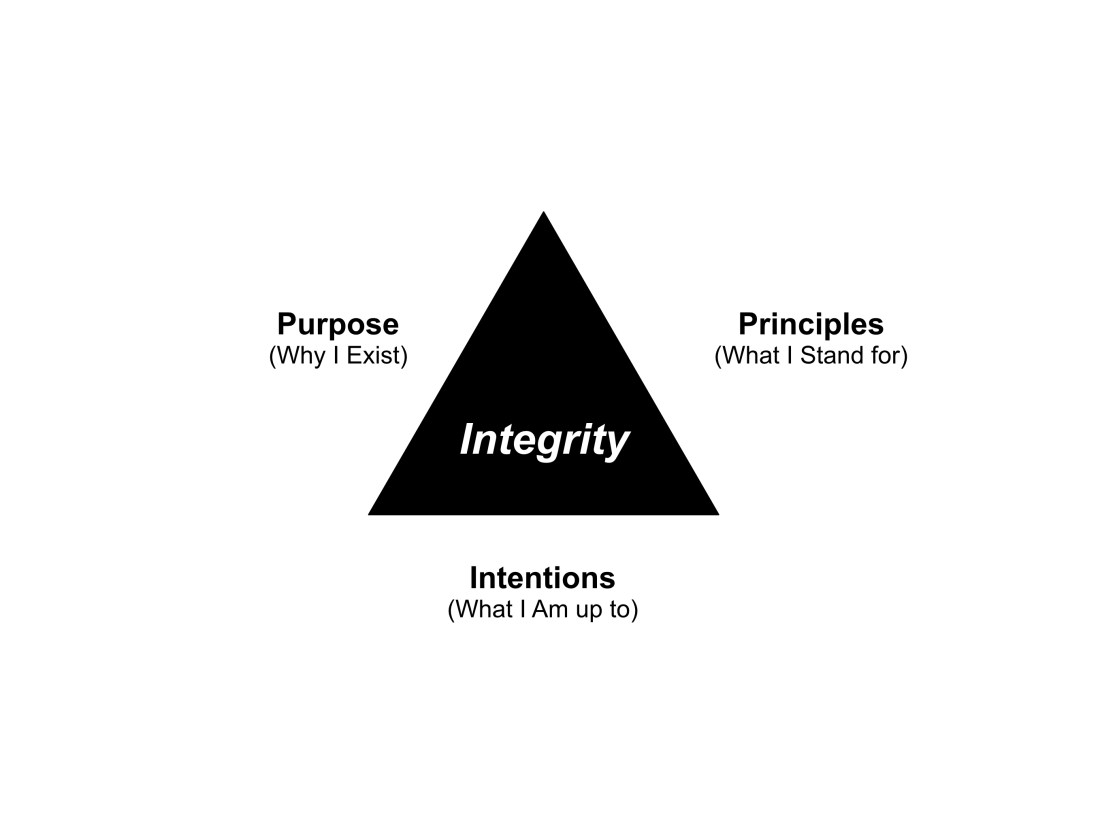
Because we are individuals, each of us sees ourselves as having distinctive characteristics in physical appearance, psychological profile, and “presence”” among others. The concept of presence is related to what is called “integrity.”” The diagram below shows the basic building blocks of integrity: purpose —- why I exist; principles— – what I stand for; and intentions – —what I am up to.

916f4183-484d-4019-ac71-6b61d57c7a9b

A person’s integrity is an inherent product of the life process. It is inevitable. The nature of our integrity is obvious regardless of our conscious and deliberate awareness of it.

This leads to one of our primary challenges: to KNOW what our integrity is. Only we can determine what are our purposes, principles, and intentions. Just like we can’t opt out and not have integrity, no one else can determine ours for us. And when we have even touched or deeply felt what comprises our integrity it remains ours alone; hence, the drawing is black and white just as our self-knowledge, though changing over time, appears at any given moment to be cut and dried.

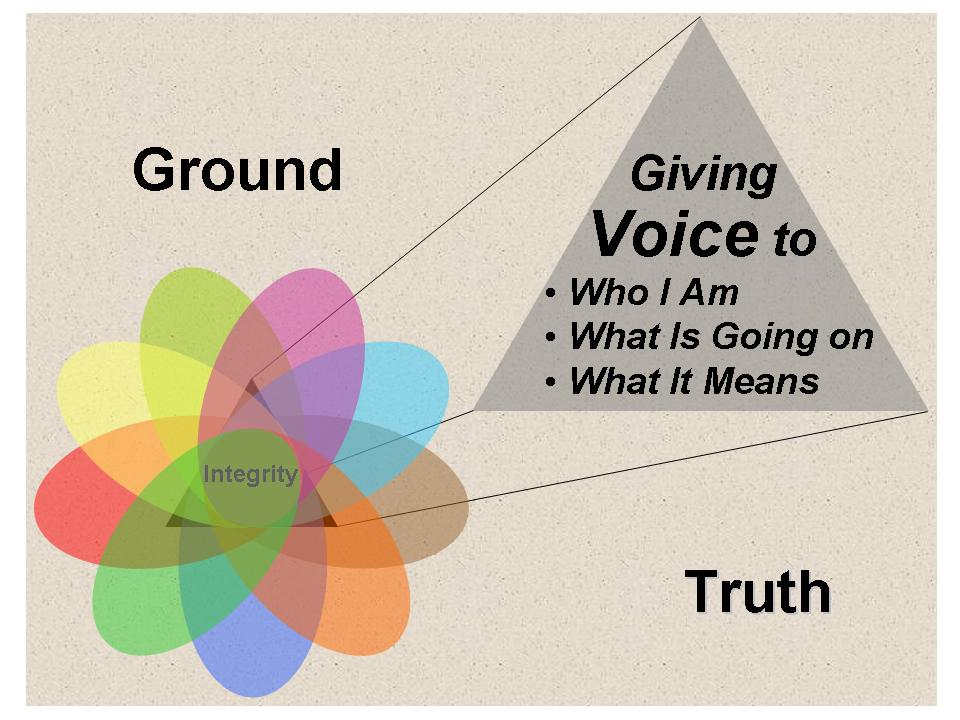
Ah, if it was only that simple! Alas, we are social beings. Our lives are enmeshed with the lives of others. The diagram below positions the integrity of a person in the context of five general social categories wherein each of us is placed in relationship to others.

Family members, the locations where we live, our employers, the political platforms we advocate, and the religious beliefs we hold, etc. contribute to a “web” of experiences” we share with others and influence our sense of ourselves. These social structures have direct impact on the context in which our lives are conducted.

We tell stories about our experiences that project our integrity through the filters and screens of the groups to which we “belong.”” Our true selves – —our integrity – —is often concealed in the shadows overlaid by layers of interpretation about us that are not really ours. Those stories may or may not speak about how we really feel and what we really think and how we really believe, but how someone else wants us to.

This theme is expressed in the illustration below. Because our relationships with others are lifelong, complex, and filled with nuances of meaning that extend from unrecalled memories, our integrity becomes lost in a maze of questions about who I am, who is speaking for me, what are they saying about me, and is this REALLY my truth being spoken.

Being lost is not a permanent condition. Being found is to confront the primary challenge mentioned above of knowing what integrity is and addressing the confounding questions honestly and openly. Peeling back the onion-like layers of representation that shroud our integrity is an exercise in independent investigation of truth – —a fundamental endeavor for a knowledge broker.

As the picture below suggests, aligning with our integrity “projects”” our voices. And with our voices, we can say who we are, what is happening to us, and what it means to us and others. In other words, we speak the ground truth and with that truth spoken and heard, the groundwork is laid for our participation rather than to have others represent us on our behalf.

Originally posted to New Media Explorer by Steve Bosserman on Wednesday, August 31, 2005 and updated on Saturday, September 24, 2005