Daily Frameworks for 25 June 2026

Istijlál, 02 Raḥmat (Mercy), 183 B.E.

Quotes for Reflection

The nature of the flourishing communities that the Bahá’í world is striving to raise has profound implications for the family. It is within the family that the individual is born and nurtured, and within the family that individuals begin to learn how to live together with others. The family unit is the basic building block of community, and beyond, of the entire social order. Therefore, a society fashioned to meet the requirements of the age of the maturity of the human race requires both a mature conception of family and an ability to extend the insights derived from that conception to the relationships that shape the nation and the world. “A family is a nation in miniature”, ‘Abdu’l-Bahá explains. “The conditions surrounding the family surround the nation.” Learning about a new pattern of family life is, therefore, an integral part of the effort to learn about the release of the society-building power of the Faith. — Universal House of Justice [1]

Question for Consideration

How can one apply the general call for Bahá’í s to “render service to the world of humanity” while focusing on the aim of an ongoing series of global plans for “the release of the society-building power of the Faith in ever-greater measures” to social endeavors in eldercare? [2]

Perplexity Computer Response

Conclusion

The Bahá’í vision for eldercare is neither a niche social service program nor a simple act of charity. It is an expression of the community’s deepest convictions: that every soul possesses eternal dignity; that the aging are “treasuries of wise counsel” whose gifts the community cannot afford to lose; and that true service builds society rather than merely managing need. Placing eldercare within the framework of the global plans — as one expression of “the society-building power of the Faith” — elevates it from a welfare concern to a civilizational project: the construction, neighborhood by neighborhood, of a community life in which no one, at any age, is rendered invisible, expendable, or merely a burden. [3] [4] [5] [6] [7]


Footnotes

[1] Universal House of Justice. “19 March 2025 – To the Bahá’ís of the World.” Bahá’í Reference Library. https://www.bahai.org/r/010142019

[2] Perplexity Computer. “Rendering Service to Humanity Through Bahá’í-Oriented Eldercare.” Edited by Steve Bosserman. June 23, 2026. https://www.perplexity.ai/computer/a/7136fb50-4676-4fcd-8695-c2ee4ec4d94f

[3] O’Connor, Patricia. “The Nine Year Plan: What Do Baha’is Want for the World?” BahaiTeachings.org. https://bahaiteachings.org/nine-year-plan-what-do-bahais-want-world/

[4] Schellberg, Donald. “The Influence of the Baha’i Faith on the Aging.” reddit-r/bahai, February 2026. https://www.reddit.com/r/bahai/comments/1rkiqir/the_influence_of_the_bahai_faith_on_the_aging/

[5] Bahá’í Quotes. “Aging.” https://bahaiquotes.com/subject/aging

[6] Baha’i International Community Brussels Staff. “A European strategy for the elderly: The irreplaceable role of community life.” Bahá’í International Community, November 29, 2023. https://www.bic.org/statements/european-strategy-elderly-irreplaceable-role-community-life

[7] Randolph, Terry (Editor). “The Nine Year Plan 2022-2031.” ObeisanceBaba. https://www.obeisancebaha.org/the-nine-year-plan-2022-2031/


Be the Voice of…


Therefore, all souls should consider it incumbent upon them to investigate reality. Reality is one; and when found, it will unify all mankind. Reality is the love of God. Reality is the knowledge of God. Reality is justice. Reality is the oneness or solidarity of mankind. Reality is international peace. Reality is the knowledge of verities. Reality unifies humanity. — ‘Abdu’l-Bahá The Promulgation of Universal Peace | Bahá’í Reference Library.

Daily Frameworks for 18 June 2026

Istijlál, 14 Núr (Light), 183 B.E.

Quotes for Reflection

Our particular concern here, as we have stated, is ethnic prejudice. To distrust, fear, hate, or discriminate against another person or a whole group on the basis of ethnicity is a spiritual disease. It is also a scourge that infects social structures and causes instability. In this light, eradicating ethnic prejudice requires transformation at the level of both the individual and the social environment. “We cannot segregate the human heart from the environment outside us”, Shoghi Effendi stated in a letter written on his behalf, “and say that once one of these is reformed everything will be improved. Man is organic with the world. His inner life moulds the environment and is itself also deeply affected by it. The one acts upon the other and every abiding change in the life of man is the result of these mutual reactions.” — Universal House of Justice [1]

Question for Consideration

How can one apply the general call for Bahá’í s to “render service to the world of humanity” while focusing on the aim of an ongoing series of global plans for “the release of the society-building power of the Faith in ever-greater measures” to social endeavors in eldercare? [2]

Gemini/NotebookLM Response

Capacity Building Over Mere Service Delivery

The Bahá’í framework emphasizes building capacity in individuals, institutions, and communities rather than simply delivering services. In eldercare, this translates to: equipping family members and neighbors with the spiritual insight and practical skills to accompany elders well; developing institutional capacity in local Spiritual Assemblies and cluster agencies to sustain eldercare engagement over time; and building community-level cultures of intergenerational care rather than outsourcing that care to professional industries alone. [3] [4] [5]


Footnotes

[1] Universal House of Justice. “1 November 2022 – To the Followers of Bahá’u’lláh in the Democratic Republic of the Congo.” Bahá’i Reference Library. https://www.bahai.org/r/047681497

[2] Perplexity Computer. “Key Principles for Bahá’í-Oriented Eldercare.” Edited by Steve Bosserman. June 17, 2026. https://www.perplexity.ai/computer/a/7136fb50-4676-4fcd-8695-c2ee4ec4d94f

[3] Bahá’í Community of Canada. “Social Action.” Bahá’ís of Canada. https://www.bahai.ca/en/what-we-do/social-action/

[4] Baha’i International Community Brussels Staff. “A European strategy for the elderly: The irreplaceable role of community life.” Bahá’í International Community, November 29, 2023. https://www.bic.org/statements/european-strategy-elderly-irreplaceable-role-community-life

[5] Office of Social and Economic Development. “Social Action.” Universal House of Justice, November 26, 2012. https://universalhouseofjustice.bahai.org/involvement-life-society/osed-2012-social-action


Be the Voice of…


Therefore, all souls should consider it incumbent upon them to investigate reality. Reality is one; and when found, it will unify all mankind. Reality is the love of God. Reality is the knowledge of God. Reality is justice. Reality is the oneness or solidarity of mankind. Reality is international peace. Reality is the knowledge of verities. Reality unifies humanity. — ‘Abdu’l-Bahá The Promulgation of Universal Peace | Bahá’í Reference Library.

Framework for Localization-in Action

In my previous posting, Framework for Localization – an Overview, I introduced a set of slides that illustrated the interrelationships among key participants in a business ecosystem (see Framework4Localization Overview posted on SlideShare).

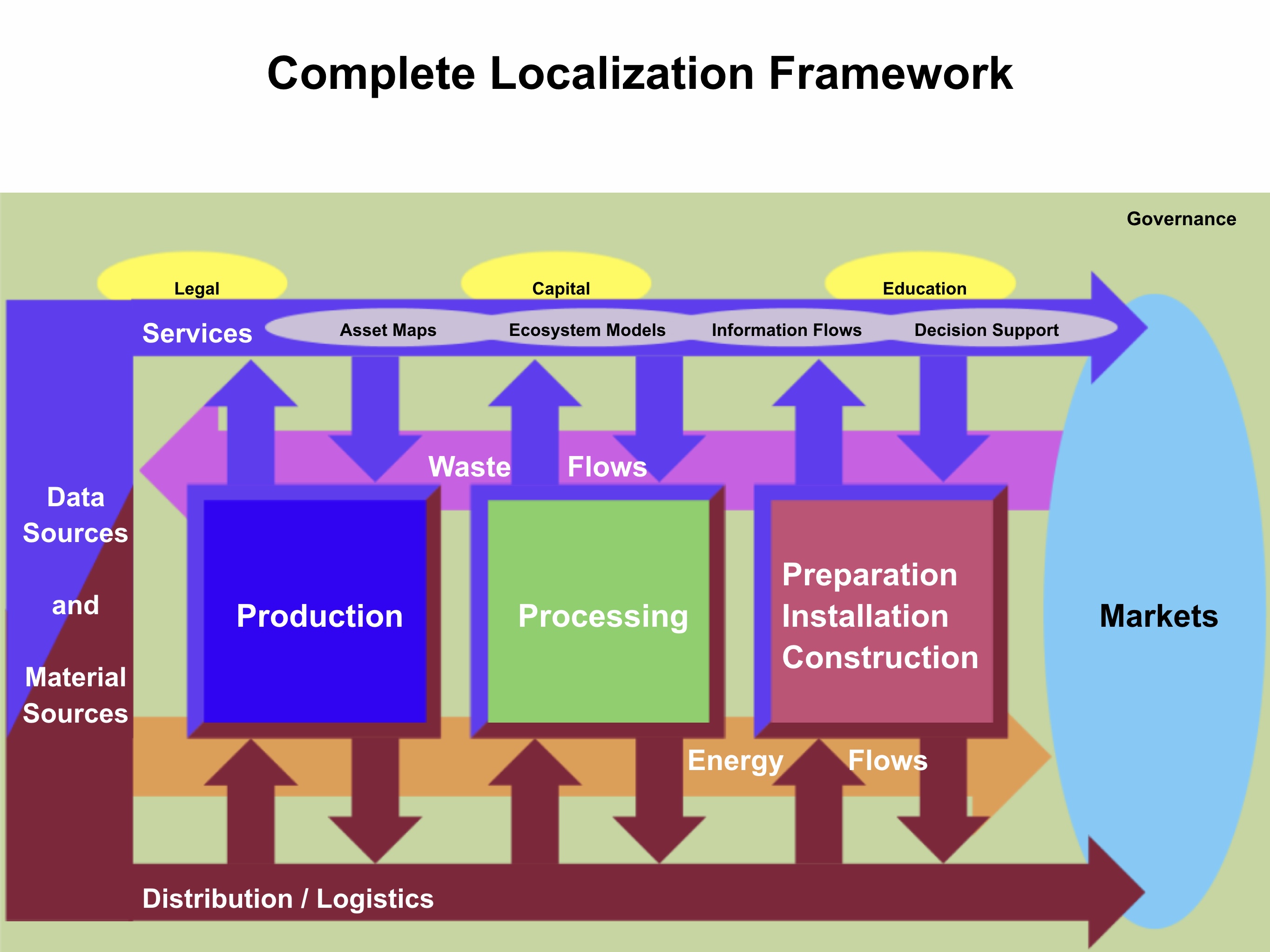
The final slide below, “Complete Localization Framework,” summarizes all of the key elements in one view:

It provides the starting point for this posting which outlines steps one can take to use the framework as a tool to help localize a community’s business ecosystem.

The slides shown in this posting are part of a presentation, Framework4Localization – in Action, which you may view or download from SlideShare by clicking the link in the title.

Purpose of Localization

The purpose of localization is to increase a community’s self-reliance and improve its chances for long-term sustainability. Localization done well results in more businesses that start-up and scale-up in response to demand from community members and do so profitably so they, too, are sustainable. But in order for that to happen within a local context, the metrics of success must be clear and the processes for business development must be well-managed.

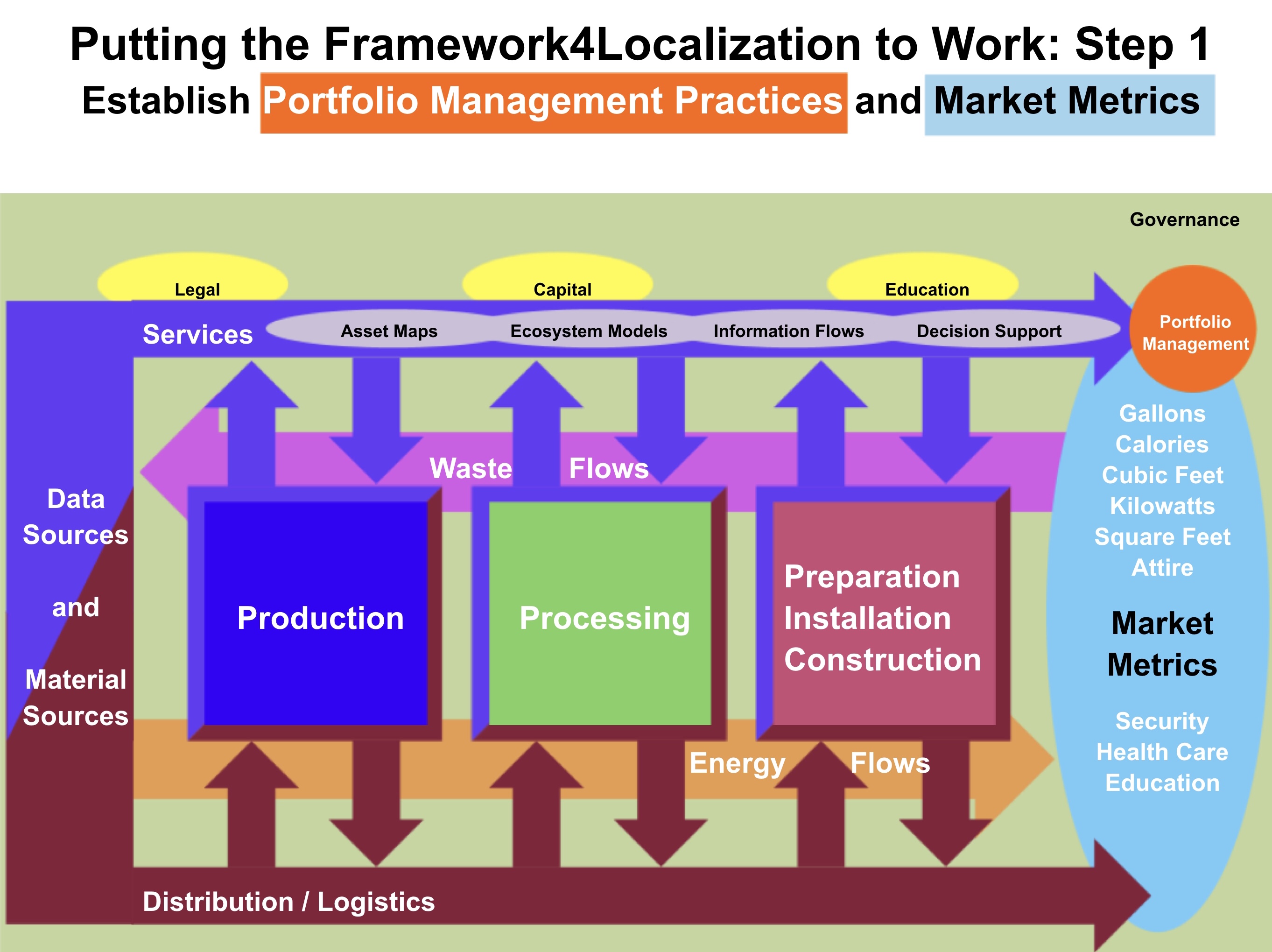
Slide 1 below recommends that community members establish portfolio management practices and market metrics as a first step in their localization strategy. Given the emphasis on self-reliance and sustainability, the metrics that relate to basic needs, e.g., gallons of water, calories of food, kilowatts of electrical power, square feet of living space, etc., met by the local economy take precedence over others that are more readily available through the global economy.

Slide 1

Because all businesses within the community function within a business ecosystem, seeing them within a “community portfolio” is a useful construct. The dynamics of adding new, expanding some, and redirecting others to build the local economy invite wise use of community assets to do so, in other words, portfolio management. As pointed out in an earlier posting, participation by community members on many different levels which includes “investment” of community assets they own or control, is essential for localization to work. In effect, portfolio management practices provide the guidelines by which community members can effectively exercise their participation.

Bear in mind, this is not a social experiment. Even though businesses are in a community portfolio, that does not give them the latitude to be mismanaged and perform poorly. Profitability remains their primary goal since that is the only way businesses can stay in business and the only way the business ecosystem can sustainably localize.

Businesses listed in the community portfolio can be anywhere in their development cycle from an innovative idea, to a business case preparing for launch, to a business already underway and looking to expand, to a mainstay in the business ecosystem needing to modernize and redirect. In addition to where they are developmentally, they also have a spot on the localization framework.

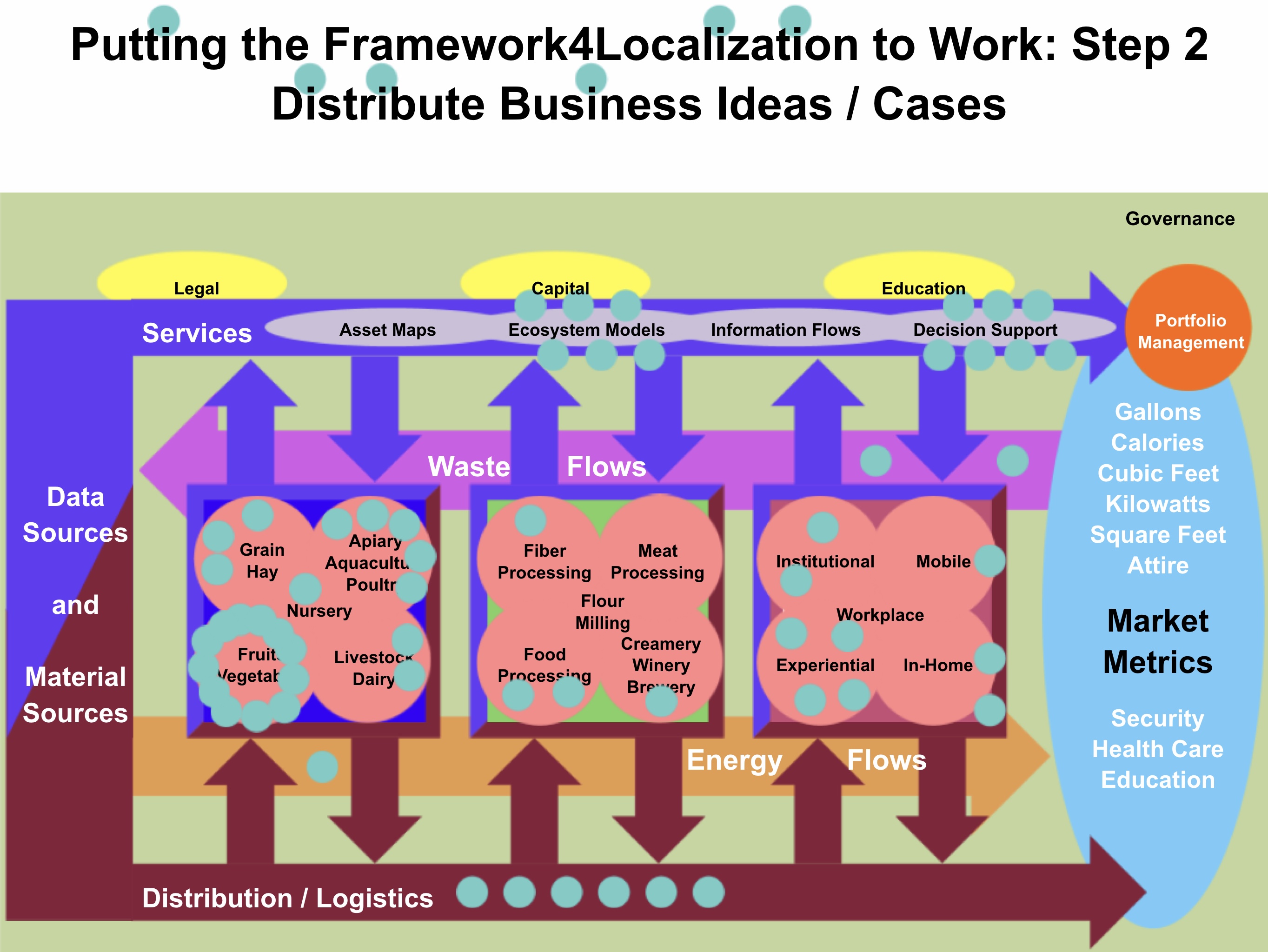
Slide 2 below shows the distribution of business ideas and cases that surfaced during a series of stakeholder sessions conducted in Lorain County, Ohio during 2010 – 2011. While this does not capture all of them, it does show the variety of ideas and cases in each category.

Slide 2

Typical of our experiences in these forums, participants generated more ideas and cases in production than any other area. But knowing how ideas and cases fit into the framework is useful information because it offers insights into how to design the localization strategy going forward and where to bolster the localization inroads already made. For instance, strong output from local food production is certainly a plus in the overal drive to localize a community’s business ecosystem. However, a preponderance of local food production compared to downstream, value-added stages may relegate market access to a smattering of direct sales to community members in the local economy through farmers’ markets and community-supported agriculture (CSA) subscriptions, or contracted sales to food aggregators / distributors or retail food chains in the global economy. The former lacks sufficient volume at marketable prices to cover the cost of operations whereas the latter runs counter to localization.

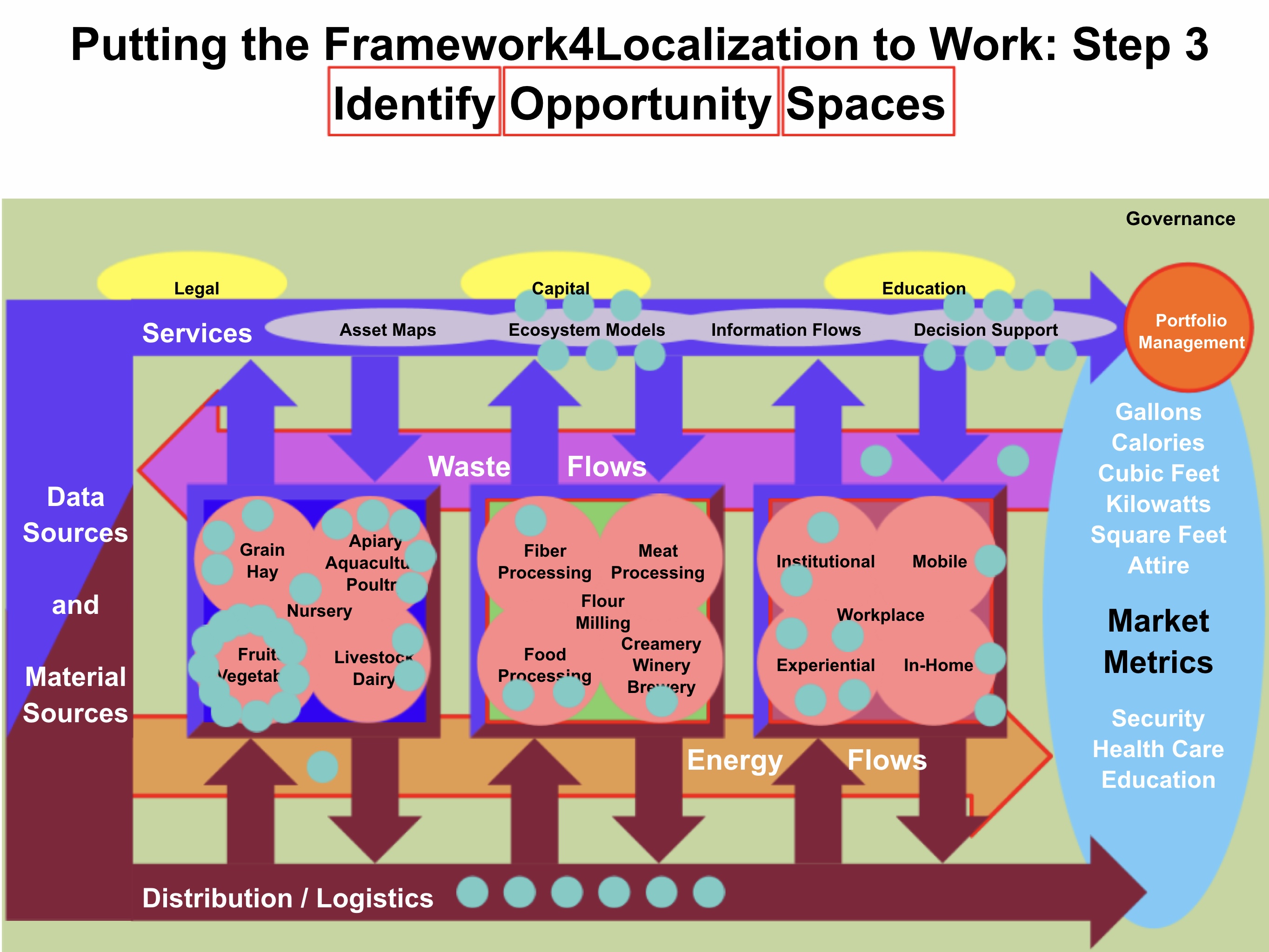
Value-added stages between production and consumption with insufficient businesses to create viable business-to-business connections and increase access to local markets become opportunity spaces for new or expanding businesses to fill. Slide 3 below outlines several value-added stages in a red border to designate them as opportunity spaces ripe for business growth in the Lorain County example.

Slide 3

As examples, among those opportunity spaces identified, “energy flows” and “waste flows” offer a considerable range of freedom for business development in composting, anaerobic digesters, and other waste-to-energy alternatives. Notice, too, the absence of established portfolio management practices. If left unaddressed, this deficiency leads to poor communication and coordination among community members about how to populate the community portfolio and how to invest community assets to advance those entries.

Sound portfolio management practices include the development of a strategy that localizes the business ecosystem as expeditiously as possible. With sustained profitability as the goal, preferred strategies increase the number of high-margin transactions closer to points of consumption. This both speeds those businesses directly involved toward profitability and increases the amount of revenue that can be distributed throughout the value chain. The result contributes to the profitability of the overall localized business ecosystem, which derives maximum benefit and return from invested assets.

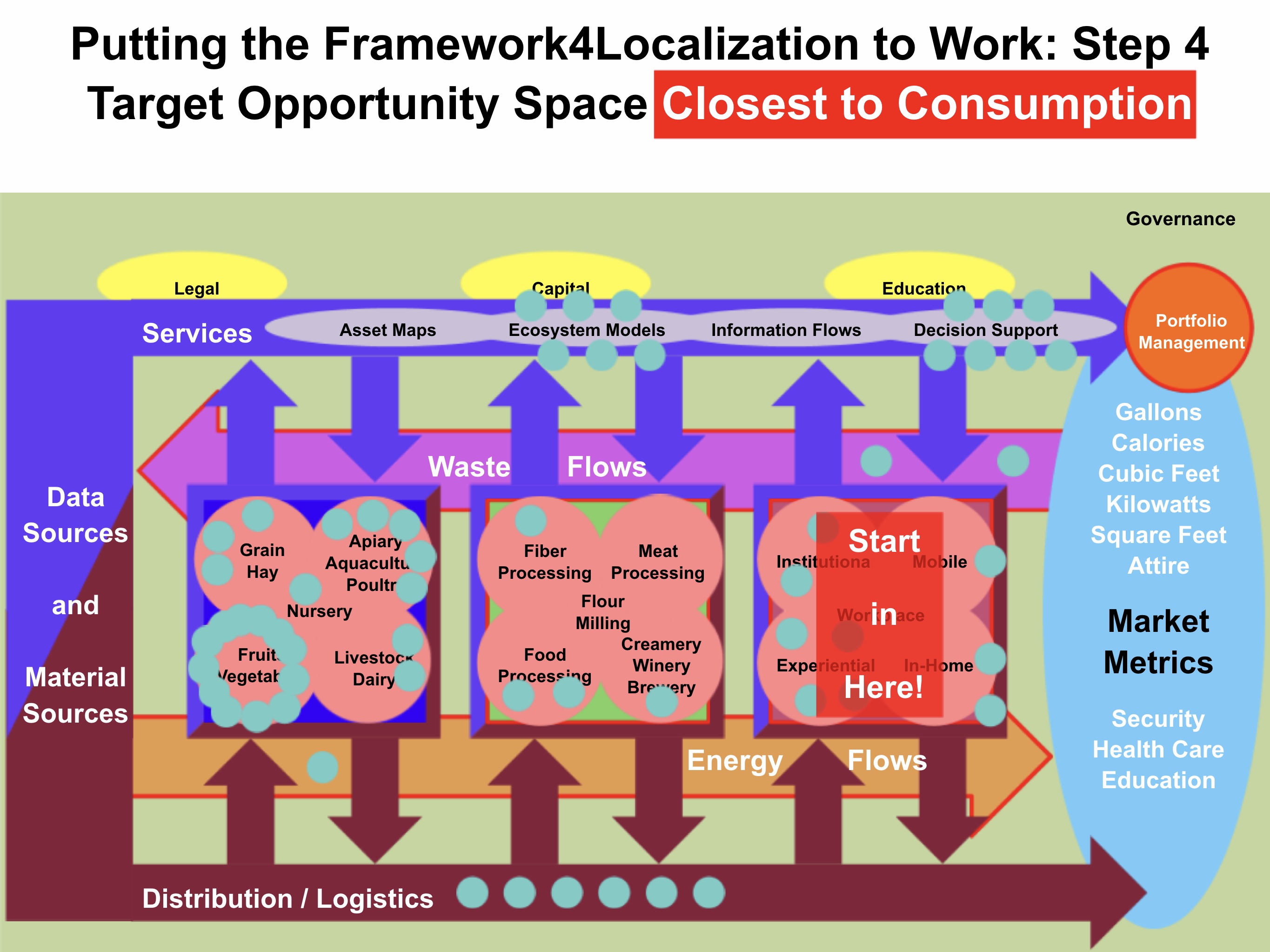
Slide 4 below draws attention to those transactions that occur within the opportunity spaces closest to the points of consumption.

Slide 4

In the case of localizing the food system in Lorain County, that meant focus on food preparation for quick delivery of ready-to-eat calories to consumers. Potential venues include schools, health care facilities, food trucks / carts, farm-to-table dining experiences, take-home meals for employees, and home deliveries.

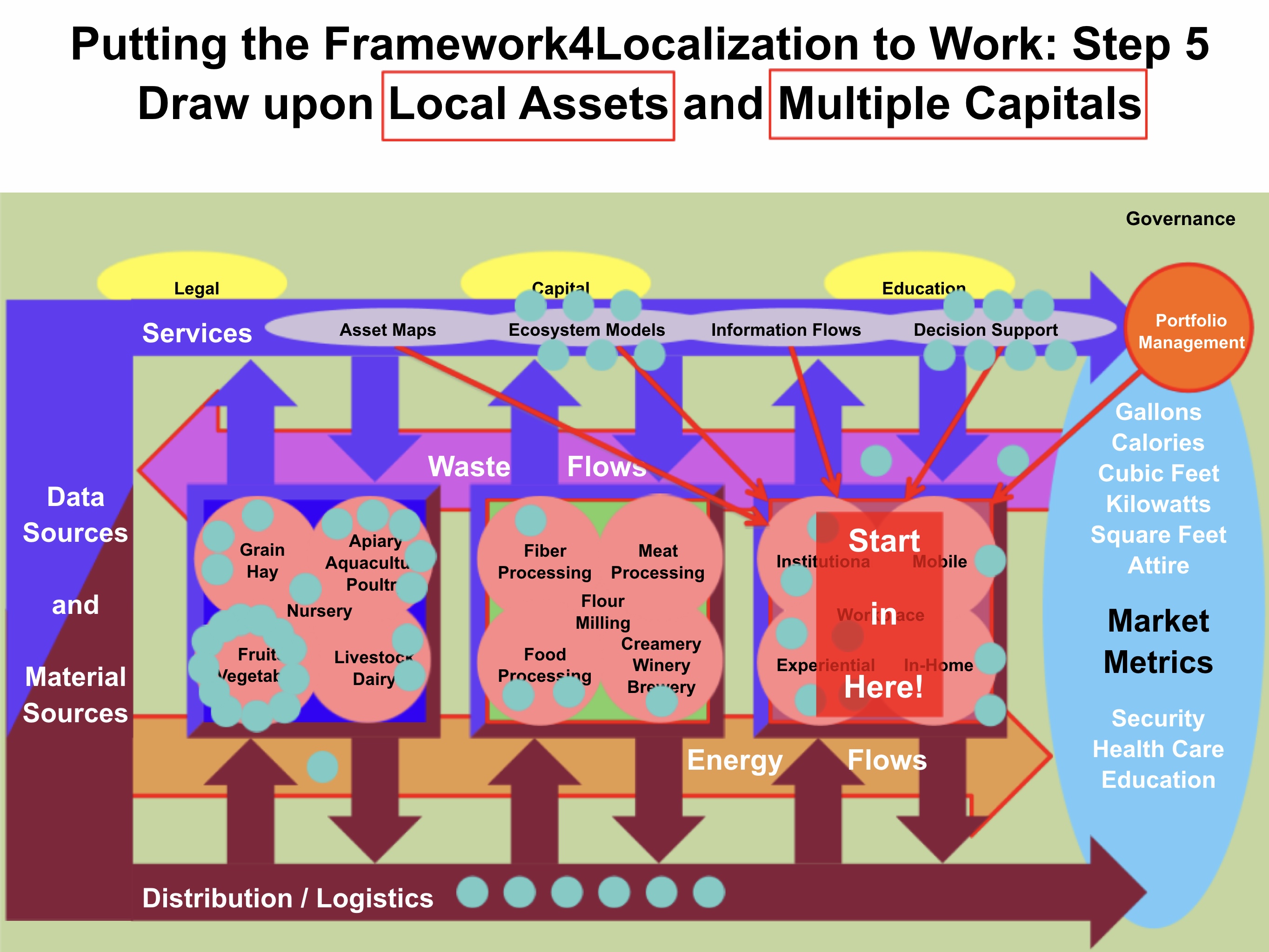
Those business ideas and cases that emerged through this kind of gap-filling / start-closest-to-the-points-of-consumption strategy provide ample opportunities for community members to participate. Slide 5 below points out those areas of participation that are oftentimes discounted or forgotten compared to their more notable value-added counterparts.

Slide 5

These data management services identify, record, and track utilization of community assets through tools and techniques that include mapping, modeling, information flows, decision support, and portfolio management. In actuality, the processes that account for community assets build a formidable knowledge commons and know-how value network. These can be combined with available land, facilities, equipment, etc., under the control of community members to create highly adaptive business models and develop innovative solutions to address roadblocks along the way to start-up, scale-up, and sustainability.

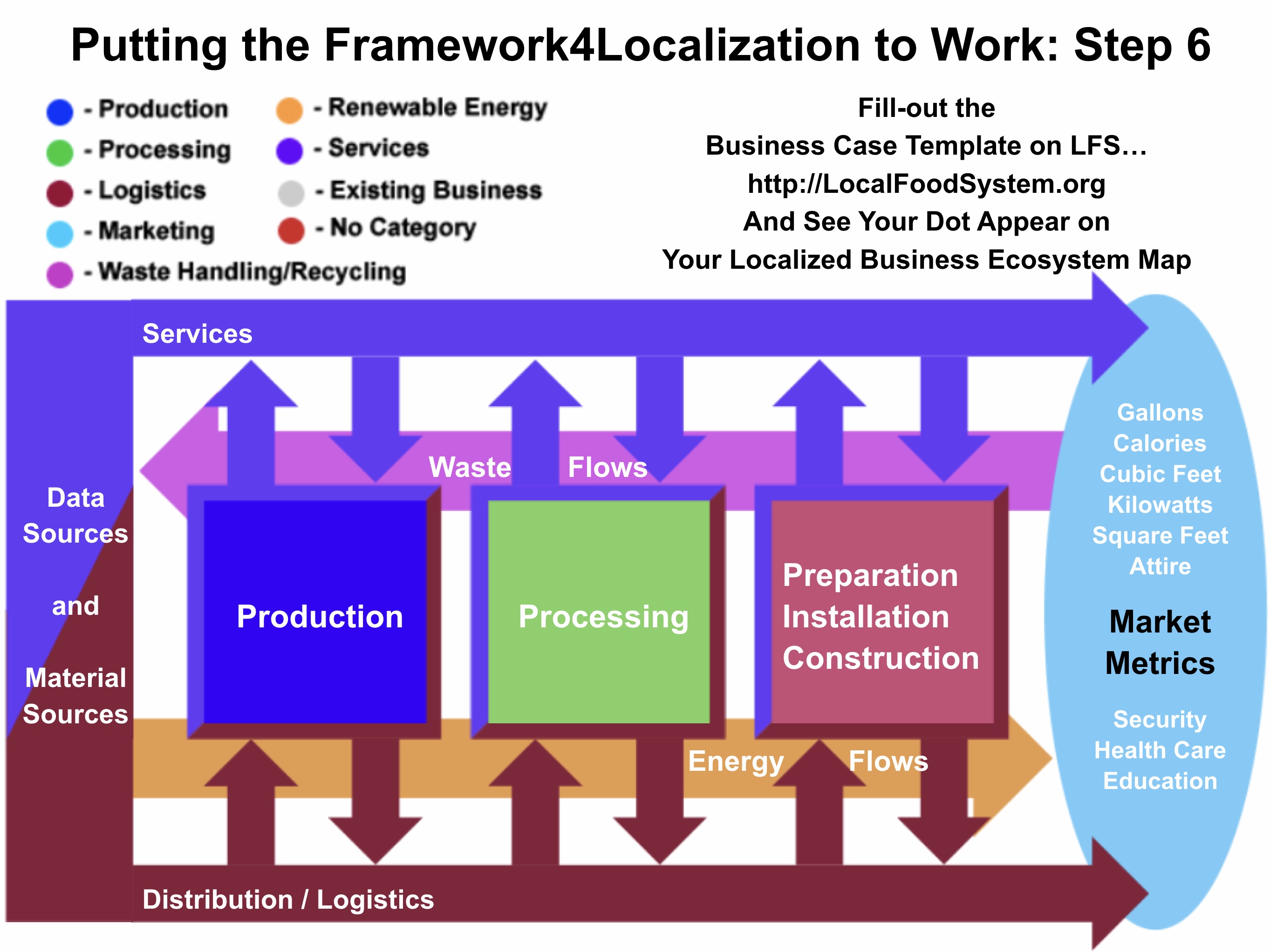
Accounting for assets is an important step in any localization strategy. Slide 6 refers to the set of templates and tools available on LocalFoodSystems.org (LFS) that enables entrepreneurs, business ecosystem participants, and community members to begin documenting their assets and developing their strategies to apply them.

Slide 6

Note that the categories and color-coding listed in the legend for the LFS site correspond to the Framework4Localization diagram.

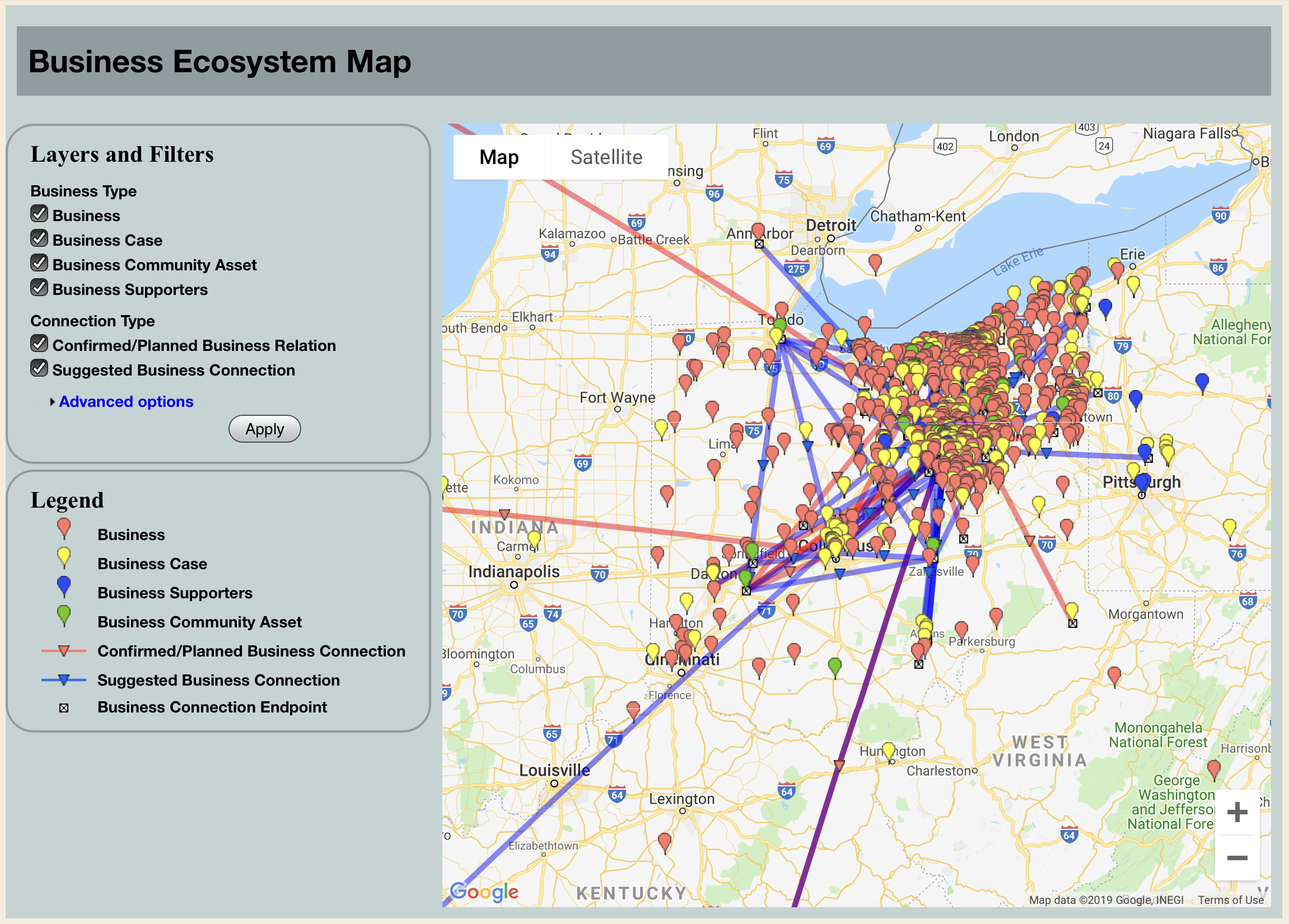
Click Business Ecosystem Map (see screenshot below) and, as the previous slide suggests, get your business on the map…and into your business ecosystem.

Also, check the LFS site frequently for new features you might find useful as you further develop your business ideas and cases.

Epilogue:

Lorain County participants led one of the first initiatives in Northeast Ohio to load their business ideas and cases into a “Community Investment Portfolio” and use it to shape the rollout of their localization strategy. Today, this strategy is encapsulated in The Oberlin Project.

Look for future postings on this blog which explore the general concept of a community investment portfolio in more detail and note how it has evolved over the past two years to become an effective economic and business development tool.

Originally posted to Sustainable Local Economic Development by Steve Bosserman on Saturday, August 25, 2012

Framework for Localization-an Overview

The simple dictum is: successful localization of a business ecosystem demands widespread participation by community members. Easy to say. It’s another thing for community members to know what that means and what to do about it. This is where another kind of map — a “framework for localization” — comes in handy to help community members define their business ecosystem, understand its dynamics, and assess to what degree it is already localized.

During the course of my work on the USDA-SCRI and FFEF grants, I had the opportunity to develop such a framework. I documented it in two presentations available for view and download on Slideshare. The first, Framework4Localization – Overview, provides a graphic representation of a typical business ecosystem. It is the subject of this posting. The second, Framework4Localization – in Action, offers steps community members can consider as they develop a strategy for localizing their business ecosystem. It will be the topic of the second posting in this series. Together, these set the stage for community members to build a “portfolio” of business cases that attracts widespread participation and drives the localization process. The nature of this portfolio and how community members invest in it will be the theme of a third posting.

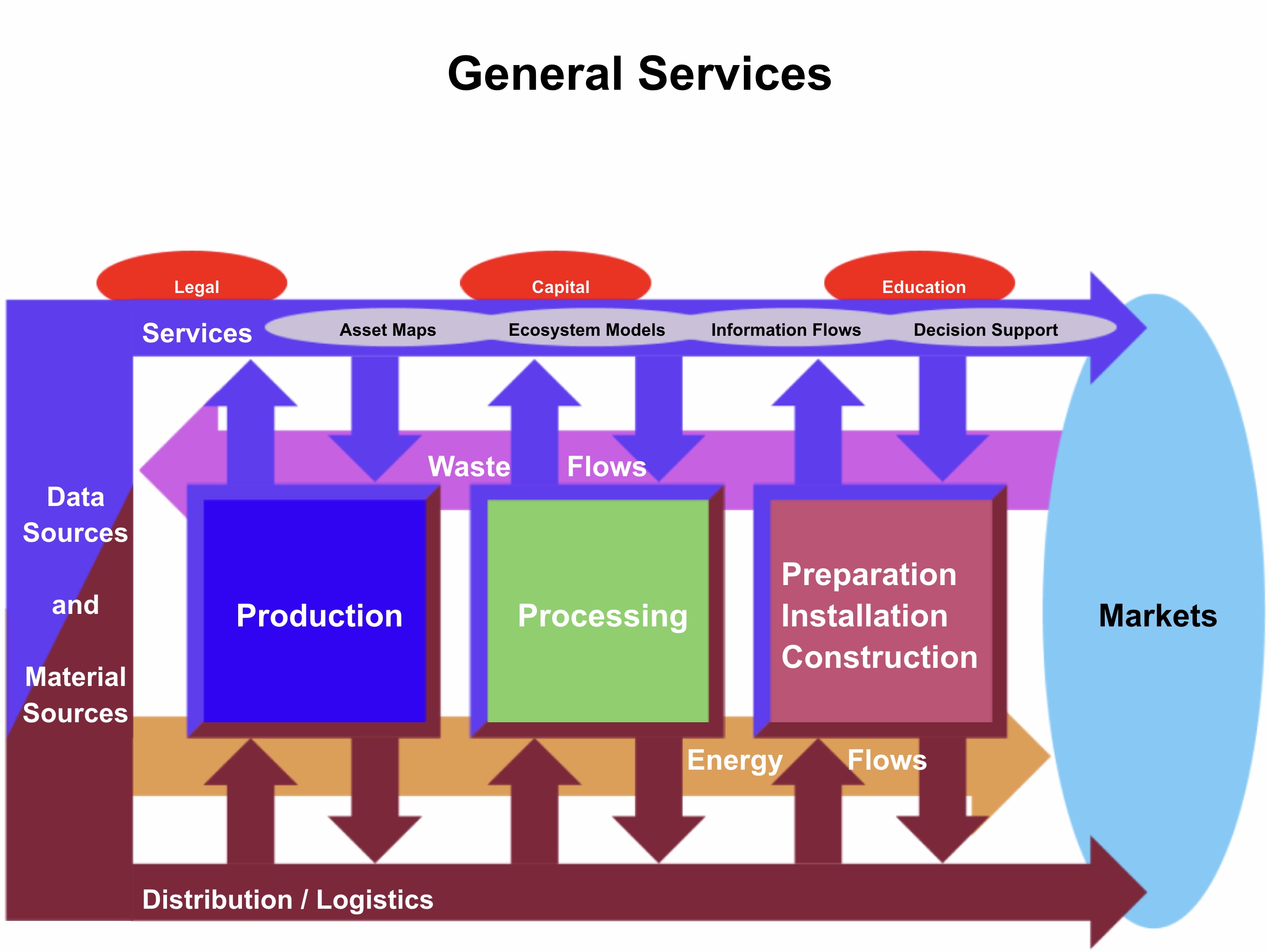
Let’s begin this overview with a general description of a business ecosystem. Like a natural ecosystem, the business version functions due to material and data flows from source points to use points. Again, as with its natural counterpart, sustainability depends on a continuous flow from sources to points of use.

As sources become scarce, costs go up and the search is on for a suitable alternative. For instance, businesses that require inputs that are unavailable locally at competitive prices, import needed materials from source points further away. And if suitable sources cannot be found, those businesses in the ecosystem that depend on them cease to operate because they cannot secure what they need.

The challenge for sustainability of business operations in their ecosystem is to draw upon their sources at rates that allow them to recharge, or slow their use so as to not exhaust them, or provide a window of time large enough to find suitable substitutes.

In the context of a community whose members have basic needs that must be fulfilled daily, the availability of water, food, housing, etc. becomes significant in terms of THEIR sustainability. The sustainability challenge is similar to what businesses must confront only with the caveat that the distance between life-giving sources and community members who depend on their delivery imposes another level of dependence and urgency. Localization, then, closes this distance gap and reduces dependence and anxiety levels.

With the general explanation of terms in mind, the purpose of this overview is to help community members “see” the various elements of their business ecosystem in relationship to one another as a first step in taking action to localize.

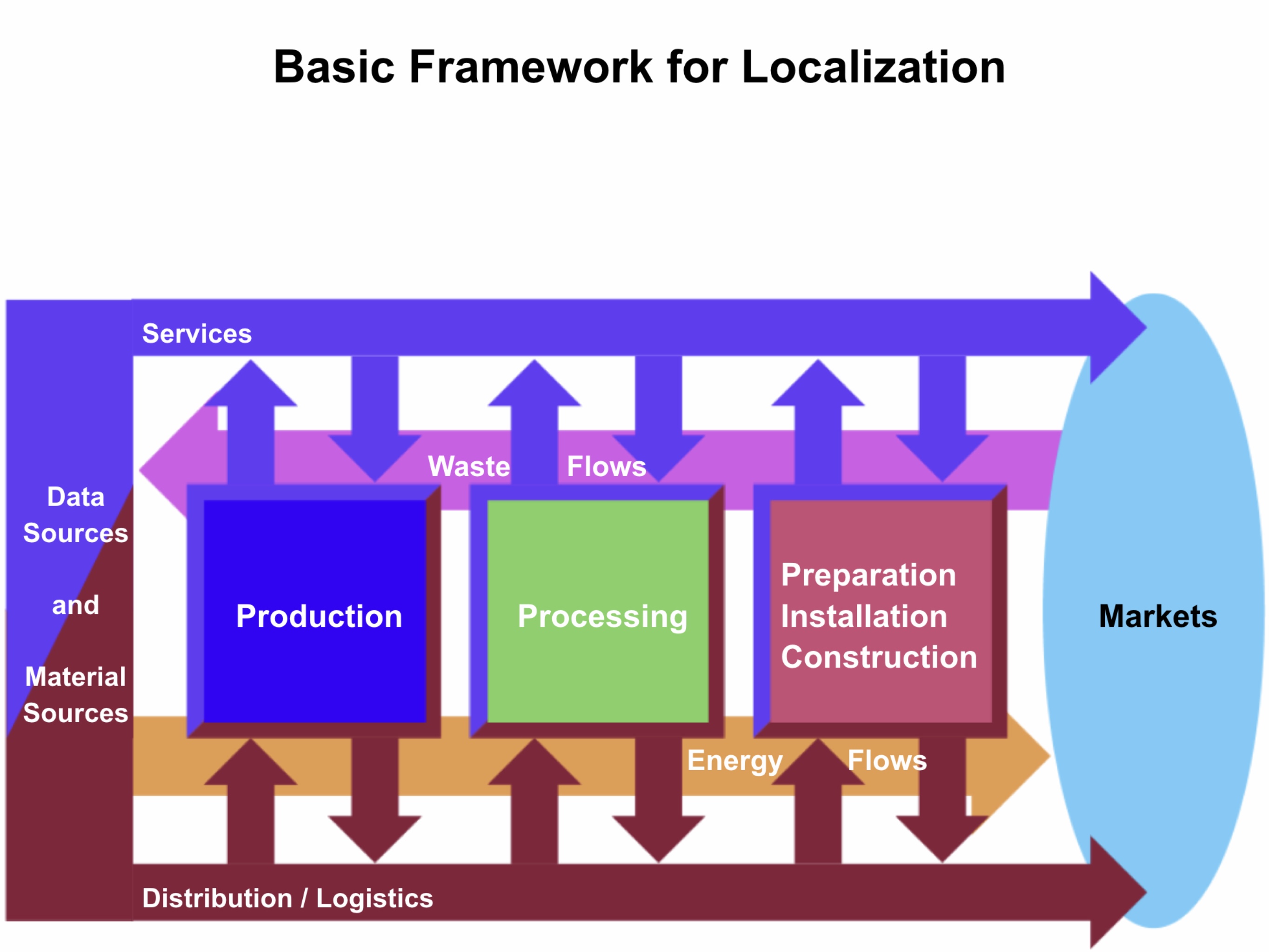
Slide 1 lays out the basics for a localization framework that, in effect, ties source points on the left to downstream use points and markets on the right.

Slide 1

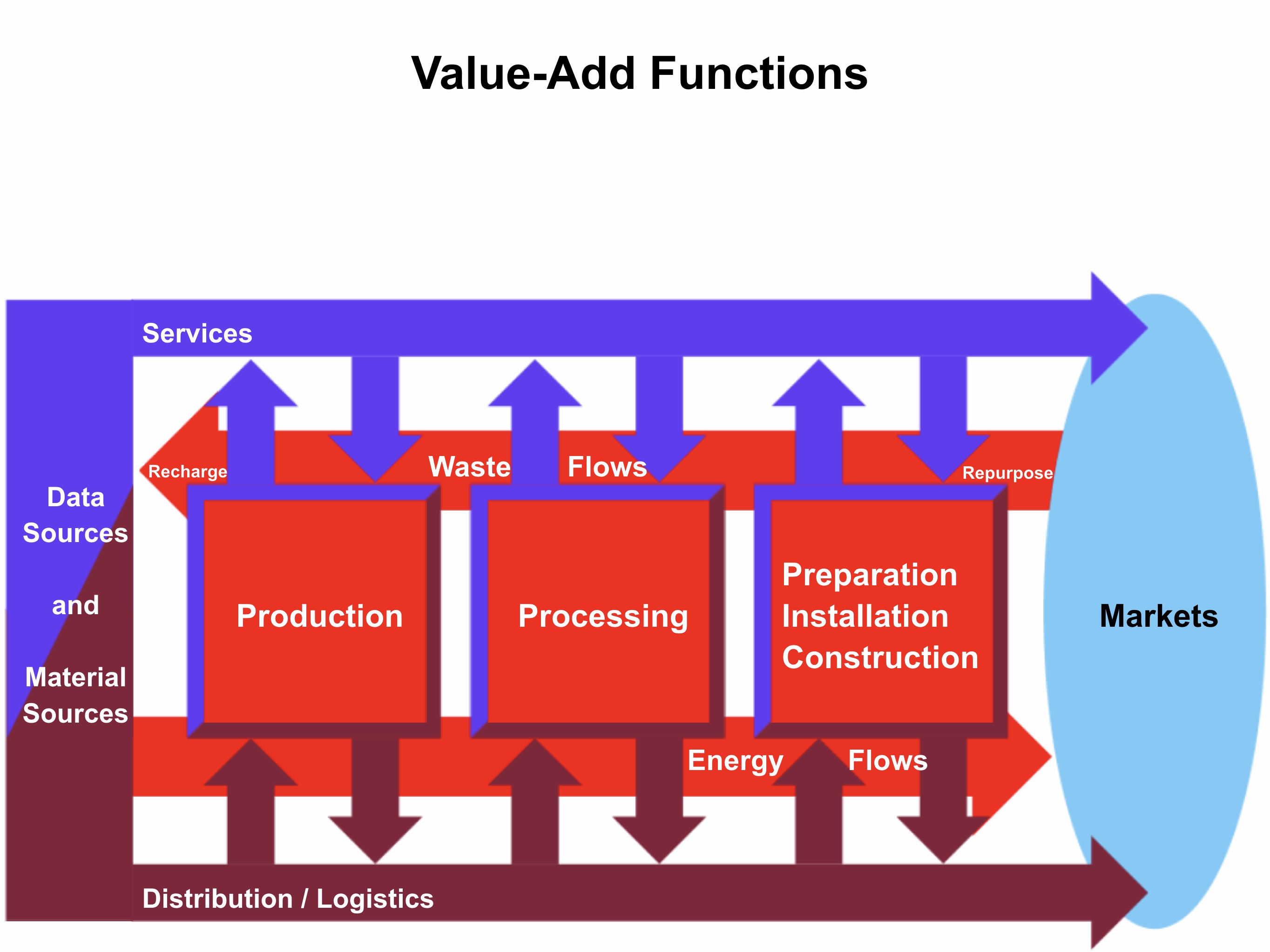
Slide 2 outlines value-added (see USDA definition in italics below) functions that are central to the business ecosystem. This includes stages of production, processing, and preparation, installation, construction as well as the flows of energy necessary to make the conversions in each stage, and the waste management flows that seek to recharge sources with what is not used, repurposed, and recovered during conversions and consumption.

Agricultural product that has undergone a change in physical state or was produced, marketed, or segregated (e.g., identity-preserved, eco-labeling, etc.) in a manner that enhances its value or expands the customer base of the product is considered a value-added product.1

Slide 2

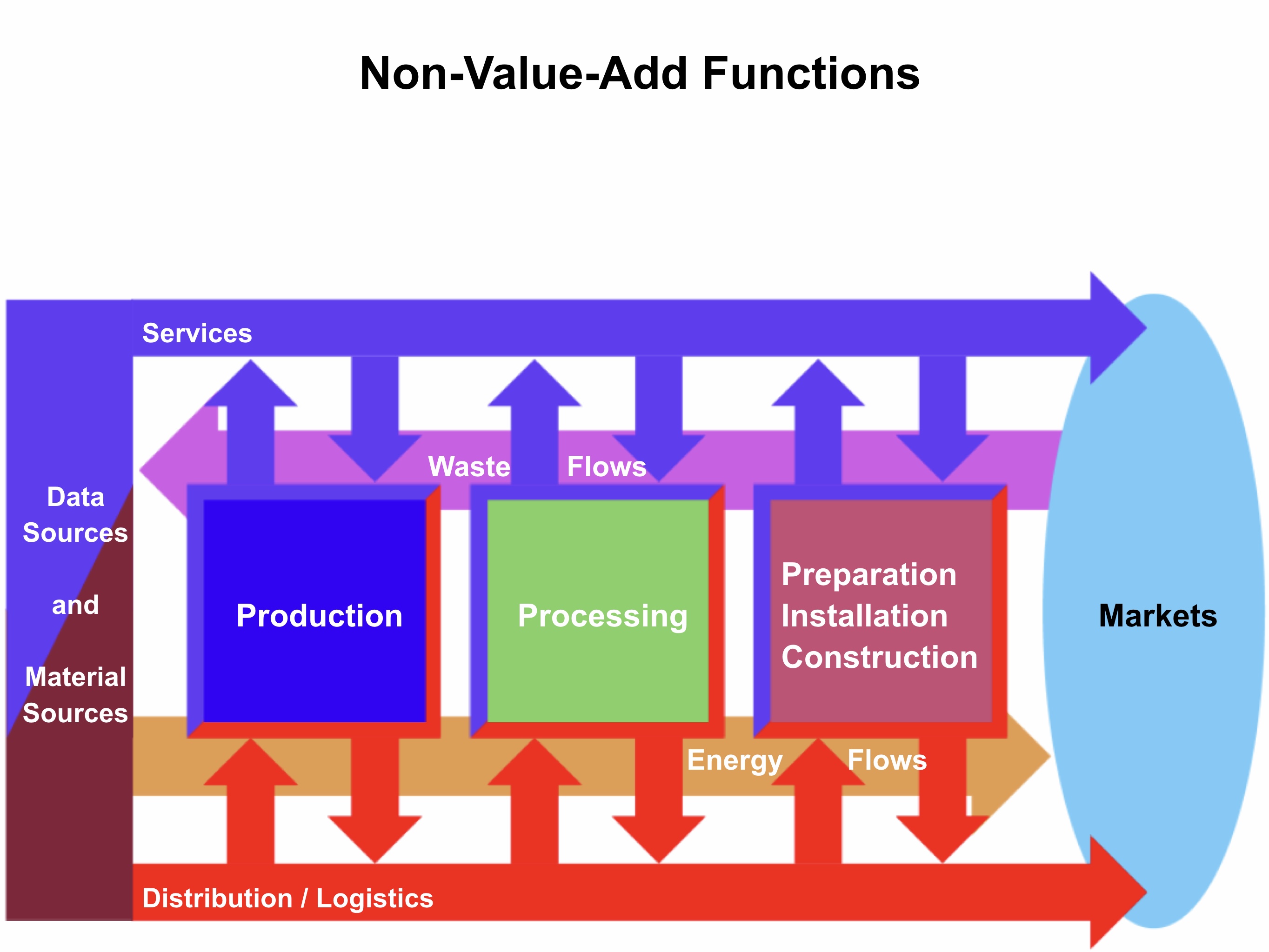
Slide 3 highlights a distribution and logistics system that manages the shipping and storage of material as inputs and outputs on their way to various markets. These functions are non-value-added given the USDA definition of “value-added” (see definition in previous slide).

Slide 3

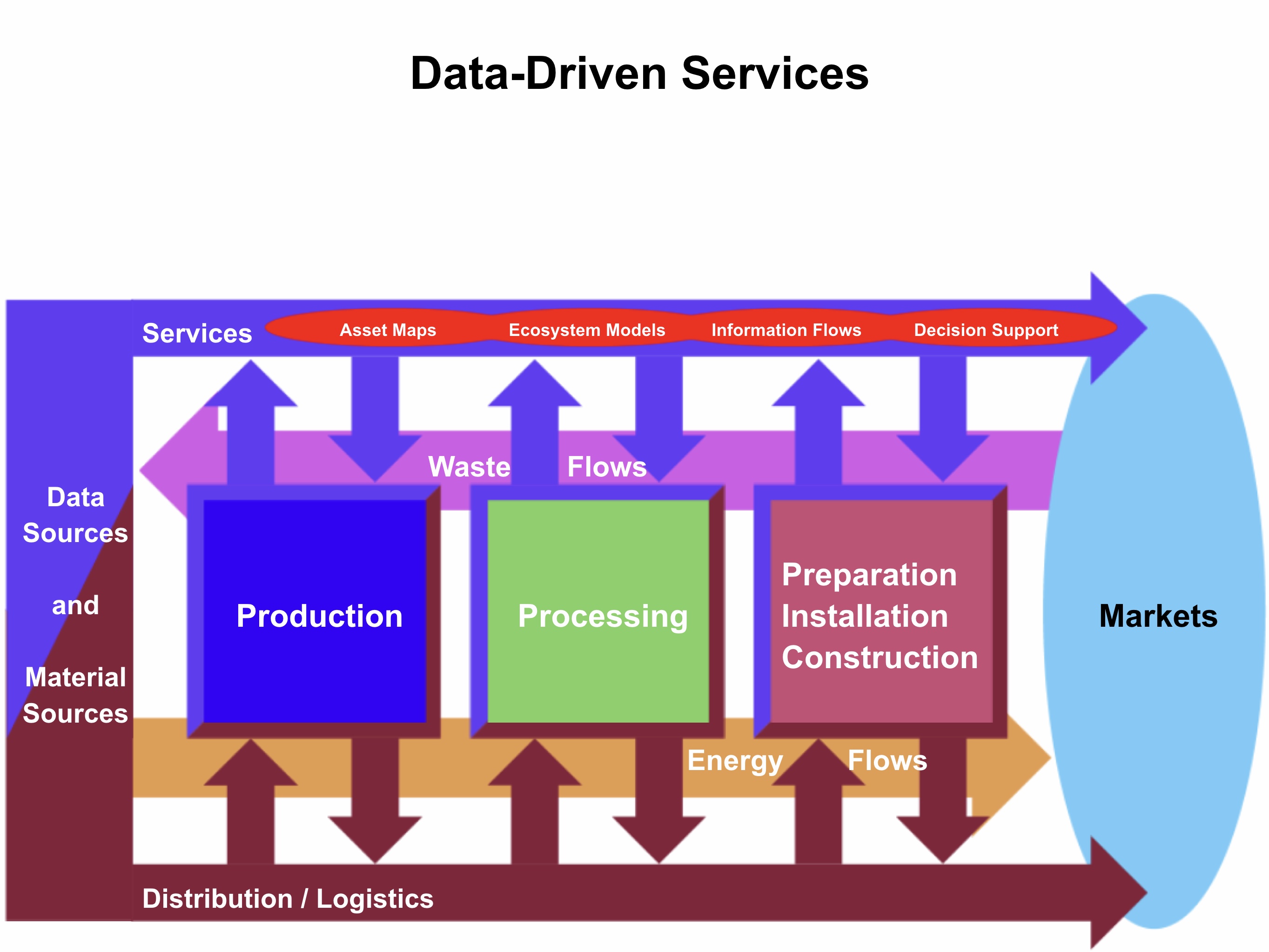
Slide 4 targets those data-driven services that provide a virtual representation of the material side of the business ecosystem. Asset maps utilize a graphical user interface to capture all relevant data about participants in a business ecosystem so they are easy to see; ecosystem models readily demonstrate the dynamics among business ecosystem participants and generate likely scenarios about how to improve the efficiency, performance, and sustainability of the business ecosystem; information flows deliver real-time, continuous, detailed overlays and insights into the behaviors of preferred ecosystem models upon their adoption; and decision support provides an information-enriched knowledge commons for business ecosystem participants to access and apply in their decisions.

Slide 4

Slide five identifies the three main service areas that influence the larger context in which the business ecosystem functions. These three hold significant implications on the cost to adopt a different business ecosystem model, such as one dedicated to localization of the food system. The current globalized food system is held in place by entrenched legal, capital, and education institutions. To localize requires changes in all three. This means confronting major inertia.

Slide 5

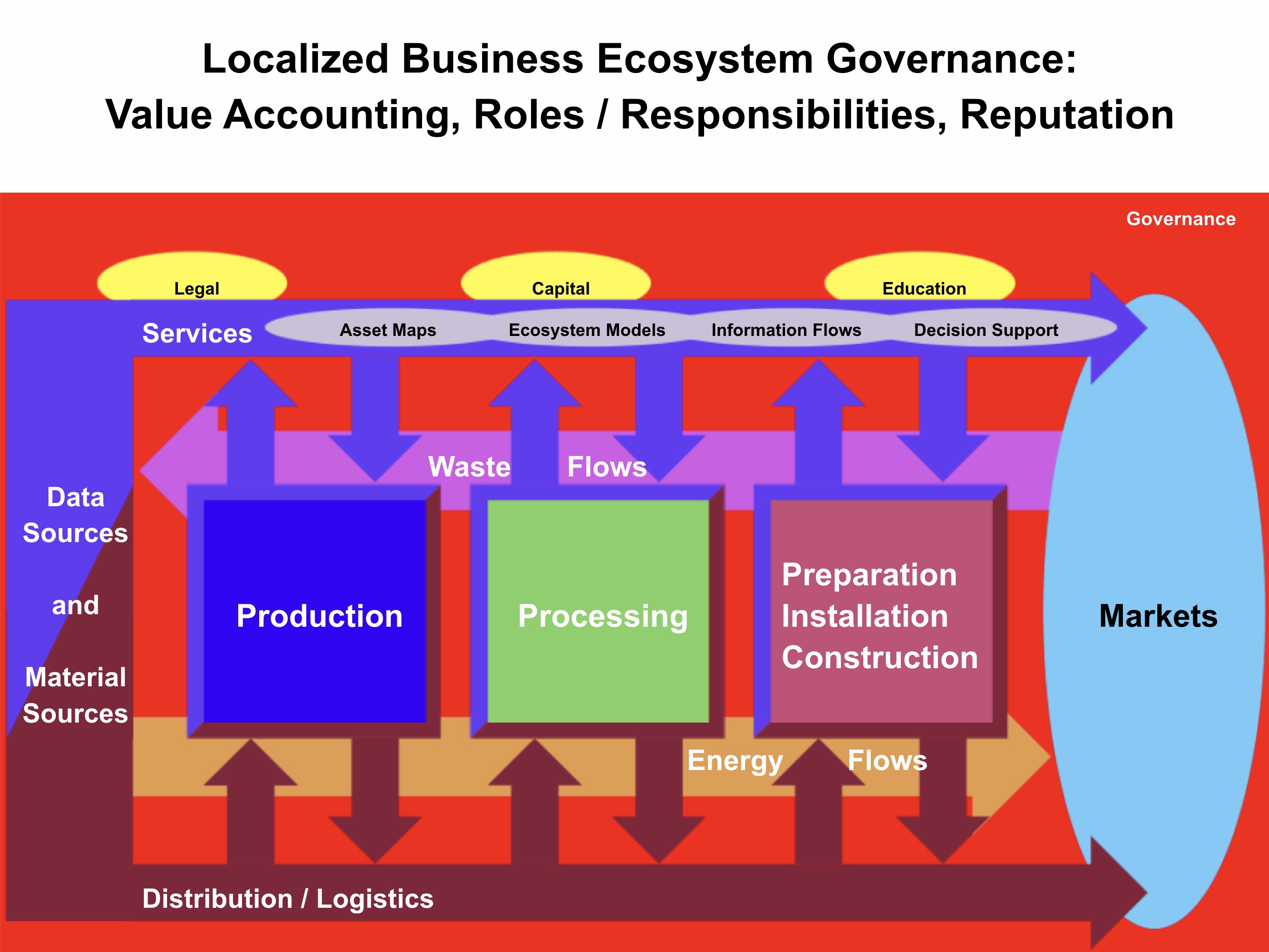
Slide six posits governance as the backdrop for change in the system. Governance is the process by which laws, codes, rules, regulations, and curricula change. And that changes the legal, capital, and education institutions. And that expedites the localization of a business ecosystem. Governance provides fair and impartial incentives for community members to participate in localization by playing a diverse array of roles and exercising certain responsibilities, delivering value, and building on their reputations.

Slide 6

Slide seven illustrates the complete localization framework as a “map” that can be tailored to the specific circumstances of a community and its business ecosystem.

Slide 7

And that sets up the second posting in this series which shows how community members can use this framework to guide their localization strategies. Stay tuned…

Originally posted to Sustainable Local Economic Development by Steve Bosserman on Saturday, August 18, 2012

  1. Community Food Systems-Other USDA Grant Opportunities