Greenhouses That Change the World

Richard (Rick) Nelson is the inventor of SolaRoof, a novel approach to greenhouse design and function that integrates a unique covering, heating / cooling system, and infrastructure / framework. It will revolutionize the greenhouse industry. More than that, once the materials are certified for use in human habitation, it will be disruptive to the housing and building industry as well. So what is SolaRoof, anyway, and why does it carry such potential to change the world? Let’s find out.

Revolutionary Technology:

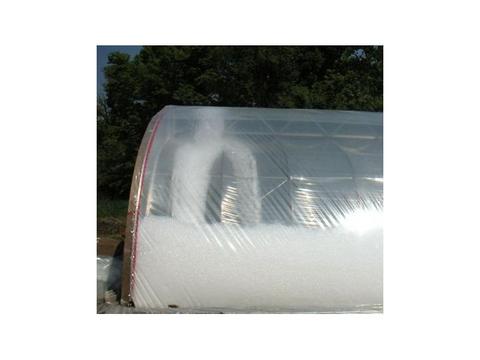
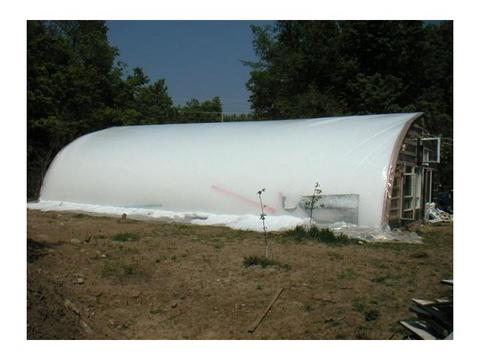
The greenhouse construction is unlike any other. Rather than a single layer of covering or glazing there are two. Each layer is a laminate of woven fiber mesh sandwiched in between two sheets of transparent plastic material. The laminated layers are sealed against the top and bottom of the roof and wall frames to create air-tight spaces. This combination by itself offers hardly any insulating value. However, fill the space with bubbles—yes, bubbles—and the equation becomes totally different!

The distance between the two layers varies depending on the desired amount of insulating value. Each inch is roughly equivalent to an R-factor of 1. A distance of a little over a yard yields an R-factor of nearly 40. That is almost unheard of in traditional construction techniques. And given the transparency of the two layers of covering, over 80% of the photosynthesis-catalyzing sunlight reaches the inside of the greenhouse.

In the (now defunct) SolaRoof webpage: Green Buildings for Urban Agriculture and Solar Living, two illustrations show how the process works from one extreme season to the next. Quite ingenius!

Here is a picture of a greenhouse unit as its side is being filled with bubbles:
And here is what it looks like when the cavity is completely full:
Unbounded Architectural Form:

While the technology is intriguing, it is only part of the picture when determining the disruptive value of SolaRoof. Another feature is that the shape of the structure is no longer confined to a standard box or cube that characterizes many homes, buildings, or greenhouses. It can be made to fit into an infinite array of shapes, sizes, and configurations. One of Rick’s collaborators, Harvey Rayner, who is the founder of Solar Bubble Build, describes the possibilities of the SolaRoof medium as follows:

Architecture has been a long-held passion for me, but my unwillingness to engage in academic study has kept me from pursuing any real investigation into this field. Now, having started this project initially as a practical solution to expanding my wife’s rare herb growing business, I have become engrossed in the process of designing, building and developing this technology.

Increasingly, I am viewing this work as an inroad towards one day creating pure and functional architectural forms. For me, this new breed of building gets right to the heart of how form can follow function. I believe with this technology as a starting point, unique structures can be derived which reflect the beauty of the inner workings of this truly sustainable building solution.

Several examples of Harvey’s designs are featured on Bluegreen Future Buildings.

Open Source for Everyone:

While Rick has spent over thirty years developing and refining the technologies associated with SolaRoof materials and applications, the bulk or his output is non-proprietary and open source. Anyone is welcome to join the SolaRoof Yahoo! Group (restricted) wherein there are member information exchanges, articles about SolaRoof, photos, and diagrams–all is free for the taking. Rick sums it up quite well in his introduction to the SolaRoof group:

You are welcome to join this open source collaboration where we are developing and sharing DIY(Do It Yourself) know-how for building transparent solar structures. To enhance our collaborative development of the SolaRoof methods we now are building a knowledge base where everyone can contribute to building the SolaRoofWiKi. SolaRoof structures may include but are not limited to greenhouses, sunspaces, roof gardens, residential spaces… The goal of our discussion is how to use the sun’s energy to grow food, cool and heat spaces efficiently, rather than rely on fossil fuels and power grids. Our technology includes the use of bubbles to shade and insulate glazing systems, together with liquid solar collection and thermal mass storage, although any related discussions are welcome!

SolaRoof Saves World:

This bold pronouncement was found on hi-trust.tv (now defunct), one of Chris Macrae’s video experiments. Chris, knowledge management and branding expert, offered the following endorsement of the power and potential of SolaRoof:

Rick has also been using what I amateurishly call photosynthesis agriculture and architecture innovations for over 20 years. I have known him for about 4 years in my capacity of hosting radical innovation meetings round London. I suggest a triple-wishing game – you mention a region or peoples in the world where sustainability that matters most to you, and Rick answers with what is doable now, what is developing, and what is his biggest collaboration wish for the region.

Perhaps we can make more videos if people decide this is one of the world’s great unknown practices worthy of a bit more open source weaving. (see Chris Macrae and Rick Nelson on YouTube)

Equally, if anyone knows someone else with inventions that empower every community to the other side of sustainability fuels (water, food, energy) crises, please see if they will join in. I would like to publish a small leaflet on the 5 most radically open guides to how peoples everywhere could collaborate around human sustainability if we take up the challenge and agree urgency is so great that we don’t need any marginal solutions; we need radical experiments…

And in a posting on crisisclimate.tv (now defunct), Chris describes the ramifications for SolaRoof as the underpinnings for a new business enterprise, Life Synthesis LLP, that aspires to the following:

…to shelter residential communities within SolaRoof systems. This includes replacing conventional resource and energy intensive climate control systems with new and dynamic structures that capture and use solar energy by bringing daylight and plants into buildings. These ecologically designed, low cost SolaRoof structures use energy capture, storage, and cooling methods to incorporate plants, water and water based liquids, creating an integrated ecosystem within the building itself. SolaRoof is both accessible and affordable to those living in poverty, but at the same time desirable to the affluent.

The Ball Is in Your Court

And that becomes an open invitation for any and all to take the opportunity afforded by this concept and apply it so that it makes a positive difference for the people directly involved, the community, the planet. Well worth the time and effort required to take up the challenge and do the right thing!

Originally posted to New Media Explorer by Steve Bosserman on Tuesday, October 9, 2007

Addicted to Oil

On 31 January, President George W. Bush delivered his 2006 State of the Union Message. In it he made a very powerful declaration:

Keeping America competitive requires affordable energy. And here we have a serious problem: America is addicted to oil, which is often imported from unstable parts of the world. The best way to break this addiction is through technology. Since 2001, we have spent nearly $10 billion to develop cleaner, cheaper, and more reliable alternative energy sources — and we are on the threshold of incredible advances.

While history will be the final determinant of President Bush’s impact on history and the degree to which it was favorable or not, the statement, “America is addicted to oil,” may standout as a turning point for America. While this reality was not new news for millions who listened to or read his speech, the mere fact that he gave voice to it as the elected leader of the American people was a powerful expression of what it represents. It may very well constitute the most key assertion of his administration.

Addiction is a tough term to reconcile; it is a psychological reality that takes no prisoners, so to speak. Addiction means dependency in the most profound way. Such dependency in this instance drives three potential outcomes:

  1. Depletion: what happens if we run out of oil?
  2. Defense: what happens if government leaders from countries where we buy oil use the money to our disadvantage costing even more money to protect ourselves and our way of life
  3. Destruction:1 what happens to the environment if we persist in using oil (fossil fuels)?

It isn’t necessary to know exactly when we reach Hubbert’s peak, or to know how much money it takes to defend ourselves against foreign forces that are funded by money we pay to them for their oil, or to know how much burning fossil fuel affects the environment. It is only a matter of believing that any one or a combination of them is in play to trigger intense concern. Such is the powerful hold addiction has on those in its grasp.

The significance of President Bush’s statement is that it legitimizes conversations and commitments to seek viable alternatives. And because there are three motivating forces, each equally compelling, triggered by his statement, there is a much wider audience who buys-in to the notion that the fundamental issue of oil addiction warrants attention. Time and energy do not need to be wasted convincing people to get on board. It is proving to be an efficient way to mobilize people, resources, and investments in finding viable alternatives.

We do not have answers; at least we have questions that are moving us in a healthier and more sustainable direction. Swapping fuels derived from plant materials for fossil-fuels offers a way to ease the problem, but it is not a panacea. It will be a race to see if we can slow consumption, adopt non-fossil-fuel alternatives, and develop more efficient ways to produce and move what we make from one place to the other. This is an area of considerable interest to me as 2006 wanes and 2007 creeps closer. More later…

Originally posted to New Media Explorer by Steve Bosserman on Sunday, December 10, 2006

  1. The quoted 2005 report from the Union of Concerned Scientists is not available online, however, a later statement, Car Emissions & Global Warming, addresses the same issue:“Our personal vehicles are a major cause of global warming. Collectively, cars and trucks account for nearly one-fifth of all US emissions, emitting around 24 pounds of carbon dioxide and other global-warming gases for every gallon of gas. About five pounds comes from the extraction, production, and delivery of the fuel, while the great bulk of heat-trapping emissions—more than 19 pounds per gallon—comes right out of a car’s tailpipe.” 

Riff on Michael Shuman

For thousands of people around the world each day the Google News Alerts service deposits the results of key word searches among the thousands of news sources in Google’s global network in email inboxes, mine included. Among the terms I have setup for searches is “community currencies.” This morning the following item appeared:

Candidates for Ward 1

Raise the Hammer – Canada

… His ideas of how credit unions, commercial banks and thrifts with community ownership structures, and local currencies can keep community wealth circulating in …

The content trailer was intriguing, leading me on a two-hour surfing odyssey. The results are logged below in the event that others might be interested in some of the touch points I encountered along the way.

First, click to the article on the Raise the Hammer website; then, click to learn more about the Raise the Hammer community action initiative in Hamilton, Ontario, Canada, which, according to Wikipedia is the 8th largest city in Canada with a population of slightly over 700,000.

Municipal elections are coming up and one of the candidates is a person named Brian McHattie. In a response to a request from Raise the Hammer, Mr. McHattie stated the five most important steps he would take if elected; his fifth and final point was as follows:

5) Develop a Community Economic Development Strategy. ‘Recently, Environment Hamilton brought U.S. economist Michael Shuman to Hamilton to talk about a strategy where communities adopt a strategy of self-reliance with local production for local consumption.

His ideas of how credit unions, commercial banks and thrifts with community ownership structures, and local currencies can keep community wealth circulating in and working for the community must be investigated as a basis for Hamilton’s economy, along with import substitution and directing City purchasing power to locally owned businesses, thereby keeping money circulating within the city – plugging the leaky bucket.’

Enter the name, “Michael Shuman.” So who is this Michael Shuman person?

A Google search found several listings one linked to a biographical article in The Nation. The next click goes to the homepage for The Nation and more background on the publication.

Another link in the search about Michael Shuman referenced “Community-based Economies1 at a forum on August 3, 2006 sponsored by the University of Kentucky Appalachian Center and partners.

No journey is complete unless some inviting by-ways are explored 😉 One side-road was a closer look at the terms “Sustainability, Entrepreneurship, and Local Economies.” A click in a Google search led to the University of St. Gallen in Switzerland and its Institute for Economy and the Environment. One of the faculty members, Dr. Rolf Wüstenhagen, co-authored a paper, “Structure of Sustainable Economic Value in Social Entrepreneurial Enterprises” that can be downloaded as a PDF file. Any research that can find better ways to determine value of such endeavors is worth its weight in gold and Dr. Wuestenhagen’s study is certainly a useful approach!

Another trail through the woods led to a startup originally named “Chesapeake Friendly Chicken,” funded in part by USDA grants, but now grant-independent and listed as “Bay Friendly Chicken.” There are several write-ups about this company from a wide range of perspectives including CNN Money and Animal Liberation Front. This represents an “educational process” from which many with a similar entrepreneurial spirit in agricultural production and process can learn.

But I digress, back to Mr. Shuman. His bio in the The Small-Mart Revolution—How Local Businesses Are Beating The Global Competition he is listed a Vice President for Enterprise Development with the Training & Development Center (TDC) based in Maine. The founder and president of TDC is Charles “Chuck” Tetro. Mssrs. Tetro and Shuman team as co-presenters and co-facilitators. One of those collaborations was to deliver a course at Whidbey Institute in Clinton, WA. The flyer announcing the session exploring!2 read as follows:

“Exploring Local Living Economies and Community-based Business” with Michael Shuman and Chuck Tetro Sunday, July 17 to Sunday July 24, 2005, A Residential Course at the Whidbey Institute in Clinton, WA: Michael Shuman is the author of GOING LOCAL: CREATING SELF-RELIANT COMMUNITIES IN A GLOBAL AGE and Vice President of Enterprise Development for the Training & Development Corporation. Among his current projects are a poultry company in Eastern Maryland financed through local stock, a small-business venture fund in New Mexico, and a local debit card in Maine. He speaks and consults around the country on strategies for strengthening local and regional economies, and he is one of the founding board members for the Business Alliance for Local Living Economies, a network of, by, and for community-based-businesses.”

Mr. Shuman is a busy person! A search for Business Alliance for Local Living Economies (BALLE) uncovers an active North American network. The search results also show a connection to the specific term “Living Economies” and a link to livingeconomies.org which proves to be the home page for bealocalist.org, aka, BALLE. At one time, Mr. Shuman was on the BALLE board. His former BALLE bio mentioned a website under development named, “CommunityFood” (no longer functional) that is intended “to support marketing by family farmers.” The website layout is an excellent framework / template to utilize in moving the localization of agriculture across North America. And in looking at all the blank states on the BALLE homepage map of chapters / members it appears there are thousands of opportunities 😉

Mr. Shuman’s latest book, THE SMALL-MART REVOLUTION: HOW LOCAL BUSINESSES ARE BEATING THE GLOBAL COMPETITION, published in 2006 by Berrett-Koehler and distributed by Amazon and others, continues to expand his theses in a powerful, yet engaging and entertaining manner, according to the reviewers. But see for yourself.

And this is wonderful place to stop for a while. I’m sure the odyssey will begin anew when another compelling news blurb pops into the inbox — happy reading and exploring!3

Originally posted to New Media Explorer by Steve Bosserman on Saturday, October 21, 2006

  1. Information about Michael Shuman’s forum at the University of Wyoming referenced in my original posting is no longer available online. 
  2. Links to the flyer and related information about Charles Tetro and Michael Shuman are no longer available online. 
  3. Much of the information about Michael Shuman and the terminology, projects, organizations, and source materials referenced in my original posting evolved over the intervening years. I attempted to keep as much of the original text as possible, except in several instances where deviations became inevitable. Mr. Shuman is still “living the dream” helping others develop local economies as this January 27, 2019 post to his website attests: Why Local Economies Matter. I will pick up the topic of localization in a separate post at a later date.