239 Days in America, Day 22: May 02, 1912 | Chicago

The Trials of Corinne Knight True 1

TODAY CORINNE TRUE BURIED her last surviving son. Just yesterday she had helped ‘Abdu’l-Bahá lay the cornerstone for a new temple in Wilmette. If ever a life reflected the human quandary about the nature and meaning of suffering, that life belonged to Corinne True.

Chicago

The ballroom at the LaSalle was filled with more than a thousand women of the federated clubs whom He addressed on the equality of women. A second meeting closely followed the first, for the Bahá’í women had invited all of the women’s clubs’ representatives to a reception in ‘Abdu’l-Bahá’s honor in the same ballroom. Ten speakers praised Him, and then He spoke again. 2

Talk to Federation of Women’s Clubs, Hotel La Salle, Chicago, Illinois

To accept and observe a distinction which God has not intended in creation is ignorance and superstition. The fact which is to be considered, however, is that woman, having formerly been deprived, must now be allowed equal opportunities with man for education and training. There must be no difference in their education. Until the reality of equality between man and woman is fully established and attained, the highest social development of mankind is not possible. Even granted that woman is inferior to man in some degree of capacity or accomplishment, this or any other distinction would continue to be productive of discord and trouble. The only remedy is education, opportunity; for equality means equal qualification. In brief, the assumption of superiority by man will continue to be depressing to the ambition of woman, as if her attainment to equality was creationally impossible; woman’s aspiration toward advancement will be checked by it, and she will gradually become hopeless. On the contrary, we must declare that her capacity is equal, even greater than man’s. This will inspire her with hope and ambition, and her susceptibilities for advancement will continually increase. She must not be told and taught that she is weaker and inferior in capacity and qualification. If a pupil is told that his intelligence is less than his fellow pupils, it is a very great drawback and handicap to his progress. He must be encouraged to advance by the statement, “You are most capable, and if you endeavor, you will attain the highest degree.”

It is my hope that the banner of equality may be raised throughout the five continents where as yet it is not fully recognized and established. In this enlightened world of the West woman has advanced an immeasurable degree beyond the women of the Orient. And let it be known once more that until woman and man recognize and realize equality, social and political progress here or anywhere will not be possible. For the world of humanity consists of two parts or members: one is woman; the other is man. Until these two members are equal in strength, the oneness of humanity cannot be established, and the happiness and felicity of mankind will not be a reality. God willing, this is to be so. 3

Thursday, May 2, 1912

From morning until noon ‘Abdu’l-Bahá received successive waves of visitors, both friends and inquirers, in His private room. When the numbers grew too large, He went into the outer room and spoke to the visitors about unity, fellowship and the importance of overcoming hatred and enmity. He began by saying:

“The object of my undertaking such a long journey with all its inconveniences has been to bring about spiritual illumination in the Occident, for the Occident has great capacity and its people are less fettered by vain imaginings and imitations. Lofty ideals find a quick acceptance among them and today the loftiest ideal of all is devotion to the unity of mankind and universal peace.

In the afternoon there were two public meetings at the LaSalle Hotel. One was for the Federation of Women’s Clubs and the other for the Unitarian congregation. ‘Abdu’l-Bahá’s first talk was on education and the rights of women and in the latter He spoke about human powers and gave proofs of the existence of God. Both talks were so impressive, charming and attractive that all the friends from the East and West offered thanks and glorification to the Abhá Kingdom, with smiles on their faces that were like roses in bloom.

Back at the Plaza Hotel, ‘Abdu’l-Bahá responded to questions about the differences in capacities and talents among people, saying:

“Souls possess two types of capacity: one is derived from innate powers and the other is acquired through the education imparted by the Teacher of the world of humanity. The development of innate capacity is completely dependent on education and on man’s own exertions. In other words, innate capacity is not realized without education and exertion on the part of man and its perfection demands effort and training.”

Question: ‘How should one associate with people of bad character?’ ‘Abdu’l-Bahá replied:

“This, too, has two aspects. There are certain evils whose consequences affect the doer only and do not extend to others. Of course, with discretion and tact, we must try to warn and educate wrongdoers. They are sick; we must bring healing to them. But there are actions which are injurious to others. Association with persons who commit such deeds leads to a deterioration of morals and therefore to mingle with them is not advisable, except for persons of perfect integrity, who can also impart education. They should be exhorted to exert themselves to modify their morals and refine their behavior. The public should be protected from such harmful conduct by the institutions which administer justice. Thus, in the Tablets of the Blessed Beauty, although He commends association with people of all religions and races, He also forbids fellowship with the wicked, admonishing us to shun the people of negation and denial.”

Several learned men, scientists, engineers and government officials visited ‘Abdu’l-Bahá today. 4

  1. Sockett, Robert. “The Trials of Corinne Knight True.” 239 Days in America, May 2, 2012. https://239days.com/2012/05/02/trials-corinne-knight-true/.
  2. Ward, Allan L. 239 Days: ʻAbdu’l-Bahá’s Journey in America. Wilmette, Ill: Bahá’í Publishing Trust, 1979, 53.
  3. ʻAbduʼl-Bahá. The Promulgation of Universal Peace: Talks Delivered by ʻAbduʼl-Bahá during His Visit to the United States and Canada in 1912. Edited by Howard MacNutt. 2nd ed. Wilmette, Ill: Baháʼí Publishing Trust, 1982, 76-77. https://www.bahai.org/library/authoritative-texts/abdul-baha/promulgation-universal-peace/4#607844310.
  4. ’Abdu’l-Bahá, and Mirza Mahmud-i-Zarqani. Mahmúd’s Diary: The Diary of Mírzá Mahmúd-i-Zarqání Chronicling ’Abdu’l-Bahá’s Journey to America. Edited by Shirley Macias. Translated by Mohi Sobhani. Oxford: George Ronald, 1998. https://bahai-library.com/zarqani_mahmuds_diary&chapter=3#section39.

239 Days in America, Day 20: April 30, 1912 | Chicago

The Fallout from a City in Flames 1

Next door to Handel Hall, at the Masonic Temple on the corner of State and Randolph Streets, another convention was underway that evening. Fifty-eight delegates from forty-three cities were about to elect nine members to the governing board of the Bahá’í Temple Unity, a national body formed to coordinate the largest project ever undertaken by the Bahá’ís in North America: the construction of an enormous house of worship north of Chicago. White fluted columns with capitals wrapped in acanthus leaves surrounded the delegates in Corinthian Hall as they cast their secret ballots.

After the first round of voting there was a tie for ninth place between Frederick Nutt, a white doctor from Chicago, and Louis Gregory 2, the black lawyer from Washington, DC. In a dramatic departure from the vicious 1912 Presidential election, which raged all around them, each man resigned in favor of the other.

Then Mr. Roy Wilhelm 3, a delegate from Ithaca, NY, stood and put forward a proposal. His motion, seconded by Dr. Homer S. Harper of Minneapolis, recommended that the convention accept Dr. Nutt’s resignation.

The delegates assented unanimously.

To have elected an African American to the governing board of a national organization of largely middle- and upper-class white Americans — and to have done so at the nadir of the Jim Crow era in 1912 — was rare in the extreme. Even the NAACP had only elected one black member to its executive committee when it had been formed in 1909.

‘Abdu’l-Bahá’s assault on the color line was beginning to bear fruit.

Chicago

It was a warm, springlike day on Tuesday, April 30, when Jane Addams welcomed ‘Abdu’l-Bahá to an audience that far exceeded the auditorium’s seating capacity of 750. ‘Abdu’l-Bahá spoke on the unity of races, saying, “God is not pleased with , neither should any reasonable or intelligent man be willing to recognize inequality in the races because of this distinction [color].” 4

Talk at Hull House, Chicago, Illinois

But there is need of a superior power to overcome human prejudices, a power which nothing in the world of mankind can withstand and which will overshadow the effect of all other forces at work in human conditions. That irresistible power is the love of God. It is my hope and prayer that it may destroy the prejudice of this one point of distinction between you and unite you all permanently under its hallowed protection. Bahá’u’lláh has proclaimed the oneness of the world of humanity. He has caused various nations and divergent creeds to unite. He has declared that difference of race and color is like the variegated beauty of flowers in a garden. If you enter a garden, you will see yellow, white, blue, red flowers in profusion and beauty—each radiant within itself and although different from the others, lending its own charm to them. Racial difference in the human kingdom is similar. If all the flowers in a garden were of the same color, the effect would be monotonous and wearying to the eye.

Therefore, Bahá’u’lláh hath said that the various races of humankind lend a composite harmony and beauty of color to the whole. Let all associate, therefore, in this great human garden even as flowers grow and blend together side by side without discord or disagreement between them. 5

Tuesday, April 30, 1912

Several friends and inquirers gathered in one of the rooms of ‘Abdu’l-Bahá’s suite and went in two or three at a time to speak with Him through an interpreter. Each returned transformed, soaring high in the atmosphere of happiness and joy. A few newspaper reporters were announced and He addressed them:

“We believe Bahá’u’lláh to be the supreme educator of the humanity. When the gloom of contention was spread over the Orient; when the nations of the East were steeped in enmity and hatred; when its religious sects shunned one another, denouncing one another as impure, and the people were ever engaged in war and the shedding of blood, Bahá’u’lláh appeared as the sun from the horizon of the East and summoned all to fellowship and harmony. He devoted Himself to their education and upliftment. He guided people from all nations and religions, cemented different denominations and united diverse nationalities to such an extent that if you attend their meetings you cannot say who is a Jew, who is a Muslim, who is a Parsi or who is a Christian. The despotic king of Persia with the legions of his ‘ulamá [Muslim clergymen] arose against Him and inflicted the severest persecution upon Him. They imprisoned Bahá’u’lláh and killed His followers. The oppression intensified to such a degree that all those who dared obey Bahá’u’lláh would lose life and property. But with all this, they could not resist Him; His teachings spread more and more. Then His persecutors exiled Him to Baghdád, whence He was sent to Rumelia and finally to the penal city of ‘Akká. He passed away in that city. I myself was in the same prison until the declaration of liberty by the Committee of Union and Progress when all prisoners were set free.

As to the teachings of Bahá’u’lláh, they are, first, the investigation of truth. The fundamental principle of all the Prophets is Truth. Truth is one. Abraham was the promulgator of truth; Moses was the servant of truth; Christ laid down the cornerstone of truth; Muhammad was the propagator of truth; the Báb was the herald of truth; and Bahá’u’lláh was the light of truth. Truth is the foundation of all the divine religions and is one. In truth there is no dissension. Imitations are different and are a cause of dissension and division. If people investigate truth and set aside imitations, all the nations will unite, for there exists no difference in religious truth; the differences lie in imitations only.

The second principle of Bahá’u’lláh is the unity of mankind. Bahá’u’lláh proclaims that all are the servants of one God; He has created all and provides for and sustains all. All are immersed in the ocean of His mercy and God is kind to all. Why should we be unkind to one another? We must follow the polity of God. Can we conceive a better polity than that of God?

The third principle He gave us is the harmony of science and religion. Both science and religion are truth. If religion is against reality and truth it is mere superstition. Every religious tenet that conflicts with true knowledge and sound reasoning is not worthy of belief. Thus the dogmas and imitations that stand in the way of science and progress must be removed.

The fourth principle is that religion must be the cause of unity, it must connect hearts to one another. Christ and all the other divine messengers came to create unity and love. Therefore, if religion becomes the cause of differences, its nonexistence is preferable.

The fifth principle is that all religious, racial, patriotic and political prejudices are the causes of war and the destroyers of the edifice of humanity. All these must be discarded and abolished.

The sixth principle is Universal Peace. Humanity must achieve this peace. Until its light illumines the decisions of the leaders and governments of the world, humanity will find no rest.

The seventh principle is the equality of rights for men and women. The education of women must be equal to that of men so that they may advance and achieve the same status as men. Teachings of this kind are numerous. In addition to the visits of large numbers of people at the hotel both day and night, three large meetings were held, attended by almost three thousand people, all of whom were honored to see Abdu’l-Bahá. The first meeting was held at Hull House and was attended by both blacks and whites. The Master spoke on the subject of the unity and oneness of humanity; that God has given faculties and powers equally to all and that the different colors of humankind are like the various colors of the flowers of a garden, which increases the beauty and charm of the garden. His eloquent and impressive talk thrilled His listeners.”

In addition to the visits of large numbers of people at the hotel both day and night, three large meetings were held, attended by almost three thousand people, all of whom were honored to see ‘Abdu’l-Bahá. The first meeting was held at Hull House and was attended by both blacks and whites.71 The Master spoke on the subject of the unity and oneness of humanity; that God has given faculties and powers equally to all and that the different colors of humankind are like the various colors of the flowers of a garden, which increases the beauty and charm of the garden. His eloquent and impressive talk thrilled His listeners.

There exists among the whites in America a marked animosity for the blacks, who are held in such low esteem that the whites do not allow them to attend their public functions and think it beneath their dignity to mix with them in some of the public buildings and hotels. One day, Dr Zia Bagdadi 6invited Mr [Louis] Gregory, a black Bahá’í, to his home. When his landlord heard about this, he gave notice to Dr Bagdadi to vacate his residence because he had had a black man in his home. Although such prejudice was intense, the influence of the Cause of God and the power of God’s Covenant is so great that in many cities in America hundreds of black and white Bahá’ís mingle together and associate with each other as brothers and sisters.

Another meeting held at Handel Hall especially to bring together the blacks and the whites. The Master offered a commentary on a verse from the Old Testament, ‘Let us make man in our image, after our likeness’: ‘By “image and likeness”‘, He said, ‘is meant human virtues and perfections and not the black or white color of the skin.’ The Master’s impressive talk transformed and deeply affected the gathering.

The Master then went to a third meeting, addressing some two thousand people at the Convention of the Bahá’í Temple Unity held at the spacious Drill Hall. The entire audience stood when the Master entered, even though not all were Bahá’ís. The friends were full of excitement and cried ‘Alláh-u-Abhá’ so loudly that the hall resounded with their voices.’After a song of praise and glorification, the Master gave a detailed and eloquent talk on the purpose of the Temple and the unification of all under one standard. He concluded His talk by chanting a prayer in Persian in a most melodious voice. Some of those attending the convention met Him outside and asked whether they could visit Him at His residence. The crowd gathered around Him until He got into His carriage. 7

  1. Menon, Jonathan. “The Fallout from a City in Flames.” 239 Days in America, April 30, 2012. https://239days.com/2012/04/30/the-fallout-from-a-city-in-flames/.
  2. Reneau, Annie. “Shining Lamp: Louis Gregory (1874-1951).” Brilliant Star, April 6, 2020. https://brilliantstarmagazine.org/articles/louis-gregory-1874-1951.
  3. Radley, Gail. “Shining Lamp: Roy Wilhelm (1875-1951).” Brilliant Star, August 1, 2019. https://brilliantstarmagazine.org/articles/shining-lamp-roy-wilhelm-1875-1951.
  4. Ward, Allan L. 239 Days: ʻAbdu’l-Bahá’s Journey in America. Wilmette, Ill: Bahá’í Publishing Trust, 1979, 48.
  5. ʻAbduʼl-Bahá. The Promulgation of Universal Peace: Talks Delivered by ʻAbduʼl-Bahá during His Visit to the United States and Canada in 1912. Edited by Howard MacNutt. 2nd ed. Wilmette, Ill: Baháʼí Publishing Trust, 1982, 68-69. https://www.bahai.org/library/authoritative-texts/abdul-baha/promulgation-universal-peace/4#677388614.
  6. Reneau, Annie. “Shining Lamp: Dr. Zia Mabsoot Bagdadi.” Brilliant Star, May 15, 2018. https://brilliantstarmagazine.org/articles/shining-lamp-dr.-zia-mabsoot-bagdadi.
  7. ’Abdu’l-Bahá, and Mirza Mahmud-i-Zarqani. Mahmúd’s Diary: The Diary of Mírzá Mahmúd-i-Zarqání Chronicling ’Abdu’l-Bahá’s Journey to America. Edited by Shirley Macias. Translated by Mohi Sobhani. Oxford: George Ronald, 1998. https://bahai-library.com/zarqani_mahmuds_diary&chapter=2#section37.

239 Days in America, Day 16: April 26, 1912 | Washington, DC

A Trip Through New York City, 1911 1

The following eight-minute film [1911 – A Trip Through New York City from the collection of the Museum of Modern Art (MoMA)]… The speed of the film has been corrected to smooth over the jerky motion commonplace in old silent movies, and a tapestry of sound has been added to produce a faithful representation of life in New York in the early century.

Washington D. C. 2

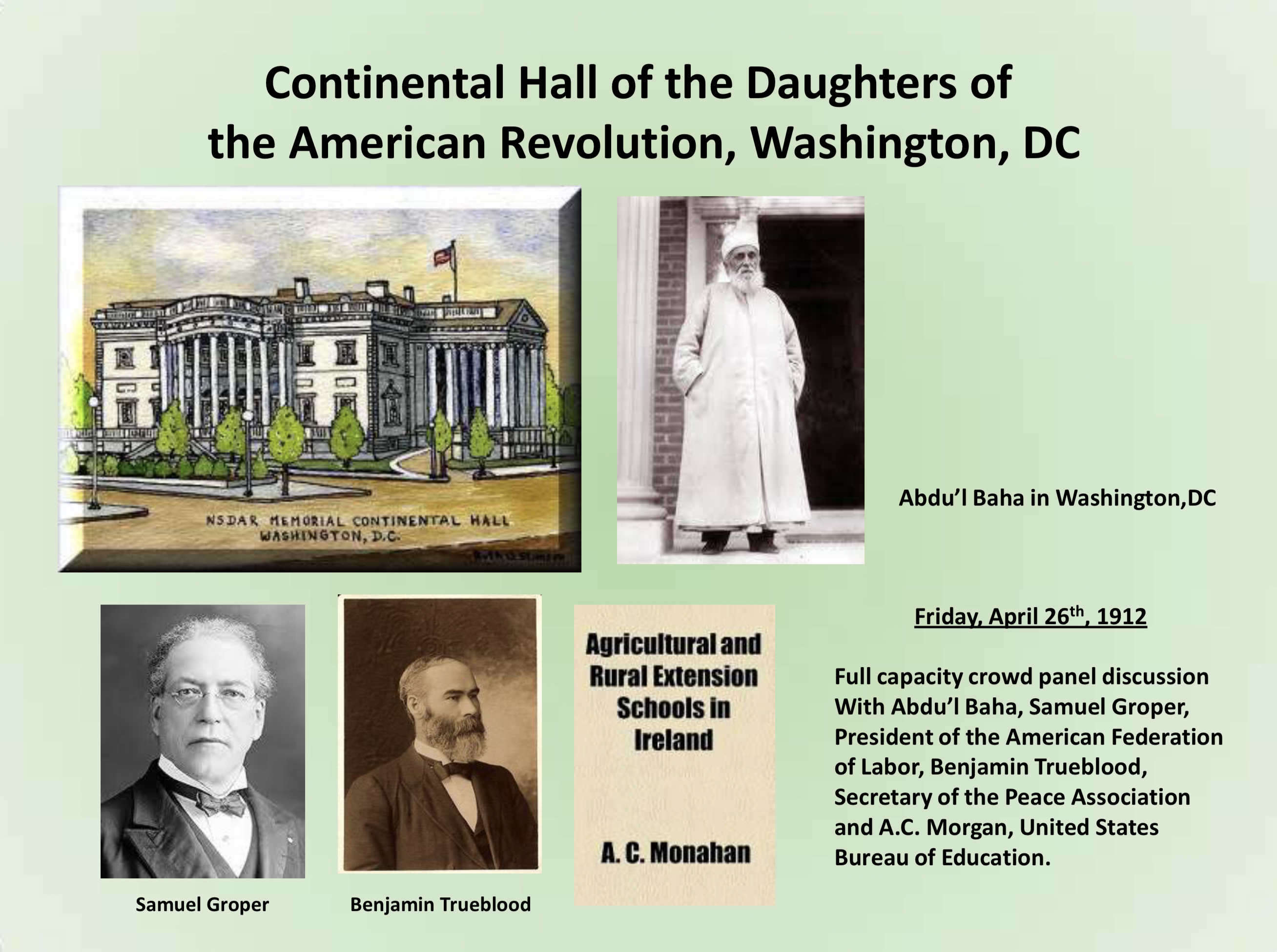
Among the visitors on Friday morning, April 26, was Lee McClung, the Secretary of the Treasury if the United States. Later ‘Abdul-Bahá addressed the ladies of President Taft’s All Saints [Souls] Unitarian Church, the room was completely filled. After the daily Parsons’ reception, He took a walk in the park. That evening He spoke to another capacity crowd, in one of the largest halls in Washington—the Continental Hall of the Daughters of the American Revolution—sharing the platform with Samuel Gompers, the president of the American Federation of Labor, Benjamin Trueblood, secretary of the American Peace Society, and A. C. Monohan [Arthur Coleman Monahan] of the United States Bureau of Education.

Abdul-Bahá, Who kept the friends in the Holy Land and Persia apprised of the activities through frequent cablegrams, cabled, “‘This day three thousand persons were interviewed in the utmost harmony.’”

“Remembering those who looked into His eyes” 3

Message to the Esperantists, Home of Mr. and Mrs. Arthur J. Parsons , 1700 Eighteenth Street, NW, Washington, D.C., 25 April 1912

Today the greatest need of the world of humanity is discontinuance of the existing misunderstandings among nations. This can be accomplished through the unity of language. Unless the unity of languages is realized, the Most Great Peace and the oneness of the human world cannot be effectively organized and established because the function of language is to portray the mysteries and secrets of human hearts. The heart is like a box, and language is the key. Only by using the key can we open the box and observe the gems it contains. Therefore, the question of an auxiliary international tongue has the utmost importance. Through this means international education and training become possible; the evidence and history of the past can be acquired. The spread of the known facts of the human world depends upon language. The explanation of divine teachings can only be through this medium. As long as diversity of tongues and lack of comprehension of other languages continue, these glorious aims cannot be realized. Therefore, the very first service to the world of man is to establish this auxiliary international means of communication. It will become the cause of the tranquillity of the human commonwealth. Through it sciences and arts will be spread among the nations, and it will prove to be the means of the progress and development of all races. We must endeavor with all our powers to establish this international auxiliary language throughout the world. It is my hope that it may be perfected through the bounties of God and that intelligent men may be selected from the various countries of the world to organize an international congress whose chief aim will be the promotion of this universal medium of speech. 4

Friday, April 26, 1912

In addition to the usual receptions at the home of Mrs Parsons, there were three public meetings: one in the morning, another in the afternoon and one in the evening. At the first gathering, at the All Saints Unitarian Church, the Master spoke on the subject of the varieties of light, the effulgence of the Sun of Reality in its original essence, and of the waiting souls with pure hearts who are like unto clear spotless mirrors, whose eyes and ears become enlightened by the appearance of the Sun of Reality. So great was the respect and devotion of the audience that ‘Abdu’l-Bahá wrote in a cable He sent to the Orient: ‘Today three thousand persons visited with the utmost harmony.’

At every gathering, whether for Bahá’ís or non-Bahá’ís, several stenographers, as well as the Persian secretaries, were in attendance. The English translations were published soon after the address itself but the Persian originals taken down by us verbatim had to be submitted to ‘Abdu’l-Bahá for correction. Because of His heavy schedule, He had little time for this, so the originals were often delayed in their publication.

The afternoon meeting was held at the home of Mrs Parsons. The subject of the talk was the interpretation of the Old Testament statement concerning the creation of man in the image of God. At the conclusion ‘Abdu’l-Bahá took His leave of the friends, promising to return to Washington DC from Chicago. On hearing this, the friends hastened to shake hands with Him and showed great reverence and humility to Him, joyful that soon He would return to their midst. After the meeting, ‘Abdu’l-Bahá went for a stroll in a park to recuperate.

In the evening ‘Abdu’l-Bahá went to a third gathering, held in a very large building, to speak to a group of young women of the suffrage movement. This was the largest meeting held thus far and the most spacious and majestic hall. ‘Abdu’l-Bahá delivered a most impressive address which He began by saying:

“One of the teachings of Bahá’u’lláh is equality of rights for men and women. When He promulgated this principle in the Orient, the people were astonished.

One of the proofs of the advancement of women is this magnificent and imposing building and this large gathering.”

‘Abdu’l-Bahá’s talk centered on the subject of equality of men and women and the necessity of giving women the same training as men. Many praised Him, both before and after His talk. The meeting closed with a song of praise.

The chairman of the meeting, Mr Hoover from New York, introduced the Master most eloquently. When ‘Abdu’l-Bahá came to the pulpit, He was received with a standing ovation and a burst of enthusiasm. Then, with a motion of His hand, all seated themselves.

As the Master arose to give His talk, everyone began to clap so loudly that the sound echoed around the great hall. Everyone was thrilled as the beloved Master stood and the hearts of the believers were relieved of all grief and anxiety. Indeed, the appearance of the Center of God’s Covenant in these meetings is worthy of the highest praise and will undoubtedly be of the greatest benefit to all. Instead of the harsh treatment meted out to the Manifestations of God, here was the advancement and elevation of the Cause of God. To listen to the melodious, resonant voice of the Center of the Covenant in such auditoriums fills one with excitement and raises the banner of everlasting honor. The presence of the Eastern friends was sorely missed.

At the end of the meeting, people again filled the room to capacity so they could glimpse ‘Abdu’l-Bahá’s beautiful face and shake His hand. 5

  1. Menon, Jonathan. “A Trip Through New York City, 1911.” 239 Days in America, April 26, 2012. https://239days.com/2012/04/26/a-great-harvest-of-results/.
  2. Ward, Allan L. 239 Days: ʻAbdu’l-Bahá’s Journey in America. Wilmette, Ill: Bahá’í Publishing Trust, 1979, 45.
  3. Van Ness, Zabine. “Remembering Those Who Looked into His Eyes: Abdul Baha’s Visits with Some Influential Dignitaries, April 11th to December 5th, 1912.” PDF, Seattle, WA, 2012, 26.https://hearttoheart.co/PDFs/Abdul-Bahaandhisvariousvisitations.pdf.
  4. ʻAbduʼl-Bahá. The Promulgation of Universal Peace: Talks Delivered by ʻAbduʼl-Bahá during His Visit to the United States and Canada in 1912. Edited by Howard MacNutt. 2nd ed. Wilmette, Ill: Baháʼí Publishing Trust, 1982, 60-61. https://www.bahai.org/library/authoritative-texts/abdul-baha/promulgation-universal-peace/3#293573670.
  5. Mahmud-i-Zarqani, Mirza. Mahmúd’s Diary: The Diary of Mírzá Mahmúd-i-Zarqání Chronicling ’Abdu’l-Bahá’s Journey to America. Edited by Shirley Macias. Translated by Mohi Sobhani. Oxford: George Ronald, 1998. https://bahai-library.com/zarqani_mahmuds_diary&chapter=2#section33