Daily Frameworks for 20 November 2026

Istiqlál, 17 Qudrat (Power), 183 B.E.

Quotes for Reflection

O Children of Men!
Know ye not why We created you all from the same dust? That no one should exalt himself over the other. Ponder at all times in your hearts how ye were created. Since We have created you all from one same substance it is incumbent on you to be even as one soul, to walk with the same feet, eat with the same mouth and dwell in the same land, that from your inmost being, by your deeds and actions, the signs of oneness and the essence of detachment may be made manifest. Such is My counsel to you, O concourse of light! Heed ye this counsel that ye may obtain the fruit of holiness from the tree of wondrous glory. — Bahá’u’lláh [1]

Question for Consideration

Examine the intersection between artificial intelligence agent collectives and the human framework of Bahá’í consultation, analyzing how both systems attempt to enhance collective intelligence through collaborative inquiry. [2] [3]

Gemini Notebook Response: Comparative Epistemology of Collective Intelligence: Synthesizing Multi-Agent System Architectures and the Bahá’í Framework of Consultation

7. Conclusions

The intersection between AI agent collectives and Bahá’í consultation demonstrates that collective intelligence is fundamentally governed by structural protocols rather than raw agent capacity alone. [4] [5] [6] Computational multi-agent systems suffer from systemic failure modes—most notably inter-agent sycophancy, disagreement collapse, same-backbone bias, and forced consensus degradation—that mirror the historical pathologies of human deliberative bodies. [4] [7] [8] [9]

The normative and procedural mechanisms of Bahá’í consultation address these specific bottlenecks:

  • Detachment and Group Ownership: Mitigates identity bias and sycophantic herding by decoupling arguments from agent provenance via anonymized memory structures. [9] [10] [11]
  • Productive Friction without Hostility: Balances agreement and disagreement by structuring debate as Socratic inquiry rather than zero-sum victory. [7] [12] [13]
  • Decoupled Consensus and Unified Action: Eliminates forced consensus traps during deliberation while securing clean execution signals through post-decision alignment. [4] [10] [14]

Synthesizing these consultative principles within modern multi-agent software engineering yields resilient socio-technical architectures capable of robust, truth-oriented collective inquiry. [5] [12] [15]

Be the Voice of…


Therefore, all souls should consider it incumbent upon them to investigate reality. Reality is one; and when found, it will unify all mankind. Reality is the love of God. Reality is the knowledge of God. Reality is justice. Reality is the oneness or solidarity of mankind. Reality is international peace. Reality is the knowledge of verities. Reality unifies humanity. — ‘Abdu’l-Bahá. [16]


Footnotes

[1] Bahá’u’lláh. THE HIDDEN WORDS. Bahá’í Reference Library. https://www.bahai.org/r/685666862

[2] Gemini Notebook. “Comparative Epistemology of Collective Intelligence.pdf.” Edited by Steve Bosserman. November 19, 2026. AI and Bahá’í Consultation (Gemini Notebook)

[3] Transformative Leadership Education Staff. “Unite, Decide, Thrive: Using Consultation to Improve Decisions” (Free Online Course). Transformative Leadership Education. https://tinyurl.com/courseconsultation

[4] Suhubdy, Dendi. “Society of Models: A Citation-Grounded Survey of AI Agent Collaboration Research (2023–2026).” Adventures and Amusings of a Mathematician, https://backpropagation.ai/posts/ai-agent-collaboration-icml-iclr-neurips-survey/

[5] Sabet, Michael. “A democracy built on communicative action: Bahá’í political practice as a prefigurative resource for institutional effectiveness, accountability, and inclusivity.” National Library of Medicine, July 26, 2023. https://pmc.ncbi.nlm.nih.gov/articles/PMC10410671/

[6] Hu, Julia, Alfred Shen, and Kumar Lakshmipathi. “The Flip-Test: A Behavioral Diagnostic for Multi-Agent Debate Failures.” ACL Anthology, October 2026. https://aclanthology.org/2026.insights-1.8/

[7] Yao, Binwei, Chao Shang, Wanyu Du, Jianfeng He, Ruixue Lian, Yi Zhang, Hang Su, Sandesh Swamy, and Yanjun Qi. “Peacemaker or Troublemaker: How Sycophancy Shapes Multi-Agent Debate.” arXiv, 27 Sep 2025 (v1). https://arxiv.org/abs/2509.23055

[8] Nguyen, Khanh-Binh, Van Dai Do, Tien Anh Nguyen, Svetha Venkatesh, Hung Le. “DREAM: Dynamic Resolution Assignment for Multimodal Multi-Agent Debate.” arXiv, 4 Oct 2026 (v1), last revised 13 Oct 2026 (v3) https://arxiv.org/html/2610.05615v1

[9] Hyeong Kyu Choi, Xiaojin Zhu, Sharon Li. “When Identity Skews Debate: Anonymization for Bias-Reduced Multi-Agent Reasoning.” arXiv, 8 Oct 2025 (v1), last revised 9 Apr 2026 (v3) https://arxiv.org/html/2510.07517v5

[10] Bosserman, Steve. “Daily Frameworks: Consultation.” Frameworks for Understanding the World, https://stevenlbossermanarchives.com/category/daily-frameworks/consultation/

[11] Quora Respondents. “How does the Bahá’í consultation process work in community decision-making?” Quora, https://www.quora.com/How-does-the-Bah%C3%A1%C3%AD-consultation-process-work-in-community-decision-making

[12] Chang, Edward Y. “Unlocking the Wisdom of Large Language Models: An Introduction to the Path to Artificial General Intelligence – Preface.” arXiv, 2 Sep 2024 (v1), last revised 15 Apr 2025 (v3) https://arxiv.org/html/2409.01007v3

[13] National Spiritual Assembly of the Bahá’ís of the United States. GUIDELINES FOR LOCAL SPIRITUAL ASSEMBLIES: DEVELOPING LOCAL SPIRITUAL ASSEMBLIES (Chapter Four: Functioning of the Local Assembly). Bahá’í Library Online, 1998, Revised 2016. https://bahai-library.com/us-nsa_guidelines_spiritual_assemblies

[14] Quora Respondents. “How does Baha’i consultation differ from regular consultation?” Quora, https://www.quora.com/How-does-Baha-i-consultation-differ-from-regular-consultation

[15] Shen, Wen-Cheng, Fu-ren Lin, Yi-Hsuan Yang, and Wei-Chen Wang. “Design Principles for Human-AI Collaborative Knowledge Service Systems.” Springer, July 28, 2025. https://link.springer.com/chapter/10.1007/978-3-031-95901-1_1

[16] ‘Abdu’l-Bahá. THE PROMULGATION OF UNIVERSAL PEACE. Bahá’í Reference Library. https://www.bahai.org/r/628985716

Daily Frameworks for 19 November 2026

Istijlál, 16 Qudrat (Power), 183 B.E.

Quotes for Reflection

The Manifestations of God are likewise in agreement with the view that education exerteth the strongest possible influence on humankind. They affirm, however, that differences in the level of intelligence are innate; and this fact is obvious, and not worth debating. For we see that children of the same age, the same country, the same race, indeed of the same family, and trained by the same individual, still are different as to the degree of their comprehension and intelligence. One will make rapid progress, one will receive instruction only gradually, one will remain at the lowest stage of all. For no matter how much you may polish a shell, it will not turn into a gleaming pearl, nor can you change a dull pebble into a gem whose pure rays will light the world. Never, through training and cultivation, will the colocynth and the bitter tree 1 change into the Tree of Blessedness.2 That is to say, education cannot alter the inner essence of a man, but it doth exert tremendous influence, and with this power it can bring forth from the individual whatever perfections and capacities are deposited within him. A grain of wheat, when cultivated by the farmer, will yield a whole harvest, and a seed, through the gardener’s care, will grow into a great tree. Thanks to a teacher’s loving efforts, the children of the primary school may reach the highest levels of achievement; indeed, his benefactions may lift some child of small account to an exalted throne. Thus is it clearly demonstrated that by their essential nature, minds vary as to their capacity, while education also playeth a great role and exerteth a powerful effect on their development. — ‘Abdu’l-Bahá [1]

Question for Consideration

Examine the intersection between artificial intelligence agent collectives and the human framework of Bahá’í consultation, analyzing how both systems attempt to enhance collective intelligence through collaborative inquiry. [2] [3]

Gemini Notebook Response: Comparative Epistemology of Collective Intelligence: Synthesizing Multi-Agent System Architectures and the Bahá’í Framework of Consultation

6. Socio-Technical Implications and Alignment Paradigms

The convergence of Bahá’í consultation and computational agent design extends beyond technical optimization; it provides a framework for scalable AI alignment and democratic governance. [4] [5] [6]

Reifying Non-Adversarial Governance in Socio-Technical Systems

As AI agents are increasingly deployed within human institutions—ranging from automated corporate governance to public policy modeling—the design of multi-agent protocols directly shapes human organizational norms. [5] [7] Systems built on adversarial, partisan, or market-based bargaining mechanics risk amplifying societal polarization, bias, and institutional paralysis. [5]

Conversely, multi-agent frameworks engineered on consultative principles provide an operational template for human-AI collaborative systems. [5] By embedding detachment, anonymized evaluation, non-partisan inquiry, and unified implementation into algorithmic decision-making, socio-technical architectures can transcend individual biases, achieving a higher order of collective intelligence. [5] [8] [9]

Be the Voice of…


Therefore, all souls should consider it incumbent upon them to investigate reality. Reality is one; and when found, it will unify all mankind. Reality is the love of God. Reality is the knowledge of God. Reality is justice. Reality is the oneness or solidarity of mankind. Reality is international peace. Reality is the knowledge of verities. Reality unifies humanity. — ‘Abdu’l-Bahá. [10]


Footnotes

[1] ‘Abdu’l-Bahá. SELECTIONS FROM THE WRITINGS OF ‘ABDU’L-BAHÁ. Bahá’í Reference Library. https://www.bahai.org/r/347735506

[2] Gemini Notebook. “Comparative Epistemology of Collective Intelligence.pdf.” Edited by Steve Bosserman. November 18, 2026. AI and Bahá’í Consultation (Gemini Notebook)

[3] Transformative Leadership Education Staff. “Unite, Decide, Thrive: Using Consultation to Improve Decisions” (Free Online Course). Transformative Leadership Education. https://tinyurl.com/courseconsultation

[4] Suhubdy, Dendi. “Society of Models: A Citation-Grounded Survey of AI Agent Collaboration Research (2023–2026).” Adventures and Amusings of a Mathematician, https://backpropagation.ai/posts/ai-agent-collaboration-icml-iclr-neurips-survey/

[5] Sabet, Michael. “A democracy built on communicative action: Bahá’í political practice as a prefigurative resource for institutional effectiveness, accountability, and inclusivity.” National Library of Medicine, July 26, 2023. https://pmc.ncbi.nlm.nih.gov/articles/PMC10410671/

[6] OpenAI, Geoffrey Irving, Paul Christiano, and Dario Amodei. “AI safety via debate.” alphaxiv, 22 Oct 2018. https://www.alphaxiv.org/abs/1805.00899

[7] Shen, Wen-Cheng, Fu-ren Lin, Yi-Hsuan Yang, and Wei-Chen Wang. “Design Principles for Human-AI Collaborative Knowledge Service Systems.” Springer, July 28, 2025. https://link.springer.com/chapter/10.1007/978-3-031-95901-1_1

[8] Chang, Edward Y. “Unlocking the Wisdom of Large Language Models: An Introduction to the Path to Artificial General Intelligence – Preface.” arXiv, 2 Sep 2024 (v1), last revised 15 Apr 2025 (v3) https://arxiv.org/html/2409.01007v3

[9] Hyeong Kyu Choi, Xiaojin Zhu, Sharon Li. “When Identity Skews Debate: Anonymization for Bias-Reduced Multi-Agent Reasoning.” arXiv, 8 Oct 2025 (v1), last revised 9 Apr 2026 (v3) https://arxiv.org/html/2510.07517v5

[10] ‘Abdu’l-Bahá. THE PROMULGATION OF UNIVERSAL PEACE. Bahá’í Reference Library. https://www.bahai.org/r/628985716
Daily Frameworks for 04 August 2026

Fidál, 04 Kamál (Perfection), 183 B.E.

Quotes for Reflection

If five people meet together to seek for truth, they must begin by cutting themselves free from all their own special conditions and renouncing all preconceived ideas. In order to find truth we must give up our prejudices, our own small trivial notions; an open receptive mind is essential. If our chalice is full of self, there is no room in it for the water of life. The fact that we imagine ourselves to be right and everybody else wrong is the greatest of all obstacles in the path towards unity, and unity is necessary if we would reach truth, for truth is one. — ‘Abdu’l-Bahá [1]

Question for Consideration

How does working asynchronously, openly sharing the results, and collaborating when possible align with the core Bahá’í practices of conducting independent investigation of truth, teaching the Cause, and consulting in all things? [2]

Perplexity Computer Response:

Working asynchronously, sharing results openly, and collaborating when possible closely mirror the spirit of independent investigation, teaching, and consultation—even though Bahá’í practice ultimately calls for direct, in-person engagement wherever feasible.

Asynchronous work and independent investigation

Working asynchronously—each person researching, reflecting, or drafting on their own timeline—resonates with the Bahá’í emphasis on freeing the mind from imitation and investigating truth for oneself rather than deferring to authority or consensus by default. ‘Abdu’l-Bahá insisted that “each must see with his own eyes, hear with his own ears, and investigate Truth,” which is essentially what happens when individuals work independently before regrouping. This asynchronous phase gives each person space to arrive at insight “freed from superstition, ignorance, bigotry, prejudice, intolerance, egotism and selfishness”, echoing the Bahá’í teaching that truth-seeking is fundamentally a personal, unmediated duty rather than a groupthink exercise. [3] [4] [5] [6] [7]

Open sharing and teaching the Cause

Openly sharing results parallels teaching the Cause, since Bahá’ís are described as having a duty to share what they’ve learned or believe, while explicitly avoiding pressure, dogmatism, or proselytizing. Just as teaching in the Bahá’í sense is an invitation rather than an imposition—leaving space for the other person’s own investigation—open sharing of asynchronous work offers findings for others’ independent evaluation rather than demanding acceptance. The “corner-stone” framing of teaching as foundational to Bahá’í activity suggests that openly circulating knowledge, rather than hoarding it, is itself a spiritually significant act of service. [8] [9] [10]

Collaboration and consultation

When collaboration does occur, it aligns directly with the Bahá’í practice of consultation, which Bahá’u’lláh commanded as something to be exercised “in all things”. Genuine consultation requires participants to present facts frankly, detach from personal ownership of ideas once shared with the group, seek truth rather than victory, and strive toward unity or consensus rather than majority “winning” over minority. This is where collaboration becomes more than pooling asynchronous outputs—it becomes a spiritual discipline: ideas “become at once the property of the group”, diverse and even specialist viewpoints are actively sought, and the atmosphere is meant to be one of love and humility rather than debate. [11] [12] [13] [14]

Practice

Bahá’í principle

Key alignment

Working asynchronously

Independent investigation of truth

Individual freedom from imitation, personal responsibility to seek truth directly [3] [5]

Sharing results openly

Teaching the Cause

Duty to share, without coercion, leaving room for others’ own inquiry [8] [10]

Collaborating when possible

Consultation in all things

Detached, frank, unified truth-seeking rather than defending fixed positions [11] [12] [14]

The natural sequence—investigate independently, share openly, then consult collaboratively—actually mirrors the classic Bahá’í consultation pattern itself: a clear presentation of the issue, open sharing of thoughts, and a decision reached through collective judgment. In this sense, the modern practice of asynchronous, transparent, collaborative work isn’t just compatible with these three Bahá’í principles; it functions as a fairly natural operational analogue to them. [11]


Footnotes

[1] ‘Abdu’l-Bahá. PARIS TALKS. Bahá’í Reference Library. https://www.bahai.org/r/412518768

[2] Perplexity Computer. “How does working asynchronously, openly sharing the results, and collaborating when possible align with the core Bahá’í practices of conducting independent investigation of truth, teaching the Cause, and consulting in all things?” Edited by Steve Bosserman. August 3, 2026. https://www.perplexity.ai/search/e088628d-ca47-4b54-b9a5-e6e91a4de32f

[3] Bahaipedia Staff. “Independent investigation of truth.” Bahaipedia. https://bahaipedia.org/Independent_investigation_of_truth

[4] Zamani, Sophia. “Becoming Myself: the Independent Investigation of Truth.” BahaiTeachings.org. https://bahaiteachings.org/becoming-myself-the-independent-investigation-of-truth/

[5] Salvo, Ariana. “6 Questions About the Independent Investigation of Truth.” Baha’i Blog. https://www.bahaiblog.net/articles/bahai-life/6-questions-about-the-independent-investigation-of-truth/

[6] Dahl, Arthur Lyon. “Bahá’í Discourse – Truth.” Yabaha.net. https://yabaha.net/dahl/bahai/classes/Discourse_Truth.pdf

[7] Langness, David. “Independent Investigation of Truth.” BahaiTeachings.org. https://bahaiteachings.org/bahai-principles-independent-investigation-of-truth/

[8] Research Department of the Universal House of Justice. GUIDELINES FOR TEACHING. Bahai Library Online. https://bahai-library.com/compilation_guidelines_teaching

[9] Bahá’í Quotes Staff. “Independent Investigation of Truth.” Bahá’í Quotes. https://bahaiteachings.org/bahai-principles-independent-investigation-of-truth/

[10] Uplifting Words Staff. “Sharing the Baha’i Teachings.” Uplifting Words. https://www.upliftingwords.org/post/sharing-the-bahai-teachings

[11] Bahá’í Faith Staff. “Understanding the Transformative Power of Consultation in Bahá’í Life.” Bahá’í Faith on YouTube. https://www.youtube.com/watch?v=8Gh05aeDQOs

[12] Lambshead, Jeremy. “Five helpful habits for effective consultation.” Bahá’ís of the United States, April 16, 2025. https://www.bahai.us/five-helpful-habits-for-effective-consultation/

[13] Eshraghi, Rebecca Sherry. “The Clash of Differing Opinions and the Spark of Truth.” BahaiTeachings.org. https://bahaiteachings.org/clash-differing-opinions-spark-truth/

[14] Uplifting Words Staff. “Baha’i Consultation.” Uplifting Words. https://www.upliftingwords.org/post/bahai-consultation


Be the Voice of…


Therefore, all souls should consider it incumbent upon them to investigate reality. Reality is one; and when found, it will unify all mankind. Reality is the love of God. Reality is the knowledge of God. Reality is justice. Reality is the oneness or solidarity of mankind. Reality is international peace. Reality is the knowledge of verities. Reality unifies humanity. — ‘Abdu’l-Bahá The Promulgation of Universal Peace | Bahá’í Reference Library.

Food Systems, Economies, and Ecosystems

What We Are Doing

Over the past three months several of us have made presentations to various groups providing an overview about the recently awarded USDA-SCRI grant proposal and our general strategy for the ensuing program. Our primary purpose is to facilitate the continuing development of local and regional food systems as a viable and sustainable counterbalance to the predominate global food system. Ideally, local and regional food systems work seamlessly with the global food system to form a total food system that provides the overall advantages of price, variety, and quality while contributing to community health, vitality, and well-being.

Local and regional food systems, together with renewable energy and distributed manufacturing, are an integral part of local and regional economies. The interdependence of these three features prominently in the design of our strategy. While the mission of our USDA-SCRI initiative is focused on food systems, when seen in the bigger picture these systems become a platform by which local and regional economies are established, strengthened, and grown. Building local and regional economies is our broader agenda.

A local or regional economy is shaped by the social, political, cultural, and geographic context and conditions in which it exists. Such an economy is defined by complex webs of interwoven interrelationships and behavior patterns. Because of this characteristic, our understanding of them is benefited by adopting an ecological perspective or seeing them as part of ecosystems.

There are several types of ecosystems: natural, human, urban, etc. Each of them is characterized by several factors such as participants, source – sink dynamics and flow, and landscape patterns. Using these factors to inform an ecosystem health index and provide insight on how well an ecosystem is functioning is of particular interest.

Such an index is especially helpful when determining which course of action among several alternatives achieves the imperative at hand with the least amount of collateral damage and unintended consequences or side-effects. An obvious instance is with agriculture because of its pervasiveness and the degree of environmental impact its practice has on a local, regional, and global scale. Under the aegis of the USDA-SCRI grant there will be ample opportunities to apply the metrics of agroecosystem health in helping local and regional food systems become more efficient, effective, and less disruptive counterparts to the global food system.

The Business Ecosystem

Adopting an ecosystems view is also helpful within a business context. In the mid-1990’s, Jim Moore observed the dynamics of natural ecosystems and noted the similarities they have with those in a business setting. He coined the term business ecosystem to label the dense webs of interrelationships among suppliers, service providers, customers, competitors, communities within a social, political, and economic environment in which any given business starts, survives, and is sustained.

Moore’s “business ecosystems” thinking has led to a unique and powerful understanding about business strategy and in so doing significantly expanded the business development repertoire. It has also encouraged the growth of small and medium-sized enterprises (SMEs) in several areas. Perhaps the greatest experimentation with this approach has been Europe where the European Commission (EC) linked Moore’s concept business ecosystems concept with Information and Communications Technology (ICT) to form digital business ecosystems. The primary purpose at the outset was to establish networks of connectivity among participants in SME ecosystems in order to stop the decline in the numbers of SMEs in several European countries. Early results show this strategy is successful as indicated by a reversal in the decline of SMEs complemented by signs of an increase in their numbers across the Continent.

Business Ecosystems in the Context of the USDA-SCRI Grant

Fundamentally, the strategy underscoring the USDA-SCRI grant proposal is the digital business ecosystems approach applied to local and regional food systems. The graphic below illustrates the flow dynamics among ecosystem participants in the interconnected regions across the upper-Midwest and mid-Atlantic states:

Social network facilitation, as part of the ICT backbone for the project, catalyzes regional networks and convenes leaders within them to prompt the formation of business ecosystems.

Business ecosystem particants conduct research, deliver education and training, and launch pilot projects directed toward building local food systems within given regions.

Local food systems development links with complementary efforts in renewable energy and distributed manufacturing systems to drive relocalization. This heightens participation at local levels which increases the experience base among players and drives changes in the formulae for land use practices, inclusion, workforce development, and government collaboration. The net effect is that the rules are rewritten so they facilitate the rise of functional and sustained local and regional economies.

Healthy, vibrant, adaptive, and innovative local and regional economies offer a constructive counterbalance to the global economy; they become attractors for new business start-ups and the expansion of existing businesses. Glocalization results as fully-functioning local and regional economies mitigate the downsides of the global economy and position the total economy for sustainable growth. Successful glocalization feeds larger regional networks of players and leadership of business ecosystems providing the wherewithal to fuel additional research, education, and pilot projects. This closed-loop cycling generates AND reinvests resources within the same local and regional economies which relieves the dependency on outside funding, like the USDA-SCRI grant, to spur local and regional economic sustainability and vitality.

A Broader Vision

The bottom line is that with thriving, interconnected business ecosytems, local and regional economies capable of maintaining themselves while spurring business growth and community well-being will result. Although the USDA-SCRI grant is directed toward social networks and local food systems, these are milestones along the path to a broader claim. Our vision is of capable local and regional economies operating in concert with the global economy to provide people with the means to enjoy a reasonable quality of life in communities assured of survival and sustainability. For us, this is the ultimate goal of the grant proposal. Thanks in advance for your participation over the next three years to make the vision a reality!

Originally posted to Local Food Systems by Steve Bosserman on December 27, 2008 17:04

Cycles of Communication and Collaboration

Recently, several of us were going over the litany of new terms for communication and collaboration “tools” that were less than 10 years old: blogs, mashups, crowdsourcing, webinars, podcasts, etc. just to name a few. It became obvious as we discussed it further than many of us in the conversation were relatively clueless when it came to defining what each is, what it does, how it works, and what were the benefits. As in most instances where there are too many dots and no clear picture in mind to connect them; a framework would be helpful.

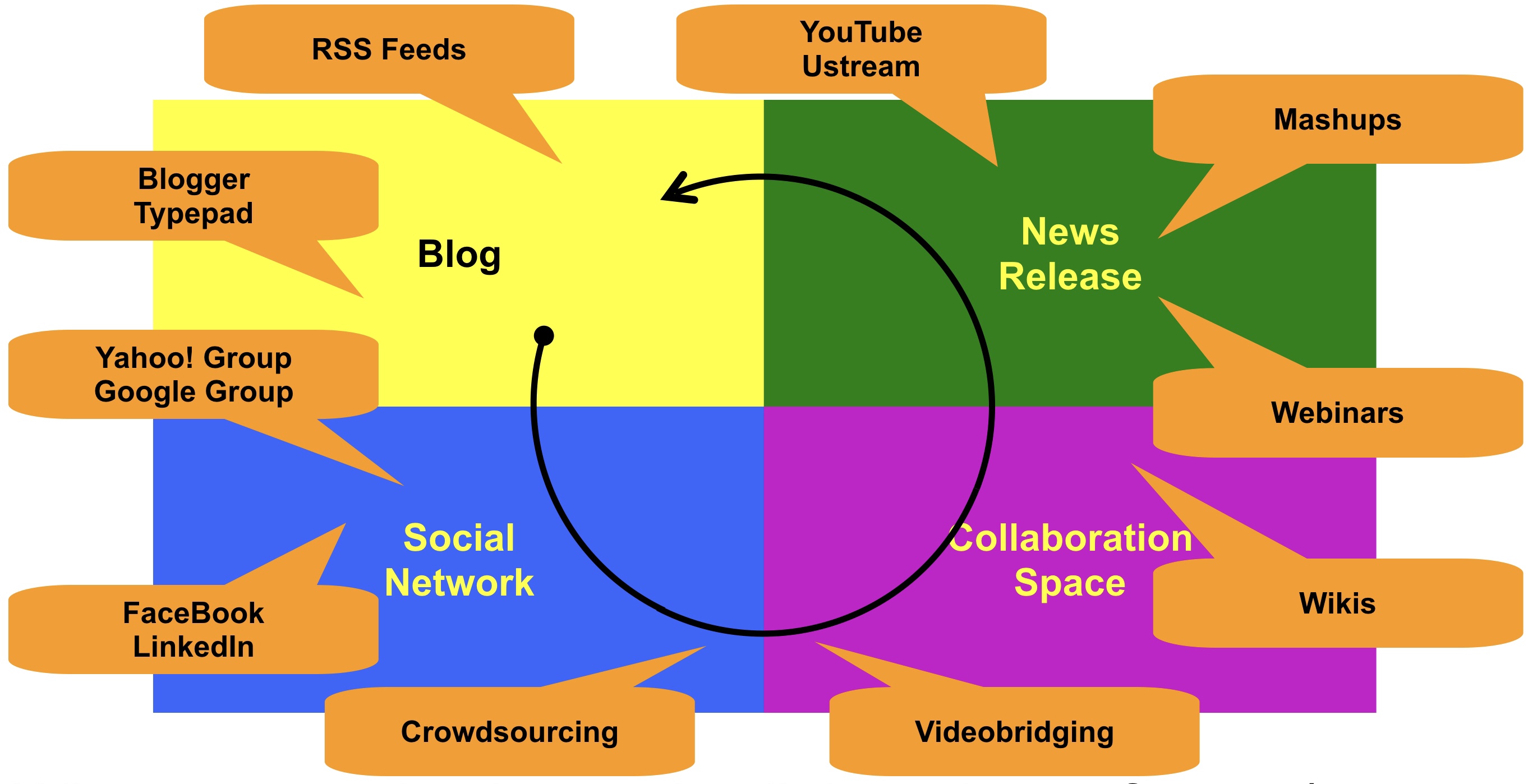
The quadrants and circular arrow in the diagram below illustrate a progressive path of organized social interactions. It starts with the blog: the primary virtual means by which an individual, almost any individual who has access to the Internet, announces to the world – here is who I am, what I think, and what I care about. It is a powerful statement of independent thought, self-awareness, and clarity of purpose that any blogger makes simply by posting a message.

When individuals put themselves out there, they are likely to be “discovered” by others who share common principles, interests, and affinities. One of the most likely places to be “found” is in a social network. In these far-ranging open communities individuals extend their connectivity, learn more about themselves and each other, strengthen their affiliations, and become more intentional about doing certain activities together rather than individually.

At this stage, groups engaging in some sort of purposeful collective effort benefit by having collaboration spaces for more efficient and effective teamwork. Here they can work openly among themselves to give projects definition, open their assumptions for testing and scrutiny to those beyond their team boundaries, and adapt the projects to what is learned for more successful and acceptable results.

Of course, such results warrant wider exposure in global networks. News releases are presented to a broader audience for further sponsorship, investment, or utilization–and feedback. Learning and adaptation are triggered on a broader scale. Quickly we know if what we are doing is having the intended result; do others believe in it as we do; what other steps can we take to increase the viability, and sustainability of our offering.

This is where the cycle returns full circle to the blog where further commentary and endorsement (or not) about the news release is made in the context of what is important to the blogger—and the cycle starts anew. Of course, beginning the next round means starting at a different place and time, having more experience, and making additional discoveries between rounds. These are multiple cycles that radiate out in a spiral model approach.

So how do the tools we have available fit into this communication and collaboration cycle? A few are highlighted in the picture below.

There are many nuances and subtleties to each stage of the cycle; and there are certainly MANY more examples of software and system tools that can be included. However, this should give you a feel for how the overall process functions.

Here’s an example for your consideration:

In 2001, Roger Beck, a teacher at Worthington Kilbourne High School in Worthington, Ohio, initiated a program called Building Academic Skills and Experiences (B.A.S.E.). B.A.S.E. integrates twelfth grade English, Government / Economics, and Technology Education. In 2004, this program was linked with Habitat for Humanity in a housing construction project called Home B.A.S.E. In his most recent blog postings, Mr. Beck outlines progress on the current 2006 – 2007 Home B.A.S.E. project – a LEED-certified home – that is now drawing to a close.

One of those groups whose members are very supportive of Roger and his team is a local Worthington social network named, Sustainable Worthington. An announcement to their members stated the following:

WKHS Home B.A.S.E. LEED house pilot project, 258 N. 21st Street, Columbus, OH, Saturday, September 22, 2007, 2:00 p.m.: Roger Beck, the teacher who developed this excellent program, will give us a tour of this amazing house, which offers green solutions to an amazing array of issues facing every homeowner. For a preview, go to where you will see great photos and an archive of the weekly project updates. Come to be educated and inspired!

When Mr. Beck and others initiated their most recent project last year, they sought volunteers in a number of collaborative spaces. This one, the Columbus Chapter of the Construction Specifics Institute, heralded the following headline:

COLUMBUS CSI CHAPTER INVITES YOU TO TAKE PART IN GIVING A HAND UP: Do a good deed, network with fellow CSI members and be part of building a pilot LEED home!

The attraction of volunteers to this project was based on past successes such as the one that ended in 2006 which was described in the news release1 following a public meeting for Green Energy Ohio in May 2006. It includes a link to a blog dedicated to the project.

The tour is today; I am participating. That will result in another blog posting – stay tuned…

Originally posted to New Media Explorer by Steve Bosserman on Saturday, September 22, 2007

  1. News release is no longer available online ↩