Local Timebanking

My previous post, Conjoined Economies, pointed out how despite the importance of parity between a time-based economy and a money-based economy for the health and well-being of community members, the money-based economy maintains a dominant presence within most social systems. Because of that imbalance, it is essential to bring time-based economy activities out of the shadows and acknowledge their value.

Timebanking provides opportunities for communities to make the time-based economy more explicit at a local level and a stronger partner with (or worthy opponent to) the predominant money-based economy, globally.

The diagram below illustrates how the two economies would relate to one another on more local (smaller circumference) and global scales.
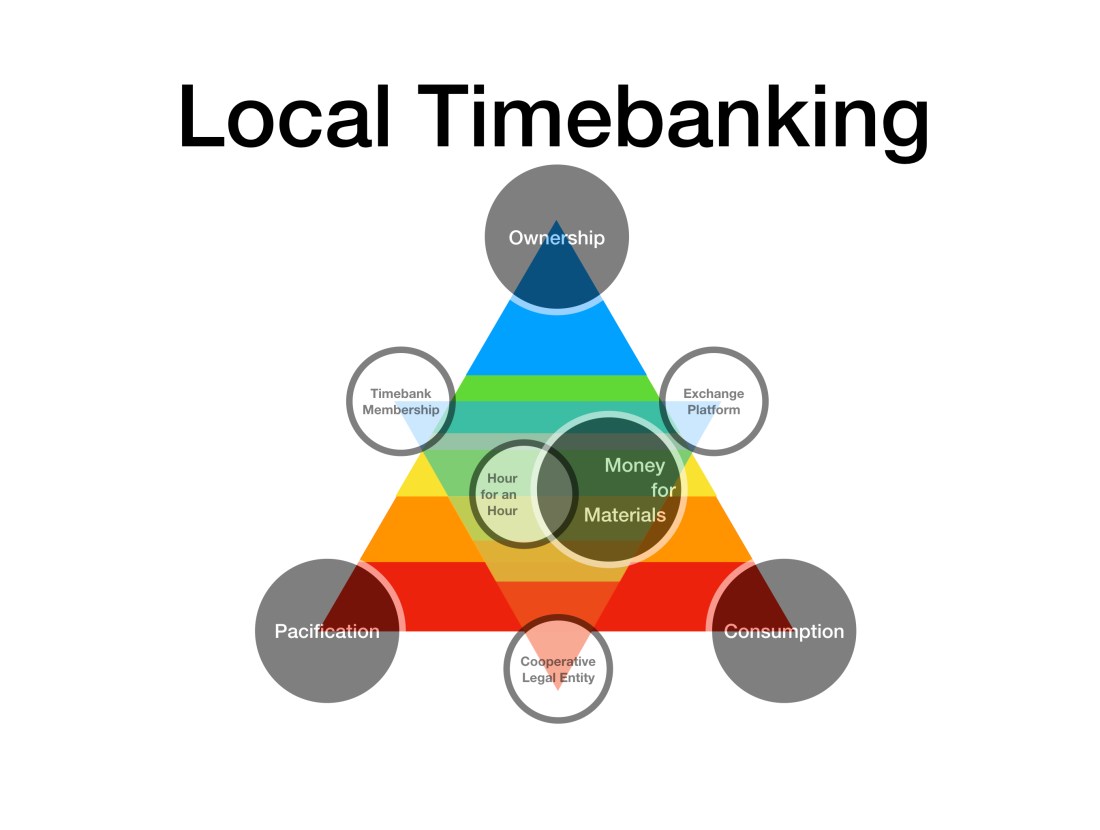
While the organizing principles for a time-based economy are similar, those defining timebanking have several key characteristics, namely: “participation” becomes membership with an account in a timebank; “exchange” becomes use of a specific exchange platform; and “commons” relates to a cooperative or otherwise legal entity as a governance structure. In addition, the general concept of time as the driver for economic activity shifts to more specific notion of an hour of service for an hour of credit.

Timebanking Core Values

TimeBanks USA, founded by Edgar Cahn in 1995, offers a complete package of operating philosophy, materials, software, and support for communities to get involved in timebanking. As an example, below are The Five Core Values of TimeBanking initially stated by Cahn: 1

  1. Asset: Every one of us has something of value to share with someone else.
  2. Redefining Work: There are some forms of work that money will not easily pay for, like building strong families, revitalizing neighborhoods, making democracy work, advancing social justice. Time credits were designed to reward, recognize and honor that work.
  3. Reciprocity: Helping that works as a two-way street empowers everyone involved – the receiver as well as the giver.
    The question: “How can I help you?” needs to change so we ask: “Will you help someone too?” Paying it forward ensures that, together, we help each other build the world we all will live in.
  4. Social Networks: Helping each other, we reweave communities of support, strength & trust. Community is built by sinking roots, building trust, creating networks. By using timebanking, we can strengthen and support these activities.
  5. Respect: Respect underlies freedom of speech, freedom of religion, and everything we value. Respect supplies the heart and soul of democracy. We strive to respect where people are in the moment, not where we hope they will be at some future point.

Note the similarity of the five Core Values to Jay Walljasper’s interpretation of the eight design principles Elinor Ostrom defined for effective governance of the commons quoted in Organizing Principles for a Time-Based Economy.

Timebanking – The Realized Value of Unpaid Time

In accordance with these Core Values, the timebank becomes a venue in which any member has the opportunity to take greater responsibility for unpaid time by doing the following:

  • Document unpaid time in a personal member account
  • Convert unpaid time into a currency according to a rate shared by all members
  • Exchange unpaid time in account for access and usage of resources offered by other members

Timebanking – Benefits

Of course, realizing the value of unpaid time is more about building relationships within local communities than conducting transactions. hOurworld, a self-described “…international network of neighbors helping neighbors,” defines the timebank venue as a place where

Members share their talents and services, record their hours, then ‘spend’ them later on services they want. Everyone’s hours are equal. There is no barter. These are friendly, neighborly favors. Together we are restoring local community currency based on relationships.”

The Hour Exchange Portland lists the benefits of an exchange as follows:

  • Trusting relationships – (trust, reciprocity and civic engagement)
  • Greater access to goods and services
  • Employment references
  • Stronger informal support systems
  • Safety in neighborhoods
  • Increased self-esteem / confidence
  • Greater participation in community events
  • Diminished loneliness
  • Accept help with dignity – knowing you’ll help others in return
  • Building social capital in neighborhoods — Robert Putnam 2

These descriptions of timebanking core values and benefits of an exchange certainly speak to how timebanking can help us progress toward the goals:

  1. Legitimize time-based economy behaviors
  2. Expand symbiotic / synergistic coverage by both the time-based and money-based economies

But there is so much more that timebanking offers as well as numerous platforms, processes, currencies, etc. at work to bring the time-based economy into its rightful position of parity with the money-based economy. Look to future posts that take deeper dives into timebanking and explore the topical landscape of complementary currencies, peer-to-peer relationships, systems change theory in practice, etc. more broadly.

  1. The Five Core Values of TimeBankingEdgar Cahn is the founder of modern timebanking. He noticed that successful timebanks almost always work with some specific core values in place. In his book No More Throw-Away People, he listed four values. Later, he added a fifth. These have come to be widely shared as the five core values of timebanking – and most timebanks strive to follow them. They are a strong starting point for successful timebanking.
  2. Smith, M. K. (2001, 2007) ‘Robert Putnam’, the encyclopaedia of informal education, www.infed.org/thinkers/putnam.htm. Last update: May 29, 2012.

Paid Time Distribution

The principle way we earn money is by being paid for our time fulfilling the contracted terms of a job description or statement of work.

This paid work, called “jobs” for the sake this post, can be offered by employers or contractors in the public sector or the private sector, which covers non-governmental organizations (NGO) and cooperatives among others.

Not all jobs are created equal in terms of paid time distribution. Some pay more than others for the same block of time. As a rule, jobs that pay more are harder to find and the requirements to get them are more stringent.  Conversely, lower paid jobs may be more plentiful and easier to get, but a person must work multiple jobs to earn the equivalent of a higher paying one. As a result, pay scale determines the time a person spends in paid work and the range of choices a person has to participate in quality of life activities outside of paid work.

The diagram below applies these characteristics of jobs and pay to Maslow’s Hierarchy.

Doing so shows how the distribution of paid time relates to meeting basic needs and enjoying a reasonable quality of life. The demarcation between these two can be represented as a poverty line. In this case, the poverty line represents the amount of income from paid time from employment, public services, and volunteer services sufficient to meet one’s basic needs.

At a minimum, a fully functional society assures each member receives daily basic needs in exchange for 24-hours of life in that society. Ideally, society provides opportunities for each member to meet daily basic needs through no more than 8 hours of paid time, leaving 16 hours of unpaid time available for sleep and quality of life endeavors as described in the previous post, Lifetime Hours Revisited.

Oftentimes, societies fall short of the ideal and, in more difficult situations, fail to be fully functional. The consequences are borne by families that must put more time into paid work or supplement it with income from public services and volunteer services in order to meet their basic needs. The diagram below illustrates this dynamic in the form of a question:

Of course, at the heart of this question is an even more fundamental one which asks what does the future hold for a family that cannot spend the time and generate enough income from all sources to procure basic needs? And what does that say about the condition of the society to which those families belong?

Questions for consideration in subsequent posts…

Motivation to Allocate Your 700,000 Hours

The mere fact that we live means that we allocate our allotted time on the planet to various activities. Even though we may have myriad alternatives as to what we could do with our time at any given moment, most are mutually exclusive. For instance, as I’m writing this, I’m not able to do anything else at the same time. In other words, I must choose this activity and let others go by. This internal zero-sum game we’re forced to play makes time our scarcest resource.

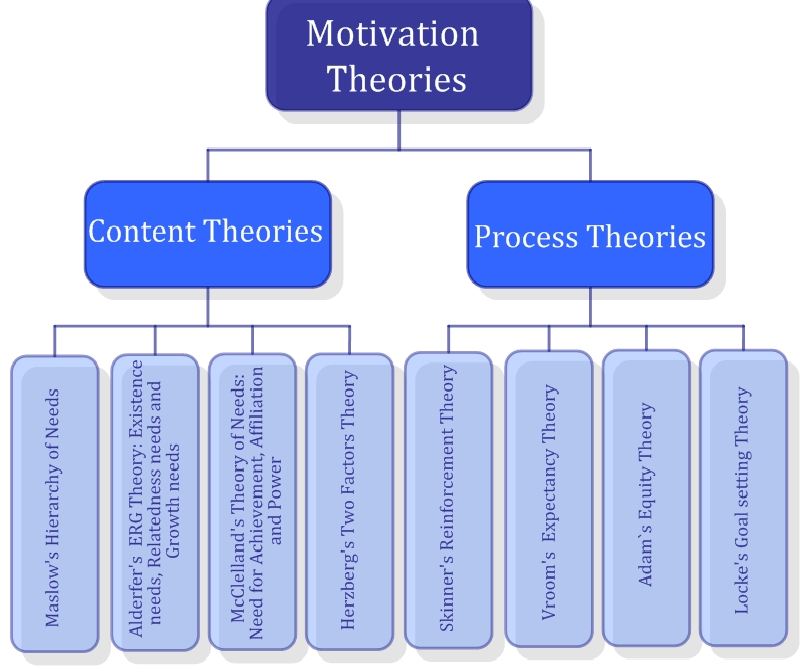
As distasteful as playing the game may seem, we do have to take responsibility for our decisions about how we use our time or the resource slips away and we risk regret over lost opportunities or, worse yet, we find our lives imperiled. Such responsibility taking is at the heart of why we do what we do when we do it. Human motivation is the longstanding subject of ongoing research, study and analysis resulting in a number of theories to explain it. The following diagram from Psychology by Juliánna Katalin Soós and Ildikó Takács (2013), identifies several of the more prominent ones.

MotivationTheoriesDiagram.png

For the purpose of this post, Abraham Maslow’s Hierarchy of Needs is the theory of choice because is well-known, easy to understand, and widely accepted as a framework for examining human motivation (see diagram below).  It can become the basis for each of us to consider in how we spend our 700,000 hours.

Maslow’s theory suggests that under natural circumstances we would divide a 24-hour period into thirds with one-third dedicated to sleep – an essential physiological need about which we are only now beginning to understand the degree of importance it holds, (see Why Sleep Is Important), another third to the remaining basic needs we all have, and the final third to achieving an improved quality of life the characteristics of which are unique to each of us.

The diagram below positions Maslow’s Hierarchy of Needs in between a couple of ways to carve-up a 24-hour period in relation to it:

The left-hand time stack, entitled Work-Life Balance, shows three equal 8-hour segments in keeping with the “natural” division of a given 24-hour period described above. While an even split may seem idealized, the intent is to emphasize the importance of a balanced allocation of one’s time as the foundation for a healthy and satisfying life. Just as successful personal finance strategies emphasize the importance of investing in a diverse portfolio for better long-term results, balancing one’s daily life offers the best return on investment for one’s 700,000 hours.

The right-hand stack, entitled Koyaanisqatsi – the Hopi word for “unbalanced life” – illustrates a disproportionate allocation of time in a day to meeting basic needs. The result is that one must make trade-offs between sleeping less in order to have some modicum of quality of life or sacrificing higher aspirations altogether in exchange for longer sleep. Regardless, an unbalanced life inexorably becomes one that is unhealthy either physically or psychologically or both. And this condition is frequently a point of discussion and debate among those who study it, suffer because of it, offer relief from it, and even contribute to it as mentioned in these articles: Is the Stuff You Buy Over 20 Years Worth 40,000 Hours of Time? – The New York Times and Buying Time, Not Stuff, Might Make You Happier : Shots – Health News : NPR.

So, how does your life stack up?  Does it matter in how you make your decisions about how to spend your time from one day to the next? If it does matter and you want to change it, how will you go about doing so?