Leadership 101

Last week was spent on the road checking in with clients and helping them manage changes within their organizations. Oftentimes, the causes for such changes are presented to me as breakdowns in communication, unrealized opportunities, performance problems, inadequate adaptation, and gaps in the flow of resources. The clients’ default reactions are hierarchical: someone needs to be contracted or hired, someone else is opting to retire, others need to be reassigned, and others still, let go. However, the reality is bigger and more complex than having a few people go and bringing in fresh blood. Change, in a flurry of what’s working, what’s not, and what could work better, first requires that these disparate conditions be placed within a framework. This is followed by convening people whose interactions have the potential to make a positive difference for their organization within that framework. Their interactions lead to more appropriate and measured actions through goals, objectives, strategies, and tactics.

As explored more fully in an earlier posting, organizations consist of sustained conversations – the basis of all human social behavior. If one wants to change an organization, change the conversations its members are having. On one level this is simple and straightforward. Matching forums with meaningful agendas is at the heart of what strategic framing and organization design are all about. People draw upon their power to convene within a social system to setup a wide range of conversations and sustain those that are deemed the most important. Of course, the point of these conversations when establishing or sustaining an organization is to gain alignment – the energy source for growth, progress, and success of any organization.

There is a clear association between those who have the power to convene for alignment and leadership. In fact, while there are hundreds of definitions for leadership, the one I use is “the exercising of power by an individual within a social system to produce alignment.” Productive, collective effort within a social system requires people to be pulling on the rope in the same direction. And through that alignment, motivation is stimulated.

Alignment occurs in three ways:

  1. Integrity. Just as an organization has integrity, so do people. Purpose: why am I here; principles: what do I stand for; intentions: what am I up to, constitute the foundation of institutional and personal integrity. When I feel that my integrity is held in the integrity expressed by others and, ultimately, their organization, I am motivated to participate in what they are doing to see how our collective efforts can be leveraged.
  2. Vision. Imagining a world where one’s purpose, principles, and intentions play out so that others can see it, too, and want to be part of making it happen is a powerful act of vision. Any vision is based first in personal experience. When it is presented to others such that they can shape it with their own dreams and create a shared view of what is possible, the vision becomes an engaging, motivating force.
  3. Fear – Greed. Visions cannot become reality without drawing upon the talents and skills of those who do not necessarily align with the values of integrity or share the same vision. Their motivation comes from a combination of “what’s in it for me” and “what will happen to me if I don’t participate.” The fear – greed continuum appeals to the baser instincts of people in areas where their absence of detachment affects their decisions. For the vast majority, it is easier to do what one is told, to do one’s job, to follow the rules. Alignment means playing along to enjoy the benefits and avoid the pitfalls. But it is a route that is susceptible to the corruptive forces of the hierarchy as explored in a previous posting.

Depending on the circumstances, leaders draw upon the energies available within each of the three types of alignment to advance the organizations they lead. Some have integrity so unquestionably solid it compels others to follow despite not having a clear picture of what the world would look like if everyone behaved according to these values or a hierarchical structure upon which to calculate the cost, risk, and benefit of participation. The most notable of such leaders represent particular spiritual or philosophical belief systems that became the cornerstones for the most persistent social systems in human history. Certainly the evidence is strong that there is much to be gained from fronting one’s core values as a key element in leadership. But, not everyone is ready to cast their lot with someone solely on values alone. This may garner alignment at the outset, but they need more to stay aligned.

Some leaders are able to describe through words and graphics how the world could look if a particular set of core values were adopted such that many others are immediately engaged by it, resonate with it, take it as their own, and start down the path toward making it reality; the vision of one becomes the vision of many. However, the more likely scenario is that one person’s vision matches the visions of others to one degree or another, but not completely. In this case, the effective leader introduces a process by which multiple visions are brought together into one shared vision that holds critical elements for all who want to pursue it. While a shared vision produces alignment, it commands the strongest buy-in only by those who were there when it was created. The leader must stay vigilant in continually representing the vision to those who are new to the organization and in some instances prompt further adaptation of the vision to hold others who come in later.

With both integrity and vision, the virtual or physical presence of and interaction with the leader is essential to maintain alignment. Collective efforts that have dependency on one leader are at risk to go astray unless a formal system is setup to manage the behavior of people in the organization. Formal systems provide boundaries that determine who is in and who is out of an organization, enable the formation of hierarchies, enact rules, regulations, policies, and procedures, and establish processes that manage the work of organizations. Within a formal system, the vision of the organization is translated into sets of actionable goals, objectives, strategies, and tactics. Alignment is achieved when people work these plans. Some leaders are effective enforcing this type of alignment within the formal systems by encouraging them through the promise of reward should they accomplish what they are responsible to do and threatening them with undesirable consequences should they fail. It is the classic case of “carrot and stick” motivation. In other words, the fear – greed continuum is alive and well.

As mentioned earlier, my work with people in client organizations is about framing their circumstances so that an appropriate set of conversations are convened and the participants can make a positive difference in helping their organization adapt. The evolving design of the organization is based on the results of certain conversations that need to happen: does the organization need to recall its integrity – get back to its roots, so to speak; does it need to renew its vision – see itself in an entirely different way filled with more possibilities; does it need to redirect its formal system – become more consequent and disciplined. These questions require different conversations and depending on whether the organizational alignment is better derived from integrity, vision, or fear – greed determines the leadership skills required to make the conversations happen.

Therein lays the challenge of doing my work well – matching the skills of leaders with the circumstances where they will prompt alignment. And if there are no immediate leaders available with the requisite skills, I coach those who show talent and interest so they strengthen their “toolkits,” gain confidence in their capabilities, and embark upon leading in new ways under unfamiliar situations. And helping those people become more evolved, well-rounded, and flexible leaders is what makes doing this work worthwhile!

Originally posted to New Media Explorer by Steve Bosserman on Wednesday, February 1, 2006

A Philosophy of Solutions

There are myriad ways in which we humans understand ourselves and our needs and wants within our experiences of the world around us. Self-awareness coupled with the dissatisfaction resulting from unmet needs and wants motivate us to influence circumstances in an effort to have a more favorable experience—to find a solution. Contentment, if ever achieved, is fleeting. The viability of a solution just found crumbles in the face of curiosity, “antsiness,” or ennui as further needs and wants rush in to renew the cycle. While this predicament may appear to be a routine fueled by frustration, the continual search for solutions is the creative impetus that advances every aspect of human civilization.

Solutions exist at multiple levels. The one most familiar to us, personally, is at the mind level. Despite our immediate circumstances we can always dream about a reality quite different from our current condition. In the realm of the imagination all realities are possible. Even though I may not have the details, the mental world in which my solution is envisioned is different than what I experience in the physical world; and it is preferable. This reality envisioned is a powerful construct, that when acted upon externally has the potential to bring a solution into existence at other levels.

Solutions stated are externalized. Whether verbalized, graphically represented, or physically demonstrated, the act of moving a solution from the mind to the surrounding world externalizes the solution. It becomes an agenda item in a forum outside myself and initiates conversation with others. Those in my family or community or workplace react to it by doing nothing or something, but react they must.

Solutions experienced externally are virtual or material. For instance, I can play soccer on a real field in a real stadium with real teammates and a real opposing team or I can play soccer on a virtual field in a virtual stadium with virtual teammates and a virtual opposing team. In the first case I am required to be somewhere at a specific time with the proper equipment and be prepared to expend a great deal of physical and mental energy for the duration of the game and run considerable risk of getting exhausted or injured. In the second case, I have an avatar who responds as I dictate within a virtual space wherein my teammates and the opposing team are similar representations. The game can start whenever and be played by whoever shows up online or I can make up my own players and have my own game independent of others. Fatigue and injury are still possible. However, eye fatigue from staring at the screen too long and injury to fingers and wrists due to excessive rapid maneuvering of the joystick are of a different nature!

The cost of designing and developing the material solution dictates the use of a virtual solution. When the cost of the material solution is quite high and testing is essential to manage risks, modeling that solution virtually at the outset carries significant value. Buildings, equipment, vehicles, appliances, even construction and manufacturing systems are likely candidates for designing and developing the virtual solution first to prove the concept before converting it into the much more expensive material solution.

Virtual and material solutions are transactional. Once solutions are expressed in the external world by whatever means other people experience those solutions and have conversations about them. Our desire to see our solutions be successful defines needs and wants for information, resources, and authority beyond what we can muster by ourselves to fulfill our solutions in the virtual or material realm. These needs and wants lead us to conduct conversations with others in transactional patterns to gain their understanding of, agreement with, and commitment to or permission for our solution to advance. Many times the world easily accommodates our efforts to advance our solutions and the transactions required to carry them out are minimal. Other times, though, the social and natural systems are perturbed by our solutions such that we are compelled to engage in numerous transactions to move forward with our solutions.

Transactions are economic. I need or want information, resources, or authority that others have and I must negotiate with others to get it. Either they give it to me through some altruistic motivation or we come to an agreement where I get it in exchange for something I give them. The nature and type of transactions I conduct to get what I need and want are directly related to the importance and urgency I have for my solution to be successful. As a result, transactions are governed by social convention, ethical and moral frameworks, conversational skill and savvy, and immediate personal circumstances. Transactions constitute the medium of exchange within an economic system by which solutions are externalized within the political and business arenas.

Originally posted to New Media Explorer by Steve Bosserman on Sunday, September 18, 2005 and updated on Saturday, September 24, 2005

Changing Organizations

An organization is a sustained, focused set of conversations between and among people intended to generate results that are deemed of sufficient value by participants such that the relationships are worth continuing. Since conversations are inherent in human communication, it can be concluded that an organization is defined and held together by the unique communication patterns it manifests. People in conversations establish organizations.

Oftentimes, we have little choice about the organization in which we are a member. In some instances, such as with parents and family, it is a lifelong association over which we have no say about who these people are to us. Other organizations are much more elective and temporary. Regardless of the type of organization or whether our membership is by choice, as long as we are associated with it we continually look for ways to make it function more effectively in meeting our interests. The dilemma becomes one of how to change the organization, but keep it intact.

At the heart of staying together is the concept of “integrity.”” In an earlier post, the notion of personal integrity was introduced as shown in the lower-left part of the graphic in the diagram below. Organizations, as human social constructs, also have integrity – —organizational integrity. Many of the elements, such as those in the authority, fiduciary, and legal arenas, are almost identical with personal integrity. Others are variations on personal integrity themes: “purpose”” is transposed to “mission statement,”” “principles”” to “vision statement”” and “intentions”” to “values statement.”” As indicated by the arrow in the background, people with their individual statements of “personal integrity,”” carry those forward into the organizational integrity of the group to which they are members. Hence, what I endeavor to do that is beyond my capacity as one person, I link with others in an organization so that I can accomplish more.

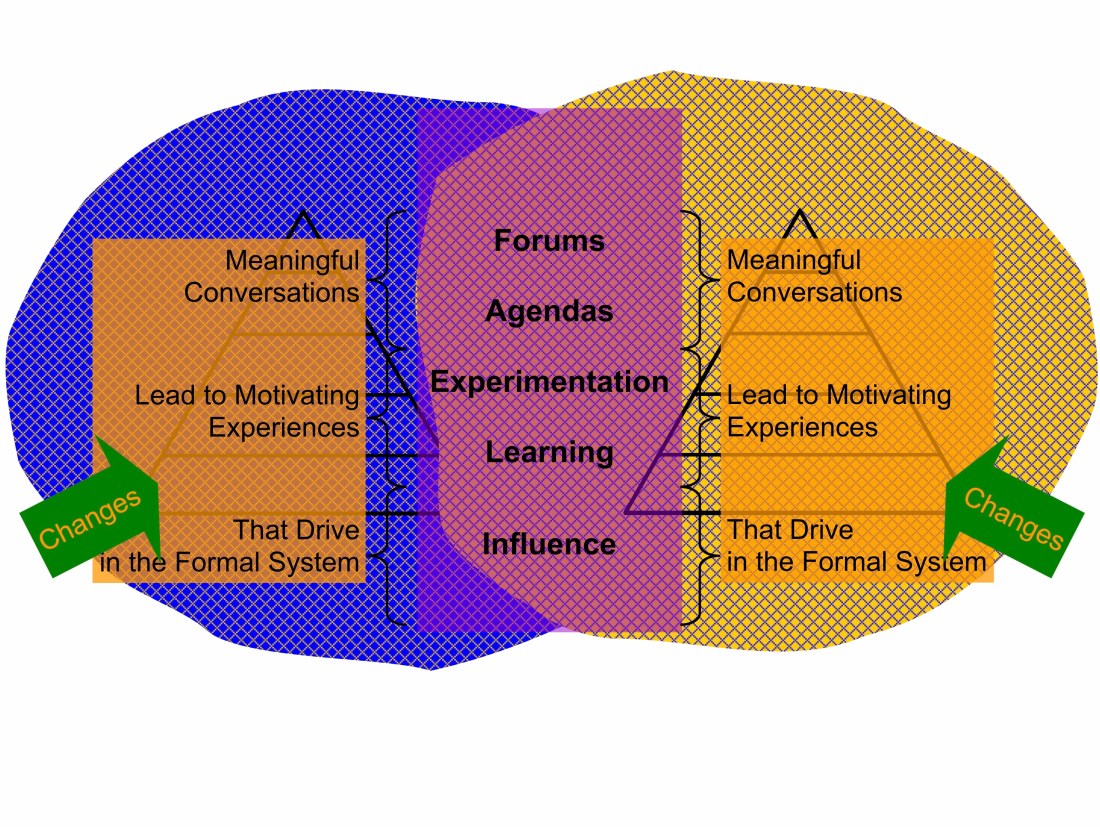
Organizations stay intact by keeping their organizational integrity unwavering. However, to adapt and respond to different conditions and circumstances organizations have to change. What is it, then, that changes? The answer is—: the formal system. In the diagram below, the triangle of organizational integrity is layered with the hierarchy (authority structure) of a formal system characterized by “rules and regulations” – ”—compliance to externally imposed laws; “policies and procedures” – ”—compliance to internally imposed guidelines; “programs and processes” – ”—what work is done in the organization and how; “funding and resources” – ”—how the work of the organization is supported according to the dictates of wise stewardship; and “roles and relationships” – ”—how authority and responsibility are distributed to assure accountability. This formal system carries with it certain conversations, e.g., staff meetings, program reviews, performance evaluations, etc., that keep its basic functioning intact. However, the formal system is immersed in a larger informal system of networks and webs which fosters a much less constrained set of conversations, usually dealing with possibilities outside the scope of formal system conversations. Members of the organization belong to both systems simultaneously. Since they wear both hats, they draw upon the dynamics of each system depending on the nature of the conversation at hand— – a delicate balancing act to be sure!

There is an infinite variety of manifestations of the formal system structure that can be adopted. It is incumbent on members to keep looking for different ways to change the formal system so the organization is more effective and efficient. However, when members are not clear what the organizational integrity is or they are not aligned with it, their dependency on the formal system deepens. This dependency leads, on the one hand, to fear of change to the formal system over concern that the organization will lose its integrity and destruct, or, on the other hand, unwillingness to change the formal system because its current state is overtly beneficial to certain members. Either way, the result, as depicted in the graphic below, is a “red arrow”” of resistance to change. This is opposed to the green “explosions”” on the edge of the informal system where receptivity to change is a way of life. As we well know, change begins at the periphery of a living system and pushes inward.

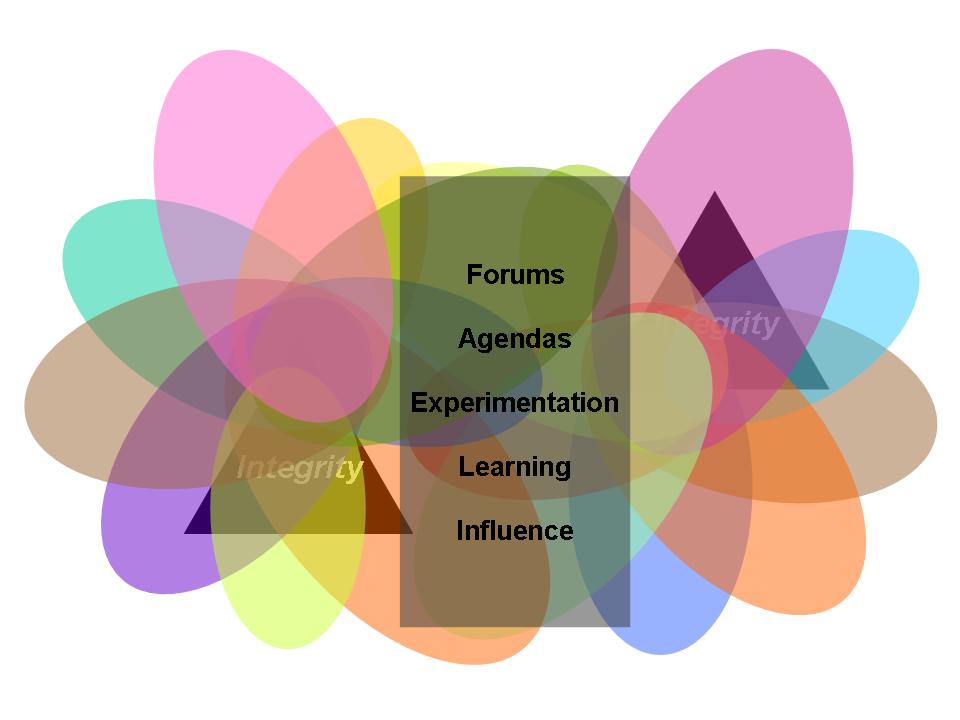
One role of a knowledge broker is to promote healthy organization change by convening those conversations that will make a positive difference in the formal system without damaging the integrity of the organization. In a previous posting, the visual of forums, agendas, experimentation, learning, and influence superimposed over the integrity and filters and screens representing two people in conversations gave a sense of the complexity involved. The graphic below builds on this concept as it extends from a couple of people to two organizations. Here again, the approach is to convene conversations, largely in the informal system, yet ask participants to wear their formal system hats long enough to give credence to the applicability of what they experience. Armed with that understanding and agreement, they commit to tell the stories in the formal system conversations that initiate changes in that system. Knowing what conversations to convene and setting up viable forums and agendas in response – —that is the heart of organization design.

Originally posted to New Media Explorer by Steve Bosserman on Sunday, September 11, 2005and updated on Saturday, September 24, 2005

Forums and Agendas

Conversation, —simply defined as a combination of verbal and non-verbal “statements” between two individuals,” —is the fundamental building block of human communication. Conversations can be real-time or asynchronous. Participants can be present, virtually or physically.

Regardless of how a conversation is enacted, at a minimum it strives to produce understanding. In many cases being understood is insufficient, especially when changes to one’s current condition are expected. A press ensues for agreement about what is, what that means, and what are possibilities for the future. With agreement in hand about a preferable condition it is possible to pursue commitment —the impetus for deliberate and purposeful action which drives experimentation, learning, and, ultimately, influence.

Any conversation, formal or informal,, consists of a forum and agenda. A forum is the context in which a conversation occurs. This includes who is in the conversation (invited and attending), where the conversation is held, what technologies are used to support the conversation, what date and time the conversation takes place, even in what language the conversation is conducted. The agenda is the subject of the conversation. Depending on psychological, social, and political factors, the agenda can be explicit and openly stated or implicit and hidden. In addition, there can be more than one agenda in a conversation each shaped by a different motivation and entertaining a unique position along the explicit-to-implicit continuum.

This blending of forum and agenda makes conversation an extension of complex human social behavior. Knowing the agenda(s) requires relating it to the forum in order to get a fuller sense of what is behind the conversation and a better interpretation of what are the expected outcomes of the conversation. Obviously, the more one knows others in the conversation and their contextual circumstances the higher the likelihood of accurately “reading”” the agenda layers and offering culturally appropriate responses.

Conversations are convened. Someone sets the forum and determines an agenda and others participate. Convening is an exercise of social power. Everyone is experienced at convening if nothing more than saying “Good morning!”” to another and soliciting a response. This requires minimal social power to extend the invitation for the other to join. However, depending on who are the desired participants in a particular conversation, differing levels of power are often required to garner the commitments of each to join.

Social power is directly related to the capacity one has to affect consequences for others. The more a person can influence the context in which the interests of others are advanced or met and costs are minimized, the more convening power that person has. Social power not only grants an individual the license to convene, it also permits a person to NOT invite. A conversation says much about the convening authority carried by the person who initiated it based on who is there AND who isn’t!

Knowledge brokers are conveners. They are granted the authority to initiate conversations based on the trust placed in them by participants that their “ground truths”” will be respected and their stories heard and understood. Knowledge brokers gain this trust because of the consistency and thoroughness with which they conduct personal investigations of truth then relate those discoveries in conversations where to speak one’s truth carries a potentially negative consequence. This capacity to know one’s truth, grant others the conversational space and opportunity to hold and state theirs, and pursue the lines of experimentation, learning, and influence that follow understanding, agreement, and commitment is a hallmark of a knowledge broker.

Originally posted to New Media Explorer by Steve Bosserman on Saturday, September 10, 2005 and updated on Saturday, September 24, 2005

Conversations and Stories

As mentioned in an earlier post, integrity is manifested through the filters and screens that make up the various affiliations in a person’s life. Some of these affiliations are stronger, newer, and exercise greater influence than others. Because of these differences, integrity is not necessarily central in a person’s affiliation landscape as evidenced in the graphic below. Furthermore, this positioning is not static. As time passes, the filters and screens vary in intensity and significance, and the balance point for integrity shifts.

Filters and Screens

We humans are social creatures. We have highly evolved language skills and capabilities which we use to communicate with each other through conversation. These conversations convey meaning about us, our situations, our needs, and our aspirations. Essentially, they are our stories.

Stories are structured conversations we have with others about our experiences and the meanings they hold for us. Because of the influence exacted by filters and screens upon us, the stories we tell at one time may be quite different than the stories we tell at another time, place, and circumstance. Stories are contextual. The “truth” they express is relative.

As stated in an earlier post, establishing ground truth is a critical first step for knowledge brokers to ascertain behavior and communication patterns and make relevant responses be they positive or negative. Proclaiming one’s ground truth is an exercise of story-telling. Context is crucial if the reality that shapes a person’s story and truth can be well-understood and acted upon appropriately.

Stories are dependent on the conditions that exist at the time of their telling. The forum — who is in the conversation, where it occurs, when it takes place, and what processes are followed — and the agenda — topics for conversation, expected outcomes from the conversation, and next steps to be taken — are major determinants in how the story is told. Even the same experience shared by many will be related differently depending on the forum and agenda.

Knowledge brokers are concerned about ground truth because of the implications on communication patterns. Repeated over time, stories are reflections of sustained conversation themes and understanding. Changing forums and agendas changes these conversations. Changing conversations leads to experimentation and different experiences. New experiences prompt learning which leads to different stories in an attempt to make meaning out of the new experiences. These new stories influence recurring conversation themes. Told with sufficient frequency over time, stories change the underlying communication patterns and adaptation and evolution occur.

Originally posted to New Media Explorer by Steve Bosserman on Tuesday, September 6, 2005 and updated on Saturday, September 24, 2005