Adding Value and Receiving Fair Compensation

There are three ways to add value: make something others need / want; provide a service others value, but not enough to do it themselves; and, deliver a totally satisfying experience around a package of something(s) made and services provided.

When I entered the business world in the U.S. some forty-plus years ago, it was all about exploiting natural resources elsewhere and making things in highly, vertically-integrated production enterprises. Over the last 25 years, there has been a distinct split between making things and providing services others would rather not spend their time doing, vertically-integrated firms were decentralized and distributed, and U.S. businesses have “gone global” in an effort to exploit human resources elsewhere. During the last 10 years, there has been a significant uptick in melding a particular desired experience with things and services to provide an integrated, experiential package. The work I currently do with businesses and non-profit organizations focuses on helping them take advantage of this shift and get more efficient and effective at doing the integration and promoting the anticipated experience with customers.

The process Andrius Kulikauskas followed in the Chocolate Project to collect and compile information about the chocolate industry yielded a potential goldmine of business opportunities. These include:

  1. Making things – beans, nibs, cocoa liquor, cocoa butter, cocoa powder, finished chocolate products ready for retail – up and down the value chain
  2. Providing services such as logistics, inventory management, quality assurance, traceability, trading, etc.
  3. Developing integrated, experiential packages using chocolate as the centerpiece -a posting from Idziak Waclaw outlined ways to think about such possibilities

For that matter, the process, tools, and techniques Andrius used for the project can be replicated in other projects where there is a similar opportunity to merge openness with the proprietary in ways that “do no harm.” Some of the approaches Andrius used in the Chocolate Project include the following:

  1. Working openly / working in parallel wiki where all the information gathered was categorized and posted for the world to look over the participants’ shoulders and see
  2. Focused moderation to keep collaborative energies and efforts in the spaces where the value would be greatest for the sponsor
  3. Direct correspondence with the sponsor to assure that proprietary boundaries are honored

No doubt there are more. The point isn’t to be exhaustively philosophical in what they are, but to apply the ones we can do elsewhere for broader benefit. As an example, currently, I am floating the concept of a wiki to a private sector client wherein key questions related to the business are posed by the moderator. The wiki is organized to “catch” the responses in ways that prompt more questions and accelerate the exploration of those strategic spaces where the client’s business will be heavily influenced over the next 5-10 years.

As another example, several colleagues and I are completing a grant proposal which will be submitted later this month that explores characteristics of leadership in institutional contexts where the key objective is to prompt a higher rate of adaptation and responsiveness within non-profit organizations. One of the major elements of the strategy we are proposing is the use of a moderated wiki a la the Chocolate Project. Our intent is to create an extensive library of information on the wiki about leadership that is open to all, yet we are able to extract and compile specific content into publications that target particular audiences within the non-profit arena.

The bottom line is that this approach can be leveraged / applied over and over again to generate an enormous amount of information on a particular subject, identify potential candidates to participate in a supportive broad-based network, and develop opportunities to add value. However, adding value is only half of the equation:

On New Year’s Day, there was a posting on the Yahoo! Group, Cyfranogi from Stephen DeMeulenaere, about the organization he represents – Complementary Currency Resource Center. It makes a strong connection between adding value and receiving fair compensation. When people are compensated, in part, with a complementary currency that remains in the local community where it was earned, its expenditure continuhttps://www.linkedin.com/in/stephendemeulenaere/es to benefit the community. The bulk of mainstream financial systems used to compensate people for value-add are extensions of hierarchical and global political / economic systems. They are organized to concentrate power and wealth in the hands of a few. As a result, when people are compensated solely by these global, federally-backed currencies their expenditures remove the purchasing power from the community to a place far afield from the point of value-add.

Unfortunately, there is no system we can devise that escapes this reality – inequalities among people drive inequalities in access to power and wealth. What we can do, though, is experiment with more locally-based, complementary currency systems that mitigate the forces of concentrating wealth on the global level from draining creativity, energy, and resources from local communities. Andrius’ approach to blending federally-backed compensation with home-grown complementary currency compensation on the Chocolate Project is a start. As this blending is pursued on other projects, the experience base will be broadened and the mettle of the emerging complementary currency systems tested so the combination between the two becomes more robust, scalable, and, ultimately, effective.

Projects born in a social network are only as good as there are participants representing a wide and comprehensive set of perspectives about the topics under consideration. People are attracted to these efforts within a social network by a variety of reasons: alignment on the values the project leader and other participants hold dear and readily espouse; affinity for and commitment to the cause being advanced by the project; recognition for performance which can be carried into other opportunities where more compensation is available; and, fair compensation for value-add. Obviously, the more of these a project offers the higher the likelihood of widespread participation. For this reason, if an alternative to federally-backed currencies can be offered which fairly compensates people for the value their contributions add then, the chances are substantially increased that the creative talent, skill, and expertise in the social network can be tapped. The challenge is to know that we are nowhere close to where we need to be and to keep trying!

Originally posted to New Media Explorer by Steve Bosserman on Tuesday, January 3, 2006
Ground Truth and Social Sensors

Ground truth is the unfettered and unfiltered relating of people’s experiences within a human social system. It can be associated with a specific event at a particular point in time, such as personal interviews with survivors on December 26, 2004 in Sri Lanka shortly after the devastating tsunami struck. It can be the review of a series of experiences across a period of time such as follow-up interviews with those same Sri Lankans who were interviewed originally to understand how their circumstances are changing. It can be the stories told about how members of a social system, who experienced a catastrophe like the tsunami, adapted their social, political, and economic structures in response; namely, what worked, what didn’t, and what changes to make. Ground truth is given when people speak for themselves. It is the ONLY way a human social system knows what is REALLY going on.

People who deliver their ground truth are acting as well-functioning “social sensors” in a broader social system. They draw upon a wide range of information and communication technologies (ICT) e.g., websites, email, blogs, wikis, with land-line, cellular, and satellite connections from locations throughout the world, no matter how remote, to relate their experiences instantaneously and continuously. Social sensing parallels similar functions within mechanical and biological systems. In fact, there is a point of convergence between scientific and social sensor development paths that establishes the possibility of two working together in a highly interrelated manner that enables large, complex systems to be better managed.

Sensor technology, too, has it roots in ICT. The earliest application of ICT during its commercial development was data collection. People would make manual entries into databases of data they and others collected utilizing various measuring devices at certain points within factory or office operations. The computer would use programs to analyze those data and put them into an informational format that could help interpret what was occurring and develop responses to improve the processes or procedures.

One of the first areas where ICT quickly developed in the 1970s and 1980s was in sensor technology. With increased capability and reliability, sensor technology contributed significantly to the replacement of humans as the means through which data was collected and entered into databases. Further developments over the last 15-20 years greatly reduced the size and power requirements for sensors, and increased the sophistication and range of type and capability of sensor technology. Now, sensors are pervasive; they influence almost every aspect of our lives and endeavors. And they continue to displace people from those activities where consistency, repetitiveness, quality, and reliability are essential for effective and efficient operations.

Of particular significance in these developments and displacement is the degree of integration and compatibility between what is being sensed and what is doing the sensing. Today, extensive sensor networks are carefully nested within all manner of systems: mechanical, chemical, optical, biological, and social. Regardless of application, these sensor networks monitor and evaluate conditions which become feedback in larger, adaptive systems that devise corrective strategies and take appropriate actions in response. The key to their success is the accuracy and timeliness of their input as well as the pervasiveness and comprehensiveness of their coverage.

In many ways, the human body is a complex web of sensor networks. Millions of nerve receptors of different types and functions are distributed throughout the body and send continuous signals through the central nervous system to the brain where they are processed and given responses. And like any sensor network, the quality of the response is tied directly to the quality of the input.

Despite highly evolved and elaborate redundancies that function effectively the vast majority of the time, our senses can be fooled: hot can feel cold and vice-versa; we see mirages we believe are real; we hear sounds when there is silence; odors we smell and taste evoke memories that do not accurately reflect what we are experiencing in the moment. And as in the interplay between sensor networks and the larger systems they help regulate, there are different ways of analyzing and processing input with each eliciting different responses. Furthermore, we can ignore sensory input or respond in ways that override evidence suggesting a more appropriate course of action. So, regardless of how well-designed the system and how well-refined the processes, the arbitrariness and irrationality of our decision-making have the potential to bring it to naught.

Like the human body, human social systems are vast sensor networks. Each member of the system is a “sensor” who “reports” on conditions as they are experienced. The system – comprised of hierarchical political, economic, and social structures that operate according to sets of self-serving rules – sorts, aggregates, and analyzes data entries from sensory members in an effort to understand, interpret, determine response possibilities, consider alternatives, and decide on a course of action. Of course when considered on a global scale there are myriad social systems in play simultaneously. Members of one social system can concurrently be members of others. Interpretation of sensory input in one social system can elicit a different response compared to what happens in response by another social system. The key determinants are rank, status, and position in the formal structure and presence, voice, and passion in the informal structures.

Human social systems are analogous to the human body in other ways. There are over 6 million people in the world. The human body consists of billions of cells. Thousands of people die and thousands more are born every day. Millions of cells in the human body die daily and millions more are regenerated. Of the thousands who are born, live, and die each day, I have the opportunity to know only a handful. I know my body, in general, through its organization by function, role, and relationship of one part or system to another. Most of it I will never see and I don’t have to; I trust that it will do what it should without my deliberate attention if I follow simple rules of good health in terms of diet, nutrition, exercise, and rest. Similarly, most people in the world obey the rules of the social system to which they belong. These rules present choices and people decide in ways that permit them to adapt to current circumstances, but preserve the integrity of the system. Behavior is managed and people stick by the intent of their roles, responsibilities, and relationships.

What happens when taking care and following the rules is not enough? Even when we do our best to prevent it, inevitably, our bodies get sick. Sensory cells we seldom hear from send messages that indicate they or the systems to which they belong are in trouble. Depending on the nature of the condition they are signaling there is a wide array of prescriptive treatments from which we can select. These can be non-invasive wherein normal functions of the cells and systems are restored through medications; or invasive through the repair, removal, or replacement of tissue. The same phenomenon occurs in social systems. People in their “sensory roles” relate experiences wherein the system – no matter how well-designed the rules and how noble the principles and ideals that frame them – fails to respond within an acceptable range. Functions break down; remedies are required. In some instances a simple reinterpretation of an existing rule is all that is needed. Other times, though, more radical steps are in order such as rescinding laws and enacting new ones, closing operations and opening others, and eliminating products or canceling services and offering of others.

Oftentimes, we do not heed the early warning signals from our bodies indicating something is amiss and what was once easily restored must now be repaired, removed, or replaced. The sensory networks did not fail, but we chose through our heads or hearts to ignore the input, e.g., “I don’t feel any pain” or “I don’t see any bruises” or to not give the input appropriate attention, e.g., “It will go away” or It’s nothing.” Because the human body is marvelously adaptive, this approach works to some degree, but the performance of the whole and the cellular arrangement and functioning that comprise it are compromised. We live with it in a compromised state or we take more radical steps to correct or reverse the damage.

Again, there is a clear parallel within human social systems. Billions of people in the world have a nearly infinite variety of experiences daily. How do these experiences fit the frameworks of the social systems to which people are members? Where are there anomalies between expectations and experiences? Do these differentials drive responses? Is the system stretched beyond its limits to adequately respond and more deliberate and protracted strategies are needed to spur deeper adaptation? To know the answers requires being attentive to the “sensors.” It means getting to “ground truth” with people in the system about their circumstances.

Establishing ground truth is a three-step process:

  1. Ask people for the truth about their realities and encourage them to tell their stories openly
  2. Hear their truth, once offered, understand it; and commit to respond with appropriate action
  3. Follow-up afterward to confirm that the responses were, indeed, appropriate and that the current situation is corrected and steps are underway for longer term changes in the system preventing recurrence of the problems

Just as we do not heed messages within our bodies we do the same in social systems. To know what is really going on requires ground truth. To not ask, listen, comprehend, and take action are just as effective in shutting down responsiveness and adaptation in the social system as it is with our bodies. Much of time it is for the same reasons: “don’t confuse me with the facts” and “if I am ignorant I cannot be held accountable.” Typically, we do not like change even though circumstances warrant it. In addition, we do not like to know about circumstances where change is needed because we will be challenged to take action – in other words, make it happen. Either way we claim we will lose focus and be distracted from the mission we are locked into at the time.

Just as the health of our bodies is compromised when warning signals are ignored or overridden, social systems become corrupted when the ground truth of members is not heard or heeded. Social systems can continue to function, in general, despite certain levels of corruption, albeit their effectiveness and efficiency are significantly reduced depending on the type, degree, and pervasiveness of the corruption. Change is particularly problematic in established social systems. Power concentrates in the tops of the ruling hierarchies, corruption increases, and along with it an aversion to change that might disrupt the structure, grows. As a result, these hierarchies uphold tenets and “rules” that support the dominant culture remaining dominant.

Ruling minorities become increasingly distant from their ruled majorities. In so doing they become increasingly cut-off from what is really happening within the social systems they are charged to “protect and serve.” Ground truth exists in the heads, hearts, and souls of social system members whether it is sought after and cared for or not. People and their truth, like life itself, will find a way to express itself, even it means setting in motion disruptive patterns of behavior that threaten to totally transform the system in which they exist. David Brooks, in his editorial entitled, “Trade, Oppression, Revenge,” published in the NY Times on December 25, 2005, illustrates this point through a very recent example. The native Indian people of Bolivia, who comprise 65% of the population, dominated for years by a ruling white elite representing 3% of the population and controlling almost all of the resources in the country, used the democratic process to elect an Indian president. What is in store for the ruling minority of Bolivia and their repressive, exploitative policies? Something not nearly as pleasant as it could have been had the ground truth been spoken, heard, understood, heeded, and the outcomes confirmed.

Therein lays the challenge with respect to ground truth: some have to want to hear, some have to be willing to say, and others still have to respond to what the truth means about the design of the system and make changes accordingly. For any sensor to work effectively, regardless of type or application, its input signal must be captured, processed, and acted upon. This certainly pertains to people as social sensors in human social systems: their input is in the form of valuable stories to tell and their experiences constitute important feedback in regulating the function and adaptation of these same systems. Are you asking…and listening?

Originally posted to New Media Explorer by Steve Bosserman on Monday, December 26, 2005

Syllogisms about Power, Corruption, and Change

A syllogism about power:

  1. Human social systems / institutions are hierarchical and concentrate power at the top of their structures
  2. “Power corrupts and absolute power corrupts absolutely” – Lord Acton
  3. Human social systems / institutions will inevitably become corrupt

Why?

The answer is rooted in the interplay between our basic instincts for survival coupled with our evolved reasoning capabilities as Homo sapiens. Our advanced thinking capacity provides us with the ability to make choices whether to spend, save, keep, or give of our time, talent, skill, experience, insight, and energy. Like most animals, we care for ourselves by spending for what we need in the moment yet saving some for later in the event we need it. However, only humans have the option to accumulate and keep more than is ever needed or give the excess to others who are less fortunate so that their needs are covered as well. While the “spend and save” dichotomy is fundamental within many animal species, the “keep and give” dichotomy resides solely in the realm of higher reasoning exhibited by Homo sapiens.

Having the chance to acquire more than what is needed is a compelling motivation to discover and exploit opportunities. But what if discovery, exploitation, and gain from opportunities deprive others of similar opportunities? Or what if the consequences are even direr in that not only do others have no opportunities to do similarly, but their basic survival is at risk?

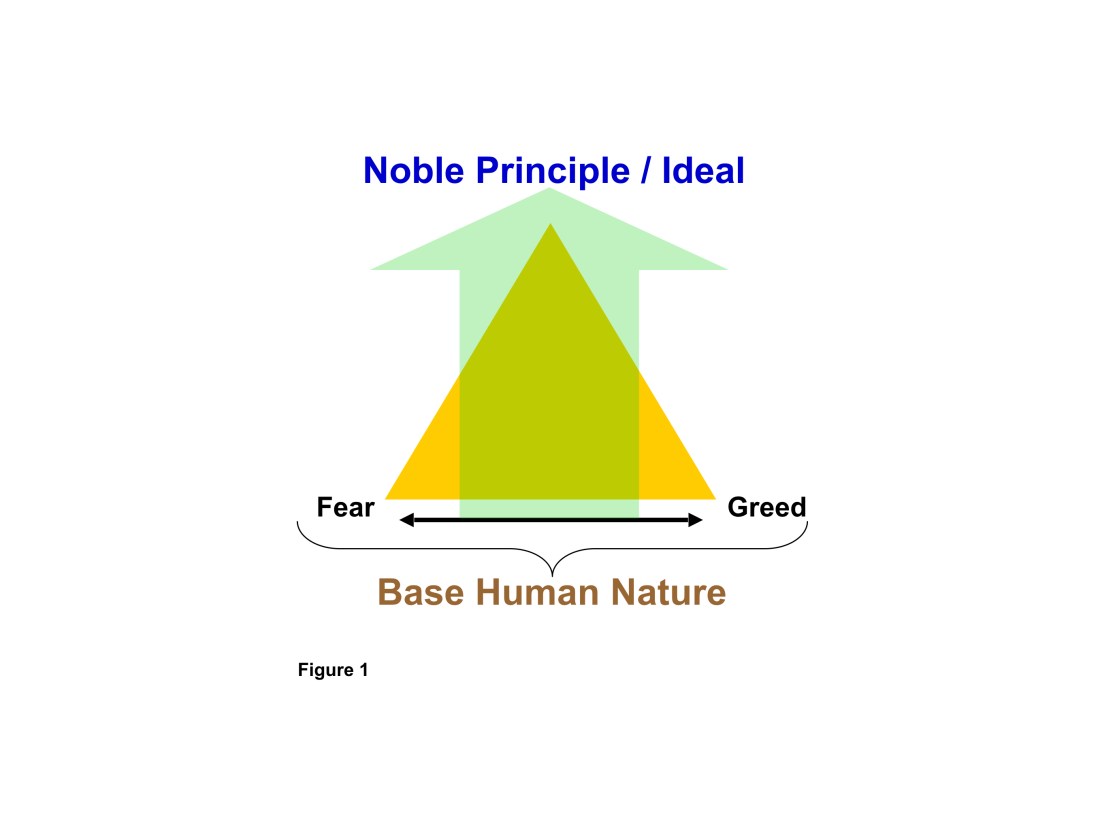
The “keep and give” dichotomy becomes a double-edged sword. On the one hand, human intelligence provides the means by which we can make or take more than we need. On the other hand, this same intelligence gives us the insight to heed a noble principle or ideal and choose to give what we have made or taken, yet do not need, to others whose survival is at stake. This is a difficult choice. For many who are caught up in the fast track of making and taking, to give does not feature very prominently and greed sets in. For others, it is not the rush to accumulate more that drives them, but quite the opposite – the fear of loss and being put into a situation where there is not enough to survive. Regardless, too many burn up their worth as creative and innovative human beings along the fear-greed continuum.

Figure 1 above illustrates a simple hierarchical social system formed by the three basic cornerstones: fear – greed – principle / ideal. Over time, however, the triangle shrinks in height until the principles and ideals that were so sterling and compelling at the outset become lost in a sea of the platitudinous and pedestrian and their relevance and influence are lost. Hierarchy, mired in the mud of fear and greed, has little nobility; it is corrupted.

Any hierarchical social system begins with a balance of principles and ideals worthy of aspiration and hope linked to the daily realities associated with fear and greed. A social system framed by such noble thoughts seeks to give all a better life. The preamble to the Constitution of the United States offers an example of these worthy ideals framing the social system of a nation:

We the People of the United States, in Order to form a more perfect Union, establish Justice, insure domestic Tranquility, provide for the common defense, promote the general Welfare, and secure the Blessings of Liberty to ourselves and our Posterity, do ordain and establish this Constitution for the United States of America.

What really happens, though?

A syllogism about corruption:

  1. Corrupt human social systems benefit their ruling minorities at the expense of their ruled majorities
  2. Ruling minorities make rules that preserve their social systems and concentrate power further
  3. Corrupt human social systems insulate their ruling minorities from their ruled majorities

Beginning in 2003, there occurred numerous instances of abuse and torture of prisoners held in the Abu Ghraib Prison in Iraq (aka. Baghdad Correctional Facility), by personnel of the 372nd Military Police Company, CIA officers and contractors involved in the occupation of Iraq.

An internal criminal investigation by the United States Army commenced in January, 2004, and subsequently reports of the abuse, as well as graphic pictures showing American military personnel in the act of abusing prisoners, came to public attention the following April, when a 60 Minutes news report (April 28) and an article by Seymour M. Hersh in The New Yorker magazine (posted online on April 30 and published days later in the May 10 issue) reported the story.

The resulting political scandal was said to have damaged the credibility and public image of the United States and its allies in the prosecution of ongoing military operations in the Iraq War, and was seized upon by critics of U.S. foreign policy, who argued it was representative of a broader American attitude and policy of disrespect and violence toward Arabs. The U.S. Administration and its defenders argued that the abuses were the result of independent actions by low-ranking personnel, while critics claimed that authorities either ordered or implicitly condoned the abuses and demanded the resignation of senior Bush administration officials.

”In Address, Bush Says He Ordered Domestic Spying” by David E. Sanger, NY Times, 18 December 2005:

WASHINGTON, Dec. 17 – President Bush acknowledged on Saturday that he had ordered the National Security Agency to conduct an electronic eavesdropping program in the United States without first obtaining warrants, and said he would continue the highly classified program because it was “a vital tool in our war against the terrorists.”

In an unusual step, Mr. Bush delivered a live weekly radio address from the White House in which he defended his action as “fully consistent with my constitutional responsibilities and authorities.”

He also lashed out at senators, both Democrats and Republicans, who voted on Friday to block the reauthorization of the USA Patriot Act, which expanded the president’s power to conduct surveillance, with warrants, in the aftermath of the Sept. 11 attacks.

The revelation that Mr. Bush had secretly instructed the security agency to intercept the communications of Americans and terrorist suspects inside the United States, without first obtaining warrants from a secret court that oversees intelligence matters, was cited by several senators as a reason for their vote.

”Katrina’s Racial Wake” by Salim Muwakkil, In These Times, 7 September 2005:

Hurricane Katrina and its disastrous aftermath have stripped away the Mardi Gras veneer and casino gloss of the Gulf Coast region, and disclosed the stark disparities of class and race that persist in 21st century America.

The growing gap between the rich and the poor in this country is old but underreported news – perhaps in part because so many of the poor also are black. Accordingly, many Americans were surprised that most of the victims of the New Orleans flood were black: Their image of the Crescent City had been one of jazz, tasty cuisine and the good-natured excesses of its lively festivals.

Where did all those black people come from, they wondered; and where were the white victims?

African Americans make up about 67 percent of the population of New Orleans, but clearly they were disproportionately victimized by the hurricane and its aftermath. And while blacks make up just about 20 percent of those living along the Gulf coast of Mississippi, their images dominated media representations of the victims there as well. In addition to race, the common denominator between blacks in both states is poverty. The “Big Easy,” has a poverty rate of 30 percent, one of the highest of any large city. The state of Mississippi has the highest percentage of people living in poverty of any state and the second-lowest median income. The state’s Gulf Coast experienced an economic boom when casinos were legalized in the early ’90s, but that new affluence did little to ameliorate the race/class divide that has deep roots in the region.

Among other things, the monster storm blew away the pretense that race has ceased to matter in the United States. Media coverage of this major disaster has made it clear that poverty and race are highly correlated.

Katrina also unearthed other uneasy truths; including the glaring ineptitude of the federal government, the domestic consequences of the illegal Iraqi invasion and the media’s proclivity to employ racial stereotypes.

Critics complain that the overwhelming blackness of the victims may have been a factor in the government’s apparent slowness to respond. In a reflection of popular black opinion, hip-hop artist Kanye West went off-script during an NBC benefit concert for Katrina victims and declared, “George Bush doesn’t care about black people.”

How did we get to this?

Hierarchical social systems are in a continual state of flux. Figure 2 above introduces some of these dynamics. These systems begin with lofty ideals and noble principles. This is the realm of the abstract, intangible, and philosophical where people in relationship to people posit their aspirations, dreams, thoughts, and feelings from which they describe and envision a better reality.

Such ideals do not remain in a pristine and unchallenged state. Like the people who populate them, social systems have basic needs / resource requirements that must be met in order for them to function. These resources have to be extracted / exploited and converted / deployed so the system can utilize / consume them. In other words, people in relationships to “things” make the system function and, hopefully, engage in behaviors that put the vision into practice.

People have different motivators that prompt their participation in a social system. Some are engaged by an envisioned end state constructed through relationships to people. Others are compelled by their relationships to things – the anticipation of rewards for contribution or a sense of obligation. Moving from vision to action puts the social system on a slippery slope toward compromising its values. Corruption sets in as anticipation of rewards gives way to greed, a sense of obligation succumbs to abject fear, and guiding principles fade from view.

However, the intention people have for a social system is to remain within the middle – a “dynamic balance zone” – where forces from the less evolved side of human nature that drag the system into the clutches of a fear-greed continuum are matched by forces resulting from new personalities and structures in the system that renew the vision and exalt the ideals once again. This dynamic balance zone is where relationships to people and things are positioned within a broader, more “ecological” context. Such positioning enables members of the system to take responsibility for the effect their actions have on others in the system and be held accountable for the consequences of their behaviors overall.

And that means what?

A syllogism about change:

  1. Corrupt human social systems are vulnerable to change
  2. Subversive groups form within ruled majorities, gain power, and force agendas of change on the ruling minorities
  3. Corrupt human social systems are supplanted

A human social system is corrupted through the increased infatuation of its members in their relationships to things rather than their relationships to themselves and others. This love of the material immerses people in the fear-greed continua and distances people from one another. This distancing is a critical determinant of how the social system will function because it establishes a condition where the consequence of one’s behavior on others is not directly experienced. In other words, there is an isolation / insulation of people in the ruling minority from the ruled majority. This breakdown in causality might be useful in the military where commanders issue orders that put soldiers in harm’s way in an effort to attack or defend. In a social system where the general health and well-being of members is contingent on socially responsible and ecologically balanced actions such a breakdown can lead to disastrous outcomes if the ruled majority pursues countermeasures; e.g., Barbara Bush:

And so many of the people in the arena here, you know, were underprivileged anyway, so this, this is working very well for them.

The degree of corruption is offset by degree of affiliation. Just as getting mired in fear and greed isolates people from one another, the formulation, articulation, and pursuit of a noble principle / ideal brings people together. No meaningful collective action can occur without people first agreeing on what they want to have happen as a result – envisioning a future worth achieving.

Figure 3 above illustrates these two counter-balancing dynamics: on the one hand, more fear and greed, more corruption; more principles and ideals, less corruption; and, on the other hand, more principles and ideals, more affiliation; more fear and greed, less affiliation. Of course, in a complex system these dynamics are playing out continuously and in a highly unpredictable manner. The only assurance we have is that there are as many or more ways to affiliate with others for mutual benefit across the community as there are opportunities to engage in the pursuit of sheer material gain. It is a question of balance for each of us and to realize that the operation of the whole requires both. How DO we stay centered? Well now, that is THE question!

Originally posted to New Media Explorer by Steve Bosserman on Friday, December 23, 2005

The Problem of Power

Since humanity began its odyssey out of Central Africa millennia ago, hierarchy is the only consistently adopted structure for distributing power within a social system. This structure holds intact the social system in which it exists. To do so, it exercises three roles:

  1. Define “boundaries” – territorial, birthright, and behavioral – that determine who’s in and who’s out
  2. Provide security that protects the boundaries, preserves the lineage, and maintains the behavioral guidelines
  3. Respond to changing circumstances so that the primary social system persists

Hierarchy is easy to install since it begins when one person assumes a dominate position relative to another. It is efficient. The dominant one sets the boundary conditions and subordinates operate within them. When coupled with fear of consequence if one does not stay within the boundaries and the promise of reward if one meets or exceeds expectations the vast majority of members comply with the dictates of the hierarchical social system.

Members of hierarchical social systems participate in governance, free enterprise, and non-governmental affiliations. The rulers set the parameters in which members operate so that government has the resources to assure security, enact rules of conduct, ownership, and commerce, and provide a system of jurisprudence in the event that members do not follow the rules or violate the rights of members. Property owners, business owners, and those who contribute their skills, time, and energy are compensated, pay some percentage of their profit and income to government so that it can function, and voluntarily give to community-based organizations that benefit the commonweal and care for those who cannot contribute. It is a system of cooperation, choice, and commitment that is simple and elegant.

Hierarchy is a structural “tool” for managing social systems. It is the integral framework upon which all institutions – governmental, business, or non-governmental / not-for-profit – are built. As such, it becomes a common denominator that cuts across society in all its endeavors. Like any tool, it is neither good nor evil. How people use hierarchical structure within their institutions and throughout their social system is what imbues it with certain characteristics of morality, ethics, and fairness and places it on a continuum of social justice ranging from barely evident on one end to being a matter of course on the other.

The driving force that shifts a social system along the scale of social justice is the use, or abuse, of power. Hierarchical social systems concentrate power in the hands of a minority number among the overall population. As Lord Acton stated, “Power tends to corrupt, and absolute power corrupts absolutely.” In other words, when holding a dominant position, some are seduced by the power they have over others. This prompts them to do the following:

  1. Stay in their positions of power
  2. Keep the hierarchical social system intact so that the positions of power they hold are preserved
  3. Curtail affiliation among those who are disenfranchised by the system so that the threat of insurrection is quelled.

Basically, people who are so affected are drawn by the possibility of extracting even more profit or garnering more control. They limit choices for subordinates and force compliance to rules and conditions that are not beneficial to members. In addition, they attempt to keep the system as it is so that their gain is consolidated and ideally, continues to grow.

As an example, approximately 50% of the world’s population earns less than $2 / day per capita through subsistence agriculture. The hope of a higher quality of life is dashed each day eking out an existence under the harshest of circumstances. Leadership in these countries is averse to mechanize and modernize agriculture because those displaced would venture to cities in an effort to find work. This would overburden the already congested and over-stressed infrastructures in these urban areas elevating discontent and unrest. Better to keep people where they are so they are contained having to care for themselves. Meanwhile, the economies grow and the top echelons gain wealth.

Another example: according to an article in The Open AIDS Journal entitled, “HIV Infection and AIDS in Sub-Saharan AfricaUNAIDS report,” Sub-Saharan Africa is home to 70% of all people afflicted with HIV in the world. This area holds some of the world’s richest natural resources, yet the population is in grave peril, health-wise, including leaders. In fact, that is the point. The world has known about AIDS / HIV in Africa for nearly 30 years and has only in the last five mobilized efforts to do something. All indications suggest it is too little, too late. Millions have died from AIDS already and millions more will do so over the next two generations as the endemic unfolds. Sub-Saharan governments are rendered ineffective due to a lack of competent, experienced leadership, citizens are not able to care or fend for themselves, economies slow their growth, and property ownership and control shifts to foreigners. Colonies once lost due to revolution are reclaimed – without firing a shot.

As yet another example, consider genocide. In his 1994 book, Death by Government: Genocide and Mass Murder since 1900, author R.J. Rummel defined and documented “democide,” e.g., atrocities committed by governments on their citizens. Of the nearly 170 million who died at the hand of their governments during the 20th Century, 130 million, over 75%, were victims of four regimes: Soviet, Communist Chinese, German, and Nationalist Chinese. This does not include Rwanda in 1994. And genocide continues as the people from Darfur have borne witness every day this year. A weakened population becomes weaker. Those who hold the most power in the world act as though they are powerless as these horrific injustices go unchecked. The reality is there is nothing to be gained by intervening and much that could be lost if circumstances go awry. The people of Darfur, like the millions before them, are collateral damage in an economic power struggle of global proportions.

In his unsettling essay, “Waiting for the Lights to Go Out ,” published in the October 16, 2005 edition of The London Times, Bryan Appleyard posits a rather grim future wherein civilization is doomed to return once again to the Dark Ages. The central theme of his essay is the meltdown of society as we know it due to our insatiable addiction to oil, the inevitable depletion of oil reserves, and our woefully inadequate and untimely response to that eventuality. At the heart of his thesis is that human nature has not progressed very far since we began our migrations throughout the world from our African origins. Appleyard states, “Our aggressive, tribal nature is hard-wired, unreformed and unreformable. Individually we are animals and, as animals, incapable of progress. The trick is to cage these animal natures in effective institutions: education, the law, government. But these can go wrong.” Not particularly encouraging!

Rulers enact laws that are increasingly restrictive, militaristic, and draconian or become arbitrary in their decisions. Owners pull more profit, become more risk averse, and offer fewer benefits. Having less voice and impact, non-governmental organizations become more fanatical and close-minded; their ratios of administrative overhead to pay-out increase, and beneficiaries receive less real assistance.

In summary, the thirst for power and the specter of losing it becomes a corruptive force that undermines the fundamental tenets of a system that is given to efficiency and effectiveness if used honorably. People suffer for lack of true justice. Is there any way institutions, no matter how well-intended, can escape the slippery slope into corruption and injustice? Or is this simply the dark underbelly of hierarchy which must be accepted until people have more distance in time from their early violent struggle for survival as Homo sapiens? What is your opinion?

Originally posted to New Media Explorer by Steve Bosserman on Monday, December 12, 2005

Pareto and the Pyramid of Power

The year 2006 marks 100 years since Vilfredo Pareto noted that 20% of the population owned 80% of the property in Italy. This conclusion combined with the analysis methods that support it led to the formulation of the “Pareto Principle.”

The tools and techniques associated with this principle have widespread application in circumstances where a small subset of one category causes a significant effect within a large subset of another category. During his work with industry, Dr. Joseph Juran coined the phrase, “the vital few and trivial many,” to describe the effect of the Pareto Principle in the business setting. For example, a company has a staff of ten sales representatives. Of the ten, the three highest performers generate 60% of the sales made during a reporting period, the five middling performers bring in 35%, and the two lowest performers contribute only 5%. Armed with this information, responses can be developed that are tailored differently for each of the three groups in an effort to increase overall sales performance for the least investment or cost. Another example is in a set of 100 manufacturing operations where the overall defect rate is .1%. There are 10 operations that cause 90% of the defects. Addressing those 10 are going to have a much more positive effect on the performance of the whole than focusing attention on combinations of the remaining 90 operations. Like most rules of thumb, the Pareto Principle can be misused; but in general it helps prioritize activities, separate the important from the pesky, and focus limited energy on the items that are going to make the most difference.

The Pareto Principle had it birth in economics, a social science. Given this background, there is another application for the Pareto Principle that covers additional ground. When this basic postulation – a small percentage of the population owns a large percentage of the property – is bracketed by two corollaries – a small percentage of the population enacts and enforces a large percentage of the rules that govern the behavior of the overall system and a small percentage of the population receives a large percentage of the compensation awarded by the total system – the resulting triad describes a fundamental truth about social systems: a small percentage of the population controls a larger percentage of the power within the whole system.

The exercise of power in a social system establishes an individual or group in a dominate role and subordinates the larger population of individuals or groups within that system. The population size can range from two – one person in relationship with another as in a marriage – to one over millions as in a country ruled by dictatorship. Regardless of population size, structure is required to maintain a requisite level of control over myriad dominate-subordinate relationships in the system so that the system persists. This structure is hierarchy.

Hierarchical social systems impact the people within them in three key ways:

  1. Each person belonging to a hierarchical social system has hierarchical relationships with all others in that system
  2. Each person has concurrent membership in multiple hierarchical social systems and can hold positions at different levels from one hierarchical social system to the other
  3. All hierarchical social systems concentrate power in the hands of a select few.

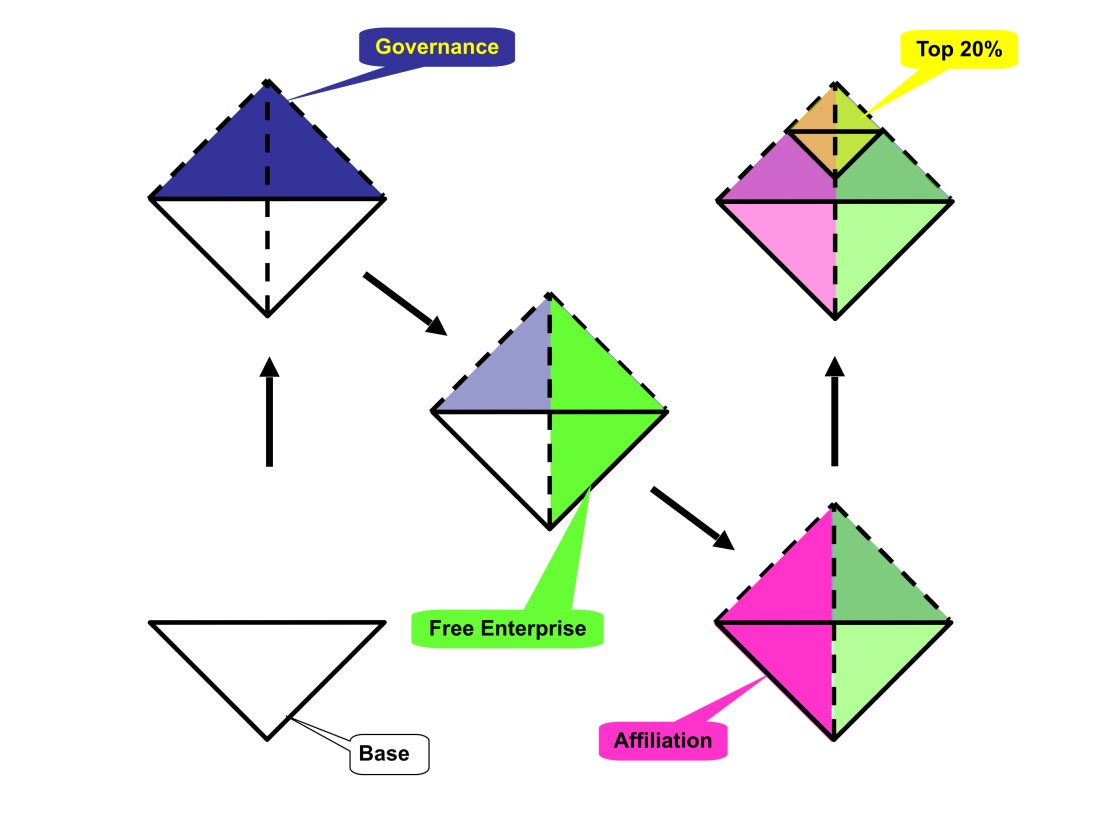
The universal symbol for a hierarchical structure is the triangle. Authority is held at the top, then distributed in varying degrees, level by level from the top to the bottom. However, a more appropriate geometric symbol for a social system is a three-sided pyramid (reference image below). One side of the pyramid is the hierarchical structure of governance. People participate in governance by making / changing the rules, enforcing the rules, and obeying the rules. Of course, there are always those who choose not to obey the rules. They are subject to some consequence levied by those who enforce the rules in the interest of what is called justice. The net result is that only a few operate at the top of the governance triangle to set and manage the rules while the clear majority obeys.

Another side of the pyramid is free enterprise. People participate by doing work that adds value for which they are compensated. They exchange that compensation for other goods and services they need and want. Wrapped up in free enterprise are concepts of property and ownership, money and capital, business and entrepreneurship, markets and customers. Wealth, in the form of assets, rests in the hands of a few.

The third side of the pyramid is affiliation. People participate by joining different groups and organizations which represent shared beliefs and ideals, customs and traditions, principles and values. These groups carry out activities that promote “causes” shaped by their worldviews. They provide forums for members to have voice and presence concerning their perspectives and interests. Those having the greatest access and influence are those who have the highest positions in the hierarchies of these organizations and represent the strength in numbers or vantage point of their memberships.

These three arenas: governance, free enterprise, and affiliation define the landscape in which organized human endeavor is conceived and carried out. The pyramid they form is a pyramid of power that develops and deploys human intelligence, energy, and skill to build, adapt, and sustain civilizations. While the three are vitally important as standalone systems, the interrelationships among them determine the effectiveness and efficiency of the whole. People vote for their leaders in governance. People make and buy based on supply and demand. People form non-governmental organizations to give body and shape to their views and interests. People derive power from the pyramid in unequal portions from the three triangles but regardless of the combination, the power they get is sufficient to stay in the system and work together so that the system persists.

Originally posted to New Media Explorer by Steve Bosserman on Saturday, December 10, 2005

Keeping the Beat with Jump Rhythm Jazz Project

My association with Jump Rhythm Jazz Project (JRJP) extends to early 1998 when Billy Siegenfeld and a cadre of JRJP dancers performed in Lakeway, TX at a Leadership for INstitutional Change (LINC) workshop sponsored by the W.K. Kellogg Foundation1. The purpose of their performance was three-fold. First, make rhythm and dance integral in the design of the leadership workshop as an appeal to the auditory-musical and bodily-kinesthetic intelligences of attendees, à la Howard Gardner and his theory of multiple intelligences. Second, act as a disruptive force among attendees and prompt them to consider a different line of thinking about leadership – followership and changing roles and responsibilities within a dynamic community. Third, provide a divertissement that would be engaging and entertaining.

The JRJP performance and subsequent question and answer period exceeded all expectations. Those who were intellectually (and physically!) asleep came to life. Those who had difficulties crossing the boundary separating their realities and the views of reality imposed by the dominant culture found a bridge. Those who believed that the most effective leadership was one that exercised control and focused choices were introduced to an open, participatory alternative that obviously worked. To this day, attendees at this workshop comment on the powerful effect JRJP had on them – it was transformational.

At the heart of JRJP is rhythm – the beat. Organized human endeavor is a pattern of communication or sustained conversation through which people give voice to what is important to them, achieve understanding, reach agreement, and garner commitment. Patterns, even conversational ones, have rhythm and voice – who is in what conversation about which topic. Changing an individual or an organization means changing conversations. Effective leaders change rhythm patterns to change conversations; over time, the people within the organization, and eventually the organization itself, change.

Because dance plays heavily on certain dimensions of human intelligence, it is a medium through which societal problems are addressed and different responses considered. A great dance presents a problem or situation for the audience to consider that is within their realm of experience and influence – a type of Theater for the Oppressed as conceived by Augusto Boal only in the form of dance and music. Through these the audience is invited to join the dancers in deliberating on social issues and exploring alternative approaches (recent examples in the JRJP repertoire include “Sorrows of Unison Dancing” and “The New from Poems”).

Building on rhythm and voice, JRJP displays a choreographic technique and musical score that is approachable and familiar. The dancers and the dance are engaging and invite participation by the audience. It is democratic in its purest sense. Democracy, though, carries certain responsibilities. As an organization, JRJP was forced to learn about these democratic principles in the context of its own behavior so that what was demonstrated in the performances was a true reflection of its own experience. The more that JRJP has found this touch point in itself the more engaging it has become with audiences worldwide. But getting there was not simple!

In July 2003, JRJP board members, staff, dancers, and close friends participated in a series of moderated conversations at a planning retreat. The intention was to drill down into what it meant to be members of JRJP and what JRJP needed to do to sustain itself into the future. The outcome of the retreat was the realization of three key points: first, JRJP was a great experience for most, but not all – surprisingly, Billy being the one experiencing the least joy; second, participating in the good things that JRJP had to offer was not associated with a commensurate level of shared responsibility – some, like Billy, had far more to do than others causing him to feel overwhelmed and living a life out of balance; and third, JRJP was heavily dependent on Billy; if he stopped doing what he did JRJP was at grave risk – sustainability was in question. This realization led to several actions including seating an Executive Director so that Billy could focus on being the Artistic Director, expanding the board membership to get more outreach to funders and supporters, defining and strengthening staff positions for distribution of operations among qualified personnel who were adequately paid for their work, and locating a home for JRJP somewhere other than Billy’s condo. These are done. And the level of performance for JRJP reflects this success!

But JRJP is not done. On June 4, 2006 there will be a second retreat. The purpose of this retreat is to make explicit what the company has accomplished, why it was able to do that, how it does what it does, and what that learning means for future activities. While many have experienced the recent changes in JRJP, several are not aware of why those changes happened and their significance for the future. The exercise of participatory democracy as a governing principle rather than hierarchical dictatorship speaks to an effective leadership – followership model. Showing others how to do this through the medium of rhythm, dance, and music is a significant deliverable JRJP can add to its repertoire.

To do this will require touching these past experiences, giving them voice, and building a confidence in moving them forward for others to learn. A different language will need to be developed that recasts what seems to be the same in the eyes of the uninitiated so that they have a very different understanding of what is going on. It is storytelling of the highest order. Between now and the retreat time and energy will be devoted to telling the JRJP story – both what has happened and the dreams for the future. By the time the retreat draws nigh, there will be a lexicon of terms and phrases incorporated into stories of vision and mission and proposals to funders that broaden the sense of what JRJP is up to for the next 5 years. It is a process of bringing the future into the present and giving it voice. JRJP will persist but will not be the same!

Originally posted to New Media Explorer by Steve Bosserman on Monday, December 5, 2005

  1. Susan Fugate, “Kellogg Foundation Initiative Seeks to Catalyze Change at Land-Grant Institutions,” Journal of Extension 34, no. 5 (1996):https://joe.org/joe/1996october/a1.php

Confessions of a Chocoholic — It’s All in the Bean

A couple of weeks ago I was visiting friends and noticed a Christmas catalogue from a German chocolatier on the table. Thumbing through it my mouth watered with the turn of every page. This visual distraction was converted into a topic of conversation. Soon, the only recourse was to raid the pantry of its Belgian chocolates and indulge our chocolate fetish. Wow!

Beyond the selection of finely-crafted chocolates featured in the catalogue, there was a section on the history of the company, some tidbits about chocolate-making and general comments about the source of chocolate – the cacao bean. I decided to research chocolate a bit further. This turned out to be quite a learning experience.

Information about chocolate is easy to find. Google has 66,500,000 hits on “chocolate” and 3,410,000 on “cacao.”

Wikipedia

The theobroma cacao, which means “food of the gods,” is an evergreen tree, native to the tropical regions of South America. Each tree has 6,000 flowers that produce maybe 20 pods. Each pod contains 20 – 60 beans. It takes 300 – 600 seeds to produce 1 kg of cocoa paste.

Field Museum

There are 592,000 Google hits on cacao production. Like most agricultural products, there is a general production process for cacao that is millennia in the making yet heavily influenced by scientific and technological developments over the past two hundred years. The pods are harvested, cut open, fermented (sweating), dried (cured), and packed in the first phase of processing. Then, the seeds are sorted, cleaned, roasted, cracked, fanned, and winnowed to separate nibs from shells in the second phase. In the third phase, nibs are ground into chocolate liquor (cocoa paste). Then, some of the liquor is pressed to render fat (cocoa butter) and the coarse leftovers are dried and ground into cocoa powder. The remainder of the un-pressed liquor is mixed with condensed milk, sugar, and extra cocoa butter form a crumb which is refined, conched, tempered, and molded into chocolates.

Much of the first phase of processing – harvesting, opening the pods, fermenting, drying, and packing – is done the same way it has been for centuries. It remains labor intensive since mechanization is not possible and several steps can only be done by hand. In addition to the physical work there is considerable human judgment involved in deciding which pods are ready to be harvested, monitoring fermentation, and controlling drying so that the result – the bean – captures the full richness of flavor and quality possible. This requires considerable skill and experience on the parts of those who are involved in this phase.

Designer Traveler

Because the cacao bean, the key raw ingredient required for making chocolate, can only be grown in certain tropical regions around the world, it’s price per pound is exceptionally high. That price is driven up by overseas buyers from Europe and North America who process the cacao but cannot grow it themselves. This is the reason cacao-growing countries like Ecuador don’t have a strong chocolate-making culture despite having the perfect cacao-growing conditions. The cost of the raw ingredients is just simply too high for the local consumption.

The cacao “Nacional” is sold in Europe as an elitist gourmet-product and gets prices up to 50 Euros per kilogram, whereas at the beginning of the production one kilogram costs only 0,58 Eurocents.”1

The post-harvest phases are highly mechanized thereby substantially reducing operating costs and improving consistency of quality and output. Considering a nearly 100:1 ratio of finished chocolate to packed cacao beans, this concentrates revenue AND profits in the later phases. It leaves very little for skilled labor conducting first phase work.

Because of high labor content, keeping the cost for labor low is an imperative. It can lead to abuse of the workforce without respect for the value and criticality of their knowledge. The most severe form of this abuse is slavery.

Food Empowerment Project2

There are 940,000 Google hits on slave labor chocolate industry. Slavery is not a new problem. Still, it challenges one’s sense of assumed social, economic, and political progress to think that the institution persists.

Dissident Voice

There are 6 hits on Google News about slave labor in the chocolate industry. There is nothing available that shows the current situation in real-time – a ground truth benchmark – but indications suggest the practice continues. It is, as it turns out, an engrained part of a colonial system setup centuries ago to facilitate exploitation. That system will not change easily because it pays-off.

TransFair USA

There are 1,330,000 hits on Google for fair trade certified chocolate. It suggests that if a sufficient number of people buy from stores or sources that sport the Fair Trade Certified label the system will change because the pay-off changes. That means changing the buying patterns of people. This means informing them about critical factors they need to take into consideration when they buy certain products, making the process of buying the products they need and want through alternative channels as easy, or easier, than conventional channels, and assuring availability with competitive prices. A tough call.

Ithaca Fine Chocolates

Equal Exchange

There are 7,900,000 hits for chocolate bars on Google. Two weeks ago I would have taken any of them. Now, I’m keeping time to a different drummer. A system changes one conversation at a time. In this case, it is one chocolate bar at a time!

Originally posted to New Media Explorer by Steve Bosserman on Friday, November 25, 2005

  1. http://www.ecuadorline.com/ecuador/newsletter/Newsletter200501.htm Original article quoted no longer available
  2. http://www.showmenews.com/2005/Feb/20050214Busi010.asp Original article no longer available

Tackling Population Density, Diversity, and Disparity

Dateline: 4 November 2005, a NY Times editorial by Thomas Friedman entitled, “From Gunpowder to the Next Big Bang” outlines how China is grooming entrepreneurs to increase the rate with which business opportunities are identified and acted upon.

Dateline: 28 October 2005, an article by Howard W. French entitled, “China Luring Scholars to Make Universities Great,” describes how China is making a concerted effort to beef up their academic institutions with rigorous, cutting edge research capabilities and open the door to more discoveries, inventions, and innovation.

Dateline: 26 October 2005, an editorial by Thomas Friedman entitled, “Living Hand to Mouth” explains how China is rapidly pushing the limits of sustainability by incurring heavy societal penalties in air and water pollution, deforestation, and loss of arable land to support the growth rate it has enjoyed over the past 10 years.

Other than being about China, what do these articles have in common? They highlight three essential tasks society is required to address as we come closer together as a global community.

First, population density. As the world’s population continues to grow, more and more people will choose to live in metropolitan areas. China has over 40 cities exceeding 1M population with the most populous being Shanghai at almost 10M. India boasts 35 cities with populations over 1M, the most populous being Mumbai at just over 16M. Cairo, the most populous city in Africa, has a population of almost 7M. Sao Paulo, Brazil, with over 10M, is the most populous city in South America; whereas Mexico City, at almost 9M, is the most populous city in North America. More especially, counting the greater metropolitan area for Mexico City, the total population stands at over 17M making it one of the densest population concentrations in the world! How do people have a quality of life in such densities? Certainly, the migration of people to these population centers will only continue. The question begs answers.

Second, population diversity. As people migrate from one area to another in an effort to improve their lot in life, they encounter those from other races, ethnicities, languages, cultures, religions, etc. The United States is a nation forged by those who came to the country in hundreds of immigrant waves across a 500+ year history. The U.S. is not alone. All countries experience migration patterns through emigration and immigration coupled by varying degrees of mobility within their borders that sees people move from one rural or urban location to another. These migratory changes are unstoppable, but not always welcomed. The consequences range from an inappreciation and nonacceptance of difference to outright conflict and bloodshed as incompatible groups find themselves in one another’s space. How do people learn to live together when they come from different places and have differing beliefs? This diversity will only continue. The question begs answers.

Third, population disparity. As people find themselves in the presence of others outside their native groups, they are confronted with a reallocation of power and resources – the pecking order is reordered. Depending on relationships with people new to the mix, this reordering takes away or grants influence. There will be winners and losers no matter what. If the losers are reduced to a point where they can no longer fend for themselves and meet their basic needs for subsistence, they will take extreme measures to assure their survival; namely, destroy the environment for water, food, clothing, and shelter, and increase the birthrate as a hedge. Both of these consequences are disastrous not only for those who are scrounging at the bottom of the power ladder, but ultimately everyone as the environment is compromised by over-population and other ways that adversely affect the whole system. How do people realize that to take so much from others and put lives at stake costs far more to correct than to leave enough so that even the least can enjoy a minimum quality of life? This disparity will only continue unless another course is taken. The question begs answers.

China is a nation dealing with density, diversity, and disparity. And the consequences of not adequately addressing these three are dire. However, as Friedman notes, China’s leaders know the future is not going to be bright for long if these conditions persist or worsen. China is stewing in the questions that beg answering.

Friedman also states that what is needed is an integrated solution. This involves countries and organizations outside China working with institutions and groups inside China. That is where the articles at the outset of this posting have particular poignancy: China is reaching across internal and external boundaries to bolster research capabilities, strengthen academic rigor, awaken and advance entrepreneurial spirit, and direct attention to improving environmental quality and along with it quality of life for Chinese citizens. That degree of focus and commitment, coupled with an abundance of resources to put into the effort, give China the opportunity to learn and gain much. While China will not find THE answers to these questions, the lessons mastered in addressing them will benefit the world. May we all get an “A” in the course!

Originally posted to New Media Explorer by Steve Bosserman on Sunday, November 6, 2005

Ménière’s Disease: Requiem for My Left Ear

This past Friday, my doctor told me I have Ménière’s disease. These two words explained a week of incessant, high-pitched ringing and pulse-throbbing pressure in my left ear, an unsteady gait when walking, and a counter-clockwise swirling of the room following any rapid movement of my head. The only action that seemed to curb it was sleeping, which is what I did. While there was much to be done, I felt like doing NOTHING!

Of course, I indulged in self-diagnosis in between waves of vertigo. Was it the result of too much coffee? Too little down-time? A simple case of the flu? I settled on three possibilities: an inoperable brain tumor (in deference to my mother – may God rest her soul – who believed in establishing an extremely severe alternative no matter how unlikely so that almost any diagnosis made by the doctor would be good news in comparison); an ear infection (where my bets were placed); and wax build-up in the ear canal (I knew this one was a long-shot, but it at least served as a balance to the first choice). Ménière’s disease?! Never heard of it!

“What is it?” I asked. The doctor offered an explanation: no one knows what causes it…could be genetic…could be a virus…there is no cure…it comes and goes unpredictably…you have atypical vestibular Ménière’s disease because you are not experiencing hearing loss in the left ear…long term prognosis is that you probably will have total, permanent hearing loss…severe vertigo can be incapacitating due to nausea and vomiting…can only treat the symptoms…surgery works in some cases to lessen vertigo. In the meantime, here is a prescription for 25mg of Meclizine to reduce dizziness…the side-effects include feeling lightheaded, sleepy, having blurred vision, change in thinking clearly…avoid driving, doing other tasks or activities that require alertness or clear vision. Anything else I can do for you?

I entered into the privacy of the doctor’s office aware of my very real, but unspecified condition. It was real because I physically and mentally experienced its consequences. And in that moment it was mine alone. No one else knew what I had or how I was affected by it, not even my wife who accompanied me. However, the doctor gave it a name. He now knew, my wife knew, and I knew and I was no longer alone with the unknowable.

The mere fact that it was symbolized with letters gave it a virtual existence extending far beyond me and touching the millions of others who have the same condition. This virtualization gives me access to the experiences, knowledge, empathy, and understanding of others; and they to mine. Because of a name, Ménière’s disease, such widespread connectedness becomes a powerful way for me to learn about myself and the result may carry far beyond the bounds of the condition. So, to start…

A Google search on the term, “Ménière’s disease” yields 667,000 results. A search of Amazon generates two pages of books, journals, magazines, even herbal medicines. There are 28 Yahoo! Groups and 3 Google Groups and almost 2700 groups across the Internet dedicated to the Ménière’s-related topics such as tinnitus, vertigo / dizziness, vestibular virus, etc. There are countless variations on how Ménière’s manifests itself and what people who have it do in response. The choices are many, ranging from pharmacological prescriptions to alternative medicines, and from low-salt diets to surgery.

It is almost impossible NOT to get connected. Clearly, I don’t know what’s next for me with Ménière’s — I could have another episode tomorrow or I could never have another one. At the moment I have no vertigo, no hearing loss, no spinning computer screen, no pressure in the ear, only a slight ringing. The prescription for Meclizine is filled, but unused. So in the moment, I go on reading more, asking more, learning more. And even if I don’t have call to use this knowledge for myself, I have it at hand in case others I meet or know are afflicted with similar symptoms and diagnoses. This potential for learning together in the future marks a distinct value of virtualization. If and when Ménière’s strikes again and the realization of the condition hits me hard, I thank all of you in the vast global network in advance for imparting your knowledge and wisdom and making me a better person for it!

Originally posted to New Media Explorer by Steve Bosserman on Saturday, October 22, 2005 and updated on Monday, October 24, 2005

A Wedding Framework

Last week, I had the distinct pleasure of participating in my daughter’s wedding. As typical for fathers of brides, I just showed up and did as I was told so as to contribute as best I could to her having the complete experience she wanted. Obviously, my participation fulfilled an essential role within a “wedding framework” my daughter spent years envisioning. However, it became obvious as the day unfolded that my role was only one of many within a complex blend of activities and sub-routines among people, businesses, and processes over the previous six months that led to the wedding framework “realization” we shared at that time.

This speaks volumes for the necessity of an envisioned framework upon which to define and queue critical activities. It is also a classic example of what happens along a virtualization — realization continuum as a total solution is put into play. As they began their wedding plans, my daughter and her then fiancé chose to get married in a small town along the coast of Maine even though they lived in the Kansas City area. I found out later this is called a “destination wedding,” or as a friend of mine termed it an “announced elopement.” In their case, neither of them lived in Maine, had been to Maine, nor knew anyone in Maine; but that was no deterrent. Enter virtualization!

Successful virtualization relies on three key elements: presence – visibility on websites, blogsites, profiles, and listings wherein a person, business, or organization can be found through routine searches; networking – chatter, buzz, references made by others that corroborate what a person, business, organization claims about themselves; and interactivity – responses in timing and content to emails, voice mails, site comments, etc.

My daughter and son-in-law brought these three elements into play right from the start of their planning. First, they tapped into their personal networks and searched the Internet for information about Maine. Their particular interest was the coast of Maine then small towns on the coast that have white churches in stereotypical settings of rural New England, followed by requisite splashes of fall colors dotting the countryside in early October. A combination of affirmative statements from family, friends, co-workers, and others within their trusted networks who had realized experiences in Maine, what they gleaned from online sources, and what was learned in exchanges of email and phone conversations with people in Maine, the destination was targeted – Camden.

Finding the location was only half the challenge. The second step entailed populating the envisioned overall “wedding framework” with virtualized pieces that nested together to create a whole virtual experience of the total solution. The same networking — web-surfing — loop-closing communication patterns used to find the location were repeated several times over the course of the six-month planning horizon with one critical difference – secondary trusted networks were available.

One of the outcomes of the initial round of site selection was the discovery, “testing,” and subsequent addition of those who passed the test into their trusted networks. These new members were local to Camden. Of course, those Camden locals knew others in their trusted networks who had the necessary qualifications and availability to fill-in the missing blanks on the wedding framework. As a result, church, pastor, bed and breakfast rooms for guests, photographer, baker, florist, marriage license office, etc. were found, their roles clarified, and their commitments sealed – the virtualized total solution was completed slightly ahead of the realized form. As a backup, the local trusted networks had sufficient redundancy that in the event of failure with one of the contracted parties another was quickly available to step in at the moment of realization to assure success.

My daughter and son-in-law had a wedding framework in mind from the start. They went through the steps necessary to find and integrate the people, businesses, and organizations required to first virtualize, then realize their “total wedding solution.” Such an integration role is central in putting together and carrying out any complex project or initiative. Successful “integrators” build new, penetrate existing, and connect interrelated networks. This skill enables them to take a framework of their or another’s making, organize it into a latticework of interconnected cells, and then pull from dense webs of resource networks to “fill” each cell with multiple layers of possible responses. It is a skill that is becoming THE key differentiator among those who are seemingly equals. It is one that my daughter and son-in-law executed flawlessly.

Just as “beauty is in the eyes of the beholder,” my description of a virtualization — realization process that was wonderfully done means nothing unless the one it is about agrees with the result! When describing the experience as her wedding day was winding down, my daughter said, “It was PERFECT!” There is nothing sweeter to the ear for a dad than to hear his daughter say this. So, indeed, it WAS perfect!

Originally posted to New Media Explorer by Steve Bosserman on Friday, October 14, 2005