Distribution Channels for Agriculture Equipment Systems in India

Overview

The long run of substantial growth in the Indian economy since liberalization in 1991 spread opportunities for business expansion and entrepreneurial start-ups in all commercial sectors, including agriculture. During the past decade and a half, noticeable gains in the purchasing power occurred for some Indian farmers. Their economic circumstances improved through the expansion and strengthening of infrastructure, rapid farm consolidation to take advantage of economies of scale, adoption of genetically modified cropping, and utilization of more productive agriculture equipment systems. However, there are 700 million farmers in India – the second largest block in the world behind China – and clearly, not all enjoyed the same level of benefit from the blistering economy as evidenced by the article, “India on Fire” in the current issue of The Economist.

Regardless of economic strata and chosen agricultural practices, all farmers are dependent on some type of agriculture equipment system to conduct their farming operations. The range of different equipment systems is quite broad, extending from low-investment handheld tools moved by draft animals to extensive, high-investment “packages” of machinery, computer systems, integrated software, and global communication networks. As with any complex marketing landscape, matching solutions with opportunities to make a difference for the customer and the company is essential.

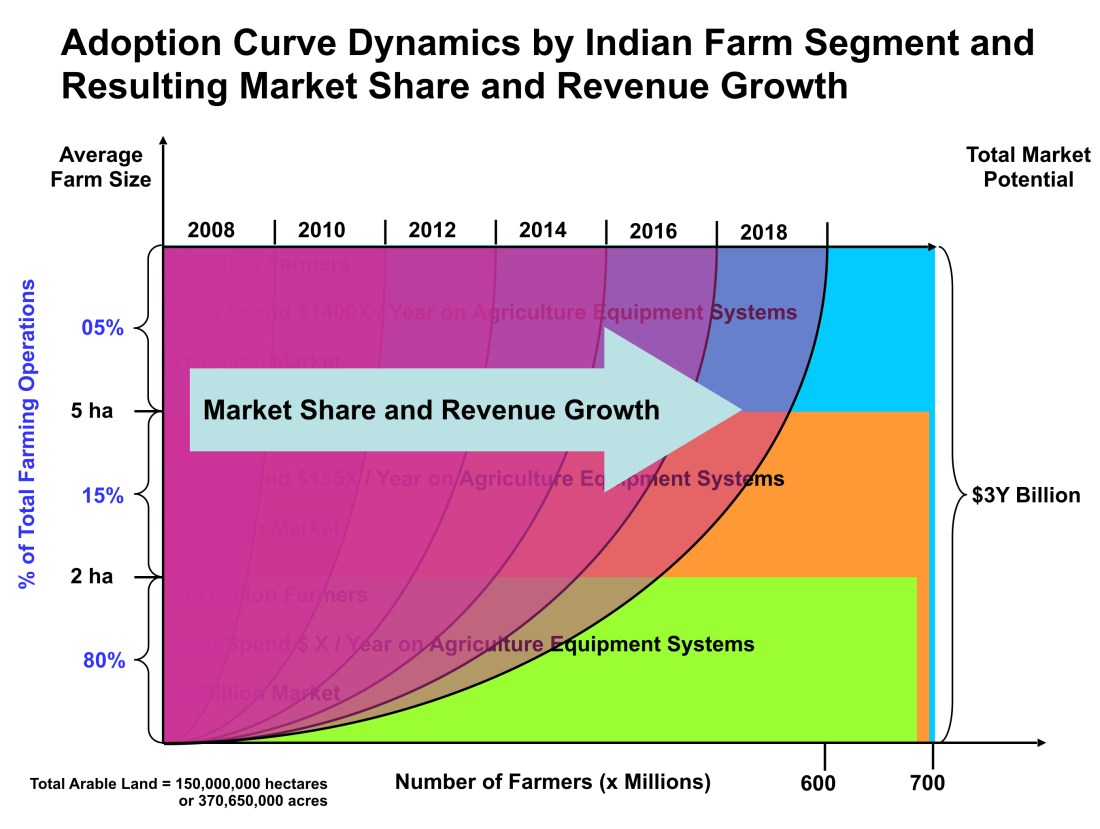
The following graphic illustrates the interrelationships of the number of farmers, farm size, and market potential for sales of agriculture equipment systems.

The distribution clearly shows that 695 million farmers hold 80% of the arable land in India on farm sizes that are less than 2 hectares, approximately 5 acres, each. In fact, estimates suggest that 600 million farmers work on lot sizes that are each less than 1.5 hectares, or slightly less than 4 acres. This distribution is significant for several reasons, but one that features prominently when considering a marketing distribution channel strategy in India is population, both in terms of density and migration. As evident by the sheer number of people involved, unchecked farm consolidation, such as what occurred in North America and Europe since WWII, is not a viable course.

The infrastructures of urban areas in India would be quickly overwhelmed if even 25-30 % of the 700 million farmers scattered across India abandoned their rural homes in hopes of brighter futures in the cities. The challenge facing India, then, is to improve agriculture practices, increase output, and raise the quality of life for 700 million farmers so they choose to stay put. Not an easy mandate to meet.

Such distribution coupled with a wide variance in farming conditions within India’s agricultural regions and a diversity of farming methods and crop portfolios in each creates a complex marketing space that is anything but homogeneous. Developing a distribution channel strategy under these circumstances is problematic unless due consideration is given to the segmentation scheme and the value propositions for those segments.

Channel Design and Infrastructure

Regardless of segment, the design of distribution channels is dictated by the reach, capability, and capacity of three fundamental systems of infrastructure: information / communication technologies, electrical power, and roadways / waterways.

1) Farmers, no matter how remote, have to communicate: among themselves, with suppliers, downstream processors and retailers, government agencies, and financiers. The more direct the connections without brokers and middlemen the better. ITC has carried this point further than many through the implementation of their trademarked e-Choupal system. Comprised of self-contained solar-powered kiosks, satellite downlink stations and cellular microwave towers, and computers, nearly 4 million farmers throughout India are able to communicate by phone, access the information from the Internet, conduct online transactions, and make daily decisions about their farming operations.

A successful channel strategy begins with the virtualization of the products, services, and solutions so they flow through the information and communication networks to current and prospective customers. This constitutes a clear value proposition through improved decision making. It also establishes the first level of trust that the relationship between provider and customer is not exploitative, but mutually beneficial.

2) It takes electrical power for a farming operation to function, despite where it is located or what is in its business portfolio. Currently, India imports 100 million tonnes of crude oil per annum and is projected to import 300 million tonnes per year by 2030. In addition, India possesses the fourth largest coal reserves in the world. However, consuming it to generate electrical power in an environmentally sound manner is problematic and costly to resolve. To continue aggressive economic growth while not compromising the environment or being held hostage, politically, by unfriendly, oil-rich nations, India must develop alternative energy sources. In a press release earlier this week, Indian president, Dr. A.P.J. Abdul Kalam, committed to put India on the path toward energy independence by 2030. Furthering the use of electrical power generated through renewable energy sources like wind, solar, geo-thermal, and biomass / methane is central to India meeting this long-term energy goal.

A successful channel strategy contributes to this in a two-fold manner. First, it discourages more dependence on oil by delivering agriculture equipment systems that do not require fossil fuels to operate. Second, it encourages the development, commercialization, and adoption of alternative energy sources to generate electrical power for agriculture. This enables farmers in rural areas where the electrical grid does not reach to have the technologies available to generate the electrical power they need. Also, as the grid becomes available they have the opportunity to draw from it as needed and transfer surplus power they generate onto it for revenue. This posits a value proposition that reduces the cost of farming operations and improves productivity and profitability. Furthermore, fostering an alignment of business interests with government intentions and policies establishes a second level of trust between the provider and customer.

3) As farm productivity increases so do variety and volume of inputs and outputs. Moving, storing, applying, and disposing of more and more material within the same block of time drives the food system to hit the limits of capability and capacity preventing it from working efficiently and effectively. India has a number of critical initiatives underway that target an overburdened infrastructure for receipt of more resources and assistance as evidenced in “Priorities for The New Millennium” by the Asian Development Bank. This is complemented by a continuing effort to setup Special Economic Zones (SEZ) that, in part, facilitates the building of critical infrastructure. It also has a dampening effect on population migration due to farm consolidation by creating jobs that can be filled by those who are displaced from farming operations. A speculative argument by Indian development economist, Atanu Dey, and Vinod Khosla advances a concept called Rural Infrastructure Services Common (RISC), that addresses rural population, infrastructure, and economic improvement. While not necessarily the answer, it does offer insight into the degree with which people of influence and power in India are aware of the issues and are searching for answers.

A successful channel strategy distributes information, methodologies, and capabilities to people engaged in agriculture so that they can work through or around infrastructure deficiencies or build-up the infrastructure so that it is no longer an impediment to growth. Of particular importance is the delivery of product and service packages primarily intended for agricultural operations but can serve a dual purpose in building, upgrading, or maintaining physical infrastructure such as roads and waterways. This establishes a value proposition based on multi-use applications for basic equipment systems thereby leveraging the investments by farmers and contributing to additional growth opportunities. Because such an approach does not place the farmer in a bad situation where the benefits promised by increased productivity are cancelled through losses due to infrastructure weaknesses, a third level of trust that speaks to a long term commitment by the provider to the customer.

To design a distribution channel strategy for agriculture equipment systems in India, it is a critical to first understand information / communication technology, electrical power, and roadway / waterway infrastructures then, respond to the business context established by them. As the graphic below suggests, the rate of adoption for various agriculture equipment systems varies from one segment to another depending on the size of the farming operation, the ability of farmers to take advantage of available opportunities, and the potential for sustaining the business. Projecting across a ten-year period, greater adoption, market share, and revenue will go to the provider of systems that span across the full landscape of Indian farming operations.

To try to sustain a growth strategy by ignoring the bottom-of-the-pyramid (BOP) representing the vast majority of farmers and tapping the upper-end who lead the adoption curve and have the most resources to invest will yield short-lived and unsatisfactory results. Accusations of exploitation of the masses will take its toll on reputation, incite resistance, and drag down sales performance as reflected in numerous press articles (“Farm Widows in India Fear Crop of Creditors,” by Aparna Pallavi and “The Tale of Three Widows,” by Jaideep Hardikar in India Together online magazine) and research papers (“Biotechnology and Suicide in India,” by Glenn Davis Stone) about increases in farmer suicides.

Moving Forward with a Distribution Channel

Given these dynamics, there are three steps in initiating, expanding, and sustaining a distribution channel for agriculture equipment systems in India:

  1. Take advantage of existing or supplement information and communication networks to disseminate valued information about agriculture in an Indian context to prospective customers. This is a low-price, high-value service with low entry barriers and costs that quickly establishes a first level of trust upon which additional value can be delivered.
  2. Expand upon the initial business information to include knowledge about the larger Indian economic and political “system” in relationship to technological developments and the realities of community life to deliver product and service packages that make a difference for the agricultural businesses, environmental conditions, and community stability. This is a moderately priced, high-value package of services and products from different providers that collectively leverages the investment of the customer while providing an acceptable return for the providers.
  3. Engage major players from industry, government, academe, and the community to affect larger, more capital-intensive projects that serve broader objectives to build more capacity and further improve productivity. This is a higher priced, high-value package of services, products, and solution management from a wide range of providers.

Essentially, this is an “infrastructure first” approach that endears the company to the people by putting in their hands the information, knowledge, and resources they need to be successful. This is the key differentiator among equals. It builds a trusting relationship based on the clarity of motive, integrity in deed, and delivery of what works for the majority before moving into more extensive and riskier endeavors that may exceed the customer’s boundaries of healthy speculation. This means that the marketers, the dealers, and the sales force must know their customers so they can keep them positioned for sustained success without overrunning their headlights. And this brings us back to best approach for partnering with the Indian farmer: focus on improving the infrastructure – it is THE winning strategy!

Originally posted to New Media Explorer by Steve Bosserman on Saturday, February 3, 2007

Agriculture Megatrends: Ten Trends Redefining the Practice of Agriculture in the World

When I was growing up in south central Kansas, agriculture was a way of life – it was all around us in the form of wheat fields, cattle ranches, pastures, and gardens. Agriculture has had enormous economic significance throughout the history of Kansas, first, as a territory then a state. And it continues to be an important factor in shaping Kansas’ future. However, changing conditions over the past 60 years transformed the practice and scope of agriculture in Kansas: myriad family farms vanished through improved mechanization and consolidation of farming operations, absentee ownership of farms increased as farming businesses incorporated and adopted professional management in an effort to be competitive in a global market, significant tracts of productive farmland were lost to urbanization, and productivity of farmland became more unpredictable as precipitation patterns shifted, water tables dropped, and soil and ground water became more contaminated through unsustainable agricultural practices. While there are arguments both pro and con for the direction these changes took and their consequences, it is safe to say that agriculture is very different today than it was even a generation ago AND it will change even more with the next generation.

Changes in agriculture experienced by Kansans are not much different than those experienced by people in other states. The same phenomena of mechanization, consolidation, absentee ownership, globalization, urbanization, and non-sustainability have had similar affects throughout the United States and many other countries in the world. While the productivity / hectare or acre has certainly improved substantially over the last 60 years, the complications arising from less arable land, more distance from the point of production to the point of consumption, less oversight, and undesirable environmental consequences makes agriculture an even riskier endeavor than when success was determined by fickleness of the weather! If one extrapolates the next 20-30 years based on historical trend lines across the previous 60 years the picture for agriculture is not a particularly rosy one.

But just as mechanization had a profound disruptive effect on agriculture over 100 years ago, there are forces at play today and into the near future that are going to have a similar impact. My contention is that agriculture, rather than being relegated to the ranks of the mundane, mistreated, and maligned, will witness a rebirth into a new golden age. Whereas agriculture meant wheat, hay, and livestock when I was a boy growing up in Kansas, today, it extends across a full range of plant and animal applications: food for human consumption, feed for animal consumption, fuel, fiber, floriculture, horticulture, and nutraceuticals to name a few. This broader scope, when prompted by rapid and far-reaching developments in information and communication technologies and placed into the context of Marshal McLuhan’sglobal village“, opens the door to examine agriculture in a more approachable, personal, and wholistic manner. Agriculture is reinstated to a more historically accurate location – an explicit, integral part of our lives, individually and collectively, and our world.

The purpose of this posting is to introduce ten agriculture “megatrends” – to borrow from John Naisbitt’s 1988 book, MEGATRENDS: TEN NEW DIRECTIONS TRANSFORMING OUR LIVES – that portend a renaissance for agriculture. Together, these offer a framework within which further details will be added. For now, though, the highlights:

Agriculture Megatrends: Ten Trends Redefining the Practice of Agriculture in the World

1) Growing concerns about the depletion of fossil fuels, the environmental impact caused by consuming them, and the consequences of paying those who do not have the best interests of others at heart for the fossil fuels is contributing to an increased investment in bio-fuels, biomass, and bio-energy.

Renewable energy from plant material and animal waste will continue to be a high-growth area.

2) Modifying a crop portfolio to include more plant material for fuel rather than food or feed equates to less food and feed UNLESS more land is put into production and productivity and output per unit of land is increased to make up the difference. This means that land in urban and suburban areas formerly dedicated to non-edible, non-fuel uses such as lawns and landscaping will be converted into higher value uses.

Localization of agriculture will be a high-growth area.

3) Raising crops for food and feed or fuel and fiber requires more production with less cost on smaller land sizes. This leads to a continuing emphasis on genetics either by modification or selective breeding to make significant improvements.

Genetic research and applications of genetically modified or selected characteristics for valued crops will be a high-growth area.

4) Using seed stocks with uniquely valued characteristics warrant tight controls through growing, harvesting, and post-harvest handling to assure purity. This promotes the application of techniques like RFID tagging and tracking to maintain an audit trail of traits, conditions, and treatments from end-products to their source.

Traceability will be a high-growth area.

5) Knowing that fresh food is grown without the use of certain fertilizers, pesticide, and herbicide is of increasing importance to consumers. The classification of “organic” is gaining ground as a way to assure food is grown and prepared according to specific guidelines that preclude the use of these chemical applications.

Organic food production will continue to be a high-growth area.

6) Curbing the release of carbon into the atmosphere is complemented by absorbing it into plant material and converting it into sugar and starch through photosynthesis. As more countries adopt broad-based systems to manage carbon credits more interest will be shown in selecting crop portfolios that take advantage of carbon credits as well as other value.

Carbon sequestration will be a high-growth area.

7) Recycling water, waste, and unused raw materials is becoming a more important consideration to increase efficiency and prevent unnecessary losses. This leads to a more systematic integration of farming practices along with the management of waste and by-products. Such systems offer wholistic approaches to year-round food production in temperate regions with a minimum of energy consumption, maximum utilization of inputs, and reuse of unconsumed outputs.

Integrated farming and waste management systems will be a high-growth area.

8) Decentralizing the generation of electric power and making electricity the common energy source for the vast majority of people worldwide is a mounting imperative. This invites the possibility of those who live in yet-to-be-electrified rural areas of the world to generate electricity through wind, solar, methane, or geo-thermal and use that energy to meet the needs of their agricultural, business, and domestic operations self-sufficiently off the grid. The development of a full array of electric-powered equipment in all price ranges is a natural complement. Of course, as the grid reaches out to more remote locations it will be a straightforward way for those who are generating electricity by whatever means to sell their surplus and draw upon in times of peak usage.

Electrification of rural areas and agricultural and multi-use equipment, especially with VERY low-cost solutions, will be a high-growth area.

9) Increasing agricultural production in widespread areas as well as concentrating agricultural operations in urban, suburban, and near rural settings requires new ways of moving and storing the output from the point of production through processing and preparation stops along the way to the point of consumption. Issues of food security and food safety coupled with the management of inventory to assure the least amount of loss while delivering the highest degree of freshness and quality are critical. This applies to inputs as well as outputs and touches upon the coordination among diverse growers for individual production portfolios.

Agricultural logistics and complex production management will be a high-growth area.

10) Forming, utilizing, and managing connections between and among agricultural producers, suppliers, logisticians, and customers is essential for effective business relationships to develop and transactions to occur. Whether wirelessly or by landline by voice, written word, or graphics, there are many ways to communicate and transfer information. The most important step is having the information and communication infrastructure to reach anyone, anywhere at anytime so that knowledge and insight about markets, prices, costs, pick-ups, deliveries, funding options, investments, etc. can occur expeditiously and consistently.

Information and communication technologies will be a high-growth area.

While these megatrends are introduced individually, the reality is many of them work in concert with one another to form an infinite variety of complex solutions addressing a wide range of community and commercial opportunities. Future postings will not only elaborate on each trend, but will showcase those combinations that provide additional value through interconnection and integration. More to come…

Originally posted to New Media Explorer by Steve Bosserman on Thursday, February 1, 2007

Value Propositions

As January draws to a close I look back on a busy month of travel that took me to three continents and visits to a wide range of clients in both the for-profit and not-for-profit sectors. A common theme no matter what type of organization is value for time, energy, and resources spent. We want more value in each of our transactions. As a result, regardless of how the metrics of time, energy, and resources are defined, they represent the ways in which comparisons between alternatives are drawn, distinctions and differentiations of one to another are determined, and ultimately, decisions to choose are made based on which alternative offers the greatest value. Does one alternative take less time than another? Does it take more physical effort, require specialized skills, or is it informed by direct experience? Does it cost more to rent, lease, buy, or contract, or does it tie-up more capital? These and related questions are at the heart of determining value.

Of course, what we are looking for from others who might help us are ways in which their input provides value. In other words, we look for what Geoffrey Moore terms the “value proposition” as the impetus to choose from what is presented to us for consideration including choosing nothing at all if it does not improve our current situation. (For further reference, consider the following books authored by Mr. Moore: CROSSING THE CHASM and INSIDE THE TORNADO, and his blog Dealing with Darwin) Essentially, the value proposition presents ways we can use our time, energy, and resources in pursuit of our endeavors. Our task is to evaluate whether one value proposition is better than what we are already doing or is best among other value propositions available. Knowing what constitutes a value proposition guides us in our evaluation of various alternatives.

Basically, value propositions surface in three ways: information, packages, and integrated solutions.

Let’s take information. Go to any blog, like this one, or website that features certain products, services, or points of view and what you see and read are testimonials with references. The authors describe the context in or circumstances under which their experiences occurred, including probable causes / root cause if a problem and contributing / off-setting factors if an opportunity; they document the results; and they offer an evaluation of the various factors and actions that made a difference one way or the other. The idea is that if we can match our circumstances with theirs we will be in position to make a more informed decision using the results of their approaches as guidelines. The value comes in not repeating the mistakes of others or duplicating what worked well by taking the same steps they did. The value proposition of time and energy spent going to a particular information source versus another is based on accuracy, timeliness, and relevance. For that reason one blog is more popular than another, one search engine is tapped more frequently than another, and one reference website is consulted more often than another.

The problem with information alone is I have to find it, first; then read it and see how it fits my situation; then act upon it. This can and often does consume considerable time. And it may very well be worth the effort. However, if I am dealing with a complex system where there are multiple dimensions to take into consideration, a complete package is preferable.

Here’s an example: let’s say I want a high-speed Internet access with a secure wireless router to do online banking transactions from my laptop. Also, I have been reading about VOIP and that service sounds interesting, maybe even a Wi-Fi phone to be independent of a computer. In addition, I have a cable TV service that includes Internet access as an option. Oh, and I have land-line phone service in the office that also includes a DSL option. But then the company providing my cell phone service offers wireless connectivity for my laptop through a wireless card. Of course, there are parts of the world where there is no cell phone coverage and land line service is spotty at best. For these there are satellite phones and high-speed Internet access.

With all these choices, how does one proceed? As one can well imagine, there is a wealth of information about each and every combination of service and product. The time and energy required researching these and putting together a cost-effective and reasonably performing bundle is ENORMOUS. Can’t someone do it for me?

Therein lies the next level of value proposition – the package. Most organizations providing a variety of products and services catalogue their offerings into generalized buckets that fit together logically and purposefully. Their interest is to reduce the time customers spend making a decision and is cost-effective and satisfying, operationally; the package functions as intended. The organization that presents a value proposition with the least outlay of costs, the fewest ongoing transactions and the greatest degree of “fit” and satisfaction wins the prize!

Despite excellent bundling and packaging strategies guided by Customer Relationship Management (CRM) practices the customer must choose among an array of options and alternatives to fulfill all the requirements of a business or personal application. Companies can engage in customer segmentation schemes to better target their package toward particular customer groups and reduce the customer’s involvement. Also, they can provide opportunities for customers to interact with representatives online or by phone to better tailor a package to meet specific and often unique requirements. Still, the customer remains the integrator who exercises the final step in putting a solution together that truly matches the unique context in which it fulfills its mandate. Packaging efforts fall short of the goal which is for an organization to design, deliver, and maintain a totally integrated solution that meets and exceeds the needs of the customer WITHOUT the customer having to be directly involved.

The strongest value proposition is the one in which the customer does not have to decide what is the best solution overall or which are the best components to include in the total solution. The organization becomes the integrator of choice for the customer. To be relieved of having to spend time, energy, and resources to develop, implement, and maintain an integrated solution is of supreme value to the customer.

This suggests a three-stage progression of value propositions organizations can use as a scorecard to see whether they are on the way to becoming the integrator or is the customer relegated to remain so:

Step one: is the information you provide accurate, timely, and relevant?

Step two: does the package of products and services you offer indicate you understand the customer’s needs and circumstances and does the package function as promised?

Step three: does the integrated solution you provide merit the trust and confidence of the customer that you are making choices in the customer’s best interest?

As might be expected, the third step is not easily reached. Only those who have the intelligence, means, moxie, and integrity to warrant such trust earn this right. However, it should be the goal of all who serve others through organizations of any type. How does your organization stack up?

Are you in position to offer a better value proposition for the customer?

Originally posted to New Media Explorer by Steve Bosserman on Tuesday, January 30, 2007

Food Systems and Distances Traveled

Food is an essential requirement for life. A certain degree of psychological preoccupation is prompted if there are risks associated with getting the need for food met. As a result, securing food is one of the fundamental building blocks in Abraham Maslow’s “hierarchy of needs.”

Distance from the source of food is a sticky wicket for food consumers. We are left in the hands of government regulations, enforcement agencies, businesses, and various special interest groups in between us and the food we need for survival, health, and well-being. Questions range from plant and animal genetics to methods of production, processing, and preparing foods, to the logistical systems that transport, store, and stock what we eat as it moves from the point of production to the point of consumption.

So how far is it from the point of production to the point of consumption? According to a 2003 study, “Checking the Food Odometer: Comparing Food Miles for Local versus Conventional Produce Sales to Iowa Institutions,” by Rich Pirog at Iowa State University it can be further than one might think. For a synopsis of Pirog’s study, please read Consumers Prefer Locally Grown Foods published by the WK Kellogg Foundation.

Drawing from Pirog’s report, Jane Black offers the following analysis in her article in Slate entitled, “What’s in a number? How the press got the idea that food travels 1,500 miles from farm to plate:1

All statistics, of course, are based on a series of assumptions. And Pirog is quick to point out that whether or not the 1,500-mile figure applies to everyone and everything—or how it’s been misused—it has raised consciousness about where food comes from. It sends a message: It matters what you buy, and where you buy it.

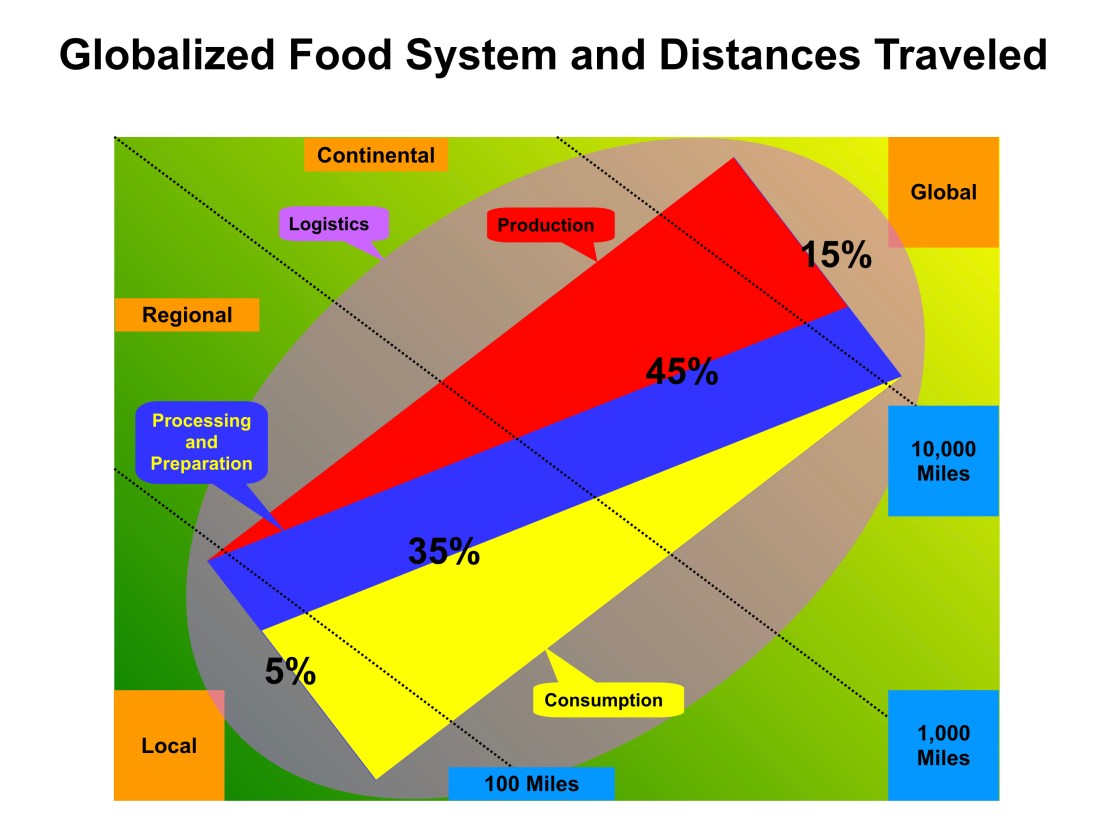
The graphic below illustrates some of the critical relationships in the current, globalized food system relative to distances food travels.

Essentially, the diagram is a continuum from local to global with regional and continental “zones” setup to offer arbitrary hash marks at the 100, 1,000, and 10,000 mile intervals in between. Clearly, the distribution of distance favors production, processing, and preparation encompassing more than 1,000 miles. Also, the interplay of production, processing and preparation, and consumption is embedded within a logistical system that supports the movement of plant and animal materials from one location to another while transferring from one production / processing stage to another.

This diagram does not attempt to quantify the complete distance traveled, but offer a way to visualize the approximate distribution of mileage when looking at the overall food system. While Pirog’s report focuses solely on fresh produce and excludes various stages of processing between production and consumption, if one included the distances incurred by these additional steps the total mileage traveled would be considerably further. Also, due to the economies of scale favored by globalized operations, processing and preparation are centralized in specific locations that enjoy advantages of lower cost labor or closer proximity to large scale production operations. This adds to total distance traveled when completing the cycle to the consumer.

In his book, PERMACULTURE: A BEGINNER’S GUIDE, Graham Burnett offers a diagram entitled, “The Industrialization of Tea” that captures the notion of distance in the globalized food system and its consequences. When the total costs of fossil fuel consumption is treated as an externality and there is relative assurance that globalized food sources are secure and can provide safe food at low cost the food system functions effectively. But what if the formula changes due to increased fuel costs? What if we cannot assure food security and safety? What is an alternative? Mr. Graham begins to explore this question by providing a second diagram, “The Permaculture Cup of Tea,” posted on the same website.

In carrying the philosophy of a “permaculture cup of tea” further, the diagram below follows the same general format as the previous graphic, only the food system is more localized than globalized.

Now, 60 % of the food system functions within an area under 1,000 miles of the point of consumption. While this stops far short of 100% under 1,000 miles, it does suggest that simply moving a mere 30% of the total food system output from over 1,000 miles to under will have a profound impact on the issues like fuel consumption, food security and safety, and community sustainability, health, and well-being. But how much difference would this really make?

While there are no data to tell us for sure, there are reports from studies in related fields that offer some insight. In The New York Times article by Matthew Wald published December 30, 2006 entitled “Travel Habits Must Change to Make a Big Difference in Energy Consumption,” the author states,

…picking a large sport utility vehicle that goes two miles farther on a gallon of gasoline than the least-efficient SUV’s would have an impact on emissions of global warming gases about five times larger than replacing five 60-watt incandescent bulbs. The dollar savings would be about 10 times larger. And the more-efficient light bulbs would have a negligible effect on oil consumption.

This suggests that shifting the 30% of the current food system activity to under 1,000 miles from the point of consumption would make a substantial difference.

There is a business case in this for sure; but how would one go about putting the business model together that leads to viable business plans and startups in localized agriculture? The key is in designing a framework that ties the critical elements of food production, processing and preparation; renewable energy and environmental remediation; logistical systems; and community sustainability together into a set of dynamic, interactive, and adaptive relationships. And that will be the topic for subsequent postings…

Wishing you all the very best in 2007!

Originally posted to New Media Explorer by Steve Bosserman on Tuesday, January 2, 2007

  1. The original article, “The Issues: Buy Local,” is no longer available online

Oil Addiction and the Business Case for Change

One responsibility that comes from communicating with readers through media such as blogs is to define terms as they are going to be used in various postings and follow-up by consistent usage of those terms according to their stated definitions. In this instance, three terms are offered for consideration in this and related postings about business opportunities: business case, business model, and business plan.

Wikipedia defines “business case” in the context of an existing business wherein certain changes are being considered. While this is certainly a useful construct in project management practices, it need not be limited solely to that purview. It is also a valuable tool for entrepreneurs to draw upon when determining start-up possibilities or expanding an existing business far beyond the boundaries and scope of its original charter.

Business cases lead to “business models.” A business model is the approach a business intends follow in order to generate revenue, control expenditures, and make a profit. More than one business model is possible in response to strong business cases. The challenge is crafting and adopting an appropriate business model that leads to a successful business within a given set of circumstances. It is a bit like playing chess and determining the opening one is going to use based on personality and temperament as much as intellect, skill, and experience. Determining and applying business models in response to business cases spawns creative experimentation that typifies entrepreneurial efforts.

A “business plan” covers comprehensive information, in-depth analysis, and detailed description about how practical application of the business model is accomplished successfully over time. Putting a business plan together demands that one think past overly optimistic assumptions about revenues and underestimates of capitalization costs and operating expenses. This exercise brings a critical level of discipline to choosing a business model. And if support from others is required to get the business going, a business plan is an excellent communication medium through which one’s attention to detail and exercise of due diligence is documented.

An earlier posting, “Addicted to Oil,” points out that such a level of dependence drives concern for quantity and quality of the addictive agent and consequences of use for the addict and the social systems that support the addict. It also turns up the heat in the addict’s thinking to consider the possibility of not succumbing to the powers of the addictive agent and choosing an alternative path of recovery. The foundation for an addict’s travels to a clean and sober life is a totally different structure and behavior than the basis for the one that supported the addiction. It requires significant sustained commitment to move from the addictive structure to the clean and sober structure. And there are many bumps in the road that test commitment and resolve. This is an act not to be taken lightly.

Recovery from oil addiction entails securing energy from renewable sources rather than fossil fuels. This is a costly route to take since the current global system is setup to generate, deliver, and consume energy from fossil fuels, not renewable sources. To make the switch requires a considerable investment of time, money, and talent to develop and apply the technologies that will make renewable energy system feasible. Such investment will not happen without the assurance that there is a business case for doing so.

Making the shift from fossil fuels to renewable energy sources requires a business case based on irrefutable evidence that not doing so will result in highly undesirable consequences. In recovery, the addict must “reach bottom” before beginning the long ascent out of the dark pit. With oil addiction that point is reached when the realization that to continue unchecked is simply an untenable position. In other words a “tipping point” is reached from which there is no turning back.

In a December 22, The New York Times 1 editorial by Thomas Friedman entitled “And the Color of the Year Is…,” he writes:

We reached a tipping point this year — where living, acting, designing, investing and manufacturing green came to be understood by a critical mass of citizens, entrepreneurs and officials as the most patriotic, capitalistic, geopolitical, healthy and competitive thing they could do. Hence my own motto: ‘Green is the new red, white and blue.’

It appears that in the minds of some the point of no return from black to green has passed. Regardless of how far beyond this point we are, it is safe to conclude that business opportunities in the renewable energy sector and the proliferation of business models and plans they spawn are nigh. We are taking first, but strong steps out of the black hole of addiction along the green path of recovery. And this growth in business possibilities will not remain within the realm of the energy sector alone. Due to the tightly woven interconnections among them, the fuel, food, feed, floriculture, and fiber industries as a whole will be transformed. A budding renaissance for agriculture is in the making. Stay tuned for more!

Originally posted to New Media Explorer by Steve Bosserman on Friday, December 29, 2006

  1. Original posting to the Stop Global Warming website is no longer available online

Addicted to Oil

On 31 January, President George W. Bush delivered his 2006 State of the Union Message. In it he made a very powerful declaration:

Keeping America competitive requires affordable energy. And here we have a serious problem: America is addicted to oil, which is often imported from unstable parts of the world. The best way to break this addiction is through technology. Since 2001, we have spent nearly $10 billion to develop cleaner, cheaper, and more reliable alternative energy sources — and we are on the threshold of incredible advances.

While history will be the final determinant of President Bush’s impact on history and the degree to which it was favorable or not, the statement, “America is addicted to oil,” may standout as a turning point for America. While this reality was not new news for millions who listened to or read his speech, the mere fact that he gave voice to it as the elected leader of the American people was a powerful expression of what it represents. It may very well constitute the most key assertion of his administration.

Addiction is a tough term to reconcile; it is a psychological reality that takes no prisoners, so to speak. Addiction means dependency in the most profound way. Such dependency in this instance drives three potential outcomes:

  1. Depletion: what happens if we run out of oil?
  2. Defense: what happens if government leaders from countries where we buy oil use the money to our disadvantage costing even more money to protect ourselves and our way of life
  3. Destruction:1 what happens to the environment if we persist in using oil (fossil fuels)?

It isn’t necessary to know exactly when we reach Hubbert’s peak, or to know how much money it takes to defend ourselves against foreign forces that are funded by money we pay to them for their oil, or to know how much burning fossil fuel affects the environment. It is only a matter of believing that any one or a combination of them is in play to trigger intense concern. Such is the powerful hold addiction has on those in its grasp.

The significance of President Bush’s statement is that it legitimizes conversations and commitments to seek viable alternatives. And because there are three motivating forces, each equally compelling, triggered by his statement, there is a much wider audience who buys-in to the notion that the fundamental issue of oil addiction warrants attention. Time and energy do not need to be wasted convincing people to get on board. It is proving to be an efficient way to mobilize people, resources, and investments in finding viable alternatives.

We do not have answers; at least we have questions that are moving us in a healthier and more sustainable direction. Swapping fuels derived from plant materials for fossil-fuels offers a way to ease the problem, but it is not a panacea. It will be a race to see if we can slow consumption, adopt non-fossil-fuel alternatives, and develop more efficient ways to produce and move what we make from one place to the other. This is an area of considerable interest to me as 2006 wanes and 2007 creeps closer. More later…

Originally posted to New Media Explorer by Steve Bosserman on Sunday, December 10, 2006

  1. The quoted 2005 report from the Union of Concerned Scientists is not available online, however, a later statement, Car Emissions & Global Warming, addresses the same issue:“Our personal vehicles are a major cause of global warming. Collectively, cars and trucks account for nearly one-fifth of all US emissions, emitting around 24 pounds of carbon dioxide and other global-warming gases for every gallon of gas. About five pounds comes from the extraction, production, and delivery of the fuel, while the great bulk of heat-trapping emissions—more than 19 pounds per gallon—comes right out of a car’s tailpipe.” 

Riff on Michael Shuman

For thousands of people around the world each day the Google News Alerts service deposits the results of key word searches among the thousands of news sources in Google’s global network in email inboxes, mine included. Among the terms I have setup for searches is “community currencies.” This morning the following item appeared:

Candidates for Ward 1

Raise the Hammer – Canada

… His ideas of how credit unions, commercial banks and thrifts with community ownership structures, and local currencies can keep community wealth circulating in …

The content trailer was intriguing, leading me on a two-hour surfing odyssey. The results are logged below in the event that others might be interested in some of the touch points I encountered along the way.

First, click to the article on the Raise the Hammer website; then, click to learn more about the Raise the Hammer community action initiative in Hamilton, Ontario, Canada, which, according to Wikipedia is the 8th largest city in Canada with a population of slightly over 700,000.

Municipal elections are coming up and one of the candidates is a person named Brian McHattie. In a response to a request from Raise the Hammer, Mr. McHattie stated the five most important steps he would take if elected; his fifth and final point was as follows:

5) Develop a Community Economic Development Strategy. ‘Recently, Environment Hamilton brought U.S. economist Michael Shuman to Hamilton to talk about a strategy where communities adopt a strategy of self-reliance with local production for local consumption.

His ideas of how credit unions, commercial banks and thrifts with community ownership structures, and local currencies can keep community wealth circulating in and working for the community must be investigated as a basis for Hamilton’s economy, along with import substitution and directing City purchasing power to locally owned businesses, thereby keeping money circulating within the city – plugging the leaky bucket.’

Enter the name, “Michael Shuman.” So who is this Michael Shuman person?

A Google search found several listings one linked to a biographical article in The Nation. The next click goes to the homepage for The Nation and more background on the publication.

Another link in the search about Michael Shuman referenced “Community-based Economies1 at a forum on August 3, 2006 sponsored by the University of Kentucky Appalachian Center and partners.

No journey is complete unless some inviting by-ways are explored 😉 One side-road was a closer look at the terms “Sustainability, Entrepreneurship, and Local Economies.” A click in a Google search led to the University of St. Gallen in Switzerland and its Institute for Economy and the Environment. One of the faculty members, Dr. Rolf Wüstenhagen, co-authored a paper, “Structure of Sustainable Economic Value in Social Entrepreneurial Enterprises” that can be downloaded as a PDF file. Any research that can find better ways to determine value of such endeavors is worth its weight in gold and Dr. Wuestenhagen’s study is certainly a useful approach!

Another trail through the woods led to a startup originally named “Chesapeake Friendly Chicken,” funded in part by USDA grants, but now grant-independent and listed as “Bay Friendly Chicken.” There are several write-ups about this company from a wide range of perspectives including CNN Money and Animal Liberation Front. This represents an “educational process” from which many with a similar entrepreneurial spirit in agricultural production and process can learn.

But I digress, back to Mr. Shuman. His bio in the The Small-Mart Revolution—How Local Businesses Are Beating The Global Competition he is listed a Vice President for Enterprise Development with the Training & Development Center (TDC) based in Maine. The founder and president of TDC is Charles “Chuck” Tetro. Mssrs. Tetro and Shuman team as co-presenters and co-facilitators. One of those collaborations was to deliver a course at Whidbey Institute in Clinton, WA. The flyer announcing the session exploring!2 read as follows:

“Exploring Local Living Economies and Community-based Business” with Michael Shuman and Chuck Tetro Sunday, July 17 to Sunday July 24, 2005, A Residential Course at the Whidbey Institute in Clinton, WA: Michael Shuman is the author of GOING LOCAL: CREATING SELF-RELIANT COMMUNITIES IN A GLOBAL AGE and Vice President of Enterprise Development for the Training & Development Corporation. Among his current projects are a poultry company in Eastern Maryland financed through local stock, a small-business venture fund in New Mexico, and a local debit card in Maine. He speaks and consults around the country on strategies for strengthening local and regional economies, and he is one of the founding board members for the Business Alliance for Local Living Economies, a network of, by, and for community-based-businesses.”

Mr. Shuman is a busy person! A search for Business Alliance for Local Living Economies (BALLE) uncovers an active North American network. The search results also show a connection to the specific term “Living Economies” and a link to livingeconomies.org which proves to be the home page for bealocalist.org, aka, BALLE. At one time, Mr. Shuman was on the BALLE board. His former BALLE bio mentioned a website under development named, “CommunityFood” (no longer functional) that is intended “to support marketing by family farmers.” The website layout is an excellent framework / template to utilize in moving the localization of agriculture across North America. And in looking at all the blank states on the BALLE homepage map of chapters / members it appears there are thousands of opportunities 😉

Mr. Shuman’s latest book, THE SMALL-MART REVOLUTION: HOW LOCAL BUSINESSES ARE BEATING THE GLOBAL COMPETITION, published in 2006 by Berrett-Koehler and distributed by Amazon and others, continues to expand his theses in a powerful, yet engaging and entertaining manner, according to the reviewers. But see for yourself.

And this is wonderful place to stop for a while. I’m sure the odyssey will begin anew when another compelling news blurb pops into the inbox — happy reading and exploring!3

Originally posted to New Media Explorer by Steve Bosserman on Saturday, October 21, 2006

  1. Information about Michael Shuman’s forum at the University of Wyoming referenced in my original posting is no longer available online. 
  2. Links to the flyer and related information about Charles Tetro and Michael Shuman are no longer available online. 
  3. Much of the information about Michael Shuman and the terminology, projects, organizations, and source materials referenced in my original posting evolved over the intervening years. I attempted to keep as much of the original text as possible, except in several instances where deviations became inevitable. Mr. Shuman is still “living the dream” helping others develop local economies as this January 27, 2019 post to his website attests: Why Local Economies Matter. I will pick up the topic of localization in a separate post at a later date.

Localize – Link – Globalize: A Closer Look at India

In my previous posting about Mukesh Ambani’s ambitious plans for Reliance Retail, Ltd., he intends to “revolutionize” two sectors: farming and retail in the process of establishing this new business. His plan to “invest more than $5 billion by 2011 to put both the farms and the stores on the road to modernity, connect them through a distribution system guided by the latest logistics technology, and create enough of a surplus to generate $20 billion in agricultural exports annually” is a bold statement of the speed, scope, and degree to which he will attack the prevailing system. No doubt this will have an impact – revolution does that, although there are often unintended consequences!

Usually, “revolutionize” in the context of agriculture means introducing labor-saving, automated, integrated mechanical and biological systems that eliminate the need for human participation. This accomplishes three things: reduces the cost of the operation by taking people out of the equation; displaces people who are no longer needed in support of agriculture so that they are compelled to do something else; and lengthens the distance between the point of agricultural production and the point of consumption of food, feed, fiber, or fuel. This approach was effective during the last century in those areas of the world where human labor was needed to power the growth of the industrial sector. In fact, the mechanization of agriculture and the subsequent displacement of people from farming and rural areas was a perfect complement to the growth of industries in the urban centers. Is the world ready for more of that?

The last thing countries with the most populous cities in the world need is more people migrating from the less populated rural areas to the urban areas. Further overcrowding of already overwhelmed infrastructures helps no one and contributes further to decline in the quality and even sustainability of life. Still, with nowhere else to go and no hope where they are, relocation to the cities is often the only recourse people have in these circumstances.

The question is: how can technology be applied in the farming sector such that the people whose welfare is dependent on agriculture are able to have sufficient quality of life centered around the principles and values they hold dear at their local community level yet be able to scale their output to meet the demand of more distant communities in need of what they produce?

One way to begin to answer this is through the e-Choupal system introduced by ITC, Ltd. to farmers throughout rural India.

ITC describes e-choupal as a system that…

…leverages Information Technology to virtually cluster all the value chain participants, delivering the same benefits as vertical integration does in mature agricultural economies like the USA.

‘e-Choupal’ makes use of the physical transmission capabilities of current intermediaries – aggregation, logistics, counter-party risk and bridge financing – while disintermediating them from the chain of information flow and market signals.

With a judicious blend of click & mortar capabilities, village internet kiosks managed by farmers – called sanchalaks – themselves, enable the agricultural community access ready information in their local language on the weather & market prices, disseminate knowledge on scientific farm practices & risk management, facilitate the sale of farm inputs (now with embedded knowledge) and purchase farm produce from the farmers’ doorsteps (decision making is now information-based).

Real-time information and customised knowledge provided by ‘e-Choupal’ enhance the ability of farmers to take decisions and align their farm output with market demand and secure quality & productivity. The aggregation of the demand for farm inputs from individual farmers gives them access to high quality inputs from established and reputed manufacturers at fair prices. As a direct marketing channel, virtually linked to the ‘mandi’ system for price discovery, ‘e-Choupal’ eliminates wasteful intermediation and multiple handling. Thereby it significantly reduces transaction costs.

‘e-Choupal’ ensures world-class quality in delivering all these goods & services through several product / service specific partnerships with the leaders in the respective fields, in addition to ITC’s own expertise.

While the farmers benefit through enhanced farm productivity and higher farm gate prices, ITC benefits from the lower net cost of procurement (despite offering better prices to the farmer) having eliminated costs in the supply chain that do not add value.”

Of course, for ITC to make this work requires a dedication to growing its business by engaging farmers as partners in making their businesses successful. ITC’s sustainability policies are based on a deep and unwavering commitment to the people of rural India: to help them improve the quality of their lives, provide them with the wherewithal to keep their families intact and grounded, and contribute fully to the betterment and sustainability of their local communities.

The effectiveness of this program on multiple fronts has not gone unnoticed. ITC has garnered several awards for the e-Choupal program namely, the Corporate Social Responsibility Award in 2004 from the Tata Energy and Resources Institute (TERI), the Wharton Infosys Business Transformation Award (WIBTA) in 2004, and most recently the Stockholm Challenge Award in May 2006.

The goal of e-Choupal is to sustain, strengthen, and scale the operations of farmers with small agricultural holdings throughout rural India. The success of this system is earmarked by farmers staying in business, improving their operations, caring for their families, and contributing to the welfare of their local communities. This outcome scores well in following the sequence of localize, link, and globalize mentioned in last week’s posting by the same title.

And there is room for more! In a country of one billion people, three-quarters of which live in rural areas the efforts of ITC and e-Choupal only touch a narrow few. Reliance Retail, Ltd. is branching out with farming and retail and is committed to build an infrastructure that stabilizes small scale farming operations rather than destroy them; in direct competition to Reliance Retail, ITC is introducing Choupal Fresh.

Then, there are companies like Bharti that partnered with the Rothschild Group to form FieldFresh Foods. They are entering the next stage of scaling up agricultural production in rural India to supply global markets. Are Indian farmers sufficiently stabilized in their newfound capabilities to remain sustainable as small businesses in light of this rapid scaling?

Andy Mukherjee writing for Bloomberg.com paints companies Reliance, ITC, and Bharti with a common brush regarding their intentions for the Indian farmers in light of a worse fate – Wal-Mart. The title of his article “Indian Food Trade Lures Reliance, Bars Wal-Mart,”1 suggests that a preferred strategy is keeping Wal-Mart at bay. Unfortunately, there are many paths that lead to premature globalization of food production at the farm level – even a seemingly healthy alliance between Bharti and Rothschild is fraught with difficulties!

Clearly, a Wal-Mart excursion into India would have a significant impact on the economics of farming and retailing in India. It poses a dilemma in whether to keep expanding the agricultural sector globally by building from a firm foundation of localized – linked – globalized farming operations, or prematurely opening the floodgates to global markets, compromising the system at local levels, and either becoming non-competitive due to excessive cost or entering the slippery slope of farm consolidation.

The title of a Knowledge@Wharton article, “Will Wal-Mart Succeed in India? Perhaps…But It Won’t Be Easy,”2 suggests imminent conflict with Indian retail chains and the Indian government in their unwillingness to allow direct foreign investment into the retail industry. In response, Wal-Mart has formed a joint venture with Bharti. Will that be enough to overcome native resistance? And in “Wal-Mart Pushing India to Lift Ban on Global Chain Stores” published in The Hometown Advantage by The New Rules Project, the argument is raised that large non-Indian retailers like Wal-Mart are not good for the local Indian economy because their realm of interest is with absentee shareholders, not the people of India at the local level. Proceeding further while carrying this lack of concern for the impact one’s business model has on people whose livelihoods are placed squarely at risk is catamount to unethical business practice. In this case, it reverses the preferred approach of localize – link – globalize to drive globalization first and align linkages to suck profits and resources away without stabilizing the local economies first.

The world has endured this “global first” extraction / domination model for centuries. It doesn’t work. It’s time to give it up!

Originally posted to New Media Explorer by Steve Bosserman on Sunday, September 3, 2006

  1. Original Bloomberg article, “Indian Food Trade Lures Reliance, Bars Wal-Mart,” is no longer available online
  2. Original Asia Media article, “Terms of Engagement for Wal-Mart India,” is no longer available online.

Localize – Link – Globalize

In the 17 July 2006 issue of Newsweek International, an article by Ron Moreau and Sudip Mazumdar entitled, “Bigger, Faster, Better: India’s top tycoon hopes to kick the country’s nascent boom into hyperdrive by remaking its stores, farms and even its biggest cities,” provides a compelling twist in corporate social responsibility. Earlier this year, Mukesh Ambani, chairman of Reliance Industries, Ltd, announced the creation of a new, major business venture under the Reliance umbrella, Reliance Retail, Ltd. This is only one step in Mr. Ambani’s far-reaching vision in retailing that seeks to bring broad-sweeping changes in agricultural production and retailing across India as well as how people live in urban areas:

…Ambani, 49, has finalized plans to invest more than $11 billion over the next decade to build two new satellite cities outside creaking, overcrowded Mumbai and Delhi. He foresees these metropolises emerging within just four years, each with a population of 5 million people making $5,000 a year, on average (or seven times India’s norm), and hosting top multinational companies. And that is all pretty simple – a development on steroids – compared with the idea that really gets Ambani going.

Ambani’s favorite scheme aims to revolutionize in one swoop two of India’s largest but most backward sectors: farming and retail. Despite boom times, India is still a nation where 100 million mostly small farmers work with ox and plow, where 96 percent of retail stores are mom-and-pop shops and most of the roads between farm and store are mud tracks. Ambani plans to invest $5 billion by 2011 to put both the farms and the stores on the road to modernity, connect them through a distribution system guided by the latest logistics technology, and create enough of a surplus to generate $20 billion in agricultural exports annually.

I don’t have a clue whether Mr. Ambani will be successful in achieving what he envisions. Actually, that is not the point. What is significant, though, is that he apparently understands the connections between the circumstances surrounding those who produce food, and food production, logistics, and retail sales to consumers; he is willing to challenge the inadequacies and deficiencies in the current system; and even more, he is taking no small risks in making a significant play to install an alternative system that is more respectful, efficient, and sustainable for those who participate at the “ground level,” so to speak.

Basically, Mr. Ambani is addressing the problem by taking an approach that runs backwards from the conventional wisdom of a globalized model. He is, first, raising the capability and capacity of the farmer / producer, establishing an infrastructure to move productive output swiftly and safely to downstream stages in the value-chain, and providing fair compensation for the farmer / producer to assure sustainability:

To transform Indian farmers into quality suppliers for his new retail chain, Ambani plans to create 1,600 farm-supply hubs across India, providing technical know-how and credit, selling seeds, fertilizer and fuel, and buying produce.

Then, he is scaling the output of the farmer / producer to exceed local demands for food stuff and move the overage into the global market:

He also plans to build some 85 logistics centers to move food to retail outlets and to ports and airports for export. Reliance is gearing up to train tens of thousands of new employees in the next six to eight months to do everything from erecting prefab warehouses to transporting fresh produce. Even Reliance’s admirers note that with little experience in farming or retail, Ambani is taking his biggest risks yet. “There will be mistakes,” Ambani admits. “But we are not scared. We will correct our mistakes fast and move on.”

This is opposite to the typical globalizing business model that strips output from agricultural producers for a pittance and pumps it into the global market at the outset without regard or interest in the sustainability of the producer’s business or preserving the sanctity of the local community. The consequence of the more typical approach is farm consolidation, loss of livelihood and location, and dependence on globalized agriculture for local food supplies – not a good position to be in if supply chains are disrupted.

The critical path is to stabilize the producer / provider at the individual / family / community level; link producers / providers with others through flexible and dynamic networks capable of moving information, goods, and services in response to demand AT A LOCAL LEVEL; and lastly, scale the operations to match output with fluctuations in demand on a global level. This simple three-step formula – localize, link, and globalize – is a useful scorecard to measure the validity of any strategy aimed at utilizing natural resources or leveraging human resources in particular areas. If it strives to globalize first or prematurely, the approach is exploitative at best and unconscionable at worst!

Originally posted to New Media Explorer by Steve Bosserman on Sunday, August 27, 2006

Life Transitions

An important milestone was breached for a dear friend of mine on 30 June 2006. This was her last day in the office as Associate Dean and it marked the end of an accomplishment-filled 30-year career in academe. Yes, she retire — and with all the honor and distinction she so rightfully deserved.

But she didn’t get any from me, at least not in some openly communicated form. In fact, this is the first time I have acknowledged it publicly. And this behavior on my part is not the only instance. So far this year three close colleagues have either retired or significantly changed their lifestyle through post-retirement decisions. I really haven’t handled any of them very graciously.

Over the years I have coached countless numbers of people representing a wide range of principles, achievements, and ambitions to get from where they are into career spaces they wanted to explore. This included helping several with their transitions into retirement. In looking back, though, I realize that with only rare exception, contact with them is lost after they retire. They went on and I went on and we went in different directions. It seemed natural enough – things DO change and life DOES play out differently for each of us. They were busy with grandchildren and family, avocations and second careers, volunteer projects and philanthropies, entertainment and travel: the typical, “things to do, places to go, and people to see.” We were not in the same spaces; and that was OK.

But that was then and this is now. These three retirement-related changes have me feeling antsy and unsettled. As is typical for retirements, the long-time working relationships I enjoyed beforehand were disrupted and the career and profession-related agenda “platforms” that framed conversations prior to retirement disappeared. This is nothing new. In the past I would attend the retirement parties of those I coached, acknowledge their achievements, and we would go our separate ways. But not in these instances – we are simply going our separate ways without even a whimper. Why?

Let’s see now, one is 53, another is 58, the third is 57, and – well – I am 56! Wait a minute, these are my peers! This could be MY retirement! This cannot be! I am not ready to retire. Maybe the coach needs a coach!

No, I am not ready to retire. But the retirement transitions of my good friends and former colleagues raise a very important question for me that, apparently, I have not given due consideration: what’s next, Mr. Bosserman? So, THAT’S what this is all about.

Life is fleeting regardless of genetics, health, and life circumstances. The only reality is that we will not get out of this world alive. My dad died of a heart attack when he was my age. My brother has survived heart attacks and surgeries and is soon to be 75. Our mother lived to be 86 and her mother made it to 90. The truth for me is somewhere between here and there with the only certainty being what’s here, now.

Life is about flow across time horizons we impose for our own sense of control. For us to gain perspective, we describe the current periods in which we live based on what we left behind in earlier phases and where we are going in subsequent stages. While we may convince ourselves that we have control over these transitions, we don’t really have all that much. However, we can choose responses to how we feel about where we are, what we are doing, and what we are considering. And this is the basis for as much management over change as one can muster.

My friends’ retirements cause me to re-examine how I’m feeling about what’s going on for me. This year marks my 20th year of self-employment. These two decades afforded me the opportunity to experience everything that makes strategic framing and organization design such a challenging and rewarding professional area of focus. Most of all it put me in touch with all manner of people, their purposes, principles, and intentions, and the organization relationships they established to carry out their hopes and dreams. It is and it was a GREAT career choice!

While I can argue that there is certainly more to be done in this field and more that I can contribute, my creative spirit is drawn elsewhere. During much of my professional life I have been intrigued by the combination of graphics and the written word to communicate complex ideas and concepts through a universal language of symbols and verbiage. Developing my skills at tapping the power these media hold and applying it more fully for the benefit of others is the next phase of my professional interest and endeavor.

Over the years, I have learned much about people and organized behavior, leadership, and the impact of information and communication technologies on how people do what they do more effectively and efficiently. Using these media to convey that learning to others so they can better do what they do is a legacy worth leaving. And maybe that’s what this is REALLY about – leaving something behind that helps others fulfill their lives. There is a strong tie between legacy-leaving and successful transitions. After all it is difficult to give up one for another unless this is an alternative worth choosing.

So, Marilyn, Bob, and Ross you are ALWAYS a part of my life and you are STILL shaping what I’m doing by doing what you are doing. Communicating through writing and graphics – how IS this going to play out? There is this blog; there is a book with Ed Hiler; there is a book with my brother; there are countless emails and web postings. The list goes on and on. Watch out; I may even write about you 😉 I can think of no one more deserving than you to have the best that can be said about you said the best way it can be said. Hopefully, I am a match for the occasion!

Originally posted to New Media Explorer by Steve Bosserman on Sunday, July 9, 2006