239 Days in America, Day 19: April 29, 1912 | Chicago

Next Stop . . . the Windy City 1

The clock at Grand Central Station reaches the noon hour. ‘Abdu’l-Bahá, who was expected at a quarter to ten this morning, still hasn’t arrived. The watchers remain on the platform, easing forward in anticipation each time a train thunders in, only to step back and resume their peering right and left along the endless lines of tracks that crisscross Chicago.

Like clockwork, their routine goes on all day.

Then evening creeps in. The sun has set and ‘Abdu’l-Bahá is nowhere to be found. A few remain on the platform, but the reporters have all gone home, or perhaps back to the office to face their editors without having gotten the story. One of them would find a clever solution to the conundrum by filing an article under the simple headline: “BAHAIST CHIEF MISSING!”

Chicago 2

“BAHAIST CHIEF MISSING,” proclaimed the Monday, April 29, Chicago Daily News:

Where is Abdul-Baha, son of Baha’o’llah, … who was coming to Chicago today to preach the universal brotherhood of man?

Chicago Bahaists—there are said to be some 40,000,000 followers in the world—asked each other this question and failed to find an answer. In the Corinthian hall in the Masonic Temple building 170 delegates attending the Bahai convention waited for the leader of the movement.

‘Abdu’l-Bahá arrived on Monday evening, April 29, His nineteenth day in America, and drove to the Plaza Hotel next to Lincoln Park. The phone was already ringing with calls from reporter requesting interview time. “‘Tomorrow morning,’” ‘Abdu’l-Bahá told them.

April 29, 1912 Feast of Lights

Tonight (er, last night) I attended and helped with the Chicago Commemoration of ‘Abdu’l-Baha’s visit. It was amazing! But I need to prepare for tomorrow (er, later today), so I won’t be able to describe it now. Suffice it to say the excitement and sublimity were palpable.

[En route to and arrival in Chicago]

Can you imagine taking a train trip with ‘Abdu’l-Bahá from Washington D.C. to Chicago? Today (in 1912) the train was still en route; it will arrive in the evening, as described below. It’s interesting to think about Chicago being the site where the first mention of the Faith was uttered in 1892–and the first community was developed. Also it is interesting how ‘Abdu’l-Bahá summarizes the time spent in Washington D.C. He will visit both cities three different times on this journey. 3

Monday, April 29, 1912

In the morning the Master again praised the beauty and fertility of the countryside; a more fertile land had never before been seen. He had breakfast in the dining car. Today He spoke mostly about the days of the Blessed Beauty and had Him constantly in mind.

The train reached Chicago at night. The city was so bright with lights it was as if it were the Feast of Lights. When the friends saw the Master at the train station, they were filled with excitement, crying out ‘Alláh-u-Abhá’ and ‘Yá ‘Abdu’l-Bahá’, their voices resounding throughout the station.

The Master went to the Plaza Hotel. After a brief rest, He was visited by some of the Bahá’ís, to whom He said:

“You have a good city. The call of God was first raised in this city. I hope that in Chicago the Cause of God will progress greatly and that it may be illumined by the light of the Kingdom just as it is brightened by electricity.

In Washington we always had audiences of one to two thousand in large meetings. Day and night I had no rest. A close friendship was created between the black and white people. Many came to the Faith. Even those who are not believers drew much closer. Notwithstanding all this, I like Chicago more because the call of Bahá’u’lláh was first raised in this city. I hope you will be assisted to do great service and to live together in the utmost love and harmony.”

When the believers begged for protection from tests and trials, ‘Abdu’l-Bahá said to them:

“The severest tests were in Persia where properties were pillaged and the friends were martyred. They had not a moment’s security. In short, I had a great desire to see you. If I hadn’t this desire, the assistance of Bahá’u’lláh would not have encompassed me. It is His assistance that has brought me here, for, at the time of leaving Alexandria, when I boarded the ship, I was not well at all.

Some newspaper reporters telephoned, asking permission to interview the Master. He agreed that they could interview Him the following morning. After dinner, He looked out at the park and, gazing at the scenery before Him, said, ‘This building commands a good view; most of the parks, streets and the city’s lights can be seen.’ 4

Talk at Howard University, Washington, D.C., 23 April 1912

Now ponder this: Animals, despite the fact that they lack reason and understanding, do not make colors the cause of conflict. Why should man, who has reason, create conflict? This is wholly unworthy of him. Especially white and black are the descendants of the same Adam; they belong to one household. In origin they were one; they were the same color. Adam was of one color. Eve had one color. All humanity is descended from them. Therefore, in origin they are one. These colors developed later due to climates and regions; they have no significance whatsoever. Therefore, today I am very happy that white and black have gathered together in this meeting. I hope this coming together and harmony reaches such a degree that no distinctions shall remain between them, and they shall be together in the utmost harmony and love. 5

  1. Sockett, Robert. “Next Stop . . . the Windy City.” 239 Days in America, April 29, 2012. https://239days.com/2012/04/29/next-stop-the-windy-city/.
  2. Ward, Allan L. 239 Days: ʻAbdu’l-Bahá’s Journey in America. Wilmette, Ill: Bahá’í Publishing Trust, 1979, 47-48.
  3. Perry, Anne. “’Abdu’l-Bahá’s Journey in the West . . .: April 29, 1912 Feast of Lights.” ’Abdu’l-Bahá’s Journey in the West . . . (blog), April 29, 2012. https://master-in-america.blogspot.com/2012/04/april-29-1912-feast-of-lights.html.
  4. Mahmud-i-Zarqani, Mirza. Mahmúd’s Diary: The Diary of Mírzá Mahmúd-i-Zarqání Chronicling ’Abdu’l-Bahá’s Journey to America. Edited by Shirley Macias. Translated by Mohi Sobhani. Oxford: George Ronald, 1998. https://bahai-library.com/zarqani_mahmuds_diary&chapter=2#section36
  5. ʻAbduʼl-Bahá. The Promulgation of Universal Peace: Talks Delivered by ʻAbduʼl-Bahá during His Visit to the United States and Canada in 1912. Edited by Howard MacNutt. 2nd ed. Wilmette, Ill: Baháʼí Publishing Trust, 1982, 45. https://www.bahai.org/library/authoritative-texts/abdul-baha/promulgation-universal-peace/3#814028704.

239 Days in America, Day 18: April 28, 1912 | Washington, DC

‘Abdu’l-Bahá Likes Chicago More 1

LONG BEFORE ‘ABDU’L-BAHÁ set eyes on Chicago, he had decided that this soot-covered city deserved a special place in his heart.

He left Washington from Union Station on Sunday, April 28 at 5:25 p.m., on a twenty-hour train ride along the B&O Railroad to the Windy City. He had spent seventeen days in two of America’s most impressive cities, yet he was heard to say that he “likes Chicago more.” The reason, it turned out, was quite simple. Discovering it requires us to take a trip back two decades into Chicago’s history…

At 1600 Pennsylvania Avenue (Redux) 2

THE PARSONS’ HORSES CLOPPED along the driveway at 1600 Pennsylvania Avenue shortly after noon on Sunday, April 28, 1912…

President Taft had invited ‘Abdu’l-Bahá to visit him at the White House at 12:30.

The horses came to a halt under the main entrance portico of the executive mansion. But before ‘Abdu’l-Bahá had a chance to dismount, a White House aide rushed out from the executive offices to make President Taft’s apologies. He had been campaigning in Boston this week in advance of the Massachusetts Republican Primary, which was coming up on Tuesday. But he had only arrived back in Washington at 4 a.m. this morning and would have to leave again for New England on the 6:35 p.m. train. Politics was an unpredictable business, and the President had to postpone.

From the White House, the carriage drove south to the Ellipse, an oval-shaped park just beneath the White House’s south lawn.

After several more interviews and a few last minute visits, the horses trotted down Massachusetts Avenue and back to Union Station, where ‘Abdu’l-Bahá and his party departed on the 5:25 p.m. train to Chicago.

“April 28, 1912 Beyond the World of Words” 3

The Master prepared to leave for Chicago. Among those who came to see Him was the ambassador of Great Britain [a note clarifies that it was Edward Alfred Mitchell [Alfred Mitchell-Innes? or Edward A. Mitchell Innes?], not the ambassador but an employee of the British Embassy in Washington—AP], who was very humble and reverent while in His presence. Many friends, believers and seekers were with ‘Abdu’l-Bahá until His departure at 5:30 p.m. As He was leaving He said to Mrs Parsons:

This was the springtime; we had good meetings at your home; I shall never forget them. I shall pray for divine confirmation for you that you may be assisted both materially and spiritually. This material world has an outward appearance, as it has also an inner reality. All created things are interlinked in a chain leading to spirituality and ultimately ending in abstract realities. I hope that these spiritual links will become stronger day by day and that this communication of hearts, which is termed inspiration, will continue. When this connection exists, bodily separation is not important; this condition is beyond the world of words and above all description.

To others He said, ‘I hope these meetings of ours will bring forth everlasting results. The greatest of all benefits is the oneness of humanity and universal peace.’

Talk at Children’s Reception, Studio Hall, 1219 Connecticut Avenue, Washington, D.C., 24 April 1912

What a wonderful meeting this is! These are the children of the Kingdom. The song we have just listened to was very beautiful in melody and words. The art of music is divine and effective. It is the food of the soul and spirit. Through the power and charm of music the spirit of man is uplifted. It has wonderful sway and effect in the hearts of children, for their hearts are pure, and melodies have great influence in them. The latent talents with which the hearts of these children are endowed will find expression through the medium of music. Therefore, you must exert yourselves to make them proficient; teach them to sing with excellence and effect. It is incumbent upon each child to know something of music, for without knowledge of this art the melodies of instrument and voice cannot be rightly enjoyed. Likewise, it is necessary that the schools teach it in order that the souls and hearts of the pupils may become vivified and exhilarated and their lives be brightened with enjoyment. 4

Sunday, April 28, 1912

The Master prepared to leave for Chicago. Among those who came to see Him was the ambassador of Great Britain, who was very humble and reverent while in His presence. Many friends, believers and seekers were with ‘Abdu’l-Bahá until His departure at 5:30 p.m. As He was leaving He said to Mrs Parsons:

“This was the springtime; we had good meetings at your home; I shall never forget them. I shall pray for divine confirmation for you that you may be assisted both materially and spiritually. This material world has an outward appearance, as it has also an inner reality. All created things are interlinked in a chain leading to spirituality and ultimately ending in abstract realities. I hope that these spiritual links will become stronger day by day and that this communication of hearts, which is termed inspiration, will continue. When this connection exists, bodily separation is not important; this condition is beyond the world of words and above all description.”

To others He said, ‘I hope these meetings of ours will bring forth everlasting results. The greatest of all benefits is the oneness of humanity and universal peace.’

Some friends came to the railway station to see ‘Abdu’l-Bahá off and to gaze once more at the Master’s beautiful countenance. Some were to accompany Him to Chicago. Among them was Mrs Moss, a stenographer, who had requested a Persian name and was given the name Marzieh Khánum.

After crossing the Potomac River, the train entered the state of Virginia, which is exceedingly fertile and green. The scenery on both sides was charming, with a verdant expanse of land as far as the eye could see. ‘Abdu’l-Bahá praised the scenery and said it was most beautiful but His face showed signs of an inner sorrow. After a few minutes He said, ‘Whenever I see such scenes, I feel great sorrow, for the Blessed Beauty liked verdure and greenery very much. God shall never pardon those who imprisoned Him in that place.

The conversation then turned to the train. The Master praised the sleeping car room, the cleanliness of the compartments and the electric lights in them; however, owing to the speed of the train, the Master was not able to sleep. 5

  1. Sockett, Robert. “‘Abdu’l-Bahá Likes Chicago More.” 239 Days in America, April 28, 2012. https://239days.com/2012/04/28/abdul-baha-likes-chicago-more-2/.
  2. Menon, Jonathan. “At 1600 Pennsylvania Avenue.” 239 Days in America, April 27, 2012. https://239days.com/2012/04/27/at-1600-pennsylvania-avenue/.
  3. Perry, Anne. “’Abdu’l-Bahá’s Journey in the West . . .: April 28, 1912 Beyond the World of Words.” ’Abdu’l-Bahá’s Journey in the West . . . (blog), April 28, 2012. https://master-in-america.blogspot.com/2012/04/april-28-1912-beyond-world-of-words.html.
  4. ʻAbduʼl-Bahá. The Promulgation of Universal Peace: Talks Delivered by ʻAbduʼl-Bahá during His Visit to the United States and Canada in 1912. Edited by Howard MacNutt. 2nd ed. Wilmette, Ill: Baháʼí Publishing Trust, 1982, 52. https://www.bahai.org/library/authoritative-texts/abdul-baha/promulgation-universal-peace/3#004219341.
  5. Mahmud-i-Zarqani, Mirza. Mahmúd’s Diary: The Diary of Mírzá Mahmúd-i-Zarqání Chronicling ’Abdu’l-Bahá’s Journey to America. Edited by Shirley Macias. Translated by Mohi Sobhani. Oxford: George Ronald, 1998. https://bahai-library.com/zarqani_mahmuds_diary&chapter=2#section35

239 Days in America, Day 17: April 27, 1912 | Washington, DC

At 1600 Pennsylvania Avenue 1

President Taft had invited ‘Abdu’l-Bahá to visit him at the White House at 12:30 [on Sunday, April 28th]. On Friday morning ‘Abdu’l-Bahá had spoken at the President’s church, All Souls Unitarian on Harvard Street. Then, on Saturday, members of the Taft family had attended an evening reception that Mrs. Parsons had held for 300 dignitaries in the capital.

William Sulzer, the Democratic Congressman from New York, had also come to the Parsons’ for a private interview with ‘Abdu’l-Bahá. He was Chairman of the House Foreign Affairs Committee, and said later that he felt he had just talked with the prophet Elijah, and Moses. Shortly afterward, another invitation arrived: this one came from Champ Clark (D-Missouri), the Speaker of the House of Representatives, who asked ‘Abdu’l-Bahá to address Congress the following week on his vision of world peace.

Washington D. C. 2

At the Parsons’ reception in the afternoon He [‘Abdul-Bahá] said to a Justice of the Supreme Court, “‘It is possible to establish such unity among the powers of the whole world as is found in the United States of America.’”

To some of the doctors He said, “‘I hope that you will raise the standard of the universal peace.’”

To a mathematician He said, “‘I hope that you will try to teach the truth and principles of divine relations to different nations as you are teaching mathematics to different persons in your school.’”

To Admiral Peary He said, “‘I hope that you will explore the invisibilities of the Kingdom.’”

To the Archbishop He said, “‘I hope you will throw away the injurious formalism, enforce the truth of the teaching of Christ, and remove all those dogmas that are against science and reality.’”

To a member of Congress He said, “‘As you are endeavoring for the good of America, so you must put forth your energy for the good of the whole world and all the nations.’”

“Remembering those who looked into His eyes” 3

Talk to Theosophical Society, Home of Mr. and Mrs. Arthur J. Parsons , 1700 Eighteenth Street, NW, Washington, D.C., 25 April 1912

Man has two powers; and his development, two aspects. One power is connected with the material world, and by it he is capable of material advancement. The other power is spiritual, and through its development his inner, potential nature is awakened. These powers are like two wings. Both must be developed, for flight is impossible with one wing. Praise be to God! Material advancement has been evident in the world, but there is need of spiritual advancement in like proportion. We must strive unceasingly and without rest to accomplish the development of the spiritual nature in man, and endeavor with tireless energy to advance humanity toward the nobility of its true and intended station. For the body of man is accidental; it is of no importance. The time of its disintegration will inevitably come. But the spirit of man is essential and, therefore, eternal. It is a divine bounty. It is the effulgence of the Sun of Reality and, therefore, of greater importance than the physical body. 4

Saturday, April 27, 1912

Mrs Parsons offered the Master a sum of money but He said that she should distribute it among the poor. No matter how much she supplicated, He would not accept it, saying, ‘If we had not had the money necessary for the expenses of the voyage, we would have accepted your offer.’

The Treasurer of the United States had lunch with the Master. This gentleman was very happy and smiling as he bade farewell to the Master. Later, the Master went to the home of an official to say goodbye. The man embraced Him, weeping with joy. When I saw the smile of the Treasurer and the tears of the official, I recited this poem: ‘The smiles and tears of the lovers are from another world.’

The Bahá’í meetings and the outstanding qualities of the Master have received such acclaim that today, out of jealousy, some narrow-minded Christian clergymen spoke out against the Cause.

Since this was the last night of the Master’s stay in the this city, Mrs Parsons held an elegant reception for dignitaries and city officials in honor of ‘Abdu’l-Bahá and on behalf of the Orient-Occident Unity Society. Three hundred people in formal attire assembled in the spacious rooms, which were beautifully decorated with flowers and ornaments. When the Master came downstairs, each guest, man and woman alike, approached Him with the utmost reverence to shake His hand. They introduced one another and paid Him their respects. The guests then went into the dining room to partake of the repast prepared for them, including beverages, cakes, ice cream and coffee.

After they had eaten the guests were ushered into the music hall while the Master sat in another room to receive those who wished to see Him. He answered all their questions. To a Washington judge He said: ‘It is possible to establish among the powers of the whole world the unity which is found among the states of the United States of America.’ To some doctors He stated, ‘I hope that you will raise the standard of universal peace.’ To a mathematician He said, ‘I hope that you will try to teach the truth and principles of divine religions to different nations just as you are teaching mathematics to different persons in your school.’ To Admiral Peary, the explorer of the North Pole, He said, ‘I hope you will discover the mysteries of the Kingdom of God.’ The Master spoke to a bishop, saying, ‘My hope is that you will abandon harmful imitations, spread the truth of the teachings of Christ and remove all those dogmas that are against science and reality.’ To the chargé d’affaires of Switzerland, the Master described His sojourn in that country. To some relatives of the President of the United States [William Howard Taft] He spoke about divine civilization. To a member of Congress, He said, ‘Just as you are exerting yourself for the good of America, so must you expend your energy for the benefit of all the nations of the world.’ He also spoke to the head of the United States Patent Office and the General Consul, the President of the Peace Congress and other well-known personages.

When this magnificent meeting ended, the guests came to ‘Abdu’l-Bahá one by one to shake His hand and to say goodbye. The night was one of the most blessed nights and that meeting one of the most great and important meetings. 5

  1. Menon, Jonathan. “At 1600 Pennsylvania Avenue.” 239 Days in America, April 27, 2012. https://239days.com/2012/04/27/at-1600-pennsylvania-avenue/.
  2. Ward, Allan L. 239 Days: ʻAbdu’l-Bahá’s Journey in America. Wilmette, Ill: Bahá’í Publishing Trust, 1979, 45-46.
  3. Van Ness, Zabine. “Remembering Those Who Looked into His Eyes: Abdul Baha’s Visits with Some Influential Dignitaries, April 11th to December 5th, 1912.” PDF, Seattle, WA, 2012, 31.https://hearttoheart.co/PDFs/Abdul-Bahaandhisvariousvisitations.pdf.
  4. ʻAbduʼl-Bahá. The Promulgation of Universal Peace: Talks Delivered by ʻAbduʼl-Bahá during His Visit to the United States and Canada in 1912. Edited by Howard MacNutt. 2nd ed. Wilmette, Ill: Baháʼí Publishing Trust, 1982, 60. https://www.bahai.org/library/authoritative-texts/abdul-baha/promulgation-universal-peace/3#470126563.
  5. Mahmud-i-Zarqani, Mirza. Mahmúd’s Diary: The Diary of Mírzá Mahmúd-i-Zarqání Chronicling ’Abdu’l-Bahá’s Journey to America. Edited by Shirley Macias. Translated by Mohi Sobhani. Oxford: George Ronald, 1998. https://bahai-library.com/zarqani_mahmuds_diary&chapter=2#section34

239 Days in America, Day 16: April 26, 1912 | Washington, DC

A Trip Through New York City, 1911 1

The following eight-minute film [1911 – A Trip Through New York City from the collection of the Museum of Modern Art (MoMA)]… The speed of the film has been corrected to smooth over the jerky motion commonplace in old silent movies, and a tapestry of sound has been added to produce a faithful representation of life in New York in the early century.

Washington D. C. 2

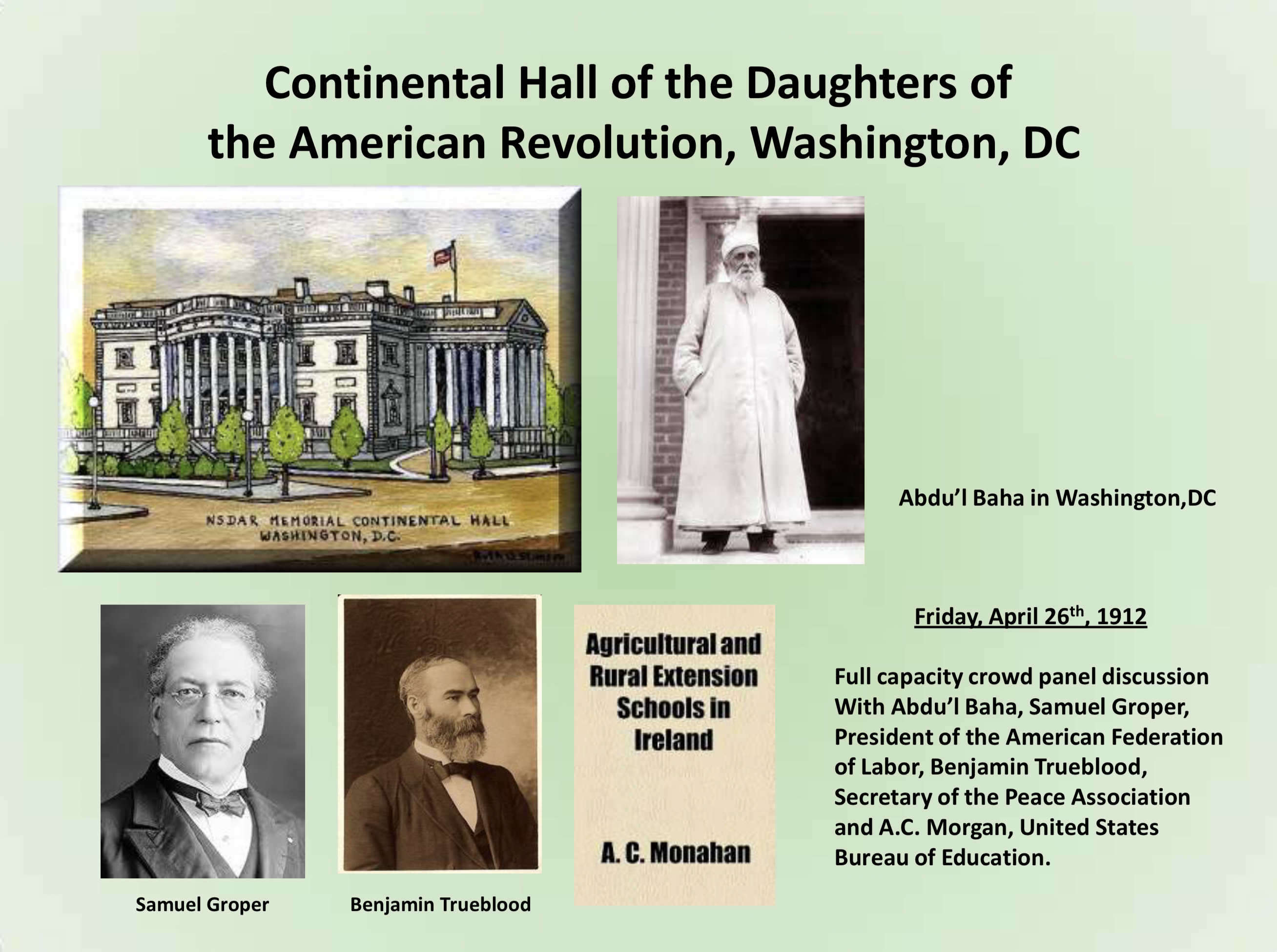
Among the visitors on Friday morning, April 26, was Lee McClung, the Secretary of the Treasury if the United States. Later ‘Abdul-Bahá addressed the ladies of President Taft’s All Saints [Souls] Unitarian Church, the room was completely filled. After the daily Parsons’ reception, He took a walk in the park. That evening He spoke to another capacity crowd, in one of the largest halls in Washington—the Continental Hall of the Daughters of the American Revolution—sharing the platform with Samuel Gompers, the president of the American Federation of Labor, Benjamin Trueblood, secretary of the American Peace Society, and A. C. Monohan [Arthur Coleman Monahan] of the United States Bureau of Education.

Abdul-Bahá, Who kept the friends in the Holy Land and Persia apprised of the activities through frequent cablegrams, cabled, “‘This day three thousand persons were interviewed in the utmost harmony.’”

“Remembering those who looked into His eyes” 3

Message to the Esperantists, Home of Mr. and Mrs. Arthur J. Parsons , 1700 Eighteenth Street, NW, Washington, D.C., 25 April 1912

Today the greatest need of the world of humanity is discontinuance of the existing misunderstandings among nations. This can be accomplished through the unity of language. Unless the unity of languages is realized, the Most Great Peace and the oneness of the human world cannot be effectively organized and established because the function of language is to portray the mysteries and secrets of human hearts. The heart is like a box, and language is the key. Only by using the key can we open the box and observe the gems it contains. Therefore, the question of an auxiliary international tongue has the utmost importance. Through this means international education and training become possible; the evidence and history of the past can be acquired. The spread of the known facts of the human world depends upon language. The explanation of divine teachings can only be through this medium. As long as diversity of tongues and lack of comprehension of other languages continue, these glorious aims cannot be realized. Therefore, the very first service to the world of man is to establish this auxiliary international means of communication. It will become the cause of the tranquillity of the human commonwealth. Through it sciences and arts will be spread among the nations, and it will prove to be the means of the progress and development of all races. We must endeavor with all our powers to establish this international auxiliary language throughout the world. It is my hope that it may be perfected through the bounties of God and that intelligent men may be selected from the various countries of the world to organize an international congress whose chief aim will be the promotion of this universal medium of speech. 4

Friday, April 26, 1912

In addition to the usual receptions at the home of Mrs Parsons, there were three public meetings: one in the morning, another in the afternoon and one in the evening. At the first gathering, at the All Saints Unitarian Church, the Master spoke on the subject of the varieties of light, the effulgence of the Sun of Reality in its original essence, and of the waiting souls with pure hearts who are like unto clear spotless mirrors, whose eyes and ears become enlightened by the appearance of the Sun of Reality. So great was the respect and devotion of the audience that ‘Abdu’l-Bahá wrote in a cable He sent to the Orient: ‘Today three thousand persons visited with the utmost harmony.’

At every gathering, whether for Bahá’ís or non-Bahá’ís, several stenographers, as well as the Persian secretaries, were in attendance. The English translations were published soon after the address itself but the Persian originals taken down by us verbatim had to be submitted to ‘Abdu’l-Bahá for correction. Because of His heavy schedule, He had little time for this, so the originals were often delayed in their publication.

The afternoon meeting was held at the home of Mrs Parsons. The subject of the talk was the interpretation of the Old Testament statement concerning the creation of man in the image of God. At the conclusion ‘Abdu’l-Bahá took His leave of the friends, promising to return to Washington DC from Chicago. On hearing this, the friends hastened to shake hands with Him and showed great reverence and humility to Him, joyful that soon He would return to their midst. After the meeting, ‘Abdu’l-Bahá went for a stroll in a park to recuperate.

In the evening ‘Abdu’l-Bahá went to a third gathering, held in a very large building, to speak to a group of young women of the suffrage movement. This was the largest meeting held thus far and the most spacious and majestic hall. ‘Abdu’l-Bahá delivered a most impressive address which He began by saying:

“One of the teachings of Bahá’u’lláh is equality of rights for men and women. When He promulgated this principle in the Orient, the people were astonished.

One of the proofs of the advancement of women is this magnificent and imposing building and this large gathering.”

‘Abdu’l-Bahá’s talk centered on the subject of equality of men and women and the necessity of giving women the same training as men. Many praised Him, both before and after His talk. The meeting closed with a song of praise.

The chairman of the meeting, Mr Hoover from New York, introduced the Master most eloquently. When ‘Abdu’l-Bahá came to the pulpit, He was received with a standing ovation and a burst of enthusiasm. Then, with a motion of His hand, all seated themselves.

As the Master arose to give His talk, everyone began to clap so loudly that the sound echoed around the great hall. Everyone was thrilled as the beloved Master stood and the hearts of the believers were relieved of all grief and anxiety. Indeed, the appearance of the Center of God’s Covenant in these meetings is worthy of the highest praise and will undoubtedly be of the greatest benefit to all. Instead of the harsh treatment meted out to the Manifestations of God, here was the advancement and elevation of the Cause of God. To listen to the melodious, resonant voice of the Center of the Covenant in such auditoriums fills one with excitement and raises the banner of everlasting honor. The presence of the Eastern friends was sorely missed.

At the end of the meeting, people again filled the room to capacity so they could glimpse ‘Abdu’l-Bahá’s beautiful face and shake His hand. 5

  1. Menon, Jonathan. “A Trip Through New York City, 1911.” 239 Days in America, April 26, 2012. https://239days.com/2012/04/26/a-great-harvest-of-results/.
  2. Ward, Allan L. 239 Days: ʻAbdu’l-Bahá’s Journey in America. Wilmette, Ill: Bahá’í Publishing Trust, 1979, 45.
  3. Van Ness, Zabine. “Remembering Those Who Looked into His Eyes: Abdul Baha’s Visits with Some Influential Dignitaries, April 11th to December 5th, 1912.” PDF, Seattle, WA, 2012, 26.https://hearttoheart.co/PDFs/Abdul-Bahaandhisvariousvisitations.pdf.
  4. ʻAbduʼl-Bahá. The Promulgation of Universal Peace: Talks Delivered by ʻAbduʼl-Bahá during His Visit to the United States and Canada in 1912. Edited by Howard MacNutt. 2nd ed. Wilmette, Ill: Baháʼí Publishing Trust, 1982, 60-61. https://www.bahai.org/library/authoritative-texts/abdul-baha/promulgation-universal-peace/3#293573670.
  5. Mahmud-i-Zarqani, Mirza. Mahmúd’s Diary: The Diary of Mírzá Mahmúd-i-Zarqání Chronicling ’Abdu’l-Bahá’s Journey to America. Edited by Shirley Macias. Translated by Mohi Sobhani. Oxford: George Ronald, 1998. https://bahai-library.com/zarqani_mahmuds_diary&chapter=2#section33

239 Days in America, Day 15: April 25, 1912 | Washington, DC

What Makes a President 1

‘Abdu’l-Bahá, a man who drove to the heart of virtually all of America’s pressing challenges, failed to comment even once on the election – neither about the headlines, nor the candidates, nor even about the winner once it was all over. Yet, like his father Bahá’u’lláh before him, ‘Abdu’l-Bahá had a good deal to say about the qualities of leadership and of principled governance. He had even written a book on the subject back in 1875, when he was just thirty-one years old, addressed to the rulers and people of Persia. He titled it The Secret of Divine Civilization.

In America, while avoiding commenting on the election at hand, he did offer his views on the kind of individual who should be President.

“The president,” he said, “must be a man who does not insistently seek the presidency. He should be a person free from all thoughts of name and rank; rather, he should say, ‘I am unworthy and incapable of this position and cannot bear this great burden.’ Such persons deserve the presidency. If the object is to promote the public good, then the president must be a well-wisher of all and not a self-seeking person. If the object, however, is to promote personal interests, then such a position will be injurious to humanity . . . ”

In a hard-fought election year where the headlines screamed self-aggrandizement and entrenched partisanship, ‘Abdul-Bahá simply directed his voice elsewhere.

Washington D. C. 2

On Thursday, April 25, a large delegation from the Theosophical Society arrived at the Parsons’ home at 10:30 A.M. They had barely departed when a group of Esperantists came. He told them “The heart is like a box and language is the key.” 3 By the afternoon when the crowds were pouring into the Parsons’ home for the daily reception, ‘Abdul-Bahá joked with Mrs. Parsons, “It is very difficult to have one like me as a guest. Every guest and traveler has a limited number of friends with whom he makes special dates for visits, but you are forced all day long to be the entertainer of all.’” 4

Talk at Home of Mr. and Mrs. Arthur J. Parsons , 1700 Eighteenth Street, NW, Washington, D.C.

The first teaching of Bahá’u’lláh is the duty incumbent upon all to investigate reality. What does it mean to investigate reality? It means that man must forget all hearsay and examine truth himself, for he does not know whether statements he hears are in accordance with reality or not. Wherever he finds truth or reality, he must hold to it, forsaking, discarding all else; for outside of reality there is naught but superstition and imagination. 5

The second teaching of Bahá’u’lláh is the oneness of the world of humanity. Every human creature is the servant of God. All have been created and reared by the power and favor of God; all have been blessed with the bounties of the same Sun of divine truth; all have quaffed from the fountain of the infinite mercy of God; and all in His estimation and love are equal as servants. He is beneficent and kind to all. Therefore, no one should glorify himself over another; no one should manifest pride or superiority toward another; no one should look upon another with scorn and contempt; and no one should deprive or oppress a fellow creature. All must be considered as submerged in the ocean of God’s mercy. We must associate with all humanity in gentleness and kindliness. We must love all with love of the heart. 6

The third teaching or principle of Bahá’u’lláh is that religion and science are in complete agreement. Every religion which is not in accordance with established science is superstition. Religion must be reasonable. If it does not square with reason, it is superstition and without foundation. It is like a mirage, which deceives man by leading him to think it is a body of water. God has endowed man with reason that he may perceive what is true. If we insist that such and such a subject is not to be reasoned out and tested according to the established logical modes of the intellect, what is the use of the reason which God has given man? 7

Thursday, April 25, 1912

In the evening the Turkish Ambassador, his honor Díyá Páshá, invited the Master to a royal feast. Most of us were also invited, as were many dignitaries, all of whom were dressed in formal attire. The Master gave a short talk at the table with the utmost majesty and beauty on the subject of the influence of the words of the Manifestations of God and their all-conquering power. The Ambassador then read from a prepared statement written in praise of the Master and presented it to Him:

“The light of His honor’s quality and knowledge in this new land and new world is now shining upon all peoples, showering them with His encouragement and enlightenment. He has suffered and sacrificed everything for the purpose of disseminating good qualities for humanity. He has now honored us by His presence. His Honor, ‘Abdu’l-Bahá, is unique in our age and is highly esteemed and treasured by all of us. With prayer to the Lord of the worlds, I wish Him a long life and good health.”

When the Ambassador [Díyá Páshá] completed his statement, the Master spoke:

“This night is a very blessed night, worthy of the utmost praise and joy for many reasons. First, praise be to God, we are in a country which is famous for its prosperity and freedom. Second, we are in a house which is connected to the great Ottoman Power. Third, we are the guests of His Excellency the Ambassador who shines like the sun in the world of morality. Fourth, this meeting provides a tangible demonstration of the love and unity that is possible between the East and the West.

His Excellency the Ambassador is from the East, while his wife is an American. Similarly, His Excellency the Ambassador of Persia is from the nobility of the Orient, while his wife is also an American. This is a proof that the Orient and Occident can meet, love and unite. The greatest wish of people of thought and broad vision and sound understanding is the oneness and unity of humanity. This reality was not so apparent in former times but in this enlightened age which is the age of science and the progress of the world of humanity, this important fact has become manifest through the help and assistance of God: that all peoples are related, that all are from one family, citizens of one country and one world. This is the century of the oneness of the world of humanity and of the decline and abrogation of the superstitions of past ages. Every learned person is persuaded that this is the century for oneness and unity and the time for fanciful prejudices to fade away. We pray that misunderstandings among nations may disappear completely so that it may be evident that the foundation of all divine principles is the oneness of mankind and that the real purpose of all divine Manifestations has been to educate humanity. Divine religions are not the cause of dissension, nor do they beget enmity and hatred, for the foundation of all of them is truth and truth is one, it has no plurality.

The differences which we find are the results of imitations. As the imitations vary one from another, they become the cause of animosity and difference. The gloom of these imitations has wholly obscured the Sun of Reality. But, praise be to God, day by day these clouds are being dispersed and dissipated; ere long, they shall be wholly removed and the Sun of Reality shall be seen to shine most brilliantly. The standard of the oneness of humanity will be unfurled, the tabernacle of the universal peace will be raised, and this world will become another world.

I thank His Excellency the Ambassador who brought about this meeting of people of different nationalities in his home. Such meetings, in truth, deserve much praise and commendation.”

At the close of the meeting the Ambassador again arose to show his respect and appreciation. He accompanied the Master to His carriage with the utmost humility and esteem.

During these days, many dignitaries and important people visited the Master. Even President [Theodore] Roosevelt came, with humility and respect, especially to see the Master. 8

  1. Menon, Jonathan. “What Makes a President.” 239 Days in America, April 25, 2012. https://239days.com/2012/04/25/the-election-year/.
  2. Ward, Allan L. 239 Days: ʻAbdu’l-Bahá’s Journey in America. Wilmette, Ill: Bahá’í Publishing Trust, 1979, 44.
  3. ʻAbduʼl-Bahá. The Promulgation of Universal Peace: Talks Delivered by ʻAbduʼl-Bahá during His Visit to the United States and Canada in 1912. Edited by Howard MacNutt. 2nd ed. Wilmette, Ill: Baháʼí Publishing Trust, 1982, 60. https://www.bahai.org/library/authoritative-texts/abdul-baha/promulgation-universal-peace/3#293573670
  4. Bagdadi, Zia. “’Abdu’l-Bahá in America.” Star of the West, June 1928, 90.
  5. ʻAbduʼl-Bahá. The Promulgation of Universal Peace: Talks Delivered by ʻAbduʼl-Bahá during His Visit to the United States and Canada in 1912. Edited by Howard MacNutt. 2nd ed. Wilmette, Ill: Baháʼí Publishing Trust, 1982, 62. https://www.bahai.org/library/authoritative-texts/abdul-baha/promulgation-universal-peace/3#502326955.
  6. ʻAbduʼl-Bahá. The Promulgation of Universal Peace: Talks Delivered by ʻAbduʼl-Bahá during His Visit to the United States and Canada in 1912. Edited by Howard MacNutt. 2nd ed. Wilmette, Ill: Baháʼí Publishing Trust, 1982, 63. https://www.bahai.org/library/authoritative-texts/abdul-baha/promulgation-universal-peace/3#732109286.
  7. ʻAbduʼl-Bahá. The Promulgation of Universal Peace: Talks Delivered by ʻAbduʼl-Bahá during His Visit to the United States and Canada in 1912. Edited by Howard MacNutt. 2nd ed. Wilmette, Ill: Baháʼí Publishing Trust, 1982, 63. https://www.bahai.org/library/authoritative-texts/abdul-baha/promulgation-universal-peace/3#907730916.
  8. Mahmud-i-Zarqani, Mirza. Mahmúd’s Diary: The Diary of Mírzá Mahmúd-i-Zarqání Chronicling ’Abdu’l-Bahá’s Journey to America. Edited by Shirley Macias. Translated by Mohi Sobhani. Oxford: George Ronald, 1998. https://bahai-library.com/zarqani_mahmuds_diary&chapter=2#section32

239 Days in America, Day 14: April 24, 1912 | Washington, DC

Breaking the Color Line 1

When dinner was announced ‘Abdu’l-Bahá stood, and everyone followed him into the dining room. Everyone, that is, except Louis Gregory. It was only 1912: Social Washington did not invite colored people to dinner.

Formality had laid out nineteen place settings along the sides of the long, rectangular banquet table according to strict Washington protocol. Good taste had strewn the table with rose petals. Regard had seated ‘Abdu’l-Bahá at its head. The guests took their seats.

Suddenly, ‘Abdu’l-Bahá stood up and looked around the table.

“Where is Mr. Gregory?” he asked. “Bring Mr. Gregory!” he told Ali-Kuli Khan.

Khan had no choice but to locate Mr. Gregory, whom he found trying to slip quietly out of the house without being noticed. By the time he re-entered the dining room with Louis Gregory, Social Washington had succumbed.

‘Abdu’l-Bahá had pushed aside the utensils, plates, and glasses that held sway over the place of honor to his right. Everyone moved over, sending a ripple of activity down one side of the table. In its place, he had laid out a twentieth place setting and ordered a twentieth chair brought to the table. Here he seated Louis Gregory. ‘Abdu’l-Bahá then sat down, explained that he was very happy to have Mr. Gregory here, and, as if nothing out of the ordinary had just occurred, began to speak on racial prejudice.

Washington D. C. 2

He then attended another of the daily receptions at the Parsons’ home, after which He proceeded to 13th Street N.W. to the home of Andrew J. Dyer. 3 In his diary, Dr. Zia Bagdadi, who served as one of ‘Abdu’l-Bahá’s translators, wrote, “In the evening, ‘Abdu’l-Bahá addressed the white and colored believers and their friends at the home of Mrs. Dyer, a member of the colored race… 4

‘Abdu’l-Bahá concluded His address by saying, … (see entry below)

Talk at Home of Mrs. Andrew J. Dyer, 1937 Thirteenth Street, NW, Washington, D.C.

When the racial elements of the American nation unite in actual fellowship and accord, the lights of the oneness of humanity will shine, the day of eternal glory and bliss will dawn, the spirit of God encompass, and the divine favors descend. Under the leadership and training of God, the real Shepherd, all will be protected and preserved. He will lead them in green pastures of happiness and sustenance, and they will attain to the real goal of existence. This is the blessing and benefit of unity; this is the outcome of love. This is the sign of the Most Great Peace; this is the star of the oneness of the human world. Consider how blessed this condition will be. I pray for you and ask the confirmation and assistance of God in your behalf. 5

Wednesday, April 24, 1912

In the morning ‘Abdu’l-Bahá went to a Bahá’í children’s conference. As He entered the hall, the children sang songs in praise of ‘Abdu’l-Bahá in unison, accompanied by the piano. When the Master saw the children, He said, ‘Praise be to God. These children, like flowers, are in a state of utmost purity, freshness and delicacy!’ After He spoke and recited prayers for the children, the Master kissed and embraced each child and gave them some sweets. The immensity of His love and affection for the children was clearly obvious.

A second meeting was held that evening at the home of Mr and Mrs Andrew J. Dyer, a mixed race couple. Those present were in such unity and love that the Master remarked:

“Before I arrived, I felt too tired to speak at this meeting but at the sight of such genuine love and attraction between the white and the black friends, I was so moved that I spoke with great love and likened this union of different colored races to a string of gleaming pearls and rubies.”

After He spoke and showered His love on each one, He left in His carriage for a third meeting.

’ Abdu’l-Bahá was so filled with joy and happiness and His voice resonated so loudly that even the people walking along the street could hear Him:

“O Bahá’u’lláh! What hast Thou done? O Bahá’u’lláh! May my life be sacrificed for Thee! O Bahá’u’lláh! May my soul be offered up for Thy sake! How full were Thy days with trials and tribulations! How severe the ordeals Thou didst endure! How solid the foundation Thou hast finally laid, and how glorious the banner Thou didst hoist!” 6

’ Abdu’l-Bahá continued in this manner until the carriage reached the home of Mr [Alexander Graham] Bell. This great individual is the inventor of the telephone and the head of a scientific society. The day before, this venerable and inventive old gentleman had visited the Master and invited Him to attend the meeting of the scientific society. When the Master entered, all rose and each in turn shook His hand. Those who had met the Master previously introduced Him to the others with the greatest respect and honor. After the Master was seated, discussion of scientific issues continued. Each spoke of his experiences and discussed his discoveries. After several people had spoken, Mr Bell asked Ali Kuli Khan, the Persian ambassador, to relate the history of the Faith. Then Mr Bell thanked the Master for coming to his home and asked Him to address the guests.

The Master began His talk by praising their good manners and praiseworthy qualities. He then spoke of the importance and the results of science, the greatness of this age and the interdependence of society, and paid a glorious tribute to the new Dispensation. Mr Bell was extremely delighted and rose to thank the Master for His talk. The hearts of those present were so moved that when the next member arose to give his talk, he could only say, ‘The talk of the Master from the East was so wonderful that I find myself inadequate to say anything’ and sat down. A few others spoke briefly and the meeting ended.

Mr Bell invited the Master and his guests to go into the dining hall. It was midnight, and as it is customary for people in the West to eat late at night before going to bed, the table was spread with bread, meat, candies, cookies, fruit and beverages. Although the Master had not yet had dinner, He spoke through Mr Bell to his wife and daughter. Mrs Bell is deaf and mute and communicates through sign language. Sign language is similar to writing, with lines, points and stops, just as in telegraph technology, and is now so well developed that people can speak easily with the deaf.

As is well known, Mr Bell’s main purpose was to invent an instrument that would enable the deaf to communicate. Out of his deep love for his wife, he devoted himself to this day and night and in the end invented the telephone. But this did not fulfill his intended purpose. The Master said:

“Yes, most of the great inventions were made in a similar way. For instance, the search for alchemy has brought into being thousands of useful medicines and the desire of finding a direct route to India from Europe became the cause of the discovery of America.” 7

  1. Menon, Jonathan. “Breaking the Color Line.” 239 Days in America, April 24, 2012. https://239days.com/2012/04/24/breaking-the-color-line/.
  2. Ward, Allan L. 239 Days: ʻAbdu’l-Bahá’s Journey in America. Wilmette, Ill: Bahá’í Publishing Trust, 1979, 43.
  3. “In those days, race constituted a social identity marker and the basis for pervasive social discrimination. One of the early American Baha’is, Andrew Jackson Dyer, said to be African American, or of a “mixed” race, was born in 1847 in Virginia, and died in 1918 in Washington, DC. Dyer was employed as a messenger in a government department. His wife, Maggie Jordan Dyer, became a Baha’i in 1909. Born in March 1858 (also in Virginia) and married around 1876, Maggie J. Dyer was listed as “mulatto” in the 1880 and 1910 United States Census and, yet was listed as “white” in the 1900 United States Census.”
    Buck, Christopher, and Steven Kolins. “African American Baha’is During Abdu’l-Baha’s Lifetime.” BahaiTeachings.org, June 1, 2020. https://bahaiteachings.org/african-american-bahais-during-abdul-bahas-lifetime/.
  4. Bagdadi, Zia. “”Abdu’l-Bahá in America.” Star of the West, June 1928, 89.
  5. ʻAbduʼl-Bahá. The Promulgation of Universal Peace: Talks Delivered by ʻAbduʼl-Bahá during His Visit to the United States and Canada in 1912. Edited by Howard MacNutt. 2nd ed. Wilmette, Ill: Baháʼí Publishing Trust, 1982, 50. https://www.bahai.org/library/authoritative-texts/abdul-baha/promulgation-universal-peace/3#769459639.
  6. Effendi, Shoghi. God Passes By. 1944. Reprint, Wilmette, IL: Bahá’í Publishing Trust, 1970, 293. https://www.bahai.org/library/authoritative-texts/shoghi-effendi/god-passes-by/21#543609895
  7. Mahmud-i-Zarqani, Mirza. Mahmúd’s Diary: The Diary of Mírzá Mahmúd-i-Zarqání Chronicling ’Abdu’l-Bahá’s Journey to America. Edited by Shirley Macias. Translated by Mohi Sobhani. Oxford: George Ronald, 1998. https://bahai-library.com/zarqani_mahmuds_diary&chapter=2#section31

239 Days in America, Day 13: April 23, 1912 | Washington, DC

This Shining Colored Man 1

Reverend Wilbur Patterson Thirkield, Howard’s eighth President, introduced ‘Abdu’l-Bahá. “This was a most notable occasion,” wrote Joseph Hannen, who was also in the audience, “and here, as everywhere when both white and colored people were present, Abdul-Baha seemed happiest. The address was received with breathless attention by the vast audience, and was followed by a positive ovation and a recall.” 2 3

‘Abdu’l-Bahá began by drawing attention to the diversity in the room. “Today I am happy,” he said, “for I see . . . white and black sitting together.” He then proceeded to reject prevailing black and white views about the essentialism of race — the popular belief that a person’s race was central to his or her humanity:

There are no whites and blacks before God. All colors are one, and that is the color of servitude to God. Scent and color are not important. The heart is important. If the heart is pure, white or black or any color makes no difference. 4

Washington D. C. 5

From Howard University He rode to the Persian Embassy, where Ali-Kuli Khan was preparing a reception. ‘Abdu’l‑Bahá went upstairs to rest and to grant a few private interviews, including conversations with Admiral Peary and Alexander Graham Bell. Mrs. Hebe Struven, who helped arrange the affair, recalling it years later, said that after the place cards had been arranged at the plates to seat people by strict Washington protocol, ‘Abdu’l‑Bahá at the last minute gathered them all up, shuffled and redistributed them, and then brought Louis G. Gregory to the place of honor at the head of the table in the otherwise all-white gathering. He thus—literally in this gather and symbolically for all occasions—abolished racial prejudice and social segregation.

Talk at Home of Mr. and Mrs. Arthur J. Parsons, 1700 Eighteenth Street, NW, Washington, D.C., 23 April 1912

…Although such an event is indeed regrettable, we must realize that everything which happens is due to some wisdom and that nothing happens without a reason. Therein is a mystery; but whatever the reason and mystery, it was a very sad occurrence, one which brought tears to many eyes and distress to many souls. I was greatly affected by this disaster. Some of those who were lost voyaged on the Cedric with us as far as Naples and afterward sailed upon the other ship. When I think of them, I am very sad indeed. But when I consider this calamity in another aspect, I am consoled by the realization that the worlds of God are infinite; that though they were deprived of this existence, they have other opportunities in the life beyond, even as Christ has said, “In my Father’s house are many mansions.” They were called away from the temporary and transferred to the eternal; they abandoned this material existence and entered the portals of the spiritual world. Foregoing the pleasures and comforts of the earthly, they now partake of a joy and happiness far more abiding and real, for they have hastened to the Kingdom of God. The mercy of God is infinite, and it is our duty to remember these departed souls in our prayers and supplications that they may draw nearer and nearer to the Source itself. 6

Talk to Bethel Literary Society, Metropolitan African Methodist Episcopal Church, M Street, NW, Washington, D.C.

All blessings are divine in origin, but none can be compared with this power of intellectual investigation and research, which is an eternal gift producing fruits of unending delight. Man is ever partaking of these fruits. All other blessings are temporary; this is an everlasting possession. Even sovereignty has its limitations and overthrow; this is a kingship and dominion which none may usurp or destroy. Briefly, it is an eternal blessing and divine bestowal, the supreme gift of God to man. Therefore, you should put forward your most earnest efforts toward the acquisition of science and arts. The greater your attainment, the higher your standard in the divine purpose. The man of science is perceiving and endowed with vision, whereas he who is ignorant and neglectful of this development is blind. The investigating mind is attentive, alive; the callous and indifferent mind is deaf and dead. A scientific man is a true index and representative of humanity, for through processes of inductive reasoning and research he is informed of all that appertains to humanity, its status, conditions and happenings. He studies the human body politic, understands social problems and weaves the web and texture of civilization. In fact, science may be likened to a mirror wherein the infinite forms and images of existing things are revealed and reflected. It is the very foundation of all individual and national development. Without this basis of investigation, development is impossible. Therefore, seek with diligent endeavor the knowledge and attainment of all that lies within the power of this wonderful bestowal. 7

How shall we utilize these gifts and expend these bounties? By directing our efforts toward the unification of the human race. We must use these powers in establishing the oneness of the world of humanity, appreciate these virtues by accomplishing the unity of whites and blacks, devote this divine intelligence to the perfecting of amity and accord among all branches of the human family so that under the protection and providence of God the East and West may hold each other’s hands and become as lovers. Then will mankind be as one nation, one race and kind—as waves of one ocean. Although these waves may differ in form and shape, they are waves of the same sea. Flowers may be variegated in colors, but they are all flowers of one garden. Trees differ though they grow in the same orchard. All are nourished and quickened into life by the bounty of the same rain, all grow and develop by the heat and light of the one sun, all are refreshed and exhilarated by the same breeze that they may bring forth varied fruits. This is according to the creative wisdom. If all trees bore the same kind of fruit, it would cease to be delicious. In their never-ending variety man finds enjoyment instead of monotony. 8

Tuesday, April 23, 1912

Today the Master went to Howard University, an educational institution for blacks. The hosts (mostly black with a few whites) had made special arrangements so that when the Master arrived He was welcomed by music from a band while the audience applauded with excitement and exuberance. It is difficult to describe the scene adequately. The president of the university was very cordial and introduced ‘Abdu’l-Bahá as the Prophet of Peace and the harbinger of unity and salvation. Then the Master rose from His seat and spoke on the subject of the harmony between blacks and whites and the unity of humankind. The audience repeatedly applauded Him during the talk, delighted at His words. At the conclusion, the president of the university thanked ‘Abdu’l-Bahá on behalf of all those gathered. As He left the auditorium, group after group formed two lines, one on each side, all showing their highest respect by bowing and waving their hats and handkerchiefs in farewell to the beloved Master.

’ Abdu’l-Bahá had lunch at the home of Ali Kuli Khan. Several believers were present, including ourselves. 9 10 11

There was a public meeting in the afternoon at the same house. The majority attending the meeting were ladies from high society. At this meeting the Master spoke about the education and improvement of women and the promotion of unity and peace in the world of humanity. After the meeting several new people arrived and sat for a brief time in the Master’s presence. They so enjoyed His company they did not want to leave.

In the evening, close to bedtime, when the Master was alone and extremely tired from the day’s activities, He prayed, praising and thanking the Blessed Beauty. On one occasion He said:

“We must offer thanks to the Blessed Beauty because it is His help that has stirred the people; it is His grace that has changed the hearts. The assistance of the Abhá Kingdom has transformed a drop into a mighty ocean. The aid of the Most High has turned a gnat into an eagle, has invested an ant with the power of a Solomon and has caused the debased one to become a source of eternal honor.’”

A third meeting was held this evening in a black church. All those present paid Him the highest respect and were delighted to hear about the new teachings. The Master’s talk, they felt, gave them honor and would cause them to progress. As is customary at churches, there was a collection and the Master made a contribution. 12

  1. Menon, Jonathan. “This Shining Colored Man.” 239 Days in America, April 23, 2012. https://239days.com/2012/04/23/this-shining-colored-man/.
  2. Hannen, Joseph H. “Abdul-Baha in Washington, D.C.” Star of the West, April 28, 1912, 6-8.
  3. Buck, Christopher. “Public Discourse on Race: ‘Abdu’l-Bahá’s Howard University Speech.” PDF presented at the Centenary of ‘Abdu’l-Bahá’s Visit to North America, Louhelen Bahá’í School, Davison, Michigan, February 11, 2012. https://bahai-library.com/pdf/b/buckabdulbahahowardlouhelen.pdf.
  4. ʻAbduʼl-Bahá. The Promulgation of Universal Peace: Talks Delivered by ʻAbduʼl-Bahá during His Visit to the United States and Canada in 1912. Edited by Howard MacNutt. 2nd ed. Wilmette, Ill: Baháʼí Publishing Trust, 1982, 44. https://www.bahai.org/library/authoritative-texts/abdul-baha/promulgation-universal-peace/3#098175321.
  5. Ward, Allan L. 239 Days: ʻAbdu’l-Bahá’s Journey in America. Wilmette, Ill: Bahá’í Publishing Trust, 1979, 40-41.
  6. ʻAbduʼl-Bahá. The Promulgation of Universal Peace: Talks Delivered by ʻAbduʼl-Bahá during His Visit to the United States and Canada in 1912. Edited by Howard MacNutt. 2nd ed. Wilmette, Ill: Baháʼí Publishing Trust, 1982, 46-47. https://www.bahai.org/library/authoritative-texts/abdul-baha/promulgation-universal-peace/3#242218565
  7. ʻAbduʼl-Bahá. The Promulgation of Universal Peace: Talks Delivered by ʻAbduʼl-Bahá during His Visit to the United States and Canada in 1912. Edited by Howard MacNutt. 2nd ed. Wilmette, Ill: Baháʼí Publishing Trust, 1982, 50. https://www.bahai.org/library/authoritative-texts/abdul-baha/promulgation-universal-peace/3#325690063.
  8. ʻAbduʼl-Bahá. The Promulgation of Universal Peace: Talks Delivered by ʻAbduʼl-Bahá during His Visit to the United States and Canada in 1912. Edited by Howard MacNutt. 2nd ed. Wilmette, Ill: Baháʼí Publishing Trust, 1982, 51. https://www.bahai.org/library/authoritative-texts/abdul-baha/promulgation-universal-peace/3#838638236.
  9. Hutchison, Sandra Lynn. ’Abdu’l-Baha in America: The Diary of Agnes Parsons. Edited by Richard Hollinger. Los Angeles: Kalimát Press, 1996, 31. https://archive.org/details/abdulbahainameri0000pars/page/30/mode/2up.
  10. Ober, Harlan F. “Louis G. Gregory.” Bahá’í World, 1956, 666-670.
  11. Thompson, Juliet. The Diary of Juliet Thompson. Edited by Marzieh Gail. 1st ed. 1947. Reprint, Los Angeles: Kalimát Press, 1983, 269. https://archive.org/details/diaryofjuliettho0000thom/page/268/mode/2up
  12. Mahmud-i-Zarqani, Mirza. Mahmúd’s Diary: The Diary of Mírzá Mahmúd-i-Zarqání Chronicling ’Abdu’l-Bahá’s Journey to America. Edited by Shirley Macias. Translated by Mohi Sobhani. Oxford: George Ronald, 1998. https://bahai-library.com/zarqani_mahmuds_diary&chapter=2#section30

239 Days in America, Day 12: April 22, 1912 | Washington, DC

Even Though the World Should Go to Smash 1

Louis Gregory first learned of ‘Abdu’l-Bahá in late 1907 from a colleague – a cultivated, southern white gentleman who shared his office at the Treasury Department. Gregory attended a discussion with Bahá’ís at the old Corcoran building as a favor to him. He was not interested in religion. Earlier in his life he “had been seeking,” he said, “but not finding truth, had given up.”

Yet as he heard more about ‘Abdu’l-Bahá and this new faith, Louis Gregory came to believe he had found the divine reply to the prayer [W. E. B.] Du Bois had written after the Atlanta Riot, “in the Day of Death, 1906” 2:

“Bewildered we are, and passion-tost, mad with the madness of a mobbed and mocked and murdered people; straining at the armposts of Thy Throne, we raise our shackled hands and charge Thee, God, by the bones of our stolen fathers, by the tears of our dead mothers, by the very blood of Thy crucified Christ: What meaneth this? Tell us the Plan; give us the Sign!

Keep not thou silence, O God!”

“Heaven and Earth heard that piercing cry,” wrote Louis Gregory in a 1936 review of Du Bois’s Black Reconstruction, “uttered by one, echoed by millions.” “Earth and Heaven answered.” After investigating the new religion for eighteen months, Louis Gregory became a Bahá’í in June, 1909.

Washington D. C. 3

Every afternoon at 5:00 P.M., from Monday through Friday, receptions were held at the Parsons’ home, to which hundreds of Washington diplomats, scientists, and socially prominent persons came. On Monday, April 22, to the dignitaries, ‘Abdu’l-Bahá explained:

“Some movements appear, manifest a brief period of activity, then discontinue. Others show forth a greater measure of growth and strength, but before attaining mature development, weaken, disintegrate and are lost in oblivion… There is still another kind of movement or cause which from a very small, inconspicuous beginning goes forward with sure and steady progress, gradually broadening and widening until it has assumed universal dimensions. The Bahai movement is of this nature.” 4

Talk at Home of Mr. and Mrs. Arthur J. Parsons, 1700 Eighteenth Street, NW, Washington, D.C.

For instance, when Bahá’u’lláh was exiled from Persia with ‘Abdu’l‑Bahá and the rest of His family, they traveled the long road from Ṭihrán to Baghdád, passing through many towns and villages. During the whole of that journey and distance they did not meet a single believer in the Cause for which they had been banished. At that time very little was known about it in any part of the world. Even in Baghdád there was but one believer who had been taught by Bahá’u’lláh Himself in Persia. Later on, two or three others appeared. You will see, therefore, that at the beginning the Cause of Bahá’u’lláh was almost unknown, but on account of being a divine Movement it grew and developed with irresistible spiritual power until in this day, wherever you travel—East or West—and in whatever country you journey, you will meet Bahá’í assemblies and institutions. This is an evidence that the Bahá’ís are spreading the blessings of unity and progressive development throughout the world under the direction of divine guidance and purpose, while other movements which are only temporary in their activities and accomplishments have no real, universal significance. 5

Monday, April 22, 1912

A meeting was held with the Bahá’ís. When the Master arrived, the friends greeted Him with poems and songs written in His praise. He spoke about the events during His long travels, the union of peoples from the East and the West, the greatness of this century and the appearance of the Greatest Name. He concluded the meeting by chanting a beautiful and moving prayer. The friends rushed to His side; one shaking His hand, another holding onto the hem of His robe and yet another with tears of joy and in the utmost happiness. When the Master left the gathering, the friends lined up in two rows as He passed through their midst. He approached His automobile and again the friends rushed towards Him like moths circling around the candle of the Covenant.

In the afternoon, the Master spoke at another gathering about the sinking of the Titanic. He prayed for the souls of the passengers and expressed His condolences to their survivors. In the evening, Mrs Parsons held a dinner in His honor to which all the friends were invited. At the table, ‘Abdu’l-Bahá said:

“Consider the confirmations of the Blessed Beauty, what He has done, how He has brought us to the house of such a personage, who in the utmost love has prepared such a feast in our honor. The power and influence of the Word of God have united the East and the West! How perfect are His heavenly favors and how all-embracing His divine bounties!” 6

  1. Menon, Jonathan. “Even Though the World Should Go to Smash.” 239 Days in America, April 22, 2012. https://239days.com/2012/04/22/even-though-the-world-should-go-to-smash/.
  2. Du Bois, W.E.B. “A Litany of Atlanta (1906).” Oxford African American Studies Center, September 30, 2013. https://oxfordaasc.com/view/10.1093/acref/9780195301731.001.0001/acref-9780195301731-e-34113.
  3. Ward, Allan L. 239 Days: ʻAbdu’l-Bahá’s Journey in America. Wilmette, Ill: Bahá’í Publishing Trust, 1979, 39-40.
  4. ʻAbduʼl-Bahá. The Promulgation of Universal Peace: Talks Delivered by ʻAbduʼl-Bahá during His Visit to the United States and Canada in 1912. Edited by Howard MacNutt. 2nd ed. Wilmette, Ill: Baháʼí Publishing Trust, 1982, 43-44. https://www.bahai.org/library/authoritative-texts/abdul-baha/promulgation-universal-peace/3#960003920
  5. ʻAbduʼl-Bahá. The Promulgation of Universal Peace: Talks Delivered by ʻAbduʼl-Bahá during His Visit to the United States and Canada in 1912. Edited by Howard MacNutt. 2nd ed. Wilmette, Ill: Baháʼí Publishing Trust, 1982, 44. https://www.bahai.org/library/authoritative-texts/abdul-baha/promulgation-universal-peace/3#804094876.
  6. Mahmud-i-Zarqani, Mirza. Mahmúd’s Diary: The Diary of Mírzá Mahmúd-i-Zarqání Chronicling ’Abdu’l-Bahá’s Journey to America. Edited by Shirley Macias. Translated by Mohi Sobhani. Oxford: George Ronald, 1998. https://bahai-library.com/zarqani_mahmuds_diary&chapter=2#section29

239 Days in America, Day 11: April 21, 1912 | Washington, DC

Washington High Society Receives ‘Abdu’l-Bahá 1

Every afternoon at 5 p.m., members of Washington’s elite sought out ‘Abdu’l-Bahá at the Parsons’s home: members of the House of Representatives, of the Senate, and of the Cabinet; Justices of the Supreme Court; officials of foreign embassies; and men of science such as Alexander Graham Bell and Admiral Robert Peary.

Agnes [Parsons] 2 had built a large, bright ballroom to the left of the front door especially for this purpose. It was twenty-five feet wide by fifty feet long, decorated in white with yellow silk curtains, and it seated 150 people. Carved garlands blanketed the ceiling, the paneled walls, and the high mantel at one end of the room. ‘Abdu’l-Bahá spoke from a platform in front of the mantel, behind a bank of American Beauty roses that were delivered fresh every day. As the days passed, the crowds grew bigger.

Yet ‘Abdu’l-Bahá didn’t come to Washington simply to meet the nation’s wealthy and powerful. He also intended to assail America’s biggest taboo – the issue of race.

Washington D. C. 3

At 4:00 P.M. He [‘Abdu’l-Bahá ] spoke at the Universalist Church at 13th and L Streets to more than one thousand persons, who had started filling the auditorium an hour before time for the service to begin, In introducing Him the Reverend John Van Schairk, Jr., pastor of the church, said, “After arrangements for this meeting had been made, I received a letter warning me that I should be false to my belief if I held it… Against such narrowness this Church has always stood. We stand today humbly seeking the Spirit of Truth…” 4 ‘Abdu’l-Bahá then addressed the gathering…

Talk at Universalist Church, Thirteenth and L Streets, Washington, D.C.

All the existing nations had a divine foundation of truth or reality originally, which was intended to be conducive to the unity and accord of mankind, but the light of that reality gradually became obscured. The darkness of superstitions and imitations came and took its place, binding the world of humanity in the chains and fetters of ignorance. Enmity arose among men, increasing to such an extent that nation strove against nation in hatred and violence. War has been a religious and political human heritage.

Now it is enough! We must investigate reality. We must put away these superstitions. It is a self-evident truth that all humanity is the creation of God. All are His servants and under His protection. All are recipients of His bestowals. God is kind to all His servants. At most it is this: that some are ignorant; they must be educated in order that they may become intelligent. Some are immature as children; they must be aided and assisted in order that they may become mature. Some are sick and ailing; they must be healed. But the suffering patient must not be tested by false treatment. The child must not be warped and hindered in its development. The ignorant must not be restricted by censure and criticism. We must look for the real, true remedy. 5

Sunday, April 21, 1912

The highlight of the day was a very important and well-attended meeting at the Universalist Church. The minister of the church introduced ‘Abdu’l-Bahá with a most glowing tribute to His life and teachings. Then the Master rose from His seat and delivered an address on the need for cooperation, love, friendship and universal peace. He stressed Christ’s statement that ‘I have yet many things to say unto you, but ye cannot bear them now. Howbeit when he, the Spirit of truth, is come, he will guide you into all truth’ [John 16:12-13], and added, ‘And now that time has come and the Divine Spirit has spoken, revealing all truth.’ …

I will now pray on your behalf:

“O Lord! These Thy servants have assembled here out of pure love. They have gathered together in perfect accord and harmony. O God! Illumine their faces, make joyous their souls with Thy most great glad tidings. Brighten their eyes with the verses of Thy guidance and delight their ears with the melody of Thy sweet voice.

O Lord, we are wrongdoers; forgive us. We are sinners; grant us Thy pardon. Shelter us in Thy refuge. Satisfy the needy through Thy forgiveness. Free us from the world of vain imaginings and guide us to the Truth, that we may seek the divine reality, shun the mortal world, approach the divine kingdom and, withdrawn from the world of darkness, enter the realm of light.

Deliver us from the darkness of material existence and illumine us with the rays of the infinite realm. Make us the manifestations of Thy light and the dawning places of Thy signs. Turn us from all else save Thee and cause us to become the recipients of Thy mysteries. Thou, O God, art the Compassionate, the Wise, the Forgiving, the Mighty.” 6

  1. Menon, Jonathan. “‘Abdu’l-Bahá Goes to Washington.” 239 Days in America, April 20, 2012. https://239days.com/2012/04/20/abdul-baha-comes-to-washington/.
  2. Reneau, Annie. “Shining Lamp: Agnes Parsons (1861-1934),” Brilliant Star, September 28, 2017. https://brilliantstarmagazine.org/articles/agnes-parsons-1861-1934.
  3. Ward, Allan L. 239 Days: ʻAbdu’l-Bahá’s Journey in America. Wilmette, Ill: Bahá’í Publishing Trust, 1979, 39.
  4. Hannen, Joseph H. “Abdul-Baha in Washington, D.C.” Star of the West, April 28, 1912.
  5. ʻAbduʼl-Bahá. The Promulgation of Universal Peace: Talks Delivered by ʻAbduʼl-Bahá during His Visit to the United States and Canada in 1912. Edited by Howard MacNutt. 2nd ed. Wilmette, Ill: Baháʼí Publishing Trust, 1982, 39-40. https://www.bahai.org/library/authoritative-texts/abdul-baha/promulgation-universal-peace/3#593384709.
  6. Mahmud-i-Zarqani, Mirza. Mahmúd’s Diary: The Diary of Mírzá Mahmúd-i-Zarqání Chronicling ’Abdu’l-Bahá’s Journey to America. Edited by Shirley Macias. Translated by Mohi Sobhani. Oxford: George Ronald, 1998. https://bahai-library.com/zarqani_mahmuds_diary&chapter=2#section28

239 Days in America, Day 10: April 20, 1912 | Washington, DC

‘Abdu’l-Bahá Goes to Washington 1

This morning — Saturday, April 20, 1912 — ‘Abdu’l-Bahá had boarded the 8 a.m. train to Washington, DC, from New York’s Pennsylvania Station. But in order to avoid the kind of brouhaha that had greeted the Cedric, he had kept his arrival time a secret. That’s why Marzieh’s parents — Florence Breed of Boston and Ali-Kuli Khan of Iran — had received a panicked telephone call at lunchtime: “Hurry! The Master is arriving at the station in half an hour!” They dropped their knives and forks, picked up the children, and ran into the street to catch a public victoria.

The Khans arrived at Union Station with five minutes to spare: the train pulled in at 1:33 p.m. Mother rushed into the flower shop and bought two bouquets. Rahim 2, Marzieh’s elder brother, received violets; she got red roses. ‘Abdu’l-Bahá loved flowers.

Washington D. C. 3

Saturday night He spoke to the Persian-American Society, with six hundred people packed into a public library hall that normally seated four hundred. At least one hundred more standing outside took off their hats as ‘Abdu’l-Bahá approached. The audience in the auditorium rose to its feet as soon as He entered and stood until He bade them be seated. The next day the Washington Evening Star reported that “after he had spoken and when he was seated on the platform, hundreds pressed around him, seeking to grasp his hand.”

Included in the group were reporters who asked His opinions of the Titanic disaster. They reported that He said, “‘Both Americans and Europeans seem to be possessed of the mania for speed… It was a pitiful waste of life that came because of the effort to save a few hours in time—rushing a great vessel at top speed when it was known there was danger from ice.’” 4

Talk at Orient-Occident-Unity Conference, Public Library Hall, Washington, D.C.

Briefly, I have traveled this long distance, crossed the Atlantic Ocean to this western continent in the desire and hope that the strongest bond of unity may be established between America and Persia. I know this to be your wish and purpose also and am sure of your cooperation. We shall, therefore, offer supplication in the divine threshold that a great love may take possession of the hearts of men and unite the nations of the world. We will pray that the ensign of international peace may be uplifted and that the oneness of the world of humanity may be realized and accomplished. All this is made possible and practicable through your efforts. May this American democracy be the first nation to establish the foundation of international agreement. May it be the first nation to proclaim the universality of mankind. May it be the first to upraise the standard of the Most Great Peace, and through this nation of democracy may these philanthropic intentions and institutions be spread broadcast throughout the world. Truly, this is a great and revered nation. Here liberty has reached its highest degree. The intentions of its people are most praiseworthy. They are, indeed, worthy of being the first to build the Tabernacle of the Most Great Peace and proclaim the oneness of mankind. I will supplicate God for assistance and confirmation in your behalf. 5

Saturday, April 20, 1912

In the early morning after prayers, meditations, morning tea and receiving some of the believers, ‘Abdu’l-Bahá left the Hotel Ansonia for the railway station [Grand Central Station]. A large group of friends and well-wishers were there to bid Him farewell. One by one they came to Him and in their own ways expressed their respect, attraction and humility.

When He arrived at the station, ‘Abdu’l-Bahá walked around the building, praising its beauty and construction. We were informed that it is one of the finest in the world, its construction costing about six million dollars. The train began its journey and for the first few miles it traveled by the great river. As well as His usual companions, two American Bahá’ís traveled with the Master. One was Mr John Bosch from California, who had come to New York specifically to see Him. He had asked for a Persian name and was given the name Núrání [’the Luminous’] by the Master. The other American was Dr Edward Getsinger, who begged ‘Abdu’l-Bahá that he be allowed to be a part of His entourage. As most American trains have but one class of travel, except for sleeping compartments, we were all accommodated in one cabin.

After a journey of about five hours the train reached Washington DC. Before the journey the Master had sent a telegram to the friends in Washington requesting that a house be rented for Him. Mrs [Agnes] Parsons had invited the Master to stay at her home but He did not at first accept her invitation. However, after He was told by the friends that her home had been especially prepared for His visit, for which she had been anxiously waiting, He agreed to her request; for had her invitation not been accepted, she would have been heartbroken and deeply saddened. The Master and a translator went to Mrs Parsons’s home and ‘Abdu’l-Bahá instructed the other members of His entourage to stay at the house rented for Him. Thus Mrs Parsons’s house was the first home in America in which the Master resided; He stayed there for several days. 6

That evening ‘Abdu’l-Bahá attended the annual meeting of the Orient-Occident Unity Conference at the public library. It was a vast gathering and the hall was filled to capacity. As the Master entered the hall, the audience was awe-struck. All stood and remained standing until He bade them be seated. It was amazing to witness how spontaneously these people paid Him their respect, even though most were not Bahá’ís. He spoke on the importance of the relationship between the East and the West, the unity of people and about the Revelation of the Greatest Name. His talk was so moving and inspiring that afterwards everyone wanted to meet Him but because He was too tired to greet everyone, He decided to return home. 7

  1. Menon, Jonathan. “‘Abdu’l-Bahá Goes to Washington.” 239 Days in America, April 20, 2012. https://239days.com/2012/04/20/abdul-baha-comes-to-washington/.
  2. Notes from Baha’i History. “‘Ali-Kuli Khan and Florence Meet ‘Abdu’l-Bahá,” December 18, 2017. https://dailynotebahaihistory.blogspot.com/2017/12/ali-kuli-khan-and-florence-meet-abdul.html.
  3. Ward, Allan L. 239 Days: ʻAbdu’l-Bahá’s Journey in America. Wilmette, Ill: Bahá’í Publishing Trust, 1979, 38.
  4. Newspaper Staff Writers. “Due to Speed Mania: Abdul Baha Accounts for Titanic Disaster.” Washington Evening Star. April 21, 1912, The Sunday Star edition, sec. 1.
  5. ʻAbduʼl-Bahá. The Promulgation of Universal Peace: Talks Delivered by ʻAbduʼl-Bahá during His Visit to the United States and Canada in 1912. Edited by Howard MacNutt. 2nd ed. Wilmette, Ill: Baháʼí Publishing Trust, 1982, 36-37. https://www.bahai.org/library/authoritative-texts/abdul-baha/promulgation-universal-peace/3#810048538.
  6. Joseph Hannen notes that ’Receptions were held at the home of Mrs Parsons every afternoon at about 5:00 o’clock [sic], from Monday to Friday, inclusive’. Star of the West, vol. 3, no. 3, p. 7.
    https://bahai-library.com/zarqani_mahmuds_diary&chapter=13#fn35
  7. Mahmud-i-Zarqani, Mirza. Mahmúd’s Diary: The Diary of Mírzá Mahmúd-i-Zarqání Chronicling ’Abdu’l-Bahá’s Journey to America. Edited by Shirley Macias. Translated by Mohi Sobhani. Oxford: George Ronald, 1998. https://bahai-library.com/zarqani_mahmuds_diary&chapter=2#section27